Thank you for visiting SNEWPapers!
Sign up free
Letter to Editor
July 9, 1954
Nogales International
Nogales, Santa Cruz County, Arizona
What is this article about?
Harvey A. Heath reminisces about life as a sandhill farmer in Nebraska, including watermelon seed harvesting, bartering for bread, unrefrigerated produce, home butchering, church services in bale structures, and walking long distances to court his future wife of 33 years.
Clipping
OCR Quality
98%
Excellent
Full Text
I REMEMBER
BY THE OLD TIMERS
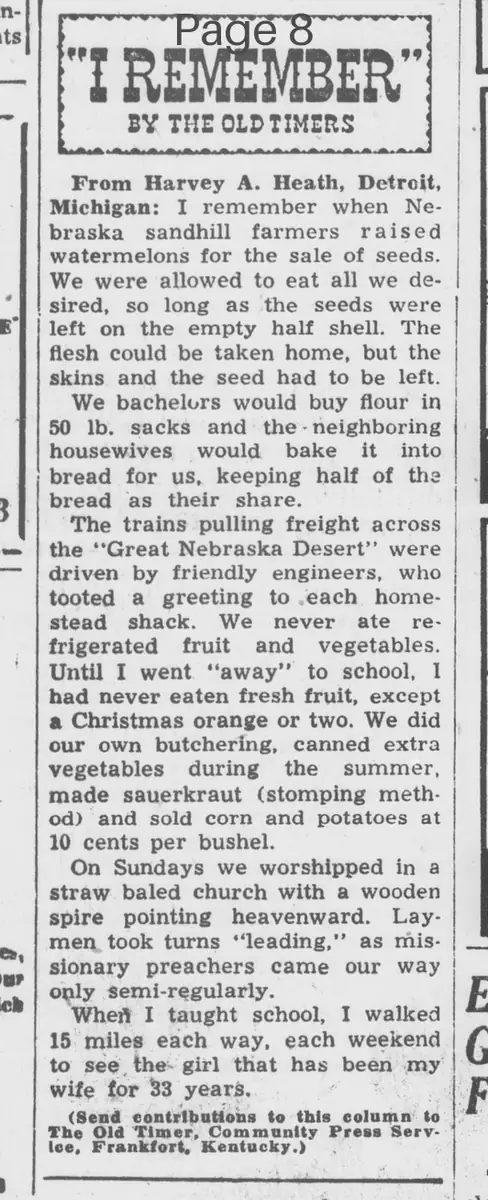
From Harvey A. Heath, Detroit, Michigan: I remember when Nebraska sandhill farmers raised watermelons for the sale of seeds. We were allowed to eat all we desired, so long as the seeds were left on the empty half shell. The flesh could be taken home, but the skins and the seed had to be left. We bachelors would buy flour in 50 lb. sacks and the neighboring housewives would bake it into bread for us, keeping half of the bread as their share. The trains pulling freight across the "Great Nebraska Desert" were driven by friendly engineers, who tooted a greeting to each homestead shack. We never ate refrigerated fruit and vegetables. Until I went "away" to school, I had never eaten fresh fruit, except a Christmas orange or two. We did our own butchering, canned extra vegetables during the summer, made sauerkraut (stomping method) and sold corn and potatoes at 10 cents per bushel. On Sundays we worshipped in a straw baled church with a wooden spire pointing heavenward. Laymen took turns "leading," as missionary preachers came our way only semi-regularly. When I taught school, I walked 15 miles each way, each weekend to see the girl that has been my wife for 33 years.
(Send contributions to this column to The Old Timer, Community Press Service, Frankfort, Kentucky.)
BY THE OLD TIMERS
From Harvey A. Heath, Detroit, Michigan: I remember when Nebraska sandhill farmers raised watermelons for the sale of seeds. We were allowed to eat all we desired, so long as the seeds were left on the empty half shell. The flesh could be taken home, but the skins and the seed had to be left. We bachelors would buy flour in 50 lb. sacks and the neighboring housewives would bake it into bread for us, keeping half of the bread as their share. The trains pulling freight across the "Great Nebraska Desert" were driven by friendly engineers, who tooted a greeting to each homestead shack. We never ate refrigerated fruit and vegetables. Until I went "away" to school, I had never eaten fresh fruit, except a Christmas orange or two. We did our own butchering, canned extra vegetables during the summer, made sauerkraut (stomping method) and sold corn and potatoes at 10 cents per bushel. On Sundays we worshipped in a straw baled church with a wooden spire pointing heavenward. Laymen took turns "leading," as missionary preachers came our way only semi-regularly. When I taught school, I walked 15 miles each way, each weekend to see the girl that has been my wife for 33 years.
(Send contributions to this column to The Old Timer, Community Press Service, Frankfort, Kentucky.)
What sub-type of article is it?
Reflective
Historical
Emotional
What themes does it cover?
Agriculture
Education
Social Issues
What keywords are associated?
Nebraska Sandhills
Pioneer Life
Rural Farming
Homesteading
Nostalgic Memories
Community Worship
School Teaching
What entities or persons were involved?
Harvey A. Heath, Detroit, Michigan
The Old Timer
Letter to Editor Details
Author
Harvey A. Heath, Detroit, Michigan
Recipient
The Old Timer
Main Argument
shares nostalgic memories of rural life, farming, community, and hardships in the nebraska sandhills during pioneer times.
Notable Details
Raised Watermelons For Seeds
Bachelors Traded Flour For Bread
Walked 15 Miles To See Future Wife
Worshipped In Straw Baled Church
Sold Corn And Potatoes At 10 Cents Per Bushel