Thank you for visiting SNEWPapers!
Sign up free
Story
August 16, 1827
The Virginian
Lynchburg, Virginia
What is this article about?
In the Scottish borders, outlaw Raven of Hornscliff ravages a wedding, flees across heath to Raven's Tower, leaps chasm to escape bridegroom's pursuit; both men leap, fight, and die falling into river. (187 chars)
Clipping
OCR Quality
95%
Excellent
Full Text
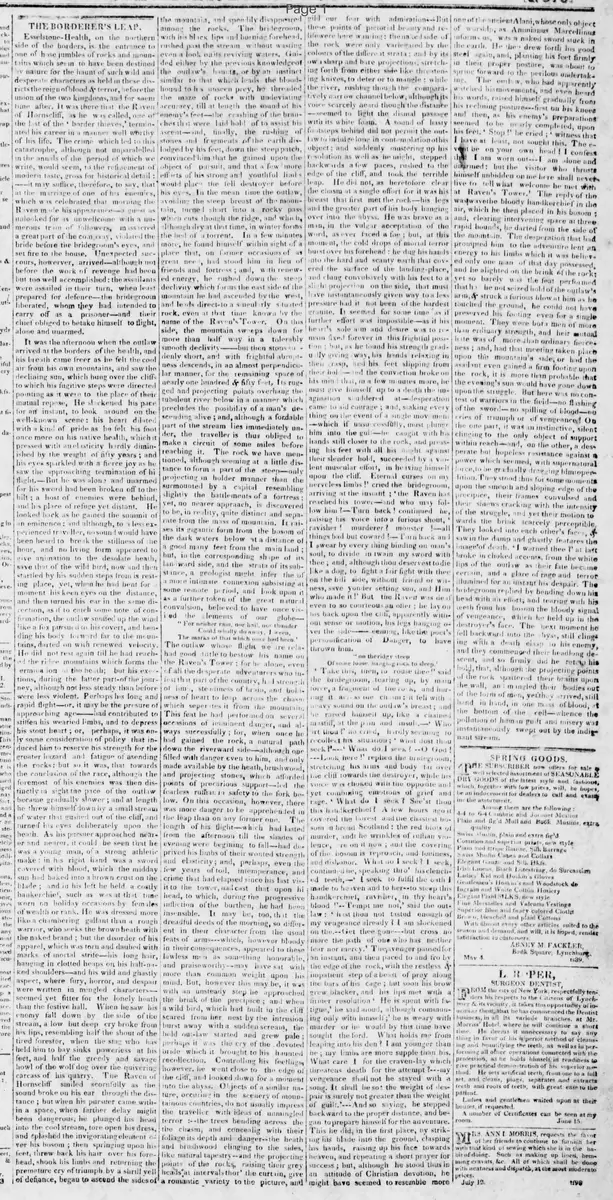
THE BORDERER'S LEAP.
Esselstone-Heath, on the northern side of the borders, is the entrance to one of those jumbles of rocks and mountains which seem to have been destined by nature for the haunt of such wild and desperate characters as held in these districts the reign of blood & terror, before the union of the two kingdoms, and for some time after. It was there that the Raven of Hornscliff, as he was called, one of the last of the border thieves, terminated his career in a manner well worthy of his life. The crime which led to this catastrophe, although not unparalleled in the annals of the period of which we write, would seem, to the refinement of modern taste, gross for historical detail:—it may suffice, therefore, to say, that at the marriage of one of his enemies, which was celebrated that morning the Raven made his appearance—guest so unusual as unwelcome—with a numerous train of followers, massacred a great part of the company, violated the bride before the bridegroom's eyes, and set fire to the house. Unexpected succours, however, arrived—although not before the work of revenge had been but too well accomplished: the assailants were assailed in their turn, when least prepared for defence—the bridegroom liberated, whom they had intended to carry off as a prisoner—and their chief obliged to betake himself to flight, alone and unarmed,
It was the afternoon when the outlaw arrived at the borders of the heath, and his breath came freer as he felt the cool air from his own mountains, and saw the declining sun, which hung over the cliffs to which his fugitive steps were directed pointing as it were to the place of their mutual repose. He slackened his pace for an instant, to look around on the well-known scene: his heart dilated with a kind of pride as he felt his foot once more on his native heath, which it pressed with an elasticity hardly diminished by the weight of fifty years; and his eyes sparkled with a fierce joy as he saw the approaching termination of his flight.—But he was alone and unarmed for his sword had been broken off to the hilt; a host of enemies were behind, and his place of refuge yet distant. He looked back as he gained the summit of an eminence: and although, to a less experienced traveller, no sound would have been heard to break the stillness of the hour, and no living form appeared to give animation to the desolate heath, save that of the wild bird, now and then startled by his sudden steps from its resting place, yet, when he had bent for a moment his keen eyes on the distance, and then turned his ear in the same direction, as if to catch some note of confirmation, the outlaw snuffed up the wind like a fox pursued to his covert, and bending his body forward far to the mountains, darted on with renewed velocity.
He did not rest again till he had reached the ridge mountains which forms the termination of the heath; but his exertions, during the latter part of the journey, although not less steady than before were less violent. Perhaps his long and rapid flight—or, it may be the pressure of approaching age—had contributed to stiffen his wearied limbs, and to depress his stout heart; or, perhaps, it was only some consideration of policy that induced him to reserve his strength for the greater hazard and fatigue of ascending the rocks: but so it was, that towards the conclusion of the race, although the foremost of his enemies was then distinctly in sight the pace of the outlaw became gradually slower; and at length he threw himself down by a small stream of water that gushed out of the cliff, and turned his eyes deliberately upon the heath. As his pursuer approached nearer and nearer, it could be seen that he was a young man, of a strong athletic make: in his right hand was a sword covered with blood, which the midday sun had baked into a brown crust on the blade; and in his left he held a costly handkerchief, such as was at that time worn on holiday occasions by females of wealth or rank. He was dressed more like a chambering gallant than a rough warrior, who seeks the brown heath with the naked brand; but the disorder of his apparel, which was torn and daubed with marks of mortal strife—his long hair, hanging in clotted heaps on his half-naked shoulders—and his wild and ghastly aspect, where fury, horror, and despair were written in mingled characters—seemed yet fitter for the lonely heath than the festive hall. When he saw his enemy fall down by the side of the stream, a low but deep cry broke from his lips, resembling half the shout of the tired forester, when the stag who has held him to bay sinks powerless at his feet, and half the greedy and savage howl of the wolf dog over the quivering carcass of his quarry. The Raven of Hornscliff smiled scornfully as the sound broke on his ear through the distance; but when his pursuer came within a space, when farther delay might have been dangerous, he plunged his head into the cool stream, tore open his dress, and splashed the invigorating element over his bosom; then springing upon his feet, threw back his hair over his forehead, shook his limbs and returning the premature cry of triumph by a shrill yell of defiance, began to ascend the sides of the mountain, and speedily disappeared among the rocks. The bridegroom, with his black lips and burning forehead, rushed past the stream without wasting even a look on its reviving waters. Guided either by the previous knowledge of the outlaw's haunts, or by an instinct similar to that which leads the blood-hound to his unseen prey, he threaded the maze of rocks with undeviating accuracy, till at length the sound of his enemy's feet—the crashing of the branches that were laid hold of to assist his ascent—and, finally, the rushing of stones and fragments of the earth dislodged by his feet, down the steep path, convinced him that he gained upon the object of pursuit, and that a few more efforts of his strong and youthful limbs would place the fell destroyer before his eyes. In the mean time the outlaw, avoiding the steep breast of the mountain, turned short into a rocky pass which cuts through the ridge, and which though dry at that time, in winter forms the bed of a torrent. In a few minutes more, he found himself within sight of a place that, on former occasions of as great need, had stood him in lieu of friends and fortress; and, with renewed energy, he rushed down the steep declivity which forms the east side of the mountain he had ascended by the west, and leads direct to a singularly situated rock, even at that time known by the name of the Raven's Tower. On this side, the mountain sweeps down for more than half way in a tolerably smooth declivity—but then stops suddenly short, and with frightful abruptness descends, in an almost perpendicular manner, for the remaining space of nearly one hundred & fifty feet. Its rugged and projecting points overhang the turbulent river below in a manner which precludes the possibility of a man's descending alive; and, although a fordable part of the stream lies immediately under, the traveller is thus obliged to make a circuit of some miles before reaching it. The rock we have mentioned, although seeming at a little distance to form a part of the steep—only projecting in bolder manner than the rest—surmounted by a capital resembling slightly the battlements of a fortress; yet, no nearer approach, is discovered to be, in reality, quite distinct and separate from the mass of mountain. It raises its gigantic form from the bosom of the dark waters below at a distance of a good many feet from the main land; but, in the corresponding shape of its landward side, and the strata of its substance, a geologist might infer the of a more intimate connexion subsisting at some remote period, and look upon it as a further token of the great natural convulsion, believed to have once visited the elements of our globe—
"For neither rain, nor hail, nor thunder Could wholly do away, I ween, The marks of that which once had been."
The outlaw whose flight we are relating had good title to bestow his name on the Raven's Tower; for he alone, even of all the desperate adventurers who infest that part of the country, had strength of limb, steadiness of brain, and boldness of heart to leap across the chasm which separates it from the mountain. This feat he had performed on several occasions of imminent danger, and always successfully; for, when once he had gained the rock, a natural path down the riverward side—although open filled with danger even to him, and only made available by the heath, brushwood, and projecting stones, which afforded points of precarious support—led the fearless ruffian in safety to the ford below. On this occasion, however, there was more danger to be apprehended in the leap than on any former one. The length of his flight—which had lasted from the afternoon till the shades of evening were beginning to fall—had deprived his limbs of their wonted strength and elasticity; and, perhaps, even the few years of toil, intemperance, and crime that had elapsed since his last visit to the tower, had cast that upon his head, to which, during the progressive affliction of the burthen, he had been insensible. It may be, too, that the dreadful deeds of the morning, so different in their character from the usual feats of arms—which, however bloody in their consequences, appeared to these lawless men as something honorable, and praiseworthy—may have sat with more than common weight upon his mind. But, however this may be, it was with an unsteady step he approached the brink of the precipice; and when a wild bird, which had built in the cliff scared from her nest by the intrusion burst away with a sudden scream, the bold out-law started and grew pale; perhaps it was the cry of the devoted bride which it brought to his haunted recollection. Controlling his feelings however. he went close to the edge of the cliff, and looked down for a moment into the abyss. Objects of a similar nature, occurring in the scenery of mountainous countries, do not usually impress the traveller with ideas of unmingled terror:—the trees bending across the chasm, and concealing with their foliage its depth and danger—the heath and brushwood clinging to the sides, like natural tapestry—and the projecting points of the rocks, raising their grey heads at intervals through the curtain, give a romantic variety to the picture, and gild our fear with admiration—but these points of pictorial beauty and relief were here wanting: the naked side of the rock were only variegated by the colours of the different strata; and by its own sharp and bare projections, stretching forth from either side like threatening knives, to deter or to mangle: while the river, rushing though the comparatively narrow channel below, although its voice scarcely heard though the distance—seemed to light the dismal passage with its white foam. A sound of hasty footsteps behind did not permit the out-law to indulge long in contemplation of this object; and suddenly mustering up his resolution as well as he might, stepped backwards a few paces, rushed to the edge of the cliff, and took the terrible leap. He did not, as heretofore clear the chasm at a single effort for it was his breast that first met the rock—his legs and the greater part of his body hanging over into the abyss. He was brave as a man, in the vulgar acceptation of the word, as ever faced a foe; but, at this moment, the cold drops of mortal terror burst over his forehead: he dug his hands into the hard and scanty earth that covered the surface of the landing-place, and clung convulsively with his feet to a slight projection on the side, that must have instantaneously given way to a less pressure had it not been of the hardest granite. It seemed for some time as if further effort was impossible—as if his heart's sole aim and desire was to remain fixed forever in this frightful position; but, as he found his strength gradually giving way, his hands relaxing in their grasp, and his feet slipping from their hold—and the conviction broke on his mind that, in a few minutes more, he must give himself up to a death the imagination shuddered at—desperation came to aid courage; and, staking every thing on the event of a single movement—which if unsuccessful, must plunge him into the gulf—he caught with his hands still closer to the rock, and pressing his feet with all his might against their slender hold, succeeded by a violent muscular effort, in heaving himself upon the cliff. 'Eternal curses on my nerveless limbs!' cried the bridegroom, arriving at the instant; the Raven has reached his tower—and who may follow him?—Turn back! continued he, raising his voice into a furious shout, 'ravisher! murderer! monster!—all things bad but coward!—Turn back and I swear by every thing binding on man's soul, to divide in twain my sword with thee; and, although thou deserve to die like a dog, to fight a fair fight with thee on the hill side, without friend or witness, save yonder setting sun, and Him who made it!' But the Raven was deaf even to so courteous an offer; he lay on his back upon the cliff, apparently without sense or motion, his legs hanging over the side—seeming, like the poet's personification of Danger, to have thrown him.
"on the ridgy steep Of some loose hanging rock to sleep."
'Take this, then, to rouse thee!' said the bridegroom, tearing up, by main force, a fragment of the rock, and hurling it across the chasm: it fell with heavy sound on the outlaw's breast; and he raised himself up, like a chained mastiff, at the pain and insult.—'Who is it thou?' he cried, hardly seeming to recollect his situation; 'what dost thou seek?'—'What do I seek —O God! —Look here!' replied the bridegroom, stretching his arms and body far over the cliff towards the destroyer, while his voice was choked with the opposite and yet combining emotions of grief and rage. 'What do I seek? See'st thou this handkerchief? A few hours ago it covered the fairest and the chastest bosom in broad Scotland: the red blots of murder, and the wrinkles of brutal violence, are on it now; and the covering of the bosom is reproach, and foulness, and dishonor. What do I seek? I seek,' continued he, speaking though his clenched teeth,—'I seek to fulfil the oath I made to heaven and to her—to steep this handkerchief, ravisher, in thy heart's blood'.—'Tempt me not,' said the out-law: 'hast thou not tasted enough of my vengeance already? I am sated with blood,—Get thee gone—but cross no more the path of one who has neither tear nor mercy.' The avenger paused for an instant, and then paced to and fro by the edge of the rock, with the restless & impatient step of a beast of prey along the bars of his cage; but soon his brow grew blacker, and his lips met with a firmer resolution 'He is spent with fatigue,' he said aloud, although communing only with himself; 'he is weary with murder or he would by this time have sought the ford. What holds me from leaping into his den? I am younger than he; my limbs are more supple than his. What care I for the craven-lay which threatens death for the attempt?—No—my vengeance shall not be stayed with a song. It shall be so: the weight of despair is surely not greater than the weight of guilt.'—And so saying, he stepped backward to the proper distance, and began to prepare himself for the adventure. This he did, in the first place, by striking his blade into the ground, clasping his hands, raising up his face towards heaven, and repeating a short prayer for success; but, although he stood thus in an attitude of Christian devotion, he might have seemed to resemble more of worship, as Ammianus Marcellinus informs us, was a naked sword stuck in the earth. He then drew forth his good steel again, and, planting his feet firmly in their proper posture, was about to spring forward to the perilous undertaking. The outlaw, who had apparently watched his movements, and even heard his words, raised himself gradually from his reclining posture—first on his knees and then, as his enemy's preparations seemed to be nearly completed, upon his feet. 'Stop!' he cried; 'witness that I have at least, not sought this. The event be on your own head! I confess that I am worn out—I am alone and unarmed: but the visitor who thrusts himself unbidden on me here shall never live to tell what welcome he met with at Raven's Tower.' The reply of the bridegroom was to wave the bloody handkerchief in the air, which he then placed in his bosom; and, clearing the intervening space at three rapid bounds, he darted from the side of the mount in. The desperation that had prompted him to the adventure lent an energy to his limbs which it was believed only one man of that day possessed, and he alighted on the brink of the rock; yet so barely was the feat performed that had he not seized hold of the outlaw's arm, & struck a furious blow at him as he touched the ground, he could not have preserved his footing even for a single moment. They were both men of more than ordinary strength, and their mutual hate was of more than ordinary fierceness; and, had that meeting taken place upon the mountain's side, or had the assailant even gained a firm footing upon the rock, it is more than probable that the evening's sun would have gone down upon the struggle. But here was no contest of warriors in the field—no flashing of the sword—no spilling of blood—no cries of triumph or of vengeance! On the one part, it was an instinctive, silent clinging to the only object of support within reach and, on the other, a desperate but hopeless resistance against a power which seemed, with supernatural force, to be gradually dragging him to perdition. They stood thus for some moments upon the smooth and sloping edge of the precipice, their frames convulsed and their sinews cracking with the intensity of the struggle, and yet their motion towards the brink scarcely perceptible They looked into each other's faces, saw in the damp and ghastly features the image of death. 'I warned thee?' at last broke in choked accents, from the white lips of the outlaw as their fate became certain, and a glare of rage and terror illumined for an instant his despair. The bridegroom replied by bending down his head with an effort, and tearing with his teeth from his bosom the bloody signal of vengeance, which he held up in the destroyer's face. The next moment he fell backward into the abyss, still clinging with a death clasp to his enemy, and they commenced their headlong descent, and so firmly did he retain his hold, that, although the projecting points of the rock spattered their brains upon the wall, and mangled their bodies out of the form of men, yet they arrived, still hand in hand, in one mass of blood, the bottom of the cliff—whence the pollution of human guilt and misery was instantaneously swept out by the indignant stream.
Esselstone-Heath, on the northern side of the borders, is the entrance to one of those jumbles of rocks and mountains which seem to have been destined by nature for the haunt of such wild and desperate characters as held in these districts the reign of blood & terror, before the union of the two kingdoms, and for some time after. It was there that the Raven of Hornscliff, as he was called, one of the last of the border thieves, terminated his career in a manner well worthy of his life. The crime which led to this catastrophe, although not unparalleled in the annals of the period of which we write, would seem, to the refinement of modern taste, gross for historical detail:—it may suffice, therefore, to say, that at the marriage of one of his enemies, which was celebrated that morning the Raven made his appearance—guest so unusual as unwelcome—with a numerous train of followers, massacred a great part of the company, violated the bride before the bridegroom's eyes, and set fire to the house. Unexpected succours, however, arrived—although not before the work of revenge had been but too well accomplished: the assailants were assailed in their turn, when least prepared for defence—the bridegroom liberated, whom they had intended to carry off as a prisoner—and their chief obliged to betake himself to flight, alone and unarmed,
It was the afternoon when the outlaw arrived at the borders of the heath, and his breath came freer as he felt the cool air from his own mountains, and saw the declining sun, which hung over the cliffs to which his fugitive steps were directed pointing as it were to the place of their mutual repose. He slackened his pace for an instant, to look around on the well-known scene: his heart dilated with a kind of pride as he felt his foot once more on his native heath, which it pressed with an elasticity hardly diminished by the weight of fifty years; and his eyes sparkled with a fierce joy as he saw the approaching termination of his flight.—But he was alone and unarmed for his sword had been broken off to the hilt; a host of enemies were behind, and his place of refuge yet distant. He looked back as he gained the summit of an eminence: and although, to a less experienced traveller, no sound would have been heard to break the stillness of the hour, and no living form appeared to give animation to the desolate heath, save that of the wild bird, now and then startled by his sudden steps from its resting place, yet, when he had bent for a moment his keen eyes on the distance, and then turned his ear in the same direction, as if to catch some note of confirmation, the outlaw snuffed up the wind like a fox pursued to his covert, and bending his body forward far to the mountains, darted on with renewed velocity.
He did not rest again till he had reached the ridge mountains which forms the termination of the heath; but his exertions, during the latter part of the journey, although not less steady than before were less violent. Perhaps his long and rapid flight—or, it may be the pressure of approaching age—had contributed to stiffen his wearied limbs, and to depress his stout heart; or, perhaps, it was only some consideration of policy that induced him to reserve his strength for the greater hazard and fatigue of ascending the rocks: but so it was, that towards the conclusion of the race, although the foremost of his enemies was then distinctly in sight the pace of the outlaw became gradually slower; and at length he threw himself down by a small stream of water that gushed out of the cliff, and turned his eyes deliberately upon the heath. As his pursuer approached nearer and nearer, it could be seen that he was a young man, of a strong athletic make: in his right hand was a sword covered with blood, which the midday sun had baked into a brown crust on the blade; and in his left he held a costly handkerchief, such as was at that time worn on holiday occasions by females of wealth or rank. He was dressed more like a chambering gallant than a rough warrior, who seeks the brown heath with the naked brand; but the disorder of his apparel, which was torn and daubed with marks of mortal strife—his long hair, hanging in clotted heaps on his half-naked shoulders—and his wild and ghastly aspect, where fury, horror, and despair were written in mingled characters—seemed yet fitter for the lonely heath than the festive hall. When he saw his enemy fall down by the side of the stream, a low but deep cry broke from his lips, resembling half the shout of the tired forester, when the stag who has held him to bay sinks powerless at his feet, and half the greedy and savage howl of the wolf dog over the quivering carcass of his quarry. The Raven of Hornscliff smiled scornfully as the sound broke on his ear through the distance; but when his pursuer came within a space, when farther delay might have been dangerous, he plunged his head into the cool stream, tore open his dress, and splashed the invigorating element over his bosom; then springing upon his feet, threw back his hair over his forehead, shook his limbs and returning the premature cry of triumph by a shrill yell of defiance, began to ascend the sides of the mountain, and speedily disappeared among the rocks. The bridegroom, with his black lips and burning forehead, rushed past the stream without wasting even a look on its reviving waters. Guided either by the previous knowledge of the outlaw's haunts, or by an instinct similar to that which leads the blood-hound to his unseen prey, he threaded the maze of rocks with undeviating accuracy, till at length the sound of his enemy's feet—the crashing of the branches that were laid hold of to assist his ascent—and, finally, the rushing of stones and fragments of the earth dislodged by his feet, down the steep path, convinced him that he gained upon the object of pursuit, and that a few more efforts of his strong and youthful limbs would place the fell destroyer before his eyes. In the mean time the outlaw, avoiding the steep breast of the mountain, turned short into a rocky pass which cuts through the ridge, and which though dry at that time, in winter forms the bed of a torrent. In a few minutes more, he found himself within sight of a place that, on former occasions of as great need, had stood him in lieu of friends and fortress; and, with renewed energy, he rushed down the steep declivity which forms the east side of the mountain he had ascended by the west, and leads direct to a singularly situated rock, even at that time known by the name of the Raven's Tower. On this side, the mountain sweeps down for more than half way in a tolerably smooth declivity—but then stops suddenly short, and with frightful abruptness descends, in an almost perpendicular manner, for the remaining space of nearly one hundred & fifty feet. Its rugged and projecting points overhang the turbulent river below in a manner which precludes the possibility of a man's descending alive; and, although a fordable part of the stream lies immediately under, the traveller is thus obliged to make a circuit of some miles before reaching it. The rock we have mentioned, although seeming at a little distance to form a part of the steep—only projecting in bolder manner than the rest—surmounted by a capital resembling slightly the battlements of a fortress; yet, no nearer approach, is discovered to be, in reality, quite distinct and separate from the mass of mountain. It raises its gigantic form from the bosom of the dark waters below at a distance of a good many feet from the main land; but, in the corresponding shape of its landward side, and the strata of its substance, a geologist might infer the of a more intimate connexion subsisting at some remote period, and look upon it as a further token of the great natural convulsion, believed to have once visited the elements of our globe—
"For neither rain, nor hail, nor thunder Could wholly do away, I ween, The marks of that which once had been."
The outlaw whose flight we are relating had good title to bestow his name on the Raven's Tower; for he alone, even of all the desperate adventurers who infest that part of the country, had strength of limb, steadiness of brain, and boldness of heart to leap across the chasm which separates it from the mountain. This feat he had performed on several occasions of imminent danger, and always successfully; for, when once he had gained the rock, a natural path down the riverward side—although open filled with danger even to him, and only made available by the heath, brushwood, and projecting stones, which afforded points of precarious support—led the fearless ruffian in safety to the ford below. On this occasion, however, there was more danger to be apprehended in the leap than on any former one. The length of his flight—which had lasted from the afternoon till the shades of evening were beginning to fall—had deprived his limbs of their wonted strength and elasticity; and, perhaps, even the few years of toil, intemperance, and crime that had elapsed since his last visit to the tower, had cast that upon his head, to which, during the progressive affliction of the burthen, he had been insensible. It may be, too, that the dreadful deeds of the morning, so different in their character from the usual feats of arms—which, however bloody in their consequences, appeared to these lawless men as something honorable, and praiseworthy—may have sat with more than common weight upon his mind. But, however this may be, it was with an unsteady step he approached the brink of the precipice; and when a wild bird, which had built in the cliff scared from her nest by the intrusion burst away with a sudden scream, the bold out-law started and grew pale; perhaps it was the cry of the devoted bride which it brought to his haunted recollection. Controlling his feelings however. he went close to the edge of the cliff, and looked down for a moment into the abyss. Objects of a similar nature, occurring in the scenery of mountainous countries, do not usually impress the traveller with ideas of unmingled terror:—the trees bending across the chasm, and concealing with their foliage its depth and danger—the heath and brushwood clinging to the sides, like natural tapestry—and the projecting points of the rocks, raising their grey heads at intervals through the curtain, give a romantic variety to the picture, and gild our fear with admiration—but these points of pictorial beauty and relief were here wanting: the naked side of the rock were only variegated by the colours of the different strata; and by its own sharp and bare projections, stretching forth from either side like threatening knives, to deter or to mangle: while the river, rushing though the comparatively narrow channel below, although its voice scarcely heard though the distance—seemed to light the dismal passage with its white foam. A sound of hasty footsteps behind did not permit the out-law to indulge long in contemplation of this object; and suddenly mustering up his resolution as well as he might, stepped backwards a few paces, rushed to the edge of the cliff, and took the terrible leap. He did not, as heretofore clear the chasm at a single effort for it was his breast that first met the rock—his legs and the greater part of his body hanging over into the abyss. He was brave as a man, in the vulgar acceptation of the word, as ever faced a foe; but, at this moment, the cold drops of mortal terror burst over his forehead: he dug his hands into the hard and scanty earth that covered the surface of the landing-place, and clung convulsively with his feet to a slight projection on the side, that must have instantaneously given way to a less pressure had it not been of the hardest granite. It seemed for some time as if further effort was impossible—as if his heart's sole aim and desire was to remain fixed forever in this frightful position; but, as he found his strength gradually giving way, his hands relaxing in their grasp, and his feet slipping from their hold—and the conviction broke on his mind that, in a few minutes more, he must give himself up to a death the imagination shuddered at—desperation came to aid courage; and, staking every thing on the event of a single movement—which if unsuccessful, must plunge him into the gulf—he caught with his hands still closer to the rock, and pressing his feet with all his might against their slender hold, succeeded by a violent muscular effort, in heaving himself upon the cliff. 'Eternal curses on my nerveless limbs!' cried the bridegroom, arriving at the instant; the Raven has reached his tower—and who may follow him?—Turn back! continued he, raising his voice into a furious shout, 'ravisher! murderer! monster!—all things bad but coward!—Turn back and I swear by every thing binding on man's soul, to divide in twain my sword with thee; and, although thou deserve to die like a dog, to fight a fair fight with thee on the hill side, without friend or witness, save yonder setting sun, and Him who made it!' But the Raven was deaf even to so courteous an offer; he lay on his back upon the cliff, apparently without sense or motion, his legs hanging over the side—seeming, like the poet's personification of Danger, to have thrown him.
"on the ridgy steep Of some loose hanging rock to sleep."
'Take this, then, to rouse thee!' said the bridegroom, tearing up, by main force, a fragment of the rock, and hurling it across the chasm: it fell with heavy sound on the outlaw's breast; and he raised himself up, like a chained mastiff, at the pain and insult.—'Who is it thou?' he cried, hardly seeming to recollect his situation; 'what dost thou seek?'—'What do I seek —O God! —Look here!' replied the bridegroom, stretching his arms and body far over the cliff towards the destroyer, while his voice was choked with the opposite and yet combining emotions of grief and rage. 'What do I seek? See'st thou this handkerchief? A few hours ago it covered the fairest and the chastest bosom in broad Scotland: the red blots of murder, and the wrinkles of brutal violence, are on it now; and the covering of the bosom is reproach, and foulness, and dishonor. What do I seek? I seek,' continued he, speaking though his clenched teeth,—'I seek to fulfil the oath I made to heaven and to her—to steep this handkerchief, ravisher, in thy heart's blood'.—'Tempt me not,' said the out-law: 'hast thou not tasted enough of my vengeance already? I am sated with blood,—Get thee gone—but cross no more the path of one who has neither tear nor mercy.' The avenger paused for an instant, and then paced to and fro by the edge of the rock, with the restless & impatient step of a beast of prey along the bars of his cage; but soon his brow grew blacker, and his lips met with a firmer resolution 'He is spent with fatigue,' he said aloud, although communing only with himself; 'he is weary with murder or he would by this time have sought the ford. What holds me from leaping into his den? I am younger than he; my limbs are more supple than his. What care I for the craven-lay which threatens death for the attempt?—No—my vengeance shall not be stayed with a song. It shall be so: the weight of despair is surely not greater than the weight of guilt.'—And so saying, he stepped backward to the proper distance, and began to prepare himself for the adventure. This he did, in the first place, by striking his blade into the ground, clasping his hands, raising up his face towards heaven, and repeating a short prayer for success; but, although he stood thus in an attitude of Christian devotion, he might have seemed to resemble more of worship, as Ammianus Marcellinus informs us, was a naked sword stuck in the earth. He then drew forth his good steel again, and, planting his feet firmly in their proper posture, was about to spring forward to the perilous undertaking. The outlaw, who had apparently watched his movements, and even heard his words, raised himself gradually from his reclining posture—first on his knees and then, as his enemy's preparations seemed to be nearly completed, upon his feet. 'Stop!' he cried; 'witness that I have at least, not sought this. The event be on your own head! I confess that I am worn out—I am alone and unarmed: but the visitor who thrusts himself unbidden on me here shall never live to tell what welcome he met with at Raven's Tower.' The reply of the bridegroom was to wave the bloody handkerchief in the air, which he then placed in his bosom; and, clearing the intervening space at three rapid bounds, he darted from the side of the mount in. The desperation that had prompted him to the adventure lent an energy to his limbs which it was believed only one man of that day possessed, and he alighted on the brink of the rock; yet so barely was the feat performed that had he not seized hold of the outlaw's arm, & struck a furious blow at him as he touched the ground, he could not have preserved his footing even for a single moment. They were both men of more than ordinary strength, and their mutual hate was of more than ordinary fierceness; and, had that meeting taken place upon the mountain's side, or had the assailant even gained a firm footing upon the rock, it is more than probable that the evening's sun would have gone down upon the struggle. But here was no contest of warriors in the field—no flashing of the sword—no spilling of blood—no cries of triumph or of vengeance! On the one part, it was an instinctive, silent clinging to the only object of support within reach and, on the other, a desperate but hopeless resistance against a power which seemed, with supernatural force, to be gradually dragging him to perdition. They stood thus for some moments upon the smooth and sloping edge of the precipice, their frames convulsed and their sinews cracking with the intensity of the struggle, and yet their motion towards the brink scarcely perceptible They looked into each other's faces, saw in the damp and ghastly features the image of death. 'I warned thee?' at last broke in choked accents, from the white lips of the outlaw as their fate became certain, and a glare of rage and terror illumined for an instant his despair. The bridegroom replied by bending down his head with an effort, and tearing with his teeth from his bosom the bloody signal of vengeance, which he held up in the destroyer's face. The next moment he fell backward into the abyss, still clinging with a death clasp to his enemy, and they commenced their headlong descent, and so firmly did he retain his hold, that, although the projecting points of the rock spattered their brains upon the wall, and mangled their bodies out of the form of men, yet they arrived, still hand in hand, in one mass of blood, the bottom of the cliff—whence the pollution of human guilt and misery was instantaneously swept out by the indignant stream.
What sub-type of article is it?
Crime Story
Adventure
Tragedy
What themes does it cover?
Crime Punishment
Revenge
Tragedy
What keywords are associated?
Border Thief
Wedding Massacre
Outlaw Pursuit
Raven's Leap
Tragic Fall
What entities or persons were involved?
Raven Of Hornscliff
Bridegroom
Where did it happen?
Esselstone Heath, Northern Side Of The Borders
Story Details
Key Persons
Raven Of Hornscliff
Bridegroom
Location
Esselstone Heath, Northern Side Of The Borders
Story Details
The Raven of Hornscliff massacres wedding guests, violates the bride, and flees pursued by the bridegroom to the Raven's Tower rock. He barely leaps the chasm; the bridegroom follows, they struggle, and both plummet to their deaths in the river below.