Thank you for visiting SNEWPapers!
Sign up free
Bismarck Daily Tribune
Bismarck, Burleigh County, North Dakota
What is this article about?
In Washington on Oct. 22, the Schley court of inquiry heard testimony from Lieutenant B. W. Wells, Jr., Schley's secretary during the Cuban campaign, detailing the July 3 battle off Santiago, dispatches received, and Schley's composed demeanor. Recalls and cross-examinations focused on dispatch timings and movements.
Clipping
OCR Quality
Full Text
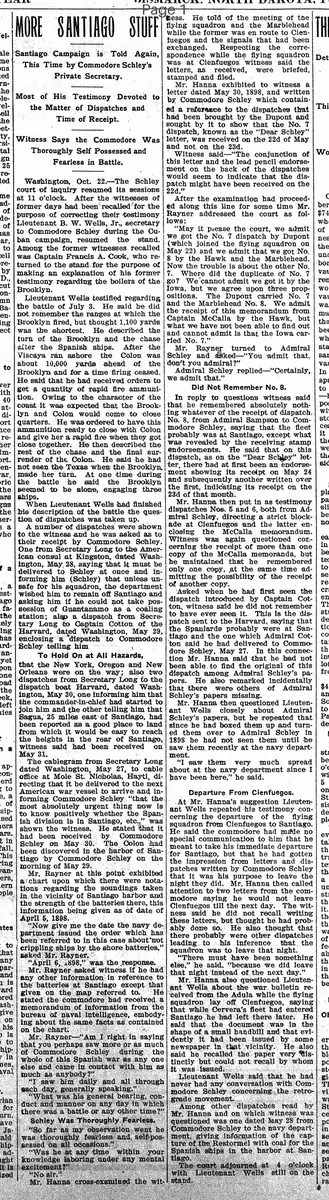
This Time by Commodore Schley's Private Secretary.
Most of His Testimony Devoted to the Matter of Dispatches and Time of Receipt.
Witness Says the Commodore Was Thoroughly Self Possessed and Fearless in Battle.
Washington, Oct. 22.—The Schley court of inquiry resumed its sessions at 11 o'clock. After the witnesses of former days had been recalled for the purpose of correcting their testimony Lieutenant B. W. Wells, Jr., secretary to Commodore Schley during the Cuban campaign, resumed the stand. Among the former witnesses recalled was Captain Francis A. Cook, who returned to the stand for the purpose of making an explanation of his former testimony regarding the boilers of the Brooklyn.
Lieutenant Wells testified regarding the battle of July 3. He said he did not remember the ranges at which the Brooklyn fired, but thought 1,100 yards was the shortest. He described the turn of the Brooklyn and the chase after the Spanish ships. After the Viscaya ran ashore the Colon was about 10,000 yards ahead of the Brooklyn and for a time firing ceased. He said that he had received orders to get a quantity of rapid fire ammunition. Owing to the character of the coast it was expected that the Brooklyn and Colon would come to close quarters. He was ordered to have this ammunition ready to close with Colon and give her a rapid fire when they got close together. He then described the rest of the chase and the final surrender of the Colon. He said he had not seen the Texas when the Brooklyn made her turn. At one time during the battle he said the Brooklyn seemed to be alone, engaging three ships.
When Lieutenant Wells had finished his description of the battle the question of dispatches was taken up. A number of dispatches were shown to the witness and he was asked as to their receipt by Commodore Schley. One from Secretary Long to the American consul at Kingston, dated Washington, May 28, saying that it must be delivered to Schley at once and informing him (Schley) that unless unsafe for his squadron, the department wished him to remain off Santiago and asking him if he could not take possession of Guantanamo as a coaling station; also a dispatch from Secretary Long to Captain Cotton of the Harvard, dated Washington, May 29, enclosing a dispatch to Commodore Schley telling him to hold on at all hazards, that the New York, Oregon and New Orleans were on the way; also two dispatches from Secretary Long to the dispatch boat Harvard, dated Washington, May 30, one informing him that the commander-in-chief had started to join him and the other telling him that Sagua, 25 miles east of Santiago, had been reported as a good place to land from which it would be easy to reach the heights in the rear of Santiago, witness said had been received on May 31.
The cablegram from Secretary Long dated Washington, May 27, to cable office at Mole St. Nicholas, Hayti, directing that it be delivered to the next American war vessel to arrive and informing Commodore Schley "that the most absolutely urgent thing now is to know positively whether the Spanish division is in Santiago, etc.," was shown the witness. He stated that it had been received by Commodore Schley on May 30. The Colon had been discovered in the harbor of Santiago by Commodore Schley on the morning of May 29.
Mr. Rayner at this point exhibited a chart upon which there were notations regarding the soundings taken in the vicinity of Santiago harbor and the strength of the batteries there, this information being given as of date of April 5, 1898.
"Now give me the date the navy department issued the order which has been referred to in this case about not crippling ships by the shore batteries," asked Mr. Rayner.
"April 6, 1898," was the response.
Mr. Rayner asked witness if he had any other information in reference to the batteries at Santiago except that given on the map referred to. He stated the commodore had received a memorandum of information from the bureau of naval intelligence, embodying about the same facts as contained on the chart.
Mr. Rayner: "Am I right in saying that you perhaps saw more or as much of Commodore Schley during the whole of this Spanish war as any one else and came in contact with him as much as anybody?"
"I saw him daily and all through each day, generally speaking."
"What was his general bearing, conduct and manner on any day in which there was a battle or any other time?"
Schley Was Thoroughly Fearless.
"So far as my observation went he was thoroughly fearless and self-possessed on all occasions."
"Was he at any time, within your knowledge, laboring under any mental excitement?"
"No sir."
Mr. Hanna cross-examined the witness. He told of the meeting of the flying squadron and the Marblehead while the former was en route to Cienfuegos and the signals that had been exchanged. Respecting the correspondence while the flying squadron was at Cienfuegos witness said the letters, as received, were briefed, stamped and filed.
Mr. Hanna exhibited to witness a letter dated May 30, 1898, and written by Commodore Schley which contained a reference to the dispatches that had been brought by the Dupont and sought by it to show that the No. 7 dispatch, known as the "Dear Schley" letter, was received on the 22d of May and not on the 23d.
Witness said: "The conjunction of this letter and the lead pencil endorsement on the back of the dispatches would seem to indicate that the dispatch might have been received on the 22d."
After the examination had proceeded along this line for some time Mr. Rayner addressed the court as follows:
"May it please the court, we admit we got the No. 7 dispatch by Dupont (which joined the flying squadron on May 22) and we admit that we got No. 8 by the Hawk and the Marblehead. Now the trouble is about the other No. 7. Where did the duplicate of No. 7 go? We cannot admit we got it by the Iowa, but we agree upon three propositions. The Dupont carried No. 7 and the Marblehead No. 8. We admit the receipt of this memorandum from Captain McCalla by the Hawk, but what we have not been able to find out and cannot admit is that the Iowa carried No. 7."
Mr. Rayner turned to Admiral Schley and asked: "You admit that, don't you admiral?"
Admiral Schley replied: "Certainly, we admit that."
Did Not Remember No. 8.
In reply to questions witness said that he remembered absolutely nothing whatever of the receipt of dispatch No. 8, from Admiral Sampson to Commodore Schley, saying that the fleet probably was at Santiago, except what was revealed by the receiving stamp endorsements. He said that on this dispatch, as on the "Dear Schley" letter, there had at first been an endorsement showing its receipt on May 24 and subsequently another written over the first, indicating its receipt on the 23d of that month.
Mr. Hanna then put in as testimony dispatches Nos. 5 and 6, both from Admiral Schley, directing a strict blockade at Cienfuegos and the latter enclosing the McCalla memorandum.
Witness was again questioned concerning the receipt of more than one copy of the McCalla memoranda, but he maintained that he remembered only one copy, at the same time admitting the possibility of the receipt of another copy.
Asked when he had first seen the dispatch introduced by Captain Cotton witness said he did not remember to have ever seen it. This is the dispatch sent to the Harvard, saying that the Spaniards probably were at Santiago and the one which Admiral Cotton said he had delivered to Commodore Schley, May 27. In this connection Mr. Hanna said that he had not been able to find the original of this dispatch among Admiral Schley's papers. He also remarked incidentally that there were others of Admiral Schley's papers missing.
Mr. Hanna then questioned Lieutenant Wells closely about Admiral Schley's papers, but he repeated that since he had boxed them up and turned them over to Admiral Schley in 1898 he had not seen them until he saw them recently at the navy department.
"I saw them very much spread about at the navy department since I have been here," he said.
Departure From Cienfuegos.
At Mr. Hanna's suggestion Lieutenant Wells repeated his testimony concerning the departure of the flying squadron from Cienfuegos to Santiago. He said the commodore had made no special communication to him that he meant to take his immediate departure for Santiago, but that he had gotten the impression from letters and dispatches written by Commodore Schley that it was his purpose to leave the night they did. Mr. Hanna then called attention to two letters from the commodore saying he would not leave Cienfuegos till the next day. The witness said he did not recall writing these letters, but thought he had probably done so. He also thought that there probably were other dispatches leading to his inference that the squadron was to leave that night.
"There must have been something else," he said, "because we did leave that night instead of the next day."
Mr. Hanna also questioned Lieutenant Wells about the war bulletin received from the Adula while the flying squadron lay off Cienfuegos, saying that while Cervera's fleet had entered Santiago he had left there later. He said that the document was in the shape of a small handbill and that evidently it had been issued by some newspaper in that vicinity. He also said he recalled the paper very distinctly but could not recall by whom it was issued.
Lieutenant Wells said that he had never had any conversation with Commodore Schley concerning the retrograde movement.
Among other dispatches read by Mr. Hanna and on which witness was questioned was one dated May 28 from Commodore Schley to the navy department, giving information of the capture of the Restormel with coal for the Spanish ships in the harbor at Santiago.
The court adjourned at 4 o'clock with Lieutenant Wells still on the stand.
What sub-type of article is it?
What keywords are associated?
What entities or persons were involved?
Where did it happen?
Domestic News Details
Primary Location
Washington
Event Date
Oct. 22
Key Persons
Outcome
ongoing court proceedings; testimony on battle actions and dispatch receipts; no immediate resolution.
Event Details
The Schley court of inquiry session featured testimony from Lieutenant Wells on the July 3, 1898, battle off Santiago, including Brooklyn's maneuvers, chase of Spanish ships, and ammunition preparations. Extensive examination of dispatches' receipt dates and contents from May 1898, including orders to hold Santiago and blockade Cienfuegos. Wells described Schley as fearless and self-possessed. Cross-examination addressed squadron movements, papers, and conflicting endorsements.