Thank you for visiting SNEWPapers!
Sign up free
Story
May 19, 1845
The Daily Union
Washington, District Of Columbia
What is this article about?
U.S. Navy Brig Truxton captures American schooner Spitfire, suspected of slave trading, in Rio Pongas, Africa, in March 1845. Expedition details from Commander Henry Bruce's letter; crew examined in Boston on charges of fitting out for slave trade.
Clipping
OCR Quality
98%
Excellent
Full Text
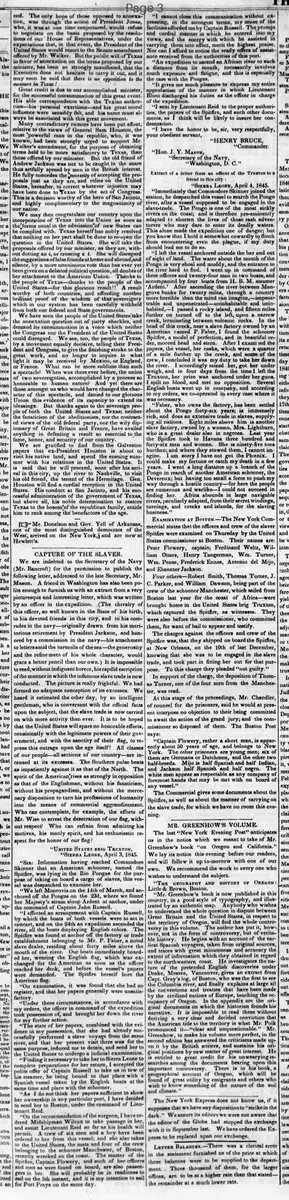
CAPTURE OF THE SLAVER.
We are indebted to the Secretary of the Navy (Mr. Bancroft) for the permission to publish the following letter, addressed to the late Secretary, Mr. Mason. A friend in Washington has also been polite enough to furnish us with an extract from a very picturesque and interesting letter, which was written by an officer in the expedition. (The chivalry of this officer, so well known in the State of his birth, to his devoted friends in this city, and to his comrades in the navy-originally drawn from his meritorious retirement by President Jackson, and honored by a commission in the navy--his attachment to letters amid the turmoils of the sea—the generosity and the refinement of his whole character, would grace a better pencil than our own.) It is impossible to read, without indignant horror, his rapid description of the manner in which the infamous slave trade is now conducted. The picture is really frightful. We had formed no adequate conception of its excesses. We heard it estimated the other day, by an intelligent gentleman, who is conversant with the official facts upon the subject, that the slave trade is now carried on with more activity than ever. It is to be hoped that the United States will spare no honorable efforts, consistently with the legitimate powers of their government, and with the sanctity of their flag, to repress this outrage upon the age itself! All classes of our people-all sections of our country-are incensed at its excesses. The Southern pulse beats as impatiently against it as that of the North. The spirit of the American rises as strongly in opposition as that of the Englishman, without his fanaticism. without his propagandism, and without the mercenary disposition to turn his professions of humanity into the means of commercial aggrandizement. Who can contemplate, for example, the efforts of Mr. Wise to arrest the desecration of our flag, without respect? Who can refrain from admiring his motives, his manly spirit, and his enthusiastic respect for the honor of our flag?
"United States Brig Truxton,
"Sierra Leone, April 3, 1845.
"Sir: Information having reached Commodore Skinner that an American schooner, named the Spitfire, was lying in the Rio Pongas for the purpose of taking on board a cargo of slaves, this vessel was despatched to examine her.
"We left Monrovia on the 14th of March, and anchored off the Pongas on the 23d, where we found her Majesty's steam sloop Ardent at anchor, under the command of Captain John Russell.
"I effected an arrangement with Captain Russell by which the boats of both vessels were to act in concert, and on the 24th an expedition ascended the river, all the boats displaying English colors. The Spitfire was found at anchor off the factory or trade establishment belonging to Mr. P. Faber, a noted slave dealer, residing about forty miles above the mouth of the river. Our boats immediately boarded her, wearing the English flag, which was exchanged for the American as soon as the officer reached her deck, and before the vessel's papers were demanded. The Spitfire herself bore the American flag.
"On examination, it was found that she had no register, and that her papers generally were unsatisfactory.
"Under these circumstances, in accordance with my orders, the officer in command of the expedition took possession of, and brought her down the river for my further action.
"The state of her papers, combined with the evidence in my possession, that she had already successfully performed a slave voyage from the same river, and that her present visit there was for the same purpose, induced me to detain, and send her to the United States to undergo a judicial examination.
"Finding it necessary to take her to Sierra Leone to complete preparations for her return, I accepted the polite offer of Captain Russell to take us in tow of his steamer, he being bound to that place with a Spanish vessel taken by the English boats at the same time and place with the schooner.
"As I do not think her papers sufficient to show her ownership in any particular port, I have decided to send her to Boston, under the command of Lieutenant Reid.
"On the recommendation of the surgeon, I have ordered Midshipman Wilcox to take passage in her. and assist Lieutenant Reid so far as his health will permit. A crew of six men and a boy have been ordered to her from this vessel; and she also takes to the United States, the mate and four of the crew belonging to the schooner Manchester, of Boston, recently wrecked on the coast. The master of the Spitfire, Captain Flowery, and such of her officers and men as were found on board, are also passengers in her. She will probably be in readiness to sail on the 5th instant, and it is my intention to sail for Port Praya on the same day.
"I cannot close this communication without expressing, in the strongest terms, my sense of the facilities afforded me by Captain Russell. The prompt and cordial manner in which he entered into my views, and the energy with which he assisted in carrying them into effect, merit the highest praise. Nor can I afford to notice the ready offers of assistance received from the authorities of this port.
"An expedition to ascend an African river to such a distance from its mouth, necessarily involves much exposure and fatigue, and this is especially the case with the Pongas.
"It gives me much pleasure to express my entire approbation of the manner in which Lieutenant Blunt discharged his duties as the officer in charge of the expedition.
"I sent by Lieutenant Reid to the proper authorities, the papers of the Spitfire, and such other documents, as I think will be likely to insure her condemnation.
"I have the honor to be, sir, very respectfully, your obedient servant,
"HENRY BRUCE,
"Commander.
"Hon. J. Y. Mason,
"Secretary of the Navy Washington, D. C."
Extract of a letter from an officer of the Truxton to a friend in this city :
"Sierra Leone, April 4, 1845.
"Immediately that Commodore Skinner joined the station, he despatched this vessel to search the Pongo river, after a vessel supposed to be engaged in the slave-trade. The Pongo is one of the most sickly rivers on the coast; and is therefore pre-eminently adapted to shorten the lives of those rash adventurers who may dare to enter its deadly waters. This alone made the expedition one of danger; but you know that I hold it somewhat cowardly to flinch from encountering even the plague, if my duty should lead me to do so.
"I left the vessel anchored outside the bar and out of sight of land. The water about the mouth of the Pongo is very shoal and muddy, and the entrance to the river hard to find. I went up in command of three officers and twenty-four men in two boats, and accompanied by four boats from H. B. M. steamer 'Ardent.' After ascending the river between Mangrove banks for twenty miles, through a country more horrible than the mind can imagine,-impenetrable and unpenetrated-uninhabitable and uninhabited,-I passed a rocky island, and fifteen miles further on turned off to the left, upon a narrow creek. terminating between volcanic rocks. In the head of this creek, near a slave factory owned by an American named P. Faber, I found the schooner Spitfire, a model of perfection, and in beautiful order, moored head and stern. After I examined the papers, the vessel, her casks, which were a quarter of a mile further up the creek, and some of the crew, I concluded it was my duty to take her down the river. I accordingly seized her, got her under weigh, and in four days from the time I left the Truxton, her prize was anchored under her guns. I spilt no blood, and met no opposition. Several English boats went up in company, and according to my orders, we co-operated in every case where it was necessary.
"Faber, who owns the factory, has been settled about the Pongo forty-six years; is immensely rich, and does an extensive trade in slaves, supplying all nations. Eight miles above him is another slave factory, owned by a woman, Mrs. Lightburn, who is a great dealer also in negroes. Last year the Spitfire took to Havana three hundred and forty-six men and women. She is ninety-five tons burthen; and where they stowed them, I cannot imagine. I am sorry I have not got the Phoenix. I could make my fortune or catch my death in a few years. I went a long distance up a branch of the Pongo in search of another American schooner, the Devereux; but having too small a force to push my way through a hostile country-for here the people are numerous and warlike-I could not succeed in finding her. Africa abounds in large navigable rivers, peculiarly adapted, from their secret windings, turnings, and creeks and islands, for the slaving business."
Examination At Boston.-The New York Commercial states that the officers and crew of the slaver Spitfire were examined on Thursday by the United States commissioner at Boston. Their names are: Peter Flowery, captain; Ferdinand Weltz, William Otters, Henry Tangerman, Wm. Turner, Wm. Pense, Frederick Ennes, Antonio del Mijo, and Ebenezer Jackson.
Four others-Robert Smith, Thomas Turner, J. C. Parker, and William Dawson, being part of the crew of the schooner Manchester, which sailed from Boston last year for the coast of Africa-were brought home in the United States brig Truxton, which captured the Spitfire, as witnesses. They were also before the commissioner, who committed them, for want of bail to appear and testify.
The charges against the officers and crew of the Spitfire was, that they shipped on board the Spitfire, at New Orleans, on the 10th of last December, knowing that she was to be engaged in the slave trade, and took part in fitting. her out for that purpose. To this charge they pleaded "not guilty."
In support of the charge, the deposition of Thomas Turner, one of the four men from the Manchester, was read.
At this stage of the proceedings, Mr. Chandler. of counsel for the prisoners, said he would at present interpose no objection to their being committed to await the action of the grand jury; and the commissioner so disposed of them. The Boston Post says:
"Captain Flowery, rather a short man, is apparently about 50 years of age, and belongs to New York. The other prisoners are young men; six of them are Germans or Dutchmen, and the other two half-breeds. Mijo is half Spanish and half Indian, and Jackson half Spanish and half negro. The white men appear as respectable as any company of foremost hands that may be met with on board of any vessel."
The Commercial gives some documents about the Spitfire, as well as about the manner of carrying on the slave trade, for which we have no room this evening.
We are indebted to the Secretary of the Navy (Mr. Bancroft) for the permission to publish the following letter, addressed to the late Secretary, Mr. Mason. A friend in Washington has also been polite enough to furnish us with an extract from a very picturesque and interesting letter, which was written by an officer in the expedition. (The chivalry of this officer, so well known in the State of his birth, to his devoted friends in this city, and to his comrades in the navy-originally drawn from his meritorious retirement by President Jackson, and honored by a commission in the navy--his attachment to letters amid the turmoils of the sea—the generosity and the refinement of his whole character, would grace a better pencil than our own.) It is impossible to read, without indignant horror, his rapid description of the manner in which the infamous slave trade is now conducted. The picture is really frightful. We had formed no adequate conception of its excesses. We heard it estimated the other day, by an intelligent gentleman, who is conversant with the official facts upon the subject, that the slave trade is now carried on with more activity than ever. It is to be hoped that the United States will spare no honorable efforts, consistently with the legitimate powers of their government, and with the sanctity of their flag, to repress this outrage upon the age itself! All classes of our people-all sections of our country-are incensed at its excesses. The Southern pulse beats as impatiently against it as that of the North. The spirit of the American rises as strongly in opposition as that of the Englishman, without his fanaticism. without his propagandism, and without the mercenary disposition to turn his professions of humanity into the means of commercial aggrandizement. Who can contemplate, for example, the efforts of Mr. Wise to arrest the desecration of our flag, without respect? Who can refrain from admiring his motives, his manly spirit, and his enthusiastic respect for the honor of our flag?
"United States Brig Truxton,
"Sierra Leone, April 3, 1845.
"Sir: Information having reached Commodore Skinner that an American schooner, named the Spitfire, was lying in the Rio Pongas for the purpose of taking on board a cargo of slaves, this vessel was despatched to examine her.
"We left Monrovia on the 14th of March, and anchored off the Pongas on the 23d, where we found her Majesty's steam sloop Ardent at anchor, under the command of Captain John Russell.
"I effected an arrangement with Captain Russell by which the boats of both vessels were to act in concert, and on the 24th an expedition ascended the river, all the boats displaying English colors. The Spitfire was found at anchor off the factory or trade establishment belonging to Mr. P. Faber, a noted slave dealer, residing about forty miles above the mouth of the river. Our boats immediately boarded her, wearing the English flag, which was exchanged for the American as soon as the officer reached her deck, and before the vessel's papers were demanded. The Spitfire herself bore the American flag.
"On examination, it was found that she had no register, and that her papers generally were unsatisfactory.
"Under these circumstances, in accordance with my orders, the officer in command of the expedition took possession of, and brought her down the river for my further action.
"The state of her papers, combined with the evidence in my possession, that she had already successfully performed a slave voyage from the same river, and that her present visit there was for the same purpose, induced me to detain, and send her to the United States to undergo a judicial examination.
"Finding it necessary to take her to Sierra Leone to complete preparations for her return, I accepted the polite offer of Captain Russell to take us in tow of his steamer, he being bound to that place with a Spanish vessel taken by the English boats at the same time and place with the schooner.
"As I do not think her papers sufficient to show her ownership in any particular port, I have decided to send her to Boston, under the command of Lieutenant Reid.
"On the recommendation of the surgeon, I have ordered Midshipman Wilcox to take passage in her. and assist Lieutenant Reid so far as his health will permit. A crew of six men and a boy have been ordered to her from this vessel; and she also takes to the United States, the mate and four of the crew belonging to the schooner Manchester, of Boston, recently wrecked on the coast. The master of the Spitfire, Captain Flowery, and such of her officers and men as were found on board, are also passengers in her. She will probably be in readiness to sail on the 5th instant, and it is my intention to sail for Port Praya on the same day.
"I cannot close this communication without expressing, in the strongest terms, my sense of the facilities afforded me by Captain Russell. The prompt and cordial manner in which he entered into my views, and the energy with which he assisted in carrying them into effect, merit the highest praise. Nor can I afford to notice the ready offers of assistance received from the authorities of this port.
"An expedition to ascend an African river to such a distance from its mouth, necessarily involves much exposure and fatigue, and this is especially the case with the Pongas.
"It gives me much pleasure to express my entire approbation of the manner in which Lieutenant Blunt discharged his duties as the officer in charge of the expedition.
"I sent by Lieutenant Reid to the proper authorities, the papers of the Spitfire, and such other documents, as I think will be likely to insure her condemnation.
"I have the honor to be, sir, very respectfully, your obedient servant,
"HENRY BRUCE,
"Commander.
"Hon. J. Y. Mason,
"Secretary of the Navy Washington, D. C."
Extract of a letter from an officer of the Truxton to a friend in this city :
"Sierra Leone, April 4, 1845.
"Immediately that Commodore Skinner joined the station, he despatched this vessel to search the Pongo river, after a vessel supposed to be engaged in the slave-trade. The Pongo is one of the most sickly rivers on the coast; and is therefore pre-eminently adapted to shorten the lives of those rash adventurers who may dare to enter its deadly waters. This alone made the expedition one of danger; but you know that I hold it somewhat cowardly to flinch from encountering even the plague, if my duty should lead me to do so.
"I left the vessel anchored outside the bar and out of sight of land. The water about the mouth of the Pongo is very shoal and muddy, and the entrance to the river hard to find. I went up in command of three officers and twenty-four men in two boats, and accompanied by four boats from H. B. M. steamer 'Ardent.' After ascending the river between Mangrove banks for twenty miles, through a country more horrible than the mind can imagine,-impenetrable and unpenetrated-uninhabitable and uninhabited,-I passed a rocky island, and fifteen miles further on turned off to the left, upon a narrow creek. terminating between volcanic rocks. In the head of this creek, near a slave factory owned by an American named P. Faber, I found the schooner Spitfire, a model of perfection, and in beautiful order, moored head and stern. After I examined the papers, the vessel, her casks, which were a quarter of a mile further up the creek, and some of the crew, I concluded it was my duty to take her down the river. I accordingly seized her, got her under weigh, and in four days from the time I left the Truxton, her prize was anchored under her guns. I spilt no blood, and met no opposition. Several English boats went up in company, and according to my orders, we co-operated in every case where it was necessary.
"Faber, who owns the factory, has been settled about the Pongo forty-six years; is immensely rich, and does an extensive trade in slaves, supplying all nations. Eight miles above him is another slave factory, owned by a woman, Mrs. Lightburn, who is a great dealer also in negroes. Last year the Spitfire took to Havana three hundred and forty-six men and women. She is ninety-five tons burthen; and where they stowed them, I cannot imagine. I am sorry I have not got the Phoenix. I could make my fortune or catch my death in a few years. I went a long distance up a branch of the Pongo in search of another American schooner, the Devereux; but having too small a force to push my way through a hostile country-for here the people are numerous and warlike-I could not succeed in finding her. Africa abounds in large navigable rivers, peculiarly adapted, from their secret windings, turnings, and creeks and islands, for the slaving business."
Examination At Boston.-The New York Commercial states that the officers and crew of the slaver Spitfire were examined on Thursday by the United States commissioner at Boston. Their names are: Peter Flowery, captain; Ferdinand Weltz, William Otters, Henry Tangerman, Wm. Turner, Wm. Pense, Frederick Ennes, Antonio del Mijo, and Ebenezer Jackson.
Four others-Robert Smith, Thomas Turner, J. C. Parker, and William Dawson, being part of the crew of the schooner Manchester, which sailed from Boston last year for the coast of Africa-were brought home in the United States brig Truxton, which captured the Spitfire, as witnesses. They were also before the commissioner, who committed them, for want of bail to appear and testify.
The charges against the officers and crew of the Spitfire was, that they shipped on board the Spitfire, at New Orleans, on the 10th of last December, knowing that she was to be engaged in the slave trade, and took part in fitting. her out for that purpose. To this charge they pleaded "not guilty."
In support of the charge, the deposition of Thomas Turner, one of the four men from the Manchester, was read.
At this stage of the proceedings, Mr. Chandler. of counsel for the prisoners, said he would at present interpose no objection to their being committed to await the action of the grand jury; and the commissioner so disposed of them. The Boston Post says:
"Captain Flowery, rather a short man, is apparently about 50 years of age, and belongs to New York. The other prisoners are young men; six of them are Germans or Dutchmen, and the other two half-breeds. Mijo is half Spanish and half Indian, and Jackson half Spanish and half negro. The white men appear as respectable as any company of foremost hands that may be met with on board of any vessel."
The Commercial gives some documents about the Spitfire, as well as about the manner of carrying on the slave trade, for which we have no room this evening.
What sub-type of article is it?
Historical Event
Naval Engagement
Crime Story
What themes does it cover?
Justice
Crime Punishment
Bravery Heroism
What keywords are associated?
Slave Trade Capture
Spitfire Schooner
Rio Pongas Expedition
Naval Seizure
Boston Examination
What entities or persons were involved?
Henry Bruce
John Russell
Peter Flowery
P. Faber
Lieutenant Blunt
Commodore Skinner
Where did it happen?
Rio Pongas, Sierra Leone; Boston
Story Details
Key Persons
Henry Bruce
John Russell
Peter Flowery
P. Faber
Lieutenant Blunt
Commodore Skinner
Location
Rio Pongas, Sierra Leone; Boston
Event Date
March 14 To April 5, 1845
Story Details
U.S. Brig Truxton, under Commander Henry Bruce, captures American schooner Spitfire in Rio Pongas for slave trading after joint expedition with British HMS Ardent. Vessel sent to Boston for trial; crew examined and charged with outfitting for slave trade.