Thank you for visiting SNEWPapers!
Sign up free
Editorial
September 3, 1804
The National Intelligencer And Washington Advertiser
Washington, District Of Columbia
What is this article about?
An anonymous editorial defends Thomas Jefferson's letter to Philip Mazzei against Federalist accusations of anti-American sentiment, arguing it rightly criticizes monarchical influences in U.S. government under Adams and Federalists, citing British privy council reports and Adams' pro-monarchy statements to warn against threats to republican liberty ahead of the 1800 presidential election.
Clipping
OCR Quality
98%
Excellent
Full Text
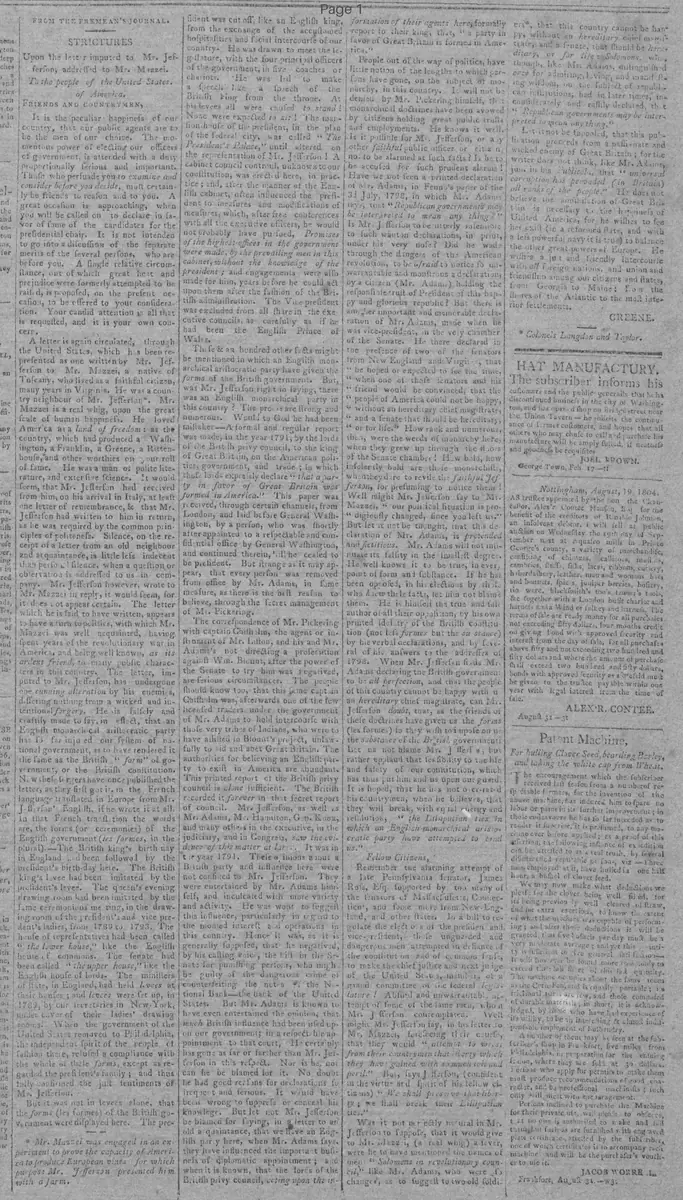
STRICTURES
Upon the letter imputed to Mr. Jefferson, addressed to Mr. Mazzei.
To the people of the United States of America.
FRIENDS AND COUNTRYMEN,
It is the peculiar happiness of our country, that our public agents are to be the men of our choice. The momentous power of electing our officers of government, is attended with a duty proportionately serious and important. Those who persuade you to examine and consider before you decide, must certainly be friends to reason and to you. A great occasion is approaching, when you will be called on to declare in favor of one of the candidates for the presidential chair. It is not intended to go into a discussion of the separate merits of the several persons, who are before you. A single relative circumstance, out of which great heat and prejudice were formerly attempted to be raised, is proposed, on the present occasion, to be offered to your consideration. Your candid attention is all that is requested, and it is your own concern.
A letter is again circulated, through the United States, which has been represented as one written by Mr. Jefferson to Mr. Mazzei, a native of Tuscany, who lived as a faithful citizen, many years in Virginia. He was a country neighbour of Mr. Jefferson. Mr. Mazzei is a real whig, upon the great scale of human happiness. He loved America as a land of freedom: as the country, which had produced a Washington, a Franklin, a Greene, a Rittenhouse, and other worthies on our roll of fame. He was a man of polite literature, and extensive science. It would seem, that Mr. Jefferson had received from him, on his arrival in Italy, at least one letter of remembrance, & that Mr. Jefferson had written to him in return, as he was required by the common principles of politeness. Silence, on the receipt of a letter from an old neighbour and acquaintance, is little less indecent than personal silence, when a question or observation is addressed to us in company. Mr. Jefferson however, wrote to Mr. Mazzei in reply, it would seem, for it does not appear certain. The letter which he is said to have written, appears to have turned on politics, with which Mr. Mazzei was well acquainted, having spent years of the revolutionary war in America, and being well known, as its ardentest friend, to many public characters in this country. The letter, imputed to Mr. Jefferson, has undergone one cunning alteration by his enemies, differing nothing from a wicked and intentional forgery. He is falsely and craftily made to say, in effect, that an English monarchical aristocratic party has so far injured our system of national government, as to have rendered it the same as the British form of government, or the British Constitution.
Now the errors have once published the letter, as they first garbled it, in the French language translated in Europe from Mr. Jefferson's English, if he wrote it at all. In that French translation the words are, the forms (or ceremonies) of the English government (les formes, in the plural).—The British king's birth day in England had been followed by the president's birth-day here. The British king's levee had been imitated by the president's levee. The queen's evening drawing room had been imitated by the same ceremonious meeting, in the drawing room of the president's and vice president's ladies, from 1789 to 1793. The house of representatives had been called the lower house, like the English house of commons. The senate had been called the upper house, like the English house of lords— The ministers of state, in England, had held levees at their houses; and levees were set up, in 1789, by our secretaries in New.York, under cover of their ladies' drawing rooms. When the government of the United States removed to Philadelphia, the independent spirit of the people of fashion there, refused a compliance with the whole of these forms, except as regarded the president's family; and thus totally consigned the just sentiments of Mr. Jefferson.
But it was not in levees alone, that the forms (les formes) of the British government were displayed here. The president was cut off, like an English king from the exchange of the accustomed hospitalities and social intercourse of our country— He was drawn to meet the legislature, with the four principal officers of the government, in six coaches or chariots. —He was led to make a speech like a speech of the British king from the throne. At his levees all were caused to stand! None were expected to sit! The mansion house of the president, in the plan of the federal city, was called "The President's Palace," until altered on the representation of Mr. Jefferson! A cabinet council controul, unknown to our constitution, was erected here, in practice: and, after the manner of the English cabinet, often influenced the president to measures and modifications of measures, which, after free conferences with all the executive officers, he would not probably have pursued, Promises of the highest offices in the government were made, by the prevailing men in this cabinet, without the knowledge of the president; and engagements were also made for him, years before he could act upon them after the fashion of the British administration. The Vice president was excluded from all share in the executive councils, as carefully as if he had been the English Prince of Wales.
The & as hundred other facts might be mentioned in which an English monarchical aristocratic party have given the forms of the British government. But, was Mr. Jefferson right in saying, there was an English monarchical party in this country? The proofs are strong and numerous. Would to God he had been mistaken—A formal and regular report was made, in the year 1791, by the lords of the British privy council, to the king of Great Britain, on the American politics, government, and trade; in which those lords expressly declare "that a party in favor of Great Britain was formed in America." This paper was received, through certain channels, from London, and laid before General Washington, by a person, who was shortly after appointed to a respectable and confidential office by General Washington, and continued therein, until he ceased to be president. But strange as it may appear, that every person was removed from office by Mr. Adams, in some measure, as there is the best reason to believe, through the secret management of Mr. Pickering.
The correspondence of Mr. Pickering with captain Chisholm, the agent or instrument of Mr. Blount, and his and Mr. Adams's not directing a prosecution against Wm. Blount, after the power of the Senate to try him was negatived, are serious circumstances. The people should know too, that this same captain Chisholm was, afterwards one of the few licensed traders under the government of Mr. Adams to hold intercourse with those very tribes of Indians, who were to have assisted in Blount's project, unlawfully to aid and abet Great Britain. The authorities for believing an English party to exist in America are abundant. This printed report of the British privy council is alone sufficient. The British recorded it forever in the secret report of council. Mr. Jefferson, as well as Mr. Adams, Mr. Hamilton, Gen. Knox, and many others in the executive, in the judiciary, and in Congress, saw the evidence of this matter at large. It was in the year 1791. The lessons on a British party and influence here were not confined to Mr. Jefferson. They were entertained by Mr. Adams himself, and inculcated with more variety and activity. He was wont to suggest this influence, particularly in regard to the monied interest and operations in this country. Hence it was, as it is generally supposed, that he negatived, by his casting voice, the bill in the Senate for punishing persons, who may be guilty of the dangerous crime of counterfeiting the notes of the National Bank—the bank of the United States. But Mr. Adams is known to have even entertained the opinion, that much British influence had been used upon our government; in a respectable appointment to that court, He certainly has gone as far or farther than Mr. Jefferson in this respect. Nor is he, nor can he be blamed for it. No doubt he had good reasons for declarations so frequent and serious. It would have been wrong to suppress or conceal his knowledge. But let not Mr. Jefferson be blamed for saying, in a letter to an old acquaintance, that we have an English party here, when Mr. Adams says, they have influenced the important business of diplomatic appointment; and when it is known, that the lords of the British privy council, acting upon the information of their agents here, formally report to their king, that, "a party in favor of Great Britain is formed in America."
People out of the way of politics, have little notion of the lengths to which persons have gone, on the subject of monarchy, in this country. It will not be denied by Mr. Pickering himself, that monarchical doctrines have been avowed by citizens holding great public trusts and employments. He knows it well. Is it possible for Mr. Jefferson, or any other faithful public officer or citizen, not to be alarmed at such facts? Is he to be accused for such prudent alarms! Have we not seen a printed declaration of Mr. Adams, in Fenno's paper of the 3d July, 1798, in which Mr. Adams lays, out "Republican governments may be interpreted to mean any thing?" Is Mr. Jefferson to be utterly insensible to such wanton declarations, in print, under his very nose? Did he wade through the dangers of this American revolution, to be afraid to notice so unwarrantable and monstrous a declaration, by a citizen (Mr. Adams) holding the responsible rule of President of this happy and glorious republic? But there is another important and memorable declaration of Mr. Adams, made when he was vice-president, in the very chamber of the Senate. He there declared in the presence of two of the senators from New England and Virginia, that "he hoped or expected to see the time, when one of those senators and his friend would be convinced, that the people of America could not be happy, without an hereditary chief magistrate, and a senate that should be hereditary, or for life." How rank and numerous, then, were the weeds of monarchy here, when they grew up through the doors of the Senate chamber! How bold, how insolently bold are these monarchists, when they dare to revile the faithful Jefferson, for presuming to notice them!
Well might Mr. Jefferson say to Mr. Mazzei, "our political situation is prodigiously changed, since you left us." But let it not be thought, that this declaration of Mr. Adams, is pretended and fictitious. Mr. Adams will not insinuate its falsity in the smallest degree. He well knows it to be true, in every point of form and substance. If he has been opposed, in his elections by those who knew these facts, let him not blame them. He is himself the true and sole author of all their opposition, by his own printed idolatry, of the British constitution (not les formes but the substance) by his verbal declarations, and by several of his answers to the addresses of 1798. When Mr. Jefferson finds Mr. Adams declaring the British government to be all perfection, and that the people of this Country cannot be happy without an hereditary chief magistrate, can Mr. Jefferson doubt, that, as the friends of these doctrines have given us the forms (les formes) so they wish to impose on us the substance of the British government? Let us not blame Mr. Jefferson, but rather applaud that sensibility to the life and safety of our constitution, which has thus put him and us upon our guard. It is hoped, that he has not over-rated his countrymen, when he believes, that they will break, with equal energy and resolution, "the Lilliputian ties in which an English monarchical aristocratic party have attempted to bind us."
Fellow Citizens,
Remember the alarming attempt of a late Pennsylvania senator, James Ross, Esq. supported by too many of the Senators of Massachusetts, Connecticut, and some more from New-England and other states. In a bill to reorganize the electors of the president and vice-president, these unguarded and dangerous men attempted in defiance of the constitution and of common sense to make the chief justice and next judge of the United States, members of a grand committee of the federal legislature! Absurd and unwarrantable attempt of some of the same men, whom Mr. Jefferson contemplated. Well might Mr. Jefferson say, in his letter to Mr. Mazzei, foreseeing their course, that they would "attempt to wrest from their countrymen that liberty which they have gained with so much toil and peril." But, says Jefferson, (confident in the virtue and spirit of his fellow citizens) "We shall preserve that liberty; we shall break their Lilliputian ties."
Was it not over early natural in Mr. Jefferson to suppose, that it would give to Mr. Mazzei, (a real whig) a fever, were he to have mentioned the names of men as Solomons in revolutionary council, like Mr. Adams, who were so changed, as to suggest to two old soldiers, that this country cannot be happy, without an hereditary chief magistrate, and a Senate, that should be hereditary, or for life: Solomons, who, though, like Mr. Adams, distinguished themselves for admiring, loving, and manifesting wisdom, on the subject of republican institutions, had in later times, inconsiderately and rashly declared, that "Republican governments may be interpreted to mean any thing."
Let it not be supposed, that this publication proceeds from a partial and wicked enemy of Great Britain; for the writer does not think, like Mr. Adams, jun. in his Publicola, that "universal corruption has pervaded (in Britain) all ranks of the people." He does not believe one administration of Great Britain is necessary to the happiness of United America, for he wishes to see her allied (in a reformed state, and with a less powerful navy it is true) to balance the other great powers of Europe. He wishes a just and friendly intercourse with all foreign nations, and union and friendship among our citizens and states, from Georgia to Maine: For on the shores of the Atlantic to the most interior settlements.
GREENE.
* Colonels Langdon and Taylor.
Upon the letter imputed to Mr. Jefferson, addressed to Mr. Mazzei.
To the people of the United States of America.
FRIENDS AND COUNTRYMEN,
It is the peculiar happiness of our country, that our public agents are to be the men of our choice. The momentous power of electing our officers of government, is attended with a duty proportionately serious and important. Those who persuade you to examine and consider before you decide, must certainly be friends to reason and to you. A great occasion is approaching, when you will be called on to declare in favor of one of the candidates for the presidential chair. It is not intended to go into a discussion of the separate merits of the several persons, who are before you. A single relative circumstance, out of which great heat and prejudice were formerly attempted to be raised, is proposed, on the present occasion, to be offered to your consideration. Your candid attention is all that is requested, and it is your own concern.
A letter is again circulated, through the United States, which has been represented as one written by Mr. Jefferson to Mr. Mazzei, a native of Tuscany, who lived as a faithful citizen, many years in Virginia. He was a country neighbour of Mr. Jefferson. Mr. Mazzei is a real whig, upon the great scale of human happiness. He loved America as a land of freedom: as the country, which had produced a Washington, a Franklin, a Greene, a Rittenhouse, and other worthies on our roll of fame. He was a man of polite literature, and extensive science. It would seem, that Mr. Jefferson had received from him, on his arrival in Italy, at least one letter of remembrance, & that Mr. Jefferson had written to him in return, as he was required by the common principles of politeness. Silence, on the receipt of a letter from an old neighbour and acquaintance, is little less indecent than personal silence, when a question or observation is addressed to us in company. Mr. Jefferson however, wrote to Mr. Mazzei in reply, it would seem, for it does not appear certain. The letter which he is said to have written, appears to have turned on politics, with which Mr. Mazzei was well acquainted, having spent years of the revolutionary war in America, and being well known, as its ardentest friend, to many public characters in this country. The letter, imputed to Mr. Jefferson, has undergone one cunning alteration by his enemies, differing nothing from a wicked and intentional forgery. He is falsely and craftily made to say, in effect, that an English monarchical aristocratic party has so far injured our system of national government, as to have rendered it the same as the British form of government, or the British Constitution.
Now the errors have once published the letter, as they first garbled it, in the French language translated in Europe from Mr. Jefferson's English, if he wrote it at all. In that French translation the words are, the forms (or ceremonies) of the English government (les formes, in the plural).—The British king's birth day in England had been followed by the president's birth-day here. The British king's levee had been imitated by the president's levee. The queen's evening drawing room had been imitated by the same ceremonious meeting, in the drawing room of the president's and vice president's ladies, from 1789 to 1793. The house of representatives had been called the lower house, like the English house of commons. The senate had been called the upper house, like the English house of lords— The ministers of state, in England, had held levees at their houses; and levees were set up, in 1789, by our secretaries in New.York, under cover of their ladies' drawing rooms. When the government of the United States removed to Philadelphia, the independent spirit of the people of fashion there, refused a compliance with the whole of these forms, except as regarded the president's family; and thus totally consigned the just sentiments of Mr. Jefferson.
But it was not in levees alone, that the forms (les formes) of the British government were displayed here. The president was cut off, like an English king from the exchange of the accustomed hospitalities and social intercourse of our country— He was drawn to meet the legislature, with the four principal officers of the government, in six coaches or chariots. —He was led to make a speech like a speech of the British king from the throne. At his levees all were caused to stand! None were expected to sit! The mansion house of the president, in the plan of the federal city, was called "The President's Palace," until altered on the representation of Mr. Jefferson! A cabinet council controul, unknown to our constitution, was erected here, in practice: and, after the manner of the English cabinet, often influenced the president to measures and modifications of measures, which, after free conferences with all the executive officers, he would not probably have pursued, Promises of the highest offices in the government were made, by the prevailing men in this cabinet, without the knowledge of the president; and engagements were also made for him, years before he could act upon them after the fashion of the British administration. The Vice president was excluded from all share in the executive councils, as carefully as if he had been the English Prince of Wales.
The & as hundred other facts might be mentioned in which an English monarchical aristocratic party have given the forms of the British government. But, was Mr. Jefferson right in saying, there was an English monarchical party in this country? The proofs are strong and numerous. Would to God he had been mistaken—A formal and regular report was made, in the year 1791, by the lords of the British privy council, to the king of Great Britain, on the American politics, government, and trade; in which those lords expressly declare "that a party in favor of Great Britain was formed in America." This paper was received, through certain channels, from London, and laid before General Washington, by a person, who was shortly after appointed to a respectable and confidential office by General Washington, and continued therein, until he ceased to be president. But strange as it may appear, that every person was removed from office by Mr. Adams, in some measure, as there is the best reason to believe, through the secret management of Mr. Pickering.
The correspondence of Mr. Pickering with captain Chisholm, the agent or instrument of Mr. Blount, and his and Mr. Adams's not directing a prosecution against Wm. Blount, after the power of the Senate to try him was negatived, are serious circumstances. The people should know too, that this same captain Chisholm was, afterwards one of the few licensed traders under the government of Mr. Adams to hold intercourse with those very tribes of Indians, who were to have assisted in Blount's project, unlawfully to aid and abet Great Britain. The authorities for believing an English party to exist in America are abundant. This printed report of the British privy council is alone sufficient. The British recorded it forever in the secret report of council. Mr. Jefferson, as well as Mr. Adams, Mr. Hamilton, Gen. Knox, and many others in the executive, in the judiciary, and in Congress, saw the evidence of this matter at large. It was in the year 1791. The lessons on a British party and influence here were not confined to Mr. Jefferson. They were entertained by Mr. Adams himself, and inculcated with more variety and activity. He was wont to suggest this influence, particularly in regard to the monied interest and operations in this country. Hence it was, as it is generally supposed, that he negatived, by his casting voice, the bill in the Senate for punishing persons, who may be guilty of the dangerous crime of counterfeiting the notes of the National Bank—the bank of the United States. But Mr. Adams is known to have even entertained the opinion, that much British influence had been used upon our government; in a respectable appointment to that court, He certainly has gone as far or farther than Mr. Jefferson in this respect. Nor is he, nor can he be blamed for it. No doubt he had good reasons for declarations so frequent and serious. It would have been wrong to suppress or conceal his knowledge. But let not Mr. Jefferson be blamed for saying, in a letter to an old acquaintance, that we have an English party here, when Mr. Adams says, they have influenced the important business of diplomatic appointment; and when it is known, that the lords of the British privy council, acting upon the information of their agents here, formally report to their king, that, "a party in favor of Great Britain is formed in America."
People out of the way of politics, have little notion of the lengths to which persons have gone, on the subject of monarchy, in this country. It will not be denied by Mr. Pickering himself, that monarchical doctrines have been avowed by citizens holding great public trusts and employments. He knows it well. Is it possible for Mr. Jefferson, or any other faithful public officer or citizen, not to be alarmed at such facts? Is he to be accused for such prudent alarms! Have we not seen a printed declaration of Mr. Adams, in Fenno's paper of the 3d July, 1798, in which Mr. Adams lays, out "Republican governments may be interpreted to mean any thing?" Is Mr. Jefferson to be utterly insensible to such wanton declarations, in print, under his very nose? Did he wade through the dangers of this American revolution, to be afraid to notice so unwarrantable and monstrous a declaration, by a citizen (Mr. Adams) holding the responsible rule of President of this happy and glorious republic? But there is another important and memorable declaration of Mr. Adams, made when he was vice-president, in the very chamber of the Senate. He there declared in the presence of two of the senators from New England and Virginia, that "he hoped or expected to see the time, when one of those senators and his friend would be convinced, that the people of America could not be happy, without an hereditary chief magistrate, and a senate that should be hereditary, or for life." How rank and numerous, then, were the weeds of monarchy here, when they grew up through the doors of the Senate chamber! How bold, how insolently bold are these monarchists, when they dare to revile the faithful Jefferson, for presuming to notice them!
Well might Mr. Jefferson say to Mr. Mazzei, "our political situation is prodigiously changed, since you left us." But let it not be thought, that this declaration of Mr. Adams, is pretended and fictitious. Mr. Adams will not insinuate its falsity in the smallest degree. He well knows it to be true, in every point of form and substance. If he has been opposed, in his elections by those who knew these facts, let him not blame them. He is himself the true and sole author of all their opposition, by his own printed idolatry, of the British constitution (not les formes but the substance) by his verbal declarations, and by several of his answers to the addresses of 1798. When Mr. Jefferson finds Mr. Adams declaring the British government to be all perfection, and that the people of this Country cannot be happy without an hereditary chief magistrate, can Mr. Jefferson doubt, that, as the friends of these doctrines have given us the forms (les formes) so they wish to impose on us the substance of the British government? Let us not blame Mr. Jefferson, but rather applaud that sensibility to the life and safety of our constitution, which has thus put him and us upon our guard. It is hoped, that he has not over-rated his countrymen, when he believes, that they will break, with equal energy and resolution, "the Lilliputian ties in which an English monarchical aristocratic party have attempted to bind us."
Fellow Citizens,
Remember the alarming attempt of a late Pennsylvania senator, James Ross, Esq. supported by too many of the Senators of Massachusetts, Connecticut, and some more from New-England and other states. In a bill to reorganize the electors of the president and vice-president, these unguarded and dangerous men attempted in defiance of the constitution and of common sense to make the chief justice and next judge of the United States, members of a grand committee of the federal legislature! Absurd and unwarrantable attempt of some of the same men, whom Mr. Jefferson contemplated. Well might Mr. Jefferson say, in his letter to Mr. Mazzei, foreseeing their course, that they would "attempt to wrest from their countrymen that liberty which they have gained with so much toil and peril." But, says Jefferson, (confident in the virtue and spirit of his fellow citizens) "We shall preserve that liberty; we shall break their Lilliputian ties."
Was it not over early natural in Mr. Jefferson to suppose, that it would give to Mr. Mazzei, (a real whig) a fever, were he to have mentioned the names of men as Solomons in revolutionary council, like Mr. Adams, who were so changed, as to suggest to two old soldiers, that this country cannot be happy, without an hereditary chief magistrate, and a Senate, that should be hereditary, or for life: Solomons, who, though, like Mr. Adams, distinguished themselves for admiring, loving, and manifesting wisdom, on the subject of republican institutions, had in later times, inconsiderately and rashly declared, that "Republican governments may be interpreted to mean any thing."
Let it not be supposed, that this publication proceeds from a partial and wicked enemy of Great Britain; for the writer does not think, like Mr. Adams, jun. in his Publicola, that "universal corruption has pervaded (in Britain) all ranks of the people." He does not believe one administration of Great Britain is necessary to the happiness of United America, for he wishes to see her allied (in a reformed state, and with a less powerful navy it is true) to balance the other great powers of Europe. He wishes a just and friendly intercourse with all foreign nations, and union and friendship among our citizens and states, from Georgia to Maine: For on the shores of the Atlantic to the most interior settlements.
GREENE.
* Colonels Langdon and Taylor.
What sub-type of article is it?
Partisan Politics
Constitutional
Foreign Affairs
What keywords are associated?
Jefferson Mazzei Letter
Monarchical Party
British Influence
Adams Declarations
Federalist Criticisms
Republican Liberty
Presidential Election
Constitutional Forms
What entities or persons were involved?
Thomas Jefferson
Philip Mazzei
John Adams
Timothy Pickering
William Blount
James Ross
George Washington
Alexander Hamilton
Henry Knox
British Privy Council
Editorial Details
Primary Topic
Defense Of Jefferson's Letter To Mazzei Against Monarchical Accusations
Stance / Tone
Pro Jefferson, Anti Federalist, Anti Monarchical
Key Figures
Thomas Jefferson
Philip Mazzei
John Adams
Timothy Pickering
William Blount
James Ross
George Washington
Alexander Hamilton
Henry Knox
British Privy Council
Key Arguments
Jefferson's Letter To Mazzei Was Altered By Enemies To Misrepresent His Views On British Influences
U.S. Government Adopted British Monarchical Forms Like Levees And Titles Under Federalists
British Privy Council Report In 1791 Confirmed Existence Of Pro British Party In America
Adams Made Pro Monarchy Declarations, Including Hopes For Hereditary Offices
Federalists Attempted Unconstitutional Changes To Electoral System
Jefferson Rightly Alarmed At Monarchical Threats To Republican Liberty
Adams Influenced By British Interests In Appointments And Policies
Pickering And Others Tied To Pro British Intrigues Like Blount's Plot
Citizens Must Resist 'Lilliputian Ties' Of Aristocratic Party
Author Advocates Friendly But Independent Relations With Britain