Thank you for visiting SNEWPapers!
Sign up free
The Enquirer
Richmond, Henrico County, Virginia
What is this article about?
Historical newspaper commentary and court proceedings on accusations against General James Wilkinson for allegedly being a Spanish pensioner while in U.S. service, linked to the Burr treason plot. Includes defenses from the Aurora, criticisms of Relf's Gazette, and witness declinations from Clarke, Rowan, and Randolph in January 1808.
Merged-components note: This is a continuation of the article on General Wilkinson from the Aurora, including court proceedings on page 2; the image overlaps spatially with the story text and is part of the same component.
Clippings
1 of 2
OCR Quality
Full Text
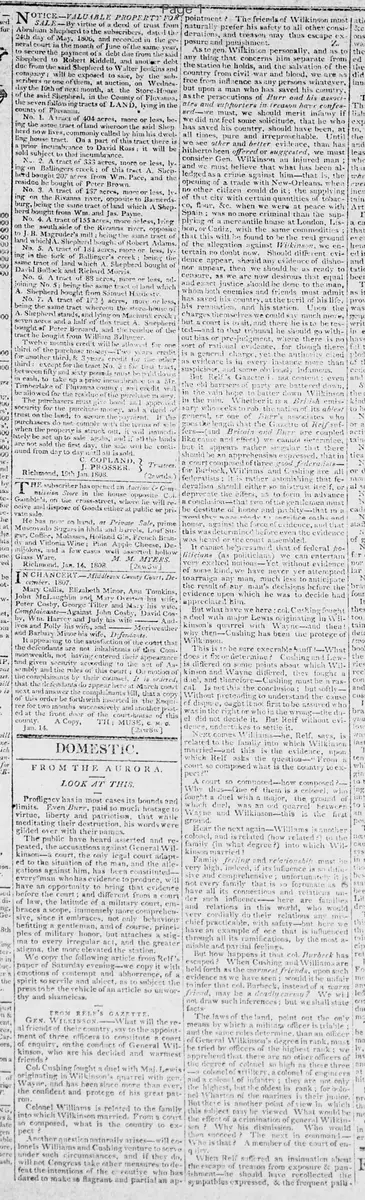
FROM THE AURORA.
LOOK AT THIS.
Profligacy has in most cases its bounds and limits. Even Burr, paid so much hostage to virtue, liberty and patriotism, that while meditating their destruction, his words were gilded over with their names.
The public have heard asserted and repeated, the accusations against General Wilkinson—a court, the only legal court adapted to the situation of the man, and the allegations against him, has been constituted—every man who has evidence to produce, will have an opportunity to bring that evidence before the court; and different from a court of law, the latitude of a military court, embraces a scope, immensely more comprehensive, since it embraces, not only behaviour befitting a gentleman, and of course, principles of military honor, but attaches a stigma to every irregular act, and the greater stigma, the more elevated the station.
We copy the following article from Relf's paper of Saturday evening—we copy it with emotions of contempt and abhorrence, of a spirit so servile and abject, as to subject the press to be the vehicle of an article so unworthy and shameless.
FROM RELF'S GAZETTE.
Gen. Wilkinson.—What will the real friends of their country, say to the appointment of three officers to constitute a court of enquiry, on the conduct of General Wilkinson, who are his decided and warmest friends?
Col. Cushing fought a duel with Maj. Lewis originating in Wilkinson's quarrel with gen. Wayne, and has been since more than ever, the confident and protege of his great patron.
Colonel Williams is related to the family into which Wilkinson married. From a court so composed, what is the country to expect?
Another question naturally arises—will colonels Williams and Cushing venture to serve under such circumstances, and if they do, will not Congress take other measures to defeat the intentions of the executive who has dared to make so flagrant and partial an appointment?
The friends of Wilkinson must naturally prefer his safety to all other considerations, and treason may thus escape exposure and punishment.
As to gen. Wilkinson personally, and as to any thing that concerns him separate from the station he holds, and the salvation of the country from civil war and blood, we are as free from influence as any persons whatever, but upon a man who has saved his country, as the persecutions of Burr and his associates and supporters in treason have confessed—we must, we should merit infamy if we did not feel some solicitude, that he who has saved his country, should have been, at all times, pure and irreproachable. Until we see other and better evidence, than has hitherto been offered or suggested, we must consider Gen. Wilkinson an injured man; and we must believe that what has been alleged as a crime against him—that is, the opening of a trade with New-Orleans, when no other citizen could do it: the supplying of that city with certain quantities of tobacco, flour, &c. when we were at peace with Spain: was no more criminal than the supplying of a mercantile house at London, Lisbon, or Cadiz, with the same commodities: that this will be found to be the real ground of the allegation against Wilkinson, we entertain no doubt now. Should different evidence appear, should any evidence of dishonor appear, then we should be as ready to censure, as we are now desirous that equal and exact justice should be done to the man, whom both enemies and friends must admit has saved his country, at the peril of his life, his reputation, and his station. Upon the charges themselves we could say much more, but a court is to sit, and there he is to be tested—and to that tribunal he should go without bias or pre-judgment, where there is no sort of rational evidence, for though there is a general charge, yet the authority cited as evidence is in every instance more than suspicious, and some obviously infamous.
But Relf's Gazette is not content: even the old barriers of party are battered down, in the vain hope to batter down Wilkinson in the ruin. Whether it is a British emissary who seeks to rob the nation of its ablest general, or one of Burr's associates who goes the length that the Gazette of Relf suffers—(and Britain and Burr are coupled like cause and effect) we cannot determine, but it appears rather singular that there should be an apprehension expressed, that in a court composed of three good federalists—for Burbeck, Williams and Cushing are all federalists: it is rather astonishing that federalism should either so mistrust itself, or desperate the effect, as to form in advance a conclusion—that two of the gentlemen must be destitute of honor and probity—that in a word they were badly to sacrifice oath, and honor, against the force of evidence, and that this was determined before even the evidence was heard or the court assembled.
It cannot be presumed that of federal politicians (as politicians) we can entertain very exalted notions—Yet without evidence of some kind, we have never yet attempted to arraign any man, much less to anticipate the result of any man's decisions before the evidence upon which he was to decide had been appreciated him.
But what have we here: col. Cushing fought a duel with major Lewis originating in Wilkinson’s quarrel with Wayne—and then! why then—Cushing has been the protege of Wilkinson.
This is to be sure execrable stuff!—What does it prove or determine? Cushing and Lewis differed on some points about which Wilkinson and Wayne differed, they fought a duel, and therefore—Cushing must be a rascal. Is not this the conclusion: but softly— Without pretending to understand the cause of dispute, ought it not first to be assured who was in the right or who in the wrong—the duel did not decide it. But Relf without evidence, undertakes to settle it.
Next comes Williams—he, Relf, says, is related to the family into which Wilkinson married—and this is the evidence, upon which Relf asks the question—“ From a court so composed what is the country to expect?”
A court so composed—how composed?— Why thus—One of them is a colonel, who fought a duel with a major, the ground of which duel, was an old quarrel between Wayne and Wilkinson—this is the first ground.
Hear the next again—Williams is another colonel, and is related (how related) to the family (in what degree?) into which Wilkinson married!
Family feeling and relationship must be very high, indeed, if its influence is so diffusive and comprehensive; unfortunately it is not every family that is so fortunate as to have all its connections and relations under such influence—there are families and relations in this world, who would very cordially do their relations any mischief practicable with safety—but here we have an example of one that is influenced through all its ramifications, by the most amiable and partial feelings.
But how happens it that col. Burbeck has escaped? When Cushing and Williams are held forth as the warmest friends, upon such evidence as we have seen: would it be unfair to infer that col. Burbeck, instead of a warm friend, may be a deadly enemy? We will not draw such inferences; but we shall state facts:
The laws of the land, point out the only means by which a military officer is triable: and the same rules determine, that an officer of General Wilkinson's degree in rank, must be tried by officers of the highest rank: we apprehend that there are no other officers of the degree of colonel so high as those three—a colonel of artillery, a colonel of engineers and a colonel of infantry; they are not only the highest, but the oldest in rank: for colonel Wharton of the marines is their junior.
But there is another point of view in which this subject may be viewed What would be the effect of a crimination of general Wilkinson? Why his dismission. Who would then succeed? The next in command— Who is that? A member of the court of enquiry.
When Relf suffered an insinuation about the escape of treason from exposure & punishment—he should have recollected the sympathies expressed, & the frequent palliations of Burr, Dayton, Swartout, Bollman &c. and that the heaviest of all the accusations that have been laid against Wilkinson was, that he first conspired with them, and then defeated their treason That he defeated them the American people know—that they hate him for it, they avow—that he did defeat them, is the best evidence of his innocence and their wickedness.
GENERAL WILKINSON.
Friday, January 15.
Gen. Wilkinson appeared, and the court having stated that they were ready to proceed to business, he enquired whether it was expected that the gentlemen notified would attend, as he would wish to make the remarks he purposed to offer in their presence. It was replied that no answers had been yet received from them.
A short time after, the following letters were received from Messrs. Clark and Rowan, in answer to the notices served upon them. The letter of Mr. Randolph was subsequently received:
The form of the notices is as follows, with the variation of the name of the gentleman to whom it was addressed:
To the Honorable Daniel Clarke, Delegate to Congress, from the territory of Orleans.
The President of the United States, at the request of Brigadier General James Wilkinson, having appointed a Military Court of Enquiry, for the purpose of hearing testimony in relation to the said Gen. Wilkinson having been, or now being a pensioner to the Spanish government, while holding a commission under the government of the United States: and it being duly intimated to the Court, that your testimony, touching the matter in question, will be material on behalf of the United States; it is therefore especially requested by the Court, that you will please attend the Court, on Friday next, at 10 o'clock, A. M. in order to give evidence in the case in hearing.
Done by order of the Court, this 13th day of January, 1808.
W. R. JONES, jr. acting as Judge-Advocate.
Wednesday, 13th Jan. 1808.
The following are the Answers received:
Washington, 15th Jan. 1808.
SIR,
I have received your note of the 13th inst. intimating the request of the Military Court of Enquiry, Instituted at the instance of General James Wilkinson by the President, that I should attend as a witness to give evidence, relative to the charge made against gen. Wilkinson, of his being or having been a pensioner of the Spanish government. You will permit me, sir, through you to inform the Court, that under the order of the House of Representatives, I have already communicated in a deposition the substance of my knowledge and information respecting the subject or the matter before the Court.
This deposition by order of the House has been transmitted to the President to be used according to his discretion. I shall have no objection to testify further before any court legally authorised to call citizens before them competent to the full investigation of so complicate a case; but understanding as I do, that a military court of enquiry has no power of acting but in relation to military men, and that the attendance of a citizen to testify before them, would be considered merely voluntary, tho I am in no degree disposed to withhold, when properly called upon, any information I possess as to the subject of the charges before the court, yet I cannot consent to appear before a tribunal whose rule of proceedings is purely military, and whose powers cannot enable them to call for corroborative proofs upon points which might be rendered questionable on the testimony of a single witness by adverse evidence.
I have the honor to remain, very respectfully, sir, your most obedient servant,
DANIEL CLARKE.
W. Jones, jr. Esq.
SIR,
Your note of the 13th inst. requesting that I would on this day attend as a witness at the Military Court now sitting for the purpose (as it is said) of enquiring into the conduct of Brigadier General Wilkinson, relative to his having been a pensioner of Spain, whilst in the service of the United States, was received by me on yesterday—I am not personally acquainted with that officer, nor do I (although I have heard and believe much) of my own knowledge, know any thing which according to the established rules of evidence in civil cases could be heard by that court on the subject of their enquiry: But if I did, my ignorance of military tribunals in the general, and of this in particular—my impressions as to its erection and object, and its impotence to coerce the attendance of corroborative witnesses would restrain me from appearing as a witness before that court—the court with whom I have not the honor of a personal acquaintance, so far from inferring from my non-attendance any want of respect to them individually will have the goodness to ascribe it to the motives above assigned, to my habitual and decided prefer ence for the civil institutions, and to my firm belief, that they only are competent to make the present enquiry efficiently.
Accept for yourself the assurance of my high respect and esteem.
JOHN ROWAN.
Walter Jones, jr. Esq.
January 13th, 1808.
SIR,
Your summons did not reach me until about an hour ago; to which circumstance alone you will impute the delay of this answer. I have no personal knowledge of any circumstances which can be material to the inquiry in which you are engaged, and therefore beg leave to decline attending the military court of which you are judge-Advocate.
I am very respectfully,
Sir,
Your obedient servant,
JOHN RANDOLPH.
Walter Jones, Esq.
Jan. 17, 1808, 2 o'clock, P. M.
The foregoing notice and answers are attested as a true copy, furnished General Wilkinson, at his request and by direction of the court
WALTER JONES.
Officiating as Judge-Advocate.
Gen. Wilkinson then rose, and delivered the following
ADDRESS:
GENTLEMEN,
from a sense of respect towards the court and of propriety to my own situation, I have been induced to trespass a few observations on your patience, preliminary to the introduction of testimony.
On receiving the first intimation of the aspersions pronounced against me on the floor of Congress, by a member of that honorable body, (Mr. John Randolph) as highly distinguished for decorum and moderation as he is for impartiality and candor; I appealed to the proper authority for an investigation into my conduct, by that tribunal which is secured to me by the constitution and the law, and you gentlemen have been ordered to sit in judgement on me.
The occasion was certainly unexpected yet it was not the less desirable, and altho the occurrence so recently after the ordeal at Richmond, may dispose some invidious persons to derogate from the motives of my honorable accuser, the candid and intelligent part of the world, when possessed of all the facts, will do him ample justice: for surely no unmanly vindictive personality can be ascribed to a gentleman of Mr. Randolph's lofty carriage and sublimated honor. Indeed when we survey the course which the accusation has travelled to this court, and examine the manner of its introduction into the House of Delegates, it would imply an unpardonable degree of scepticism to doubt the disinterested patriotism, which has guided the procedure before that honorable body, much less to complain of a failure in those chaste observances and delicate regards, which are due to the unfortunate, who may become the subject of public accusation.
Though highly flattered by the manner of my accuser, I must confess that my repugnance to unrighteous and unnecessary innovation, inclined me to prefer the plain, regular, and invariable course to military enquiry, by complaint to the superior—because it secures to the individual a constitutional right, prevents the obstruction of concerns purely executive, upon the attention of the legislative body, and spares gentlemen of glowing sensibilities, the deep regret inseparable from the analysis of individual character, on exparte testimony, or no testimony at all.
The victim of suspicion and obloquy for more than thirteen years, I have treated with frigid indifference the paragraphists & pamphleteers, who have pointed their daggers at my reputation, resolved to respond to their calumnies, by a redoubled zeal in the discharge of my duties; but I must now thank the patriot who has given the outline of my offences, for the opportunity he has furnished me to meet him on the ground of his preference, and there to defy him and his depraved informer, with the host of conspirators who participate their sympathies.
The blights with which men united for the ruin of their country, had recently attempted to sully my humble fame, in consequence of my feeble efforts in her defence, served but to excite my pity and contempt; I did indeed believe that the scene of persecution had been closed forever, and began to hope, after a long and not inactive life of military service, I might be permitted to wear out its remnant, somewhat cheered, under those privations of the heart which leave us little to wish for, by the retrospect of days without reproach, and the consciousness that whatever might have been my utility, I had lived without dishonor.
But I had forgotten that I had sinned beyond forgiveness, and that my destruction had been sealed in New-Orleans by a band of hardened traitors, who have advanced so far, that they place their safety in their success; and now for the first time I stand voluntarily, before a military tribunal, to vindicate all for which I have lived and for which I will die. The precious gift of my father—the inestimable inheritance of my children—a soldier's honor—after it has been worried, and torn, and mangled, and degraded, by whom? Let expressive silence mark the avengers of a traitor's cause! And may the angel of mercy blot out the remembrance of my wrongs. For my services shall live and be remembered, when the disciples of detraction, those pestiferous vermin who feed on calumnies, shall have perished and are forgotten.
There are certain terms in our language so offensive to an American ear, that to couple them with a man's name is sufficient to tarnish his character, such are corruption, bribery, pension, poison, and poltroon—my enemies aware of this, and knowing that a stain on military honor, like an aspersion on female chastity, sinks deep and is not to be erased
"To make assurance doubly sure
"And take a bond of fate—
"That they might tell pale hearted fear
"it lied,"
Have not been content to arraign me before my country, but in their rage for personal vengeance, they have condemned me unheard, and stigmatized me to the world, on the evidence of made up documents, perjuries and forgeries; I am sensible of the irreparable injury done me, and yet, in this our government of laws, I have found my case remediless; I have therefore suffered in silence, consoling myself with the hope, that the example of my persecutions, might be a future protection to the war worn veteran, and a useful example to those, who too readily credit the tale of detraction.
It is an easy matter to charge virtue itself with corruption, and alas, in these times, we find it almost as easy to sustain the allegation by the oaths of profligate abandoned men. But (Gracious God! Shall the unqualified imputation of corruption, without some word, deed, act, influence or instance, to consummate the offence or to designate the criminal intent or effort, suffice to rob a public officer of his hard earned repute, the price of more than twenty years of zealous faithful service? Shall bold assertions without facts or circumstances to substantiate them, even when sanctioned by the single oath of a faithless, lying, interested unprincipled man, prostrate the barriers of honor, which rest on the broad base of approved patriotism and long tried integrity. Genius of my country forbid it! Forbid it Heaven.
I ask only a suspension of the public judgement, pending the enquiry at issue. I call on my countrymen to pause and reflect before they decide. I do not address myself to Barratsters or embittered party-men, who would hazard the security of the nation, to gratify their malice, from such wretches I expect hatred and I solicit abuse. But I speak to the sweet blooded true hearted American, who is ready to renounce political dogmas, for the safety of the state, and to bleed or die in defence of its rights.
I request all such to examine the characters and motives of my accusers—the time and circumstances of the accusation—the one writhing under the anguish of public detection and merited dishonor—whilst, in this awful crisis of national affairs, he seeks the distraction of the public councils, to promote a sinister ambition and indulge his vengeful passion—the other scarcely a citizen—the enemy of our government and a disturber of the public repose—who has sought to embroil us in the face of treaties, and in face of the law, with a foreign power, for the promotion of those infamous designs, which he now charges upon me, and which with inflated zeal he, now affects to reprobate—and who when stripped of imposture will present a spectacle to the world, from which the eye and the mind will revolt with detestation and abhorrence.
In your honor and independence, gentlemen, however they may be questioned by those, who do not feel the force of those sacred bonds by which military men hold, I have an infallible guarantee for all I can desire, a patient, impartial, and I trust, rigorous scrutiny—in which I hope the nature of the accusation—the remoteness of the time—the hostility of the witness—the complexion of the first attack—and the shiftings, changes and prevarications which have ensued, may be strictly compared and combined.
Permit me to express the further desire that this court may insist on knowing, from whence the documents submitted by my accuser and his accomplice, have been derived, as this fact may furnish a clue by which to trace the foul combination to its infamous source, and to identify, in this murderous assault of my honor, the ministry of that Mexican association, formed at New-Orleans, (and referred to by Blennerhassett) for the purpose of co-operating with Aaron Burr, and which it has been my crime to detect, expose and put down.
The Court adjourned to Monday.
Monday, January 18.
The Court met according to appointment, and after a short time adjourned without transacting any business, to Wednesday 10 A. M.
What sub-type of article is it?
What themes does it cover?
What keywords are associated?
What entities or persons were involved?
Where did it happen?
Story Details
Key Persons
Location
Washington
Event Date
January 1808
Story Details
Newspaper defends General Wilkinson against accusations of being a Spanish pensioner and traitor linked to Burr's conspiracy, criticizes Relf's Gazette for bias claims against the court, reports court proceedings on January 15 where witnesses Clarke, Rowan, and Randolph decline to testify, includes Wilkinson's address vindicating his honor and services.