Thank you for visiting SNEWPapers!
Sign up free
Story
September 16, 1874
The Grange Advance
Red Wing, Goodhue County, Minnesota
What is this article about?
An article discusses advancements in livestock breeding through selection and care, refuting the theory that improved breeds revert to original types when care is withdrawn. Prof. Brewer finds no evidence of reversion, supported by high sales of improved stock.
Clipping
OCR Quality
98%
Excellent
Full Text
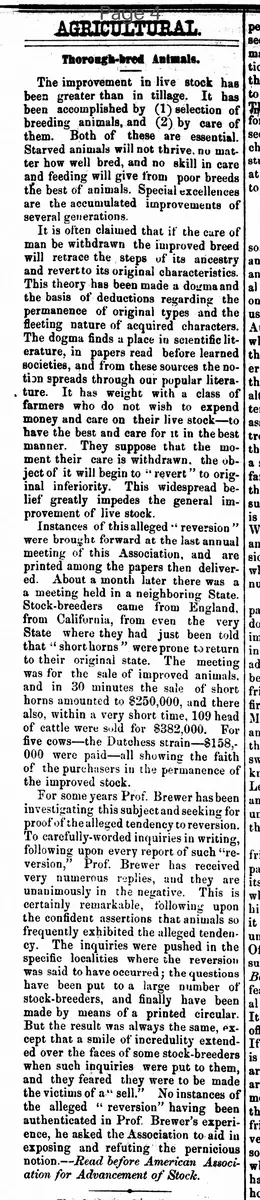
AGRICULTURAL
Thorough-bred Animals.
The improvement in live stock has been greater than in tillage. It has been accomplished by (1) selection of breeding animals, and (2) by care of them. Both of these are essential.
Starved animals will not thrive, no matter how well bred, and no skill in care and feeding will give from poor breeds the best of animals. Special excellences are the accumulated improvements of several generations.
It is often claimed that if the care of man be withdrawn the improved breed will retrace the steps of its ancestry and revert to its original characteristics.
This theory has been made a dogma and the basis of deductions regarding the permanence of original types and the fleeting nature of acquired characters.
The dogma finds a place in scientific literature, in papers read before learned societies, and from these sources the notion spreads through our popular literature. It has weight with a class of farmers who do not wish to expend money and care on their live stock--to have the best and care for it in the best manner. They suppose that the moment their care is withdrawn, the object of it will begin to "revert" to original inferiority. This widespread belief greatly impedes the general improvement of live stock.
Instances of this alleged "reversion" were brought forward at the last annual meeting of this Association, and are printed among the papers then delivered. About a month later there was a meeting held in a neighboring State.
Stock-breeders came from England, from California, from even the very State where they had just been told that "short horns" were prone to return to their original state. The meeting was for the sale of improved animals, and in 30 minutes the sale of short horns amounted to $250,000, and there also, within a very short time, 109 head of cattle were sold for $382,000. For five cows--the Duchess strain--$158,000 were paid--all showing the faith of the purchasers in the permanence of the improved stock.
For some years Prof. Brewer has been investigating this subject and seeking for proof of the alleged tendency to reversion.
To carefully-worded inquiries in writing following upon every report of such "reversion," Prof. Brewer has received very numerous replies, and they are unanimously in the negative. This is certainly remarkable, following upon the confident assertions that animals so frequently exhibited the alleged tendency. The inquiries were pushed in the specific localities where the reversion was said to have occurred; the questions have been put to a large number of stock-breeders, and finally have been made by means of a printed circular.
But the result was always the same, except that a smile of incredulity extended over the faces of some stock-breeders when such inquiries were put to them, and they feared they were to be made the victims of a "sell." No instances of the alleged "reversion" having been authenticated in Prof. Brewer's experience, he asked the Association to aid in exposing and refuting the pernicious notion.--Read before American Association for Advancement of Stock.
Thorough-bred Animals.
The improvement in live stock has been greater than in tillage. It has been accomplished by (1) selection of breeding animals, and (2) by care of them. Both of these are essential.
Starved animals will not thrive, no matter how well bred, and no skill in care and feeding will give from poor breeds the best of animals. Special excellences are the accumulated improvements of several generations.
It is often claimed that if the care of man be withdrawn the improved breed will retrace the steps of its ancestry and revert to its original characteristics.
This theory has been made a dogma and the basis of deductions regarding the permanence of original types and the fleeting nature of acquired characters.
The dogma finds a place in scientific literature, in papers read before learned societies, and from these sources the notion spreads through our popular literature. It has weight with a class of farmers who do not wish to expend money and care on their live stock--to have the best and care for it in the best manner. They suppose that the moment their care is withdrawn, the object of it will begin to "revert" to original inferiority. This widespread belief greatly impedes the general improvement of live stock.
Instances of this alleged "reversion" were brought forward at the last annual meeting of this Association, and are printed among the papers then delivered. About a month later there was a meeting held in a neighboring State.
Stock-breeders came from England, from California, from even the very State where they had just been told that "short horns" were prone to return to their original state. The meeting was for the sale of improved animals, and in 30 minutes the sale of short horns amounted to $250,000, and there also, within a very short time, 109 head of cattle were sold for $382,000. For five cows--the Duchess strain--$158,000 were paid--all showing the faith of the purchasers in the permanence of the improved stock.
For some years Prof. Brewer has been investigating this subject and seeking for proof of the alleged tendency to reversion.
To carefully-worded inquiries in writing following upon every report of such "reversion," Prof. Brewer has received very numerous replies, and they are unanimously in the negative. This is certainly remarkable, following upon the confident assertions that animals so frequently exhibited the alleged tendency. The inquiries were pushed in the specific localities where the reversion was said to have occurred; the questions have been put to a large number of stock-breeders, and finally have been made by means of a printed circular.
But the result was always the same, except that a smile of incredulity extended over the faces of some stock-breeders when such inquiries were put to them, and they feared they were to be made the victims of a "sell." No instances of the alleged "reversion" having been authenticated in Prof. Brewer's experience, he asked the Association to aid in exposing and refuting the pernicious notion.--Read before American Association for Advancement of Stock.
What sub-type of article is it?
Curiosity
Historical Event
What themes does it cover?
Deception
Moral Virtue
Triumph
What keywords are associated?
Livestock Improvement
Breeding Selection
Reversion Theory
Prof Brewer
Stock Sales
Agricultural Association
What entities or persons were involved?
Prof. Brewer
Where did it happen?
Neighboring State, England, California
Story Details
Key Persons
Prof. Brewer
Location
Neighboring State, England, California
Event Date
Last Annual Meeting, About A Month Later
Story Details
The article argues that livestock improvement via breeding selection and care is permanent, debunking the reversion theory through Prof. Brewer's inquiries and evidence from high-value sales of improved stock at breeders' meetings.