Thank you for visiting SNEWPapers!
Sign up free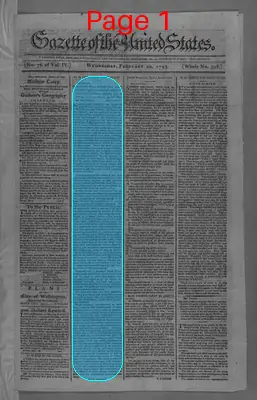
Letter to Editor
February 20, 1793
Gazette Of The United States
New York, New York County, New York
What is this article about?
Letter to the editor of the Gazette of the United States advocating for more just and benevolent views of American Indians, refuting claims of their incapacity for civilization by highlighting their physical, mental, and moral qualities.
Clipping

OCR Quality
98%
Excellent
Full Text
For the GAZETTE of the UNITED STATES.
Mr. Fenno,
I send you a few thoughts on the state of our American Indians—if they are calculated to inspire more just or benevolent sentiments respecting them, by inserting them in your Gazette, you will oblige
your humble servant,
LYCURGUS.
NOTWITHSTANDING the length of time that has elapsed since the discovery of this country—the number and success of the emigrants, and the rapid growth and improvement of the settlements, little or no attention has been paid to the melioration of the state of the natives of the soil. We are indeed imperfectly acquainted with the real state of manners among them—The remarks which have hitherto been made upon the subject are too few and detached, too informal and extravagant to satisfy an enquiring mind—The accounts which have been published, have generally been derived from traders and travellers who have been engaged in business, and have not had leisure or talents for accurate observation. From the small progress which the Indians have made in improvement, an opinion has arisen and is current among a certain class of citizens, that they are incapable of civilization—An idea so injurious to the feelings of benevolence, so inconsistent with the powers of the human mind and the strongest propensities of human nature, and so directly contrary to the progress of savage manners in past ages, must be well supported to merit our assent.
This incapacity of the Indians if any such exists must arise from some imbecility either of body or mind, but that no such infirmity can with justice be ascribed to them, the uniform testimony of all who have become acquainted with them sufficiently evinces.
In their persons and complexions like all other nations they are subject to those minute variations which climate, mode of living, poverty, or delicacy of food and the ease or difficulty of acquiring it contribute to create. They are generally tolerably well made, tall and straight, and very seldom deformed; they are remarkably active in war and in the chase—capable of enduring the greatest hardships and fatigues and in an astonishing degree insensible of inclement seasons.—The women suffer very little from the pains of child birth—they need no assistance but from nature and their own constitutions, and are confined but a few hours from their usual employments. They have generally good health without any precautions to preserve it, and are strangers to many diseases which afflict polished nations.
The powers of their minds are in no respect inferior to the qualities of their bodies; they discover great sagacity in those things with which their circumstances render them familiar: they are able to perceive with incredible facility the traces of man or beast on the smoothest grass, on the hardest earth, and even on the very stones will they discover the traces of an enemy, and by the shape of the footsteps and the distance between the prints distinguish not only whether it is a man or woman who has passed that way, but even the nation to which they belong.
They will cross a trackless forest of immense extent without any material deviation from the place at which they aimed; they will point to the place of the sun, though intercepted by clouds, and direct their course with surprising exactness by a nice attention to minute circumstances which escape the notice of more improved people.
The habit of relying upon their memories for the knowledge of past transactions, with the artificial means they use to strengthen the principle of association, render them surprisingly retentive.
Their language, correspondent to their ideas, is narrow and simple—many of their speakers, however, have arrived at considerable eminence, a greater fluency of words and grace of action than could reasonably be expected from a people ignorant of the arts and sciences, and all those terms to which improved society gives birth—Their speeches are generally bold and nervous—full of striking images, and sometimes truly sublime. The qualities of the mind and body give rank and distinction among them—The Sachems who preside in their councils and direct the affairs of the tribe, derive their influence wholly from the opinion which the nation entertains of their wisdom and integrity—Their leaders in war also owe their authority to the public estimation of their courage and conduct—As a further proof of their mental qualifications, I might mention the proficiency of such of them as have enjoyed the means of instruction—it has generally been equal to the most sanguine expectations—their rude attempts at the arts are curious and discover great ingenuity and invention.—To these may be added their magnanimity, their hospitality, and their fidelity to their friends—virtues in which they are unparalleled by civilized nations.
[To be continued.]
Mr. Fenno,
I send you a few thoughts on the state of our American Indians—if they are calculated to inspire more just or benevolent sentiments respecting them, by inserting them in your Gazette, you will oblige
your humble servant,
LYCURGUS.
NOTWITHSTANDING the length of time that has elapsed since the discovery of this country—the number and success of the emigrants, and the rapid growth and improvement of the settlements, little or no attention has been paid to the melioration of the state of the natives of the soil. We are indeed imperfectly acquainted with the real state of manners among them—The remarks which have hitherto been made upon the subject are too few and detached, too informal and extravagant to satisfy an enquiring mind—The accounts which have been published, have generally been derived from traders and travellers who have been engaged in business, and have not had leisure or talents for accurate observation. From the small progress which the Indians have made in improvement, an opinion has arisen and is current among a certain class of citizens, that they are incapable of civilization—An idea so injurious to the feelings of benevolence, so inconsistent with the powers of the human mind and the strongest propensities of human nature, and so directly contrary to the progress of savage manners in past ages, must be well supported to merit our assent.
This incapacity of the Indians if any such exists must arise from some imbecility either of body or mind, but that no such infirmity can with justice be ascribed to them, the uniform testimony of all who have become acquainted with them sufficiently evinces.
In their persons and complexions like all other nations they are subject to those minute variations which climate, mode of living, poverty, or delicacy of food and the ease or difficulty of acquiring it contribute to create. They are generally tolerably well made, tall and straight, and very seldom deformed; they are remarkably active in war and in the chase—capable of enduring the greatest hardships and fatigues and in an astonishing degree insensible of inclement seasons.—The women suffer very little from the pains of child birth—they need no assistance but from nature and their own constitutions, and are confined but a few hours from their usual employments. They have generally good health without any precautions to preserve it, and are strangers to many diseases which afflict polished nations.
The powers of their minds are in no respect inferior to the qualities of their bodies; they discover great sagacity in those things with which their circumstances render them familiar: they are able to perceive with incredible facility the traces of man or beast on the smoothest grass, on the hardest earth, and even on the very stones will they discover the traces of an enemy, and by the shape of the footsteps and the distance between the prints distinguish not only whether it is a man or woman who has passed that way, but even the nation to which they belong.
They will cross a trackless forest of immense extent without any material deviation from the place at which they aimed; they will point to the place of the sun, though intercepted by clouds, and direct their course with surprising exactness by a nice attention to minute circumstances which escape the notice of more improved people.
The habit of relying upon their memories for the knowledge of past transactions, with the artificial means they use to strengthen the principle of association, render them surprisingly retentive.
Their language, correspondent to their ideas, is narrow and simple—many of their speakers, however, have arrived at considerable eminence, a greater fluency of words and grace of action than could reasonably be expected from a people ignorant of the arts and sciences, and all those terms to which improved society gives birth—Their speeches are generally bold and nervous—full of striking images, and sometimes truly sublime. The qualities of the mind and body give rank and distinction among them—The Sachems who preside in their councils and direct the affairs of the tribe, derive their influence wholly from the opinion which the nation entertains of their wisdom and integrity—Their leaders in war also owe their authority to the public estimation of their courage and conduct—As a further proof of their mental qualifications, I might mention the proficiency of such of them as have enjoyed the means of instruction—it has generally been equal to the most sanguine expectations—their rude attempts at the arts are curious and discover great ingenuity and invention.—To these may be added their magnanimity, their hospitality, and their fidelity to their friends—virtues in which they are unparalleled by civilized nations.
[To be continued.]
What sub-type of article is it?
Informative
Persuasive
Ethical Moral
What themes does it cover?
Social Issues
Morality
What keywords are associated?
American Indians
Civilization
Native Abilities
Benevolence
Physical Qualities
Mental Sagacity
Indian Virtues
What entities or persons were involved?
Lycurgus
Mr. Fenno
Letter to Editor Details
Author
Lycurgus
Recipient
Mr. Fenno
Main Argument
american indians are capable of civilization and improvement, possessing strong physical, mental, and moral qualities; prevailing opinions of their incapacity are unfounded and should be replaced with benevolent sentiments.
Notable Details
Uniform Testimony Evinces No Imbecility In Body Or Mind
Remarkable Activity In War And Chase, Endurance Of Hardships
Sagacity In Tracking And Navigation
Retentive Memories And Eminent Oratory
Leadership Based On Wisdom, Integrity, Courage
Proficiency In Instruction And Ingenuity In Arts
Magnanimity, Hospitality, Fidelity As Unparalleled Virtues