Thank you for visiting SNEWPapers!
Sign up free
The Virginia Gazette
Richmond, Williamsburg, Richmond County, Virginia
What is this article about?
Ro. C. Nicholas writes to Mr. Henley defending his opposition to Henley's election as parish minister, citing Henley's alleged heterodox views on Christ's divinity, the Trinity, and church articles. He details witness testimonies from vestry meetings and refutes Henley's accusations of personal resentment.
Merged-components note: This is a single long letter to Mr. Henley continued across pages 1 and 2, as indicated by sequential reading order and continuous text flow.
Clippings
1 of 2
OCR Quality
Full Text
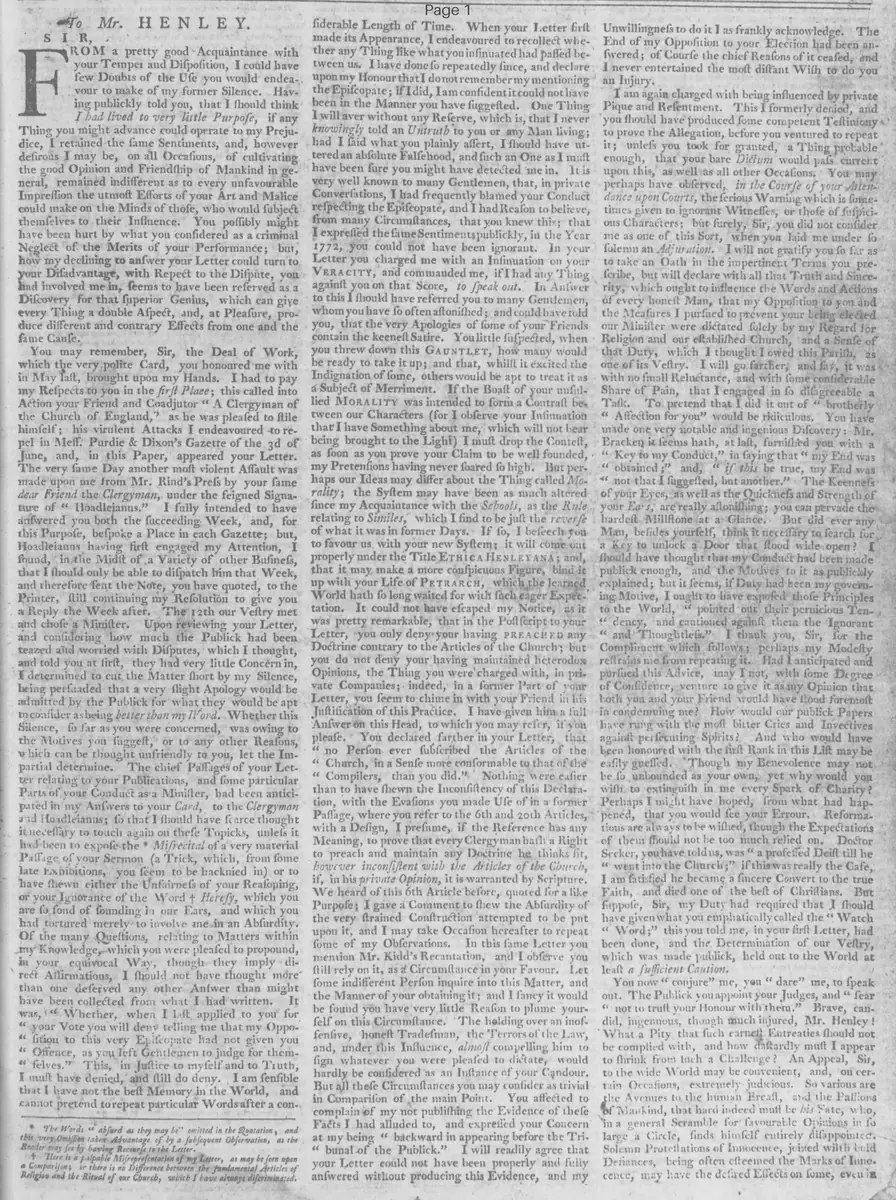
SIR,
FROM a pretty good Acquaintance with your Temper and Disposition, I could have few Doubts of the Use you would endeavour to make of my former Silence. Having publicly told you, that I should think I had lived to very little Purpose, if any Thing you might advance could operate to my Prejudice, I retained the same Sentiments, and, however desirous I may be, on all Occasions, of cultivating the good Opinion and Friendship of Mankind in general, remained indifferent as to every unfavourable Impression the utmost Efforts of your Art and Malice could make on the Minds of those, who would subject themselves to their Influence. You possibly might have been hurt by what you considered as a criminal Neglect of the Merits of your Performance; but, how my declining to answer your Letter could turn to your Disadvantage, with Respect to the Dispute, you find involved me in, seems to have been reserved as a Discovery for that superior Genius, which can give every Thing a double Aspect, and, at Pleasure, produce different and contrary Effects from one and the same Cause.
You may remember, Sir, the Deal of Work, which the very polite Card, you honoured me with in May last, brought upon my Hands. I had to pay my Respects to you in the first Place; this called into Action your Friend and Coadjutor "A Clergyman of the Church of England," as he was pleased to style himself; his virulent Attacks I endeavoured to repel in Mess. Purdie & Dixon's Gazette of the 3d of June, and, in this Paper, appeared your Letter. The very same Day another most violent Assault was made upon me from Mr. Rind's Press by your same dear Friend the Clergyman, under the feigned Signature of "Hoadleianus." I fully intended to have answered you both the succeeding Week, and, for this Purpose, bespoke a Place in each Gazette; but, Hoadleianus having first engaged my Attention, I found, in this Midst of a Variety of other Business, that I should only be able to dispatch him that Week, and therefore sent the Note, you have quoted, to the Printer, still continuing my Resolution to give you a Reply the Week after. The 12th our Vestry met and chose a Minister. Upon reviewing your Letter, and considering how much the Publick had been teazed and worried with Disputes, which I thought, and told you at first, they had very little Concern in, I determined to cut the Matter short by my Silence, being persuaded that a very slight Apology would be admitted by the Publick for what they would be apt to consider as being better than my Word. Whether this Silence, so far as you were concerned, was owing to the Motives you suggest, or to any other Reasons, which can be thought unfriendly to you, let the Impartial determine. The chief Passages of your Letter relating to your Publications, and some particular Parts of your Conduct as a Minister, had been anticipated in my Answers to your Card, to the Clergyman and Hoadleianus; so that I should have scarce thought it necessary to touch again on these Topicks, unless it had been to expose the Misrecital of a very material Passage of your Sermon (a Trick, which, from some late Exhibitions, you seem to be hacknied in) or to have shewn either the Unfairness of your Reasoning, or your Ignorance of the Word Heresy, which you are so fond of sounding in our Ears, and which you had tortured merely to involve me in an Absurdity.
Of the many Questions relating to Matters within my Knowledge, which you were pleased to propound, in your equivocal Way, though they imply direct Affirmations, I should not have thought more than one deserved any other Answer than might have been collected from what I had written. It was, "Whether, when I last applied to you for your Vote you will deny telling me that my Opposition to this very Episcopate had not given you Offence, as you left Gentlemen to judge for themselves." This, in Justice to myself and to Truth, I must have denied, and still do deny. I am sensible that I have not the best Memory in the World, and cannot pretend to repeat particular Words after a considerable Length of Time.*
*The Words "absurd as they may be" omitted in the Quotation, and this very Omission taken Advantage of by a subsequent Observation, as the Reader may see by having Recourse to the Letter.
: Here is a palpable misrepresentation of my Letter, as may be seen upon a comparison; or there is no difference between the fundamental Articles of Religion and the Ritual of our Church, which I have always discriminated.
When your Letter first made its Appearance, I endeavoured to recollect whether any Thing like what you insinuated had passed between us, I have done so repeatedly since, and declare upon my Honour that I do not remember my mentioning the Episcopate; if I did, I am confident it could not have been in the Manner you have suggested. One Thing I will aver without any Reserve, which is, that I never knowingly told an Untruth to you or any Man living; had I said what you plainly assert, I should have uttered an absolute Falsehood, and such an One as I must have been sure you might have detected me in. It is very well known to many Gentlemen, that, in private Conversations, I had frequently blamed your Conduct respecting the Episcopate, and I had Reason to believe, from many Circumstances, that you knew this; that I expressed the same Sentiments publickly, in the Year 1772, you could not have been ignorant. In your Letter you charged me with an Insinuation on your Veracity, and commanded me, if I had any Thing against you on that Score, to speak out. In Answer to this I should have referred you to many Gentlemen, whom you have so often astonished; and could have told you, that the very Apologies of some of your Friends contain the keenest Satire. You little suspected, when you threw down this GAUNTLET, how many would be ready to take it up; and that, whilst it excited the Indignation of some, others would be apt to treat it as a Subject of Merriment. If the Boast of your unallied Morality was intended to form a Contrast between our Characters (for I observe your Insinuation that I have Something about me, which will not bear being brought to the Light) I must drop the Contest, as soon as you prove your Claim to be well founded, my Pretensions having never soared so high. But perhaps our Ideas may differ about the Thing called Morality; the System may have been as much altered since my Acquaintance with the Schools, as the Rule relating to Similes, which I find to be just the reverse of what it was in former Days. If so, I beseech you to favour us with your new System; it will come out properly under the Title ETHICA HENLEYANA; and, that it may make a more conspicuous Figure, bind it up with your Life of PETRARCH, which the learned World hath so long waited for with such eager Expectation. It could not have escaped my Notice, as it was pretty remarkable, that in the Postscript to your Letter, you only deny your having PREACHED any Doctrine contrary to the Articles of the Church; but you do not deny your having maintained heterodox Opinions, the Thing you were charged with, in private Companies; indeed, in a former Part of your Letter, you seem to chime in with your Friend in his Justification of this Practice. I have given him a full Answer on this Head, to which you may refer, if you please. You declared farther in your Letter, that "no Person ever subscribed the Articles of the Church, in a Sense more conformable to that of the Compilers, than you did." Nothing were easier than to have shewn the Inconsistency of this Declaration, with the Evasions you made Use of in a former Passage, where you refer to the 6th and 20th Articles, with a Design, I presume, if the Reference has any Meaning, to prove that every Clergyman has a Right to preach and maintain any Doctrine he thinks fit, however inconsistent with the Articles of the Church, if, in his private Opinion, it is warranted by Scripture. We heard of this 6th Article before, quoted for a like Purpose; I gave a Comment to shew the Absurdity of the very strained Construction attempted to be put upon it, and I may take Occasion hereafter to repeat some of my Observations. In this same Letter you mention Mr. Kidd's Recantation, and I observe you still rely on it, as a Circumstance in your Favour. Let some indifferent Person inquire into this Matter, and the Manner of your obtaining it; and I fancy it would be found you have very little Reason to plume yourself on this Circumstance. The holding over an inoffensive, honest Tradesman, the Terrors of the Law, and, under this Influence, almost compelling him to sign whatever you were pleased to dictate, would hardly be considered as an Instance of your Candour. But all these Circumstances you may consider as trivial in Comparison of the main Point. You affected to complain of my not publishing the Evidence of these Facts I had alluded to, and expressed your Concern at my being "backward in appearing before the Tribunal of the Publick." I will readily agree that your Letter could not have been properly and fully answered without producing this Evidence, and my Unwillingness to do it I as frankly acknowledge. The End of my Opposition to your Election had been answered; of Course the chief Reasons of it ceased, and I never entertained the most distant Wish to do you an Injury.
I am again charged with being influenced by private Pique and Resentment. This I formerly denied, and you should have produced some competent Testimony to prove the Allegation, before you ventured to repeat it; unless you took for granted, a Thing probable enough, that your bare Dictum would pass current upon this, as well as all other Occasions. You may perhaps have observed, in the Course of your Attendance upon Courts, the serious Warning which is sometimes given to ignorant Witnesses, or those of suspicious Characters; but surely, Sir, you did not consider me as one of this Sort, when you laid me under so solemn an Adjuration. I will not gratify you so far as to take an Oath in the impertinent Terms you prescribe, but will declare with all that Truth and Sincerity, which ought to influence the Words and Actions of every honest Man, that my Opposition to you and the Measures I pursued to prevent your being elected our Minister were dictated solely by my Regard for Religion and our established Church, and a Sense of that Duty, which I thought I owed this Parish, as one of its Vestry. I will go farther, and say it was with no small Reluctance, and with some considerable Share of Pain, that I engaged in so disagreeable a Task. To pretend that I did it out of "brotherly Affection for you" would be ridiculous. You have made one very notable and ingenious Discovery: Mr. Bracken it seems hath, at last, furnished you with a "Key to my Conduct," in saying that "my End was obtained;" and, "if this be true, my End was not that I suggested, but another." The Keenness of your Eyes, as well as the Quickness and Strength of your Ears, are really astonishing; you can pervade the hardest Millstone at a Glance. But did ever any Man, besides yourself, think it necessary to search for a Key to unlock a Door that stood wide open? I should have thought that my Conduct had been made publick enough, and the Motives to it as publickly explained; but it seems, if Duty had been my governing Motive, I ought to have exposed those Principles to the World, "pointed out their pernicious Tendency, and cautioned against them the Ignorant and Thoughtless." I thank you, Sir, for the Compliment which follows; perhaps my Modesty restrains me from repeating it. Had I anticipated and pursued this Advice, may I not, with some Degree of Confidence, venture to give it as my Opinion that both you and your Friend would have stood foremost in condemning me? How would our publick Papers have rung with the most bitter Cries and Invectives against persecuting Spirits? And who would have been honoured with the first Rank in this List may be easily guessed. Though my Benevolence may not be so unbounded as your own, yet why would you wish to extinguish in me every Spark of Charity? Perhaps I might have hoped, from what had happened, that you would see your Error. Reformations are always to be wished, though the Expectations of them should not be too much relied on. Doctor Secker, you have told us, was "a professed Deist till he went into the Church;" if this was really the Case, I am satisfied he became a sincere Convert to the true Faith, and died one of the best of Christians. But suppose, Sir, my Duty had required that I should have given what you emphatically called the "Watch Word;" this you told me, in your first Letter, had been done, and the Determination of our Vestry, which was made publick, held out to the World at least a sufficient Caution. You now "conjure" me, you "dare" me, to speak out. The Publick you appoint your Judges, and "fear not to trust your Honour with them." Brave, candid, ingenuous, though much injured, Mr. Henley! What a Pity that such earnest Entreaties should not be complied with, and how dastardly must I appear to shrink from such a Challenge? An Appeal, Sir, to the wide World may be convenient, and, on certain Occasions, extremely judicious. So various are the Avenues to the human Breast, and the Passions of Mankind, that hard indeed must be his Fate, who, in a general Scramble for favourable Opinions in so large a Circle, finds himself entirely disappointed. Solemn Protestations of Innocence, joined with bold Defiances, being often esteemed the Marks of Innocence, may have the desired Effects on some, even in this enlightened Age.
Those instances where they are only the recourses of desperation. But, remember, good Sir, that facts, with certain concomitants, are stubborn things, and must be yielded to, when rightly understood. It is an old saying, that they who talk a great deal ought to have long memories; may not this be applied to some persons, who are fond of writing a great deal? You say to Mr. Bracken, three years almost I preached in your pulpit without being suspected by any but the treasurer, and only by him (that I knew of) till the 12th of last June. One would be apt to suppose from hence that you had preached almost constantly in our pulpit for three years, whereas I believe you did it only now and then occasionally, till you officiated for Mr. Horrocks during his indisposition and absence; and I much question, though I will not be positive, whether the whole time exceeded eighteen months. The length of time it is plain you intended to rely on as material: Newspapers we know are read in foreign countries as well as at home, and perhaps it is best to give good large tales both in respect to time and circumstances. But you were not suspected by any one but the treasurer till the 12th of June, that you knew of. Read the angry advertisement prefixed to your printed sermon, which was preached in March 1772, and certified to have been printed at Cambridge, though it was done in this city. In this you give as your reasons for publishing the discourse that it had exposed its author to obloquy, and say that some gentlemen have taken offence at the subject. What had been said of this sermon, and some of your other publications, must have convinced you that you were at least suspected. Could you have doubted but that those persons, in whose presence you had delivered such strange opinions, must have entertained suspicions? Some of these I had given you notice of in my letter published in May; so that the suspicions of others could not have been new or a surprise to you the 12th of June, the day our vestry was held. When you undertook to give an account of the evidence offered to the vestry, you certainly must have been under a strange infatuation, or you never could have obtruded on the world so partial and unjust a representation. Perhaps you might have flattered yourself that my fears were still predominant, and that I should be deterred from ever making my appearance again. In hopes of rescuing you from so great a delusion, that the characters of the witnesses, which you have dared to asperse, and that my own conduct may appear in a proper and true light, I will undertake to state the facts, as they really were, together with some other corroborative proofs, and will venture to appeal to others for the truth of all I advance. This will lead me into a detail, which I would gladly have avoided; but the candid and judicious readers, in whose decision I shall acquiesce with all cheerfulness, will best know to whom they are indebted for so great a trespass on their patience. You must remember, Sir, then, in my answer to your card, I offered either to give my author's names into your own hands, or mention them to the vestry, as might be most agreeable to you. You did not signify to me your choice, and therefore I proceeded in my own way. When the vestry met, you were, upon my motion, made acquainted that several matters had been objected to you, and that, if you chose it, the vestry were ready and willing to hear every thing you had to say, but that they did not pretend to have any authority to cite you before them. You, in consequence of this message, attended. I proposed that the witnesses should be sworn, but you were polite enough to desire that this ceremony might be waived, declaring that you should be as well satisfied without it. Colonel Richard Bland, who was first called upon, declared he remembered well, as it made a deep impression on his mind, that, in a conversation with the speaker and you, some considerable time past, upon the divine perfections, the divine trinity or our Saviour was mentioned; that he attempted to defend this doctrine, and cited several texts from the holy scriptures to prove it, particularly the first chapter of St. Paul's epistle to the Hebrews. That this gave occasion to the introduction of a Bible, and that you undertook to explain this chapter so as to deprive our Saviour of his divine character; that you made him nothing more than a messenger particularly appointed by God to promulgate a universal religion to mankind, in the same manner as Moses and the prophets of the Old Testament had been appointed to publish a particular religion and declare the will of God to the Jewish nation; that, in this respect, he was so much better than the messengers under the Jewish dispensation, who preceded him, as, by the universality of his religion, he had obtained a more excellent name than they; that his religion was to supersede the Jewish, and that, for this reason, the text says, let all the angels of God worship him, that is, let all the messengers, or which in your opinion was the same thing, the religion they established give place and pay obedience to the religion he was sent to establish universal, which was more excellent than the religion of the Jews. He declared, that, by your argument, faith in our Saviour's divinity was explained away, and his divine dignity degraded so as to make him very little superior to the prophets of the Old Testament. That he was greatly surprised such a doctrine should come from a clergyman of the established Church, and told you, with some resentment, that yours were the principles of the Socinians; to which you answered, Sir, I am not a Socinian, and he replied, I do not say you are, but whoever understands the Scriptures, in the sense you have explained them, must be a Socinian. He further declared, that he would not pretend to say you delivered your real sentiments, but that he was fully convinced, from your manner, that you spoke your own opinion, and from that time considered you as entertaining no favourable sentiments of our Saviour's divinity. He also declared, that soon after this conversation he was at my house, when, upon some occasion or other, I spoke in your favour, which I believe he had formerly done; that he then told me how much his opinion was changed, and related the substance of the conversation herein recited; that he mentioned it likewise to one or two other persons of this city; that when he returned into the country, a gentleman of the parish he lives in mentioned a prevailing report that their parish was likely to become vacant, and, on that event, told him he might have an opportunity of introducing his friend Mr. Henley; that he informed the gentleman his sentiments were entirely changed with respect to you, and gave, for reason, the strange opinions he had lately heard you maintain. I mention these circumstances to show that Colonel Bland could hardly be mistaken; his veracity and integrity are too well established for any one to suppose that he would utter an untruth, and his knowledge must have enabled him thoroughly to understand the subject he was upon. He could have had no private views in giving an account of the matter, as he had mentioned it to different persons long before any disputes happened in this parish; and I can bear him witness that it was with very great reluctance he appeared in vestry to give his testimony against you. Mr. Speaker was called upon to give an account of this conversation. This gentleman can need none of my encomiums; of his integrity and veracity I have ever had the fullest conviction. He declared to have remembered a conversation and debate between you and Colonel Bland on the subject of religion; that the colonel seemed well pleased with your conversation, and, upon being asked whether he intended to the play that evening, said that he had rather stay and converse or argue, with you; that he did not remember to have heard you utter any thing like those sentiments Colonel Bland had expressed; that his lady (whose virtues and integrity are justly admired by all who know her) was also present at the conversation, and had declared to the same purpose. This I think was the substance of the evidence given by the speaker; if he said any thing more that was material, it has escaped my memory, and is not suppressed through design. Every thing, which was said, fell vastly short, in my humble opinion, of a declaration of the injustice, as you are pleased to term it, of the charge which this witness had brought. This gentleman and his lady might not have been immediately concerned in the debate, and therefore may be supposed not to have attended so particularly to it, as the other gentleman, who was. Debates, especially of this sort, are often spun out to such lengths as to become tedious to bystanders; I will not say how it may be with others, but know very well that I have often been in company, and could truly say that I did not remember whether such or such things passed; but, at the same time, could not venture to declare that they did not happen. I must take the liberty of referring you to a passage in your former letter to me, where you ask this question. But are you certain, Sir, that your informant understood the principles of Socinus? I ask this question, because my argument, to which you refer, was a defence of the doctrine of our Church in opposition to them. Disprove it if you can. By this you must allude to Colonel Bland, who proves the contrary of what you assert. This seems to be another of your bold defiances. It strongly marks your ingenuity and dexterity at a shift. Aware of the force of his testimony, you endeavour to annihilate it, by charging him in effect with the very thing you knew he would accuse you of; he must have espoused the principles of Socinus, or else you were arguing and contending without an opponent. But, Sir, did Mr. Speaker recollect this argument of yours? I do not remember that he did; and, if not, I hope you will allow that his attention might have been interrupted, as I have supposed. Or have you any evidence to prove that Colonel Bland ever maintained the principles of Socinus? The second witness with the vague ideas was Mrs. Nicholas. It gave me much concern to be obliged to call upon her. The cause, however, I considered was not my own (though you had endeavoured to make it so) but that of the whole parish. Her veracity I was sure could not be impeached, and I knew that her testimony might be supported by several others of unquestionable veracity, to whom she had communicated what she had to say, long before any disputes happened in the parish, and, I believe, while you were upon very friendly terms with me. If you doubt her capacity to give competent testimony, even in matters of religion, because St. Paul forbids women to speak in the church, you had better undertake to examine her. Her testimony, with your interrogation, as nearly as I can recollect the material parts of it, was as follows. She declared, that in a conversation she had with you about two years before, or upwards, upon the subject of religion, you, to the best of her remembrance, denied the divinity of our Saviour Jesus Christ, the existence of the devil; that there was any such place as hell, or that there would be any eternal torments; that, upon this, she asked you, if these were your sentiments, how you could satisfy your conscience about subscribing the articles of the church of England? To which you replied, that it was expressed in one of the articles, that if any thing in the said articles should be found contrary to the word of God it should not be obligatory on the person subscribing, and therefore was not binding on you, as you understood the scriptures in a sense different from the articles. She declared, that she would not be positive as to your identical words, but that they were to this effect. Being asked whether she had ever heard of the article you alluded to, before you mentioned it, she declared she had not. Mrs. Ambler was the third witness you mention; she declared, as well as I can recollect, that her sister Nicholas had, above two years before, told her of a conversation with you, and that you had denied our Saviour to be the Son of God, the existence of the devil, such a place as hell and eternal torments, and that the same question and answer passed between you about the articles. Upon this you called out, see, they differ! Mrs. Ambler then said, she knew of no difference between denying our Saviour to be the Son of God and denying his divinity. Mrs. Nicholas likewise added, she would not be positive which of the words you made use of; that they conveyed the same ideas to her, and she had always considered them as synonymous terms. This, and this only, could have been what you call an essential difference between their testimony, and Mrs. Nicholas's varying materially, upon interrogation, in her mode of expression. You made some strictures upon this evidence, which I own to you I did not understand. You denied having said what was alleged respecting the divinity or our Saviour's being the Son of God; I do not remember your saying any thing of the devil; but, as to hell, you ludicrously told us you did not know that the geography of it had ever been settled. Mrs. Nicholas was asked whether you had said any thing of annihilation in the course of your conversation; she said that she could not be sure; that she had heard of your preaching that doctrine in our church, and possibly might have blended this account with what she might think you had said to her, and therefore desired that it might not be regarded as any part of her testimony. Upon this you said you would not deny it to be your opinion (whether you acknowledged that you had preached this doctrine I will not be positive) that the wicked, after undergoing a certain degree of punishment, would be annihilated. It was proved to the vestry that our late worthy president Blair, in his last illness, which was in the time of your officiating for Mr. Horrocks, desiring the assistance of a clergyman, refused to have you, but desired that Mr. Johnston might be sent for. His reasons may easily be supposed, and I believe can be proved. From this relation of facts, it is submitted to the candid to determine what was the inconsistency of the testimony. Suppose the second witness could not be positive as to the identity of your expression; one of two things was proved; they were both equally exceptionable; and, pray, where could be the essential difference? If by your observations you meant to invalidate the whole testimony, I would gladly know how Mrs. Nicholas could have been mistaken as to what passed between you respecting the articles, particularly that, which she declared she had never before heard of. From the question and answer it is plain that you must have maintained some doctrine, contrary to the fundamental articles of our church. The particular article under which you attempted to justify yourself must have been the 20th or 39th, which you referred to in a former letter. Let any man of sense read and compare them with the other articles, and the absurdity of your construction will be striking. The dissenters from our church, at least many of them, are desirous of being relieved from subscription; even they know it cannot be done without consent of parliament, and therefore apply for this purpose; I wish with all my heart that they may obtain their desire; but their case and yours is surely quite different. Could they assume the latitude you seem to do, they need not be uneasy about subscription, since one or two of the articles, upon this supposition, would enable them to get rid of all the rest. What you say of the good lady, as you are pleased to call her with a sneer, is a palpable misrepresentation: You say she urged home the imputation upon you with vigour, because you once had called our Saviour a prophet; though Moses and St. Peter had done so before you. The person you allude to was Mrs. Ambler, and the truth is this: When you were contradicting Colonel Bland in almost every thing he asserted, Mrs. Ambler told you that you need not deny what he charged you with, because she heard you preach a sermon last Good Friday much to the same purpose, in which you compared our Saviour to Moses, and gave him but a small degree of preference; a fact which, I am told, can be proved by several others. I remember she further told you, that, since she heard of the conversation you had held with her sister, she had been attentive to your behaviour at church, and took notice that you did not join in some parts of the service; I think she mentioned one or more of the creeds. Before the vestry met, I had heard, in general, of other testimony which might have been produced against you; but, as I had not been made acquainted with the particulars, and consequently my conduct could not have been influenced by them in the opposition made to you, I declined making inquiries, lest it should be supposed that I had occasion to fish out new testimony to support facts already advanced. The gentleman, I had been referred to, was in town the same week, but I did not speak to him on the subject. Some recent transactions, however, at last determined me to do it. I have permission to call upon him to attest certain facts, and I hope he will not take it amiss, if I refer you to him on the topic of veracity also. I know you are well acquainted with Mr. Page of Rosewell, and that you cannot question his integrity and honour. This gentleman will declare that he hath been frequently astonished at the strange opinions you have maintained; that he hath heard you argue against the doctrine of the adorable trinity, and assert that by the three persons was only meant the three characters under which God had made himself known to men, viz. as their creator, as the means of their redemption, and as inspiring them with good thoughts; for that the word person was borrowed from persona, which signified an actor's mask. He is positive as to your denying the doctrine of the trinity, and of your assertion as to persona, but will not be so as to the very words in which you explained that assertion, though thinks they were as above related. That, he thinks, he hath heard you maintain that all the expressions in scripture concerning the devil were but allegorical, and that he heard you deny, in the company of several other gentlemen, the existence of angels and a future state of punishments; when you, as at several other times, attempted to prove that the punishment of the wicked would be annihilation, without qualifying this doctrine, as you attempted to do in vestry, by saying they were to undergo some degrees of punishment and then be annihilated. This same gentleman will declare, that, at another time, he heard you deny the divinity of the Son and Holy Spirit. That you were asked, either by him or another gentleman present, if these were your sentiments, how you could use the first parts of the litany of our church; to which you answered, I read it so over thus, and then proceeded, by some strange kind of emphasis, to show how you discriminated the words and used them in a sense different from what the church intended. Need I comment upon all this? To do it would surely be an insult on the understanding of the most cursory reader. Why should I multiply words any farther, when, if I understand common English, you have by your letter, in effect, told us that it is immaterial, whether a man is an Arian, an Arian, or Socinian? I will not say you have received a deputation from the representative of St. Peter, but one would be apt to suspect that you must have made large purchases from his storehouse of those dispensations, indulgences, &c. &c. which we read of, and which we are told will justify a man in all equivocations, mental evasions, and secret reservations whatever. It is much to be feared that the transactions in the steeple of Bruton will be too long remembered. I have now recorded them, by your express command; and, whether, in so doing, I have reared a monument of my own hypocritical pretences, or of your honour and glory, the present and future generations will judge. Before you tell us again of the inefficacy of faith, and the transcendent means of good works, I must take the liberty of recommending to you a revisal of the scriptures, and particularly the epistles of our favourite apostle St. Paul, and the general epistle of St. James; compare and consider them well together. Remember also that St. Paul gives us many other characteristics of true charity besides what you have quoted, such as, Charity vaunteth not itself, is not puffed up, doth not behave itself unseemly. Before I conclude, I must express a wish, a most earnest wish, that you would cease to persecute and disturb the peace and tranquillity of this parish. I have great pleasure in believing that we are blessed with a very worthy minister, who I am persuaded will make it his study to render us all happy. The other parts of your letter relate chiefly to him, and he may answer them as he thinks fit. I am confident he will do it with truth and candour. Whether, after what you have written, you can, without some considerable change, properly use all those spiritual weapons with which you propose to meet him on other ground, I will not determine; but, that you may entitle yourself to the helmet of salvation, is the sincere wish of your humble servant, Ro. C. Nicholas.
What sub-type of article is it?
What themes does it cover?
What keywords are associated?
What entities or persons were involved?
Letter to Editor Details
Author
Ro. C. Nicholas
Recipient
Mr. Henley
Main Argument
the author's opposition to mr. henley's election as minister was motivated by concerns over henley's heterodox religious opinions, not personal resentment, as evidenced by witness testimonies detailing henley's denials of core christian doctrines like christ's divinity and the trinity.
Notable Details