Thank you for visiting SNEWPapers!
Sign up free
Story
December 5, 1836
Lynchburg Virginian
Lynchburg, Virginia
What is this article about?
Detailed account of the white veil ceremony at the Convent of the Visitation in Georgetown, D.C., where four young women voluntarily entered religious life, renouncing the world amid solemn rites led by the Archbishop.
Clipping
OCR Quality
88%
Good
Full Text
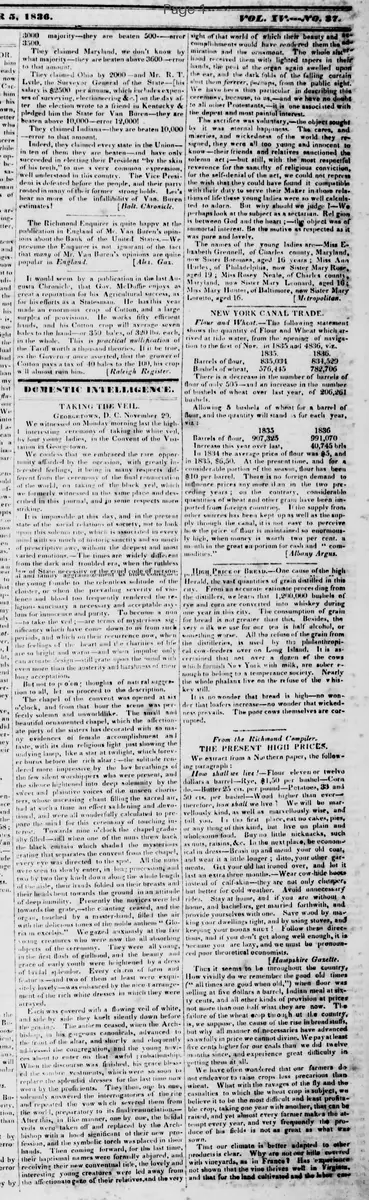
TAKING THE VEIL.
Georgetown, D. C. November 29.
We witnessed on Monday morning last the highly interesting ceremony of taking the white veil by four young ladies, in the Convent of the Visitation in Georgetown. We confess that we embraced the rare opportunity afforded by the occasion, with greatly interested feelings, it being in many respects different from the ceremony of the final renunciation of the world, on taking of the black veil, which we formerly witnessed in the same place and described in this journal, and in some respects more striking.
It is impossible at this day, and in the present state of the social relations of society, not to look upon this solemn rite, which is associated in every mind with so much of historic sanctity and so much of prescriptive awe, without the deepest and most varied emotions.--The times are widely different from the dark and troubled era, when the ruthless law of State necessity, or savage codes, etc., turns almost mimic adjustment the young female to the relentless solitude of the cloister, or when the prevailing severity of violence and blood too frequently rendered the religious sanctuary a necessary and acceptable asylum for innocence and purity. -- To become a nun -to take the veil;--are terms of mysterious significance which have come down to us from such periods, and which on their recurrence now, when the feelings of the heart and the charities of life are so bright and warm --and when impulse only can actuate design --still grate upon the mind with even more than the austerity and harshness of their long acceptation.
But not to dwell on thoughts of natural suggestion to all, let us proceed to the description.
The chapel of the convent was opened at six o'clock, and from that hour the scene was perfectly solemn and unworldlike. The small and beautiful ornamented chapel, which the affectionate piety of the sisters has decorated with so many evidences of female accomplishment and taste, with its dim religious light just showing the undying lamp, like a star at twilight, which forever burns before the rich altar :-the solitude rendered more impressive by the low breathings of the few silent worshippers who were present, and the silence heightened into deep solemnity by the sweet and plaintive voices of the unseen choristers, whose unceasing chant filling the sacred air, had at such a time an effect saddening and devotional, and were all wonderfully calculated to prepare the mind for this ceremony of touching interest.
Towards nine o'clock the chapel gradually filled--and when one of the nuns threw back the black curtain which shaded the mysterious grating that separates the convent from the chapel, every eye was directed to the spot. All the nuns were seen to slowly enter, in long procession, and two by two they knelt down along the whole length of the aisle, their hands folded on their breasts and their heads bent towards the ground in an attitude of deep humility.
Presently the novices were led towards the grate,--the chanting ceased, and the organ, touched by a master-hand, filled the air with the delicious tones of the noble anthem "Gloria in excelsis." We gazed anxiously at the four young creatures who were now the all absorbing objects of the ceremony. They were all young, in the first flush of girlhood, and the beauty and grace of early youth were heightened by a dress of bridal splendor. Every charm of form and features--and two of them at least were exquisitely lovely--was enhanced by the nice arrangement of the rich white dresses in which they were arrayed. Each was covered with a flowing veil of white, and side by side they knelt silently down before the grating.
The anthem ceased, when the Archbishop, in his gorgeous canonicals, advanced to the front of the altar, and shortly and eloquently addressed the congregation, and the young novices about to enter on that awful relationship. When the discourse was finished, his grace blessed the sombre vestments, which were so soon to replace the splendid dresses for the last time now worn by the proficients.
They then, one by one, solemnly answered the interrogatories of the rite and repeated the vow which severed them from the world, preparatory to its final renunciation. After this, in like manner, one by one, the bridal veils were taken off and replaced by the Archbishop with a hood significant of their new profession, and the symbolic torch was placed in their hands. Then coming forward, for the last time, their baptismal names were formally abjured, and receiving their new conventual title, the lovely and affectionate gaze of their relatives, and the very interesting young creatures were led away from sight of that world of which their beauty and accomplishments would have rendered them the admiration and the ornament.
The whole sisterhood received them with lighted tapers in their hands, the peal of the organ again swelled upon the ear, and the dark folds of the falling curtain shut them forever, perhaps, from the public sight.
We have been thus particular in describing this ceremony, because, to us,--and we have no doubt to all other Protestants,--it is one associated with the deepest and most painful interest. The sacrifice was voluntary, the object sought by it was eternal happiness. The cares, and miseries, and wickedness of the world they renounced, they were all too young and innocent to know--their friends and relatives countenanced the solemn act ;--but still, with the most respectful reverence for the sanctity of religious conviction, for the self-denial of the act, we could not repress the wish that they could have found it compatible with their duty to serve their Maker in those relations of life these young ladies were so well calculated to adorn. But why should we judge ?--We perhaps look at the subject as a sectarian. Religion is between God and the heart ;--the object was of immortal interest. Be the motive as respected as it was pure and lovely.
The names of the young ladies are--Miss Elizabeth Grennell, of Charles county, Maryland, now Sister Borromea, aged 16 years ; Miss Ann Horley, of Philadelphia, now Sister Mary Rose aged 19 : Miss Rosey Neale, of Charles county, Maryland, now Sister Mary Leonard, aged 16: Miss Mary Hunter, of Baltimore, now Sister Mary Lorolto, aged 16. [Metropolitan.
Georgetown, D. C. November 29.
We witnessed on Monday morning last the highly interesting ceremony of taking the white veil by four young ladies, in the Convent of the Visitation in Georgetown. We confess that we embraced the rare opportunity afforded by the occasion, with greatly interested feelings, it being in many respects different from the ceremony of the final renunciation of the world, on taking of the black veil, which we formerly witnessed in the same place and described in this journal, and in some respects more striking.
It is impossible at this day, and in the present state of the social relations of society, not to look upon this solemn rite, which is associated in every mind with so much of historic sanctity and so much of prescriptive awe, without the deepest and most varied emotions.--The times are widely different from the dark and troubled era, when the ruthless law of State necessity, or savage codes, etc., turns almost mimic adjustment the young female to the relentless solitude of the cloister, or when the prevailing severity of violence and blood too frequently rendered the religious sanctuary a necessary and acceptable asylum for innocence and purity. -- To become a nun -to take the veil;--are terms of mysterious significance which have come down to us from such periods, and which on their recurrence now, when the feelings of the heart and the charities of life are so bright and warm --and when impulse only can actuate design --still grate upon the mind with even more than the austerity and harshness of their long acceptation.
But not to dwell on thoughts of natural suggestion to all, let us proceed to the description.
The chapel of the convent was opened at six o'clock, and from that hour the scene was perfectly solemn and unworldlike. The small and beautiful ornamented chapel, which the affectionate piety of the sisters has decorated with so many evidences of female accomplishment and taste, with its dim religious light just showing the undying lamp, like a star at twilight, which forever burns before the rich altar :-the solitude rendered more impressive by the low breathings of the few silent worshippers who were present, and the silence heightened into deep solemnity by the sweet and plaintive voices of the unseen choristers, whose unceasing chant filling the sacred air, had at such a time an effect saddening and devotional, and were all wonderfully calculated to prepare the mind for this ceremony of touching interest.
Towards nine o'clock the chapel gradually filled--and when one of the nuns threw back the black curtain which shaded the mysterious grating that separates the convent from the chapel, every eye was directed to the spot. All the nuns were seen to slowly enter, in long procession, and two by two they knelt down along the whole length of the aisle, their hands folded on their breasts and their heads bent towards the ground in an attitude of deep humility.
Presently the novices were led towards the grate,--the chanting ceased, and the organ, touched by a master-hand, filled the air with the delicious tones of the noble anthem "Gloria in excelsis." We gazed anxiously at the four young creatures who were now the all absorbing objects of the ceremony. They were all young, in the first flush of girlhood, and the beauty and grace of early youth were heightened by a dress of bridal splendor. Every charm of form and features--and two of them at least were exquisitely lovely--was enhanced by the nice arrangement of the rich white dresses in which they were arrayed. Each was covered with a flowing veil of white, and side by side they knelt silently down before the grating.
The anthem ceased, when the Archbishop, in his gorgeous canonicals, advanced to the front of the altar, and shortly and eloquently addressed the congregation, and the young novices about to enter on that awful relationship. When the discourse was finished, his grace blessed the sombre vestments, which were so soon to replace the splendid dresses for the last time now worn by the proficients.
They then, one by one, solemnly answered the interrogatories of the rite and repeated the vow which severed them from the world, preparatory to its final renunciation. After this, in like manner, one by one, the bridal veils were taken off and replaced by the Archbishop with a hood significant of their new profession, and the symbolic torch was placed in their hands. Then coming forward, for the last time, their baptismal names were formally abjured, and receiving their new conventual title, the lovely and affectionate gaze of their relatives, and the very interesting young creatures were led away from sight of that world of which their beauty and accomplishments would have rendered them the admiration and the ornament.
The whole sisterhood received them with lighted tapers in their hands, the peal of the organ again swelled upon the ear, and the dark folds of the falling curtain shut them forever, perhaps, from the public sight.
We have been thus particular in describing this ceremony, because, to us,--and we have no doubt to all other Protestants,--it is one associated with the deepest and most painful interest. The sacrifice was voluntary, the object sought by it was eternal happiness. The cares, and miseries, and wickedness of the world they renounced, they were all too young and innocent to know--their friends and relatives countenanced the solemn act ;--but still, with the most respectful reverence for the sanctity of religious conviction, for the self-denial of the act, we could not repress the wish that they could have found it compatible with their duty to serve their Maker in those relations of life these young ladies were so well calculated to adorn. But why should we judge ?--We perhaps look at the subject as a sectarian. Religion is between God and the heart ;--the object was of immortal interest. Be the motive as respected as it was pure and lovely.
The names of the young ladies are--Miss Elizabeth Grennell, of Charles county, Maryland, now Sister Borromea, aged 16 years ; Miss Ann Horley, of Philadelphia, now Sister Mary Rose aged 19 : Miss Rosey Neale, of Charles county, Maryland, now Sister Mary Leonard, aged 16: Miss Mary Hunter, of Baltimore, now Sister Mary Lorolto, aged 16. [Metropolitan.
What sub-type of article is it?
Curiosity
Historical Event
Biography
What themes does it cover?
Moral Virtue
Providence Divine
Fortune Reversal
What keywords are associated?
Taking The Veil
Convent Ceremony
White Veil
Georgetown Convent
Religious Vows
Novices
Archbishop
What entities or persons were involved?
Miss Elizabeth Grennell
Sister Borromea
Miss Ann Horley
Sister Mary Rose
Miss Rosey Neale
Sister Mary Leonard
Miss Mary Hunter
Sister Mary Lorolto
Archbishop
Where did it happen?
Convent Of The Visitation In Georgetown, D.C.
Story Details
Key Persons
Miss Elizabeth Grennell
Sister Borromea
Miss Ann Horley
Sister Mary Rose
Miss Rosey Neale
Sister Mary Leonard
Miss Mary Hunter
Sister Mary Lorolto
Archbishop
Location
Convent Of The Visitation In Georgetown, D.C.
Event Date
Monday Morning Last, Prior To November 29
Story Details
Four young women, dressed in bridal white, took vows in a solemn ceremony, renouncing worldly names and lives to become novices, led by the Archbishop, entering the convent amid chants and processions.