Thank you for visiting SNEWPapers!
Sign up free
Commercial
October 12, 1832
Richmond Enquirer
Richmond, Richmond County, Virginia
What is this article about?
New York newspapers report a significant sale of 2,960 shares of U.S. Bank stock at advancing prices (118 to 119.5), rumored as a political stratagem by Nicholas Biddle and associates to sway elections against Jackson, amid speculation and denials.
Clipping
OCR Quality
95%
Excellent
Full Text
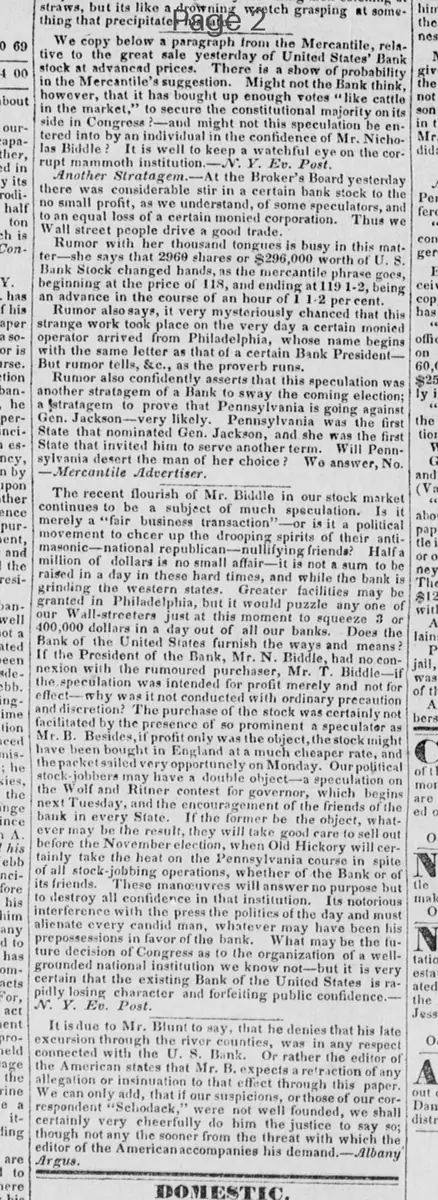
We copy below a paragraph from the Mercantile, relative to the great sale yesterday of United States' Bank stock at advanced prices. There is a show of probability in the Mercantile's suggestion. Might not the Bank think, however, that it has bought up enough votes "like cattle in the market," to secure the constitutional majority on its side in Congress?—and might not this speculation be entered into by an individual in the confidence of Mr. Nicholas Biddle? It is well to keep a watchful eye on the corrupt mammoth institution.—N. Y. Ev. Post.
Another Stratagem.—At the Broker's Board yesterday there was considerable stir in a certain bank stock to the no small profit, as we understand, of some speculators, and to an equal loss of a certain monied corporation. Thus we Wall street people drive a good trade.
Rumor with her thousand tongues is busy in this matter—she says that 2960 shares or $296,000 worth of U. S. Bank Stock changed hands, as the mercantile phrase goes, beginning at the price of 118, and ending at 119 1-2, being an advance in the course of an hour of 1 1/2 per cent.
Rumor also says, it very mysteriously chanced that this strange work took place on the very day a certain monied operator arrived from Philadelphia, whose name begins with the same letter as that of a certain Bank President—But rumor tells, &c., as the proverb runs.
Rumor also confidently asserts that this speculation was another stratagem of a Bank to sway the coming election; a stratagem to prove that Pennsylvania is going against Gen. Jackson—very likely. Pennsylvania was the first State that nominated Gen. Jackson, and she was the first State that invited him to serve another term. Will Pennsylvania desert the man of her choice? We answer, No. —Mercantile Advertiser.
The recent flourish of Mr. Biddle in our stock market continues to be a subject of much speculation. Is it merely a "fair business transaction"—or is it a political movement to cheer up the drooping spirits of their anti-masonic-national republican-nullifying friends? Half a million of dollars is no small affair—it is not a sum to be raised in a day in these hard times, and while the bank is grinding the western states. Greater facilities may be granted in Philadelphia, but it would puzzle any one of our Wall-streetors just at this moment to squeeze 3 or 400,000 dollars in a day out of all our banks. Does the Bank of the United States furnish the ways and means? If the President of the Bank, Mr. N. Biddle, had no connexion with the rumoured purchaser, Mr. T. Biddle—if the speculation was intended for profit merely and not for effect—why was it not conducted with ordinary precaution and discretion? The purchase of the stock was certainly not facilitated by the presence of so prominent a speculator as Mr. B. Besides, if profit only was the object, the stock might have been bought in England at a much cheaper rate, and the packet sailed very opportunely on Monday. Our political stock-jobbers may have a double object—a speculation on the Wolf and Ritner contest for governor, which begins next Tuesday, and the encouragement of the friends of the bank in every State. If the former be the object, whatever may be the result, they will take good care to sell out before the November election, when Old Hickory will certainly take the heat on the Pennsylvania course in spite of all stock-jobbing operations, whether of the Bank or of its friends. These manoeuvres will answer no purpose but to destroy all confidence in that institution. Its notorious interference with the press the politics of the day and must alienate every candid man, whatever may have been his prepossessions in favor of the bank. What may be the future decision of Congress as to the organization of a well-grounded national institution we know not—but it is very certain that the existing Bank of the United States is rapidly losing character and forfeiting public confidence.— N.Y. Ev. Post.
It is due to Mr. Blunt to say, that he denies that his late excursion through the river counties, was in any respect connected with the U. S. Bank. Or rather the editor of the American states that Mr. B. expects a retraction of any allegation or insinuation to that effect through this paper. We can only add, that if our suspicions, or those of our correspondent "Schodack," were not well founded, we shall certainly very cheerfully do him the justice to say so; though not any the sooner from the threat with which the editor of the American accompanies his demand.—Albany Argus.
Another Stratagem.—At the Broker's Board yesterday there was considerable stir in a certain bank stock to the no small profit, as we understand, of some speculators, and to an equal loss of a certain monied corporation. Thus we Wall street people drive a good trade.
Rumor with her thousand tongues is busy in this matter—she says that 2960 shares or $296,000 worth of U. S. Bank Stock changed hands, as the mercantile phrase goes, beginning at the price of 118, and ending at 119 1-2, being an advance in the course of an hour of 1 1/2 per cent.
Rumor also says, it very mysteriously chanced that this strange work took place on the very day a certain monied operator arrived from Philadelphia, whose name begins with the same letter as that of a certain Bank President—But rumor tells, &c., as the proverb runs.
Rumor also confidently asserts that this speculation was another stratagem of a Bank to sway the coming election; a stratagem to prove that Pennsylvania is going against Gen. Jackson—very likely. Pennsylvania was the first State that nominated Gen. Jackson, and she was the first State that invited him to serve another term. Will Pennsylvania desert the man of her choice? We answer, No. —Mercantile Advertiser.
The recent flourish of Mr. Biddle in our stock market continues to be a subject of much speculation. Is it merely a "fair business transaction"—or is it a political movement to cheer up the drooping spirits of their anti-masonic-national republican-nullifying friends? Half a million of dollars is no small affair—it is not a sum to be raised in a day in these hard times, and while the bank is grinding the western states. Greater facilities may be granted in Philadelphia, but it would puzzle any one of our Wall-streetors just at this moment to squeeze 3 or 400,000 dollars in a day out of all our banks. Does the Bank of the United States furnish the ways and means? If the President of the Bank, Mr. N. Biddle, had no connexion with the rumoured purchaser, Mr. T. Biddle—if the speculation was intended for profit merely and not for effect—why was it not conducted with ordinary precaution and discretion? The purchase of the stock was certainly not facilitated by the presence of so prominent a speculator as Mr. B. Besides, if profit only was the object, the stock might have been bought in England at a much cheaper rate, and the packet sailed very opportunely on Monday. Our political stock-jobbers may have a double object—a speculation on the Wolf and Ritner contest for governor, which begins next Tuesday, and the encouragement of the friends of the bank in every State. If the former be the object, whatever may be the result, they will take good care to sell out before the November election, when Old Hickory will certainly take the heat on the Pennsylvania course in spite of all stock-jobbing operations, whether of the Bank or of its friends. These manoeuvres will answer no purpose but to destroy all confidence in that institution. Its notorious interference with the press the politics of the day and must alienate every candid man, whatever may have been his prepossessions in favor of the bank. What may be the future decision of Congress as to the organization of a well-grounded national institution we know not—but it is very certain that the existing Bank of the United States is rapidly losing character and forfeiting public confidence.— N.Y. Ev. Post.
It is due to Mr. Blunt to say, that he denies that his late excursion through the river counties, was in any respect connected with the U. S. Bank. Or rather the editor of the American states that Mr. B. expects a retraction of any allegation or insinuation to that effect through this paper. We can only add, that if our suspicions, or those of our correspondent "Schodack," were not well founded, we shall certainly very cheerfully do him the justice to say so; though not any the sooner from the threat with which the editor of the American accompanies his demand.—Albany Argus.
What sub-type of article is it?
Stock Market
Banking
Policy
What keywords are associated?
Bank Stock Sale
Speculation
Political Maneuver
Biddle
Wall Street
U.S. Bank
What entities or persons were involved?
Nicholas Biddle
T. Biddle
Mr. Blunt
Where did it happen?
New York
Commercial Details
Location
New York
Event Date
Yesterday
Commodities
U.S. Bank Stock
Key Figures
Nicholas Biddle
T. Biddle
Mr. Blunt
Notable Details
- 2960 shares or $296,000 worth sold
- prices from 118 to 119 1/2
- advance of 1 1/2 per cent
- rumored political stratagem to influence election