Thank you for visiting SNEWPapers!
Sign up free
Story
February 8, 1816
Richmond Enquirer
Richmond, Richmond County, Virginia
What is this article about?
Conclusion of Mr. Pinkney's speech in Congress arguing that the President's treaty-making power, with Senate concurrence, is checked by public opinion, constitutional safeguards, and is essential without congressional interference, using examples like peace treaties and pardons to illustrate its supremacy over laws.
Clipping
OCR Quality
97%
Excellent
Full Text
CONGRESS.
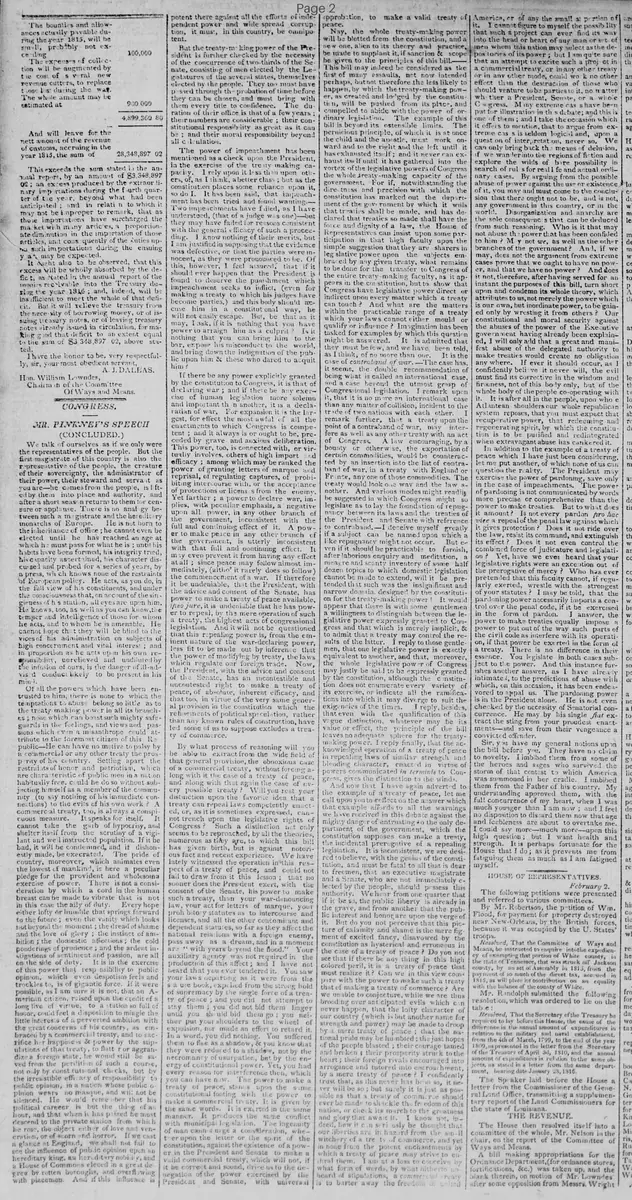
MR. PINKNEY'S SPEECH
(CONCLUDED.)
We talk of ourselves as if we only were the representatives of the people. But the first magistrate of this country is also the representative of the people, the creature of their sovereignty, the administrator of their power, their steward and servant as you are—he comes from the people, is lifted by them into place and authority, and after a short season returns to them for censure or applause. There is no analogy between such a magistrate and the hereditary monarchs of Europe. He is not born to the inheritance of office; he cannot even be elected until he has reached an age at which he must pass for what he is; until his habits have been formed, his integrity tried, his capacity ascertained, his character discerned and probed for a series of years, by a press, which knows none of the restraints of European policy. He acts, as you do, in the full view of his constituents, and under the consciousness that, on account of the singleness of his station, all eyes are upon him. He knows, too, as well as you can know, the temper and intelligence of those for whom he acts, and to whom he is amenable. He cannot hope that they will be blind to the vices of his administration on subjects of high concernment and vital interest; and in proportion as he acts upon his own responsibility, unrelieved and undiluted by the infusion of ours, is the danger of ill-advised conduct likely to be present in his mind.
Of all the powers which have been entrusted to him, there is none to which the temptations to abuse belong so little as to the treaty-making power in all its branches; none which can boast such mighty safe-guards in the feelings, and views and passions which even a misanthrope could attribute to the foremost citizen of this Republic—He can have no motive to palsy by a commercial or any other treaty the prosperity of his country. Setting apart the restraints of honor and patriotism, which are characteristic of public men in a nation habitually free, could he do so without subjecting himself as a member of the community (to say nothing of his immediate connections) to the evils of his own work? A commercial treaty, too, is always a conspicuous measure. It speaks for itself. It cannot take the garb of hypocrisy, and shelter itself from the scrutiny of a vigilant and well instructed population. If it be bad, it will be condemned, and if dishonestly made, be execrated. The pride of country, moreover, which animates even the lowest of mankind, is here a peculiar pledge for the provident and wholesome exercise of power. There is not a consideration by which a chord in the human breast can be made to vibrate that is not in this case the ally of duty. Every hope either lofty or humble that springs forward to the future; even the vanity which looks not beyond the moment; the dread of shame and the love of glory; the instinct of ambition; the domestic affections; the cold ponderings of prudence; and the ardent instigations of sentiment and passion, are all on the side of duty. It is in the exercise of this power that responsibility to public opinion, which even despotism feels and truckles to, is of gigantic force. If it were possible, as I am sure it is not, that an American citizen, risen upon the credit of a long life of virtue, to a station so full of honor, could feel a disposition to mingle the little interests of a perverted ambition with the great concerns of his country, as embraced by a Commercial treaty, and to sacrifice his happiness & power by the stipulations of that treaty, to flatter or aggrandize a foreign state, he would still be saved from the perdition of such a course, not only by constitutional checks, but by the irresistible efficacy of responsibility to public opinion, in a nation whose public opinion wears no masque, and will not be silenced. He would remember that his political career is but the thing of an hour, and that when it has passed he must descend to the private station from which he rose, the abject object of love and veneration, or of scorn and horror. If we cast a glance at England, we shall not fail to see the influence of public opinion upon an hereditary king, an hereditary nobility, and a House of Commons elected in a great degree by rotten boroughs, and overflowing with placemen. And if this influence is potent there against all the efforts of independent power and wide spread corruption, it must, in this country, be Omnipotent.
But the treaty-making power of the President is further checked by the necessity of the concurrence of two-thirds of the Senate, consisting of men elected by the Legislatures of the several states, themselves elected by the people. They too must have passed through the probation of time before they can be chosen, and must bring with them every title to confidence. The duration of their office is that of a few years; their numbers are considerable: their constitutional responsibility as great as it can be; and their moral responsibility beyond all calculation.
The power of impeachment has been mentioned as a check upon the President, in the exercise of the treaty making capacity. I rely upon it less than upon others, of, as I think, a better class; but as the constitution places some reliance upon it, so do I. It has been said, that impeachment has been tried and found wanting—Two impeachments have failed, as I have understood. (that of a judge was one)—but they may have failed for reasons consistent with the general efficacy of such a proceeding. I know nothing of their merits, but I am justified in supposing that the evidence was defective, or that the parties were innocent, as they were pronounced to be. Of this, however, I feel assured, that if it should ever happen that the President is found to deserve the punishment which impeachment seeks to inflict, (even for making a treaty to which his judges have become parties,) and this body should accuse him in a constitutional way, he will not easily escape. But, be that as it may, I ask, if it is nothing that you have power to arraign him as a culprit? Is it nothing that you can bring him to the bar, expose his misconduct to the world, and bring down the indignation of the public upon him & those who dared to acquit him?
If there be any power explicitly granted by the Constitution to Congress, it is that of declaring war; and if there be any exercise of human legislation more solemn and important than another, it is a declaration of war. For expansion it is the largest, for effect the most awful of all the enactments to which Congress is competent; and it always is or ought to be, preceded by grave and anxious deliberation. This power, too, is connected with, or virtually involves, others of high import and efficacy; among which may be ranked the power of granting letters of marque and reprisal, of regulating captures, of prohibiting intercourse with, or the acceptance of protections or licenses from the enemy. Yet farther; a power to declare war, implies, with peculiar emphasis, a negative upon all power, in any other branch of the government, inconsistent with the full and continuing effect of it. A power to make peace in any other branch of the government, is utterly inconsistent with that full and continuing effect. It may even prevent it from having any effect at all; since peace may follow almost immediately, (altho' it rarely does so follow) the commencement of a war. If therefore it be undeniable, that the President, with the advice and consent of the Senate, has power to make a treaty of peace available, ipso jure, it is undeniable that he has power to repeal, by the mere operation of such a treaty, the highest acts of congressional legislation. And it will not be questioned that this repealing power is, from the eminent nature of the war-declaring power, less fit to be made out by inference than the power of modifying by treaty, the laws which regulate our foreign trade. Now, the President, with the advice and consent of the Senate, has an incontestible and uncontested right to make a treaty of peace, of absolute, inherent efficacy, and that too, in virtue of the very same general provision in the constitution which the refinements of political speculation, rather than any known rules of construction, have led some of us to suppose excludes a treaty of commerce.
By what process of reasoning will you be able to extract from the wide field of that general provision, the obnoxious case of a commercial treaty, without forcing along with it the case of a treaty of peace, and along with that again the case of every possible treaty? Will you rest your distinction upon the favorite idea that a treaty can repeal laws competently enacted, or, as it is sometimes expressed, cannot trench upon the legislative rights of Congress? Such a distinction not only seems to be reproached, by all the theories, numerous as they are, to which this bill has given birth, but is against notorious fact and recent experience. We have lately witnessed the operation in this respect of a treaty of peace, and could not fail to draw from it this lesson; that no sooner does the President exert, with the consent of the Senate, his power to make such a treaty, than your war-denouncing law, your act for letters of marque, your prohibitory statutes as to intercourse and licenses, and all the other concomitant and dependent statutes, so far as they affect the national relations with a foreign enemy, pass away as a dream, and in a moment are 'with years beyond the flood.' Your auxiliary agency was not required in the production of this effect; and I have not heard that you ever tendered it. You saw your laws departing as it were from the statute book, expelled from the strong hold of supremacy by the single force of a treaty of peace; and you did not attempt to stay them; you did not bid them linger until you should bid them go; you neither put your shoulders to the wheel of expulsion, nor made an effort to retard it. In a word, you did nothing. You suffered them to flee as a shadow, & you know that they were reduced to a shadow, not by the necromancy of usurpation, but by the energy of constitutional power. Yet, you had every reason for interference then, which you can have now. The power to make a treaty of peace, stands upon the same constitutional footing with the power to make a commercial treaty. It is given by the same words. It is exerted in the same manner. It produces the same conflict with municipal legislation. The ingenuity of man cannot urge a consideration, whether upon the letter or the spirit of the constitution, against the existence of a power in the President and Senate to make a valid commercial treaty, which will not, if it be correct and sound, drive us to the delegation of the power exercised by the President and Senate, with universal approbation, to make a valid treaty of peace.
Nay, the whole treaty-making power will be blotted from the constitution, and a new one, alien to its theory and practice, be made to supplant it, if sanction & scope be given to the principles of this bill. This bill may indeed be considered as the first of many assaults, not now intended perhaps, but not therefore the less likely to happen, by which the treaty-making power, as created and lodged by the constitution, will be pushed from its place, and compelled to abide with the power of ordinary legislation. The example of this bill is beyond its ostensible limits. The pernicious principle, of which it is at once the child and the apostle, must work onward and to the right and the left until it has exhausted itself: and it never can exhaust itself until it has gathered into the vortex of the legislative powers of Congress the whole treaty-making capacity of the government. For if, notwithstanding the directness and precision with which the constitution has marked out the department of the government by which it wills that treaties shall be made, and has declared that treaties so made shall have the force and dignity of a law, the House of Representatives can insist upon some participation in that high faculty upon the simple suggestion that they are sharers in legislative power upon the subjects embraced by any given treaty, what remains to be done for the transfer to Congress of the entire treaty-making faculty, as it appears in the constitution, but to show that Congress have legislative power direct or indirect upon every matter which a treaty can touch? And what are the matters within the practicable range of a treaty which your laws cannot either mould or qualify or influence? Imagination has been tasked for examples by which this question might be answered. It is admitted that they must be few, and we have been told, as I think, of no more than one. It is the case of contraband of war. The case has, it seems, the double recommendation of being what is called an international case, and a case beyond the utmost grasp of Congressional legislation. I remark upon it, that it is no more an international case than any matter of collision, incident to the trade of two nations with each other. I remark further, that a treaty upon the point of a contraband of war, may interfere as well as any other treaty with an act of Congress. A law encouraging, by a bounty or otherwise, the exportation of certain commodities, would be counteracted by an insertion into the list of contraband of war, in a treaty with England or France, any one of those commodities. The treaty would look one way and the law another. And various modes might readily be suggested in which Congress might so legislate as to lay the foundation of repugnancy between its laws and the treaties of the President and Senate with reference to contraband. I deceive myself greatly if a subject can be named upon which a like repugnancy might not occur. But even if it should be practicable to furnish, after laborious enquiry and meditation, a meagre and scanty inventory of some half dozen topics to which domestic legislation cannot be made to extend, will it be pretended that such was the insignificant and narrow domain, designed by the constitution for the treaty-making power! It would appear that there is with some gentlemen a willingness to distinguish between the legislative power expressly granted to Congress and that which is merely implicit, & to admit that a treaty may control the results of the latter. I reply to those gentlemen, that one legislative power is exactly equivalent to another, and that, moreover, the whole legislative power of Congress may justly be said to be expressly granted by the constitution, although the constitution does not enumerate every variety of its exercise, or indicate all the ramifications into which it may diverge to suit the exigencies of the times. I reply, besides, that even with the qualification of this vague distinction, whatever may be its value or effect, the principle of the bill leaves no adequate sphere for the treaty-making power. I reply finally, that the acknowledged operation of a treaty of peace in repealing laws of similar strength and binding character, enacted in virtue of powers communicated in terminis to Congress, gives the distinction to the winds.
And now that I have again adverted to the example of a treaty of peace, let me call upon you to reflect on the answer which that example affords to all the warnings we have received in this debate against the mighty danger of entrusting to the only department of the government, which the constitution supposes can make a treaty, the incidental prerogative of a repealing legislation. It is inconsistent, we are desired to believe, with the genius of the constitution, and must be fatal to all that is dear to freemen, that an executive magistrate and a Senate, who are not immediately elected by the people, should possess this authority. We hear from one quarter that if it be so, the public liberty is already in the grave, and from another that the public interest and honor are upon the verge of it. But do you not perceive that this picture of calamity and shame is the mere figment of excited fancy, disavowed by the constitution as hysterical and erroneous in the case of a treaty of peace? Do you not see that if there be anything in this high colored peril, it is a treaty of peace that must realize it? Can we in this view compare with the power to make such a treaty that of making a treaty of commerce? Are we unable to conjecture, while we are thus brooding over anticipated evils which can never happen, that the lofty character of our country (which is but another name for strength and power) may be made to droop by a mere treaty of peace; that the national pride may be humbled; the just hopes of the people blasted; their courage tamed and broken; their prosperity struck to the heart; their foreign rivals encouraged into arrogance and tutored into encroachment, by a mere treaty of peace? I confidently trust that, as this never has been so, it never will be so; but surely it is just as possible as that a treaty of commerce should ever be made to shackle the freedom of this nation, or check its march to the greatness and glory that await it. I know not, indeed, how it can seriously be thought that our liberties are in hazard from the simple witchery of a treaty of commerce, and yet in none from the potent enchantments by which a treaty of peace may strive to enthral them. I am at a loss to conceive by what form of words, by what hitherto to heard of stipulations, a commercial treaty is to barter away the freedom of united America, or of any the smallest portion of it. I cannot figure to myself the possibility that such a project can ever find its way into the head or heart of any man or set of men whom this nation may select as the depositories of its power; but I am quite sure that an attempt to excite such a project in a commercial treaty, or in any other treaty or in any other mode, could work no other effect than the destruction of those who should venture to be parties to it, no matter whether a President, Senate, or a whole Congress. Many extreme cases have been put for illustration in this debate: and this is one of them: and I take the occasion which it offers to mention, that to argue from extreme cases is seldom logical and, upon a question of interpretation, never so. We can only bring back the means of delusion, if we wander into the regions of fiction and explore the wilds of bare possibility in search of rules for real life and actual ordinary cases. By arguing from the possible abuse of power against the use or existence of it, you may and must come to the conclusion that there ought not to be, and is not, any government in this country, or in the world. Disorganization and anarchy are the sole consequences that can be deduced from such reasoning. Who is it that may not abuse the power that has been confided to him? May not we, as well as the other branches of the government? And, if we may, does not the argument from extreme cases prove that we ought to have no power, and that we have no power? And does it not, therefore, after having served for an instant the purposes of this bill, turn short upon and condemn its whole theory, which attributes to us, not merely the power which is our own, but inordinate power, to be gained only by wresting it from others? Our constitutional and moral security against the abuses of the power of the Executive government having already been explained, I will only add that a great and manifest abuse of the delegated authority to make treaties would create no obligation anywhere. If ever it should occur, as I confidently believe it never will, the evil must find its corrective in the wisdom and firmness, not of this body only, but of the whole body of the people co-operating with it. It is after all in the people, upon whose Atlantean shoulders our whole republican system reposes, that you must expect that recuperative power, that redeeming and regenerating spirit, by which the constitution is to be purified and redintegrated when extravagant abuse has cankered it.
In addition to the example of a treaty of peace which I have just been considering, let me put another, of which none of us can question the reality. The President may exercise the power of pardoning, save only in the case of impeachments. The power of pardoning is not communicated by words more precise or comprehensive than the power to make treaties. But to what does it amount? Is not every pardon pro hac vice a repeal of the penal law against which it gives protection? Does it not ride over the law, resist its command, and extinguish its effect? Does it not even control the combined force of judicature and legislation? Yet, have we ever heard that your legislative rights were an exception out of the prerogative of mercy? Who has ever pretended that this faculty cannot, if regularly exerted, wrestle with the strongest of your statutes? I may be told, that the pardoning power necessarily imports a control over the penal code, if it be exercised in the form of pardon. I answer, the power to make treaties equally imposes a power to put out of the way such parts of the civil code as interfere with its operation, if that power be exerted in the form of a treaty. There is no difference in their essence. You legislate in both cases subject to the power. And this instance furnishes another answer, as I have already intimated, to the predictions of abuse with which, on this occasion, it has been endeavored to appal us. The pardoning power is in the President alone. He is not even checked by the necessity of Senatorial concurrence. He may by his single fiat extract the sting from your proudest enactments—and save from their vengeance a convicted offender.
Sir, you have my general notions upon the bill before you. They have no claim to novelty. I imbibed them from some of the heroes and sages who survived the storm of that contest to which America was summoned in her cradle. I imbibed them from the Father of his Country. My understanding approved them, with the full concurrence of my heart, when I was much younger than I am now; and I feel no disposition to discard them now that age and feebleness are about to overtake me. I could say more—much more—upon this high question; but I want health and strength. It is perhaps fortunate for the House that I do; as it prevents me from fatiguing them as much as I am fatigued myself.
MR. PINKNEY'S SPEECH
(CONCLUDED.)
We talk of ourselves as if we only were the representatives of the people. But the first magistrate of this country is also the representative of the people, the creature of their sovereignty, the administrator of their power, their steward and servant as you are—he comes from the people, is lifted by them into place and authority, and after a short season returns to them for censure or applause. There is no analogy between such a magistrate and the hereditary monarchs of Europe. He is not born to the inheritance of office; he cannot even be elected until he has reached an age at which he must pass for what he is; until his habits have been formed, his integrity tried, his capacity ascertained, his character discerned and probed for a series of years, by a press, which knows none of the restraints of European policy. He acts, as you do, in the full view of his constituents, and under the consciousness that, on account of the singleness of his station, all eyes are upon him. He knows, too, as well as you can know, the temper and intelligence of those for whom he acts, and to whom he is amenable. He cannot hope that they will be blind to the vices of his administration on subjects of high concernment and vital interest; and in proportion as he acts upon his own responsibility, unrelieved and undiluted by the infusion of ours, is the danger of ill-advised conduct likely to be present in his mind.
Of all the powers which have been entrusted to him, there is none to which the temptations to abuse belong so little as to the treaty-making power in all its branches; none which can boast such mighty safe-guards in the feelings, and views and passions which even a misanthrope could attribute to the foremost citizen of this Republic—He can have no motive to palsy by a commercial or any other treaty the prosperity of his country. Setting apart the restraints of honor and patriotism, which are characteristic of public men in a nation habitually free, could he do so without subjecting himself as a member of the community (to say nothing of his immediate connections) to the evils of his own work? A commercial treaty, too, is always a conspicuous measure. It speaks for itself. It cannot take the garb of hypocrisy, and shelter itself from the scrutiny of a vigilant and well instructed population. If it be bad, it will be condemned, and if dishonestly made, be execrated. The pride of country, moreover, which animates even the lowest of mankind, is here a peculiar pledge for the provident and wholesome exercise of power. There is not a consideration by which a chord in the human breast can be made to vibrate that is not in this case the ally of duty. Every hope either lofty or humble that springs forward to the future; even the vanity which looks not beyond the moment; the dread of shame and the love of glory; the instinct of ambition; the domestic affections; the cold ponderings of prudence; and the ardent instigations of sentiment and passion, are all on the side of duty. It is in the exercise of this power that responsibility to public opinion, which even despotism feels and truckles to, is of gigantic force. If it were possible, as I am sure it is not, that an American citizen, risen upon the credit of a long life of virtue, to a station so full of honor, could feel a disposition to mingle the little interests of a perverted ambition with the great concerns of his country, as embraced by a Commercial treaty, and to sacrifice his happiness & power by the stipulations of that treaty, to flatter or aggrandize a foreign state, he would still be saved from the perdition of such a course, not only by constitutional checks, but by the irresistible efficacy of responsibility to public opinion, in a nation whose public opinion wears no masque, and will not be silenced. He would remember that his political career is but the thing of an hour, and that when it has passed he must descend to the private station from which he rose, the abject object of love and veneration, or of scorn and horror. If we cast a glance at England, we shall not fail to see the influence of public opinion upon an hereditary king, an hereditary nobility, and a House of Commons elected in a great degree by rotten boroughs, and overflowing with placemen. And if this influence is potent there against all the efforts of independent power and wide spread corruption, it must, in this country, be Omnipotent.
But the treaty-making power of the President is further checked by the necessity of the concurrence of two-thirds of the Senate, consisting of men elected by the Legislatures of the several states, themselves elected by the people. They too must have passed through the probation of time before they can be chosen, and must bring with them every title to confidence. The duration of their office is that of a few years; their numbers are considerable: their constitutional responsibility as great as it can be; and their moral responsibility beyond all calculation.
The power of impeachment has been mentioned as a check upon the President, in the exercise of the treaty making capacity. I rely upon it less than upon others, of, as I think, a better class; but as the constitution places some reliance upon it, so do I. It has been said, that impeachment has been tried and found wanting—Two impeachments have failed, as I have understood. (that of a judge was one)—but they may have failed for reasons consistent with the general efficacy of such a proceeding. I know nothing of their merits, but I am justified in supposing that the evidence was defective, or that the parties were innocent, as they were pronounced to be. Of this, however, I feel assured, that if it should ever happen that the President is found to deserve the punishment which impeachment seeks to inflict, (even for making a treaty to which his judges have become parties,) and this body should accuse him in a constitutional way, he will not easily escape. But, be that as it may, I ask, if it is nothing that you have power to arraign him as a culprit? Is it nothing that you can bring him to the bar, expose his misconduct to the world, and bring down the indignation of the public upon him & those who dared to acquit him?
If there be any power explicitly granted by the Constitution to Congress, it is that of declaring war; and if there be any exercise of human legislation more solemn and important than another, it is a declaration of war. For expansion it is the largest, for effect the most awful of all the enactments to which Congress is competent; and it always is or ought to be, preceded by grave and anxious deliberation. This power, too, is connected with, or virtually involves, others of high import and efficacy; among which may be ranked the power of granting letters of marque and reprisal, of regulating captures, of prohibiting intercourse with, or the acceptance of protections or licenses from the enemy. Yet farther; a power to declare war, implies, with peculiar emphasis, a negative upon all power, in any other branch of the government, inconsistent with the full and continuing effect of it. A power to make peace in any other branch of the government, is utterly inconsistent with that full and continuing effect. It may even prevent it from having any effect at all; since peace may follow almost immediately, (altho' it rarely does so follow) the commencement of a war. If therefore it be undeniable, that the President, with the advice and consent of the Senate, has power to make a treaty of peace available, ipso jure, it is undeniable that he has power to repeal, by the mere operation of such a treaty, the highest acts of congressional legislation. And it will not be questioned that this repealing power is, from the eminent nature of the war-declaring power, less fit to be made out by inference than the power of modifying by treaty, the laws which regulate our foreign trade. Now, the President, with the advice and consent of the Senate, has an incontestible and uncontested right to make a treaty of peace, of absolute, inherent efficacy, and that too, in virtue of the very same general provision in the constitution which the refinements of political speculation, rather than any known rules of construction, have led some of us to suppose excludes a treaty of commerce.
By what process of reasoning will you be able to extract from the wide field of that general provision, the obnoxious case of a commercial treaty, without forcing along with it the case of a treaty of peace, and along with that again the case of every possible treaty? Will you rest your distinction upon the favorite idea that a treaty can repeal laws competently enacted, or, as it is sometimes expressed, cannot trench upon the legislative rights of Congress? Such a distinction not only seems to be reproached, by all the theories, numerous as they are, to which this bill has given birth, but is against notorious fact and recent experience. We have lately witnessed the operation in this respect of a treaty of peace, and could not fail to draw from it this lesson; that no sooner does the President exert, with the consent of the Senate, his power to make such a treaty, than your war-denouncing law, your act for letters of marque, your prohibitory statutes as to intercourse and licenses, and all the other concomitant and dependent statutes, so far as they affect the national relations with a foreign enemy, pass away as a dream, and in a moment are 'with years beyond the flood.' Your auxiliary agency was not required in the production of this effect; and I have not heard that you ever tendered it. You saw your laws departing as it were from the statute book, expelled from the strong hold of supremacy by the single force of a treaty of peace; and you did not attempt to stay them; you did not bid them linger until you should bid them go; you neither put your shoulders to the wheel of expulsion, nor made an effort to retard it. In a word, you did nothing. You suffered them to flee as a shadow, & you know that they were reduced to a shadow, not by the necromancy of usurpation, but by the energy of constitutional power. Yet, you had every reason for interference then, which you can have now. The power to make a treaty of peace, stands upon the same constitutional footing with the power to make a commercial treaty. It is given by the same words. It is exerted in the same manner. It produces the same conflict with municipal legislation. The ingenuity of man cannot urge a consideration, whether upon the letter or the spirit of the constitution, against the existence of a power in the President and Senate to make a valid commercial treaty, which will not, if it be correct and sound, drive us to the delegation of the power exercised by the President and Senate, with universal approbation, to make a valid treaty of peace.
Nay, the whole treaty-making power will be blotted from the constitution, and a new one, alien to its theory and practice, be made to supplant it, if sanction & scope be given to the principles of this bill. This bill may indeed be considered as the first of many assaults, not now intended perhaps, but not therefore the less likely to happen, by which the treaty-making power, as created and lodged by the constitution, will be pushed from its place, and compelled to abide with the power of ordinary legislation. The example of this bill is beyond its ostensible limits. The pernicious principle, of which it is at once the child and the apostle, must work onward and to the right and the left until it has exhausted itself: and it never can exhaust itself until it has gathered into the vortex of the legislative powers of Congress the whole treaty-making capacity of the government. For if, notwithstanding the directness and precision with which the constitution has marked out the department of the government by which it wills that treaties shall be made, and has declared that treaties so made shall have the force and dignity of a law, the House of Representatives can insist upon some participation in that high faculty upon the simple suggestion that they are sharers in legislative power upon the subjects embraced by any given treaty, what remains to be done for the transfer to Congress of the entire treaty-making faculty, as it appears in the constitution, but to show that Congress have legislative power direct or indirect upon every matter which a treaty can touch? And what are the matters within the practicable range of a treaty which your laws cannot either mould or qualify or influence? Imagination has been tasked for examples by which this question might be answered. It is admitted that they must be few, and we have been told, as I think, of no more than one. It is the case of contraband of war. The case has, it seems, the double recommendation of being what is called an international case, and a case beyond the utmost grasp of Congressional legislation. I remark upon it, that it is no more an international case than any matter of collision, incident to the trade of two nations with each other. I remark further, that a treaty upon the point of a contraband of war, may interfere as well as any other treaty with an act of Congress. A law encouraging, by a bounty or otherwise, the exportation of certain commodities, would be counteracted by an insertion into the list of contraband of war, in a treaty with England or France, any one of those commodities. The treaty would look one way and the law another. And various modes might readily be suggested in which Congress might so legislate as to lay the foundation of repugnancy between its laws and the treaties of the President and Senate with reference to contraband. I deceive myself greatly if a subject can be named upon which a like repugnancy might not occur. But even if it should be practicable to furnish, after laborious enquiry and meditation, a meagre and scanty inventory of some half dozen topics to which domestic legislation cannot be made to extend, will it be pretended that such was the insignificant and narrow domain, designed by the constitution for the treaty-making power! It would appear that there is with some gentlemen a willingness to distinguish between the legislative power expressly granted to Congress and that which is merely implicit, & to admit that a treaty may control the results of the latter. I reply to those gentlemen, that one legislative power is exactly equivalent to another, and that, moreover, the whole legislative power of Congress may justly be said to be expressly granted by the constitution, although the constitution does not enumerate every variety of its exercise, or indicate all the ramifications into which it may diverge to suit the exigencies of the times. I reply, besides, that even with the qualification of this vague distinction, whatever may be its value or effect, the principle of the bill leaves no adequate sphere for the treaty-making power. I reply finally, that the acknowledged operation of a treaty of peace in repealing laws of similar strength and binding character, enacted in virtue of powers communicated in terminis to Congress, gives the distinction to the winds.
And now that I have again adverted to the example of a treaty of peace, let me call upon you to reflect on the answer which that example affords to all the warnings we have received in this debate against the mighty danger of entrusting to the only department of the government, which the constitution supposes can make a treaty, the incidental prerogative of a repealing legislation. It is inconsistent, we are desired to believe, with the genius of the constitution, and must be fatal to all that is dear to freemen, that an executive magistrate and a Senate, who are not immediately elected by the people, should possess this authority. We hear from one quarter that if it be so, the public liberty is already in the grave, and from another that the public interest and honor are upon the verge of it. But do you not perceive that this picture of calamity and shame is the mere figment of excited fancy, disavowed by the constitution as hysterical and erroneous in the case of a treaty of peace? Do you not see that if there be anything in this high colored peril, it is a treaty of peace that must realize it? Can we in this view compare with the power to make such a treaty that of making a treaty of commerce? Are we unable to conjecture, while we are thus brooding over anticipated evils which can never happen, that the lofty character of our country (which is but another name for strength and power) may be made to droop by a mere treaty of peace; that the national pride may be humbled; the just hopes of the people blasted; their courage tamed and broken; their prosperity struck to the heart; their foreign rivals encouraged into arrogance and tutored into encroachment, by a mere treaty of peace? I confidently trust that, as this never has been so, it never will be so; but surely it is just as possible as that a treaty of commerce should ever be made to shackle the freedom of this nation, or check its march to the greatness and glory that await it. I know not, indeed, how it can seriously be thought that our liberties are in hazard from the simple witchery of a treaty of commerce, and yet in none from the potent enchantments by which a treaty of peace may strive to enthral them. I am at a loss to conceive by what form of words, by what hitherto to heard of stipulations, a commercial treaty is to barter away the freedom of united America, or of any the smallest portion of it. I cannot figure to myself the possibility that such a project can ever find its way into the head or heart of any man or set of men whom this nation may select as the depositories of its power; but I am quite sure that an attempt to excite such a project in a commercial treaty, or in any other treaty or in any other mode, could work no other effect than the destruction of those who should venture to be parties to it, no matter whether a President, Senate, or a whole Congress. Many extreme cases have been put for illustration in this debate: and this is one of them: and I take the occasion which it offers to mention, that to argue from extreme cases is seldom logical and, upon a question of interpretation, never so. We can only bring back the means of delusion, if we wander into the regions of fiction and explore the wilds of bare possibility in search of rules for real life and actual ordinary cases. By arguing from the possible abuse of power against the use or existence of it, you may and must come to the conclusion that there ought not to be, and is not, any government in this country, or in the world. Disorganization and anarchy are the sole consequences that can be deduced from such reasoning. Who is it that may not abuse the power that has been confided to him? May not we, as well as the other branches of the government? And, if we may, does not the argument from extreme cases prove that we ought to have no power, and that we have no power? And does it not, therefore, after having served for an instant the purposes of this bill, turn short upon and condemn its whole theory, which attributes to us, not merely the power which is our own, but inordinate power, to be gained only by wresting it from others? Our constitutional and moral security against the abuses of the power of the Executive government having already been explained, I will only add that a great and manifest abuse of the delegated authority to make treaties would create no obligation anywhere. If ever it should occur, as I confidently believe it never will, the evil must find its corrective in the wisdom and firmness, not of this body only, but of the whole body of the people co-operating with it. It is after all in the people, upon whose Atlantean shoulders our whole republican system reposes, that you must expect that recuperative power, that redeeming and regenerating spirit, by which the constitution is to be purified and redintegrated when extravagant abuse has cankered it.
In addition to the example of a treaty of peace which I have just been considering, let me put another, of which none of us can question the reality. The President may exercise the power of pardoning, save only in the case of impeachments. The power of pardoning is not communicated by words more precise or comprehensive than the power to make treaties. But to what does it amount? Is not every pardon pro hac vice a repeal of the penal law against which it gives protection? Does it not ride over the law, resist its command, and extinguish its effect? Does it not even control the combined force of judicature and legislation? Yet, have we ever heard that your legislative rights were an exception out of the prerogative of mercy? Who has ever pretended that this faculty cannot, if regularly exerted, wrestle with the strongest of your statutes? I may be told, that the pardoning power necessarily imports a control over the penal code, if it be exercised in the form of pardon. I answer, the power to make treaties equally imposes a power to put out of the way such parts of the civil code as interfere with its operation, if that power be exerted in the form of a treaty. There is no difference in their essence. You legislate in both cases subject to the power. And this instance furnishes another answer, as I have already intimated, to the predictions of abuse with which, on this occasion, it has been endeavored to appal us. The pardoning power is in the President alone. He is not even checked by the necessity of Senatorial concurrence. He may by his single fiat extract the sting from your proudest enactments—and save from their vengeance a convicted offender.
Sir, you have my general notions upon the bill before you. They have no claim to novelty. I imbibed them from some of the heroes and sages who survived the storm of that contest to which America was summoned in her cradle. I imbibed them from the Father of his Country. My understanding approved them, with the full concurrence of my heart, when I was much younger than I am now; and I feel no disposition to discard them now that age and feebleness are about to overtake me. I could say more—much more—upon this high question; but I want health and strength. It is perhaps fortunate for the House that I do; as it prevents me from fatiguing them as much as I am fatigued myself.
What sub-type of article is it?
Historical Event
Biography
What themes does it cover?
Justice
Moral Virtue
What keywords are associated?
Treaty Making Power
Constitution
President
Senate
Public Opinion
Congress
Peace Treaty
Impeachment
Pardoning Power
What entities or persons were involved?
Mr. Pinkney
President
Father Of His Country
Where did it happen?
Congress
Story Details
Key Persons
Mr. Pinkney
President
Father Of His Country
Location
Congress
Story Details
Mr. Pinkney concludes his speech defending the constitutional treaty-making power of the President and Senate, arguing it is safeguarded by public opinion, impeachment, and Senate concurrence, superior to congressional laws as shown by peace treaties and pardons, against a bill seeking House involvement.