Thank you for visiting SNEWPapers!
Sign up free
The New Hampshire Gazette And Historical Chronicle
Portsmouth, Greenland, Rockingham County, New Hampshire
What is this article about?
John Hughes of Philadelphia publicly denies the authenticity of letters published against him, accusing him of supporting the Stamp Act, and announces a lawsuit against the printers. A response criticizes Hughes for attacking press freedom and highlights his pro-Stamp Act sentiments.
Clipping
OCR Quality
Full Text
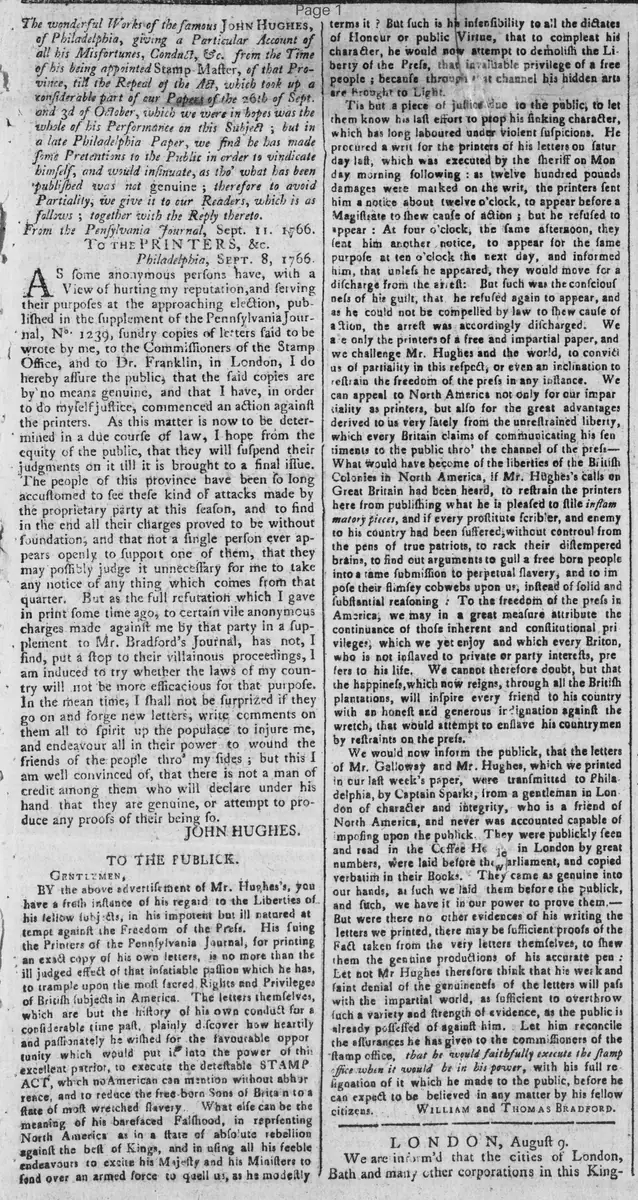
From the Pennsylvania Journal, Sept. 11. 1766.
TO THE PRINTERS. &C.
Philadelphia, Sept. 8, 1766.
Some anonymous persons have, with a View of hurting my reputation, and serving their purposes at the approaching election, published in the Supplement of the Pennsylvania Journal, No. 1239, sundry copies of letters said to be wrote by me, to the Commissioners of the Stamp Office. and to Dr. Franklin. in London. I do hereby assure the public. that the said copies are by no means genuine, and that I have, in order to do myself justice, commenced an action against the printers. As this matter is now to be determined in a due course of law. I hope from the equity of the public, that they will suspend their judgments on it till it is brought to a final issue.
The people of this province have been so long accustomed to see these kind of attacks made by the proprietary party at this season, and to find in the end all their charges proved to be without foundation; and that not a single person ever appears openly to support one of them, that they may possibly judge it unnecessary for me to take any notice of any thing which comes from that quarter. But as the full refutation which I gave in print some time ago, to certain vile anonymous charges made against me by that party in a supplement to Mr. Bradford's Journal, has not, I find, put a stop to their villainous proceedings, I am induced to try whether the laws of my country will not be more efficacious for that purpose.
In the mean time; I shall not be surprised if they go on and forge new letters; write comments on them all to spirit up the populace to injure me, and endeavour all in their power to wound the friends of the people thro' my sides ; but this I am well convinced of, that there is not a man of credit among them who will declare under his hand that they are genuine, or attempt to produce any proofs of their being so.
JOHN HUGHES.
TO THE PUBLICK.
GENTLEMEN,
BY the above advertisement of Mr. Hughes's, you have a fresh instance of his regard to the Liberties of his fellow subjects, in his impotent but ill natured attempt against the Freedom of the Press. His suing the Printers of the Pennsylvania Journal, for printing an exact copy of his own letters, is no more than the ill judged effect of that insatiable passion which he has, to trample upon the most sacred Rights and Privileges of British subjects in America. The letters themselves, which are but the history of his own conduct for a considerable time past. plainly discover how heartily and passionately he wished for the favourable opportunity which would put it into the power of this excellent patriot, to execute the detestable STAMP ACT. which no American can mention without abhorrence, and to reduce the free-born Sons of Britain to a State of most wretched slavery.. What else can be the meaning of his barefaced Falsehood, in representing North America as in a state of absolute rebellion against the best of Kings, and in using all his feeble endeavours to excite his Majesty and his Ministers to send over an armed force to quell us, as he modestly terms it ? But such is his insensibility to all the dictates
What sub-type of article is it?
What themes does it cover?
What keywords are associated?
What entities or persons were involved?
Where did it happen?
Story Details
Key Persons
Location
Philadelphia
Event Date
1766 09 08
Story Details
John Hughes denies published letters as forgeries aimed at damaging his reputation before an election and sues the printers. He accuses the proprietary party of anonymous attacks. A public reply condemns Hughes for suppressing press freedom and reaffirms the letters show his support for the Stamp Act and calls for military suppression of rebellion.