Thank you for visiting SNEWPapers!
Sign up free
The Kentucky Gazette
Lexington, Fayette County, Kentucky
What is this article about?
In a U.S. House committee, members debate Mr. Giles' resolutions charging the Secretary of the Treasury with unauthorized financial operations on European loans. Defenders like Messrs. Fitzsimons, Lawrence, Sedgwick, and Barnwell argue the actions were economical, authorized, and beneficial, refuting claims of exceeding limits or misapplying funds. Debate spans Feb. 28 to March 1, 1792.
Clipping
OCR Quality
Full Text
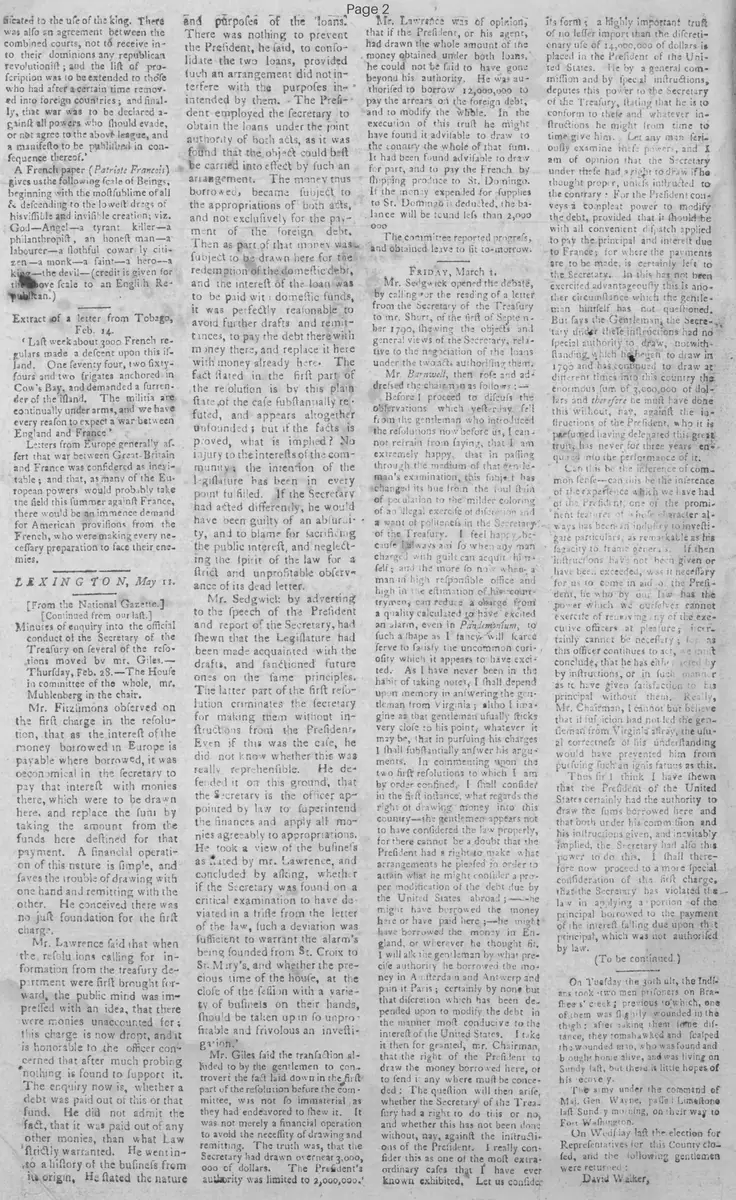
[From the National Gazette.]
[Continued from our last.]
Minutes of enquiry into the official conduct of the Secretary of the Treasury on several of the resolutions moved by mr. Giles.
Thursday, Feb. 28.
The House in committee of the whole, mr. Muhlenberg in the chair.
Mr. Fitzsimons observed on the first charge in the resolution, that as the interest of the money borrowed in Europe is payable where borrowed, it was oeconomical in the secretary to pay that interest with monies there, which were to be drawn here, and replace the sum by taking the amount from the funds here destined for that payment. A financial operation of this nature is simple, and saves the trouble of drawing with one hand and remitting with the other. He conceived there was no just foundation for the first charge.
Mr. Lawrence said that when the resolutions calling for information from the treasury department were first brought forward, the public mind was impressed with an idea, that there were monies unaccounted for; this charge is now dropt, and it is honorable to the officer concerned that after much probing nothing is found to support it. The enquiry now is, whether a debt was paid out of this or that fund. He did not admit the fact, that it was paid out of any other monies than what Law strictly warranted. He went into a history of the business from its origin. He stated the nature and purposes of the loans. There was nothing to prevent the President, he said, to consolidate the two loans, provided such an arrangement did not interfere with the purposes intended by them. The President employed the secretary to obtain the loans under the joint authority of both acts, as it was found that the object could best be carried into effect by such an arrangement. The money thus borrowed, became subject to the appropriations of both acts, and not exclusively for the payment of the foreign debt. Then as part of that money was subject to be drawn here for the redemption of the domestic debt, and the interest of the loan was to be paid with domestic funds, it was perfectly reasonable to avoid further drafts and remittances, to pay the debt there with money there, and replace it here with money already here. The fact stated in the first part of the resolution is by this plain state of the case substantially refuted, and appears altogether unfounded; but if the fact is proved, what is implied? No injury to the interests of the community; the intention of the legislature has been in every point fulfilled. If the Secretary had acted differently, he would have been guilty of an absurdity, and to blame for sacrificing the public interest, and neglecting the spirit of the law for a strict and unprofitable observance of its dead letter.
Mr. Sedgwick: by adverting to the speech of the President and report of the Secretary, had shewn that the Legislature had been made acquainted with the drafts, and sanctioned future ones on the same principles. The latter part of the first resolution criminates the secretary for making them without instructions from the President. Even if this was the case, he did not know whether this was really reprehensible. He defended it on this ground, that the Secretary is the officer appointed by law to superintend the finances and apply all monies agreeably to appropriations. He took a view of the business as stated by mr. Lawrence, and concluded by asking, whether if the Secretary was found on a critical examination to have deviated in a trifle from the letter of the law, such a deviation was sufficient to warrant the alarms being founded from St. Croix to St. Mary's, and whether the precious time of the house, at the close of the session with a variety of business on their hands, should be taken up in so unprofitable and frivolous an investigation.
Mr. Giles said the transaction alluded to by the gentlemen to controvert the fact laid down in the first part of the resolution before the committee, was not so immaterial as they had endeavored to shew it. It was not merely a financial operation to avoid the necessity of drawing and remitting. The truth was, that the Secretary had drawn over near 3,000,000 of dollars. The President's authority was limited to 2,000,000.
Mr. Lawrence was of opinion, that if the President, or his agent, had drawn the whole amount of the money obtained under both loans, he could not be said to have gone beyond his authority. He was authorised to borrow 12,000,000 to pay the arrears on the foreign debt, and to modify the whole. In the execution of this trust he might have found it advisable to draw to the country the whole of that sum. It had been found advisable to draw for part, and to pay the French by shipping produce to St. Domingo. If the money expended for supplies to St. Domingo is deducted, the balance will be found less than 2,000,000.
The committee reported progress, and obtained leave to sit to-morrow.
FRIDAY, March 1.
Mr. Sedgwick opened the debate, by calling for the reading of a letter from the Secretary of the Treasury to mr. Short, of the first of September 1790, shewing the objects and general views of the Secretary, relative to the negociation of the loans under the two acts authorising them.
Mr Barnwell, then rose and addressed the chairman as follows:-
Before I proceed to discuss the observations which yesterday fell from the gentleman who introduced the resolutions now before us, I cannot refrain from saying, that I am extremely happy, that in passing through the medium of that gentleman's examination, this subject has changed its hue from the foul stain of speculation to the milder coloring of an illegal exercise of discretion and a want of politness in the Secretary of the Treasury. I feel happy because I always am so when any man charged with guilt can acquit himself; and the more so now when a man in high responsible office and high in the estimation of his countrymen, can reduce a charge from a quality calculated to have excited an alarm, even in Pandemonium, to such a shape as I fancy will scarce serve to satisfy the uncommon curiosity which it appears to have excited. As I have never been in the habit of taking notes, I shall depend upon memory in answering the gentleman from Virginia; altho I imagine as that gentleman usually sticks very close to his point, whatever it may be, that in pursuing his charges I shall substantially answer his arguments. In commenting upon the two first resolutions to which I am by order confined, I shall consider in the first instance, what regards the right of drawing money into this country--the gentlemen appears not to have considered the law properly, for there cannot be a doubt that the President had a right to make what arrangements he pleased in order to attain what he might consider a proper modification of the debt due by the United States abroad;--he might have borrowed the money here or have paid here ;--he might have borrowed the money in England, or wherever he thought fit. I will ask the gentleman by what precise authority he borrowed the money in Amsterdam and Antwerp and paid it Paris; certainly by none but that discretion which has been depended upon to modify the debt in the manner most conducive to the interest of the United States. I take it then for granted, mr. Chairman, that the right of the President to draw the money borrowed here, or to send it any where must be conceded: The question will then arise, whether the Secretary of the Treasury had a right to do this or no, and whether this has not been done without, nay, against the instructions of the President. I really consider this as one of the most extraordinary cases that I have ever known its form; a highly important trust of no less import than the discretionary use of 14,000,000 of dollars is placed in the President of the United States. He by a general commission and by special instructions, deputes this power to the Secretary of the Treasury, stating that he is to conform to these and whatever instructions he might from time to time give him. Let any man seriously examine these powers, and I am of opinion that the Secretary under these had a right to draw if he thought proper, unless instructed to the contrary: For the President conveys a compleat power to modify the debt, provided that it should be with all convenient dispatch applied to pay the principal and interest due to France; for where the payments are to be made, is certainly left to the Secretary. In this has not been exercised advantageously this is another circumstance which the gentleman himself has not questioned. But says the Gentleman, the Secretary under these instructions had no special authority to draw, notwithstanding which he began to draw in 1790 and has continued to draw at different times into this country the enormous sum of 3,000,000 of dollars and therefore he must have done this without, nay, against the instructions of the President, who it is presumed having delegated this great trust, has never for three years enquired into the performance of it. Can this be the inference of common sense---can this be the inference of the experience which we have had of the President, one of the prominent features of whose character always has been an industry to investigate particulars, as remarkable as his sagacity in framing generals. If then instructions have not been given or have been exceeded, was it necessary for us to come in aid of the President, he who by our law has the power which we ourselves cannot exercise of removing any of the executive officers at pleasure; it certainly cannot be necessary ; for as this officer continues to act, we must conclude, that he has either satisfied by instructions, or in such manner as to have given satisfaction to his principal without them. Really, Mr. Chairman, I cannot but believe that if suspicion had not led the gentleman from Virginia's astray, the usual correctness of his understanding would have prevented him from pursuing such an ignis fatuus as this. Thus far I think I have shewn that the President of the United States certainly had the authority to draw the sums borrowed here and that both under his commission and his instructions given, and inevitably implied, the Secretary had also this power to do this. I shall therefore now proceed to a more special consideration of this first charge, that the Secretary has violated the law in applying a portion of the principal borrowed to the payment of the interest falling due upon that principal, which was not authorised by law.
(To be continued.)
What sub-type of article is it?
What keywords are associated?
What entities or persons were involved?
Domestic News Details
Event Date
Thursday, Feb. 28 To Friday, March 1
Key Persons
Outcome
the committee reported progress and obtained leave to sit tomorrow.
Event Details
House committee debates resolutions by Mr. Giles on the Secretary of the Treasury's conduct regarding loans, drawings, and payments. Members defend the Secretary's financial operations as authorized, economical, and in line with legislative intent, refuting charges of exceeding authority or misapplying funds.