Thank you for visiting SNEWPapers!
Sign up free
Editorial
March 30, 1940
The Gazette
Cleveland, Cuyahoga County, Ohio
What is this article about?
The editorial laments the rapid growth of U.S. government spending over the past ten years, which outpaces citizen resources and relies on future productivity. It vividly illustrates the scale: all 1939 income from states west of the Mississippi would barely cover last year's federal, state, and local expenditures of 19 billion dollars.
Clipping
OCR Quality
95%
Excellent
Full Text
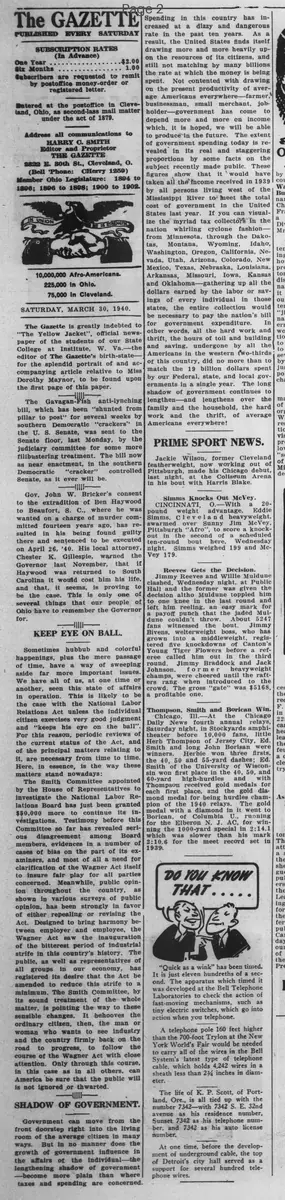
SHADOW OF GOVERNMENT.
Government can move from the front doorstep right into the living room of the average citizen in many ways. But in no manner does the growth of government influence in the affairs of the individual-the lengthening shadow of government-become more plain than where taxes and spending are concerned.
Spending in this country has increased at a dizzy and dangerous rate in the past ten years. As a result, the United States finds itself drawing more and more heavily upon the resources of its citizens, and still not matching by many billions the rate at which the money is being spent. Not contented with drawing on the present productivity of average Americans everywhere-farmer, businessman, small merchant, job-holder-government has come to depend more and more on income which, it is hoped, we will be able to produce in the future. The extent of government spending today is revealed in its real and staggering proportions by some facts on the subject recently made public. These figures show that it would have taken all the income received in 1939 by all persons living west of the Mississippi River to meet the total cost of government in the United States last year. If you can visualize the myriad tax collectors in the nation whirling cyclone fashion-from Minnesota, through the Dakotas, Montana, Wyoming, Idaho, Washington, Oregon, California, Nevada, Utah, Arizona, Colorado, New Mexico, Texas, Nebraska, Louisiana, Arkansas, Missouri, Iowa, Kansas and Oklahoma-gathering up all the dollars earned by the labor or savings of every individual in those states, the entire collection would be necessary to pay the nation's bill for government expenditure. In other words, all the hard work and thrift, the hours of toil and building and saving, undergone by all the Americans in the western two-thirds of this country, did no more than to match the 19 billion dollars spent by our Federal, state, and local governments in a single year. The long shadow of government continues to lengthen-and lengthens over the family and the household, the hard work and the thrift, of average Americans everywhere!
Government can move from the front doorstep right into the living room of the average citizen in many ways. But in no manner does the growth of government influence in the affairs of the individual-the lengthening shadow of government-become more plain than where taxes and spending are concerned.
Spending in this country has increased at a dizzy and dangerous rate in the past ten years. As a result, the United States finds itself drawing more and more heavily upon the resources of its citizens, and still not matching by many billions the rate at which the money is being spent. Not contented with drawing on the present productivity of average Americans everywhere-farmer, businessman, small merchant, job-holder-government has come to depend more and more on income which, it is hoped, we will be able to produce in the future. The extent of government spending today is revealed in its real and staggering proportions by some facts on the subject recently made public. These figures show that it would have taken all the income received in 1939 by all persons living west of the Mississippi River to meet the total cost of government in the United States last year. If you can visualize the myriad tax collectors in the nation whirling cyclone fashion-from Minnesota, through the Dakotas, Montana, Wyoming, Idaho, Washington, Oregon, California, Nevada, Utah, Arizona, Colorado, New Mexico, Texas, Nebraska, Louisiana, Arkansas, Missouri, Iowa, Kansas and Oklahoma-gathering up all the dollars earned by the labor or savings of every individual in those states, the entire collection would be necessary to pay the nation's bill for government expenditure. In other words, all the hard work and thrift, the hours of toil and building and saving, undergone by all the Americans in the western two-thirds of this country, did no more than to match the 19 billion dollars spent by our Federal, state, and local governments in a single year. The long shadow of government continues to lengthen-and lengthens over the family and the household, the hard work and the thrift, of average Americans everywhere!
What sub-type of article is it?
Economic Policy
Taxation
What keywords are associated?
Government Spending
Taxation
Fiscal Burden
Economic Resources
Public Expenditure
What entities or persons were involved?
United States Government
Federal, State, And Local Governments
Editorial Details
Primary Topic
Excessive Government Spending And Taxation
Stance / Tone
Critical Of Government Growth
Key Figures
United States Government
Federal, State, And Local Governments
Key Arguments
Government Spending Has Increased At A Dizzy And Dangerous Rate In The Past Ten Years
Draws Heavily On Current And Future Citizen Resources
All 1939 Income West Of The Mississippi Equals Last Year's 19 Billion Dollar Government Expenditures
Illustrates The Staggering Proportions Of Government Costs