Thank you for visiting SNEWPapers!
Sign up free
Letter to Editor
February 15, 1840
The New England Weekly Review
Hartford, Hartford County, Connecticut
What is this article about?
A letter praising temperance meetings in the city for free discussion but criticizing one-sided speeches and advocating moral suasion over legal force to reform intemperance. It urges improving apprentices' home lives and defending free speech for speakers like 'old uncle Capin.'
Clipping
OCR Quality
95%
Excellent
Full Text
Written for the New England Review.
Temperance.
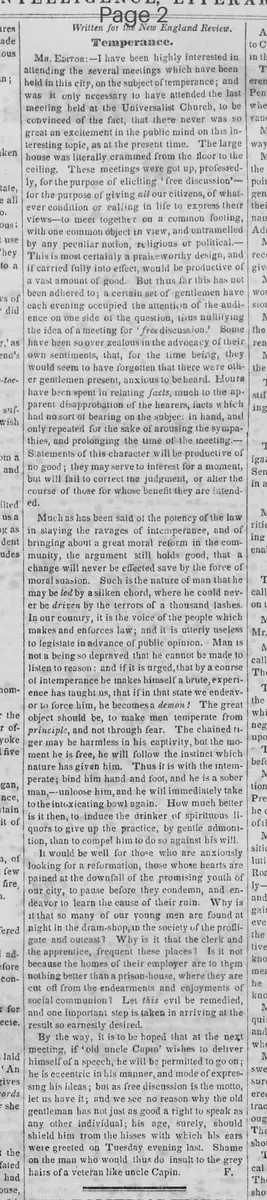
Mr. Editor:—I have been highly interested in attending the several meetings which have been held in this city, on the subject of temperance; and was it only necessary to have attended the last meeting held at the Universalist Church, to be convinced of the fact, that there never was so great an excitement in the public mind on this interesting topic, as at the present time. The large house was literally crammed from the floor to the ceiling. These meetings were got up, professedly, for the purpose of eliciting 'free discussion'—for the purpose of giving all our citizens, of whatever condition or calling in life to express their views—to meet together on a common footing, with one common object in view, and untrammelled by any peculiar notion, religious or political.—This is most certainly a praiseworthy design, and if carried fully into effect, would be productive of a vast amount of good. But thus far this has not been adhered to; a certain set of gentlemen have each evening occupied the attention of the audience on one side of the question, thus nullifying the idea of a meeting for 'free discussion.' Some have been so over zealous in the advocacy of their own sentiments, that, for the time being, they would seem to have forgotten that there were other gentlemen present, anxious to be heard. Hours have been spent in relating facts, much to the apparent disapprobation of the hearers, facts which had no sort of bearing on the subject in hand, and only repeated for the sake of arousing the sympathies, and prolonging the time of the meeting.—Statements of this character will be productive of no good; they may serve to interest for a moment but will fail to correct the judgment, or alter the course of those for whose benefit they are intended.
Much as has been said of the potency of the law in staying the ravages of intemperance, and of bringing about a great moral reform in the community, the argument still holds good, that a change will never be effected save by the force of moral suasion. Such is the nature of man that he may be led by a silken chord, where he could never be driven by the terrors of a thousand lashes In our country, it is the voice of the people which makes and enforces law; and it is utterly useless to legislate in advance of public opinion. Man is not a being so depraved that he cannot be made to listen to reason: and if it is urged, that by a course of intemperance he makes himself a brute, experience has taught us, that if in that state we endeavor to force him. he becomes a demon! The great object should be, to make men temperate from principle, and not through fear. The chained tiger may be harmless in his captivity, but the moment he is free, he will follow the instinct which nature has given him. Thus it is with the intemperate; bind him hand and foot, and he is a sober man,—unloose him, and he will immediately take to the intoxicating bowl again. How much better is it then, to induce the drinker of spirituous liquors to give up the practice, by gentle admonition, than to compel him to do so against his will.
It would be well for those who are anxiously looking for a reformation. those whose hearts are pained at the downfall of the promising youth of our city, to pause before they condemn, and endeavor to learn the cause of their ruin. Why is it that so many of our young men are found at night in the dram-shop, in the society of the profligate and outcast? Why is it that the clerk and the apprentice, frequent these places? Is it not because the homes of their employer are to them nothing better than a prison-house, where they are cut off from the endearments and enjoyments of social communion? Let this evil be remedied and one important step is taken in arriving at the result so earnestly desired
By the way, it is to be hoped that at the next meeting. if 'old uncle Capin' wishes to deliver himself of a speech, he will be permitted to go on; he is eccentric in his manner, and mode of expressing his ideas; but as free discussion is the motto, let us have it; and we see no reason why the old gentleman has not just as good a right to speak as any other individual; his age, surely, should shield him from the hisses with which his ears were greeted on Tuesday evening last. Shame on the man who would thus do insult to the grey hairs of a veteran like uncle Capin.
F.
Temperance.
Mr. Editor:—I have been highly interested in attending the several meetings which have been held in this city, on the subject of temperance; and was it only necessary to have attended the last meeting held at the Universalist Church, to be convinced of the fact, that there never was so great an excitement in the public mind on this interesting topic, as at the present time. The large house was literally crammed from the floor to the ceiling. These meetings were got up, professedly, for the purpose of eliciting 'free discussion'—for the purpose of giving all our citizens, of whatever condition or calling in life to express their views—to meet together on a common footing, with one common object in view, and untrammelled by any peculiar notion, religious or political.—This is most certainly a praiseworthy design, and if carried fully into effect, would be productive of a vast amount of good. But thus far this has not been adhered to; a certain set of gentlemen have each evening occupied the attention of the audience on one side of the question, thus nullifying the idea of a meeting for 'free discussion.' Some have been so over zealous in the advocacy of their own sentiments, that, for the time being, they would seem to have forgotten that there were other gentlemen present, anxious to be heard. Hours have been spent in relating facts, much to the apparent disapprobation of the hearers, facts which had no sort of bearing on the subject in hand, and only repeated for the sake of arousing the sympathies, and prolonging the time of the meeting.—Statements of this character will be productive of no good; they may serve to interest for a moment but will fail to correct the judgment, or alter the course of those for whose benefit they are intended.
Much as has been said of the potency of the law in staying the ravages of intemperance, and of bringing about a great moral reform in the community, the argument still holds good, that a change will never be effected save by the force of moral suasion. Such is the nature of man that he may be led by a silken chord, where he could never be driven by the terrors of a thousand lashes In our country, it is the voice of the people which makes and enforces law; and it is utterly useless to legislate in advance of public opinion. Man is not a being so depraved that he cannot be made to listen to reason: and if it is urged, that by a course of intemperance he makes himself a brute, experience has taught us, that if in that state we endeavor to force him. he becomes a demon! The great object should be, to make men temperate from principle, and not through fear. The chained tiger may be harmless in his captivity, but the moment he is free, he will follow the instinct which nature has given him. Thus it is with the intemperate; bind him hand and foot, and he is a sober man,—unloose him, and he will immediately take to the intoxicating bowl again. How much better is it then, to induce the drinker of spirituous liquors to give up the practice, by gentle admonition, than to compel him to do so against his will.
It would be well for those who are anxiously looking for a reformation. those whose hearts are pained at the downfall of the promising youth of our city, to pause before they condemn, and endeavor to learn the cause of their ruin. Why is it that so many of our young men are found at night in the dram-shop, in the society of the profligate and outcast? Why is it that the clerk and the apprentice, frequent these places? Is it not because the homes of their employer are to them nothing better than a prison-house, where they are cut off from the endearments and enjoyments of social communion? Let this evil be remedied and one important step is taken in arriving at the result so earnestly desired
By the way, it is to be hoped that at the next meeting. if 'old uncle Capin' wishes to deliver himself of a speech, he will be permitted to go on; he is eccentric in his manner, and mode of expressing his ideas; but as free discussion is the motto, let us have it; and we see no reason why the old gentleman has not just as good a right to speak as any other individual; his age, surely, should shield him from the hisses with which his ears were greeted on Tuesday evening last. Shame on the man who would thus do insult to the grey hairs of a veteran like uncle Capin.
F.
What sub-type of article is it?
Persuasive
Ethical Moral
Reflective
What themes does it cover?
Temperance
Morality
Social Issues
What keywords are associated?
Temperance Meetings
Moral Suasion
Free Discussion
Intemperance Reform
Youth In Dram Shops
Apprentice Conditions
What entities or persons were involved?
F.
Mr. Editor
Letter to Editor Details
Author
F.
Recipient
Mr. Editor
Main Argument
temperance reform should rely on moral suasion and gentle persuasion rather than coercive laws, as true change comes from principle, not fear. improve apprentices' living conditions to prevent them from seeking solace in dram-shops, and ensure meetings allow free discussion without interruption.
Notable Details
Meetings At Universalist Church
Criticism Of One Sided Speeches And Irrelevant Facts
Defense Of 'Old Uncle Capin' Against Hisses
Analogy Of Chained Tiger To Forced Sobriety