Thank you for visiting SNEWPapers!
Sign up free
Norfolk Gazette And Publick Ledger
Norfolk, Virginia
What is this article about?
Editorial in National Intelligencer praises Mr. Gregg's resolutions against British injustices, urges firm US response. Includes Cobbett's account from October 26 Political Register detailing US-Britain dispute over British admiralty decisions condemning American ships as prizes under obsolete maritime rules, sparking complaints and threats of reprisals.
Clipping
OCR Quality
Full Text
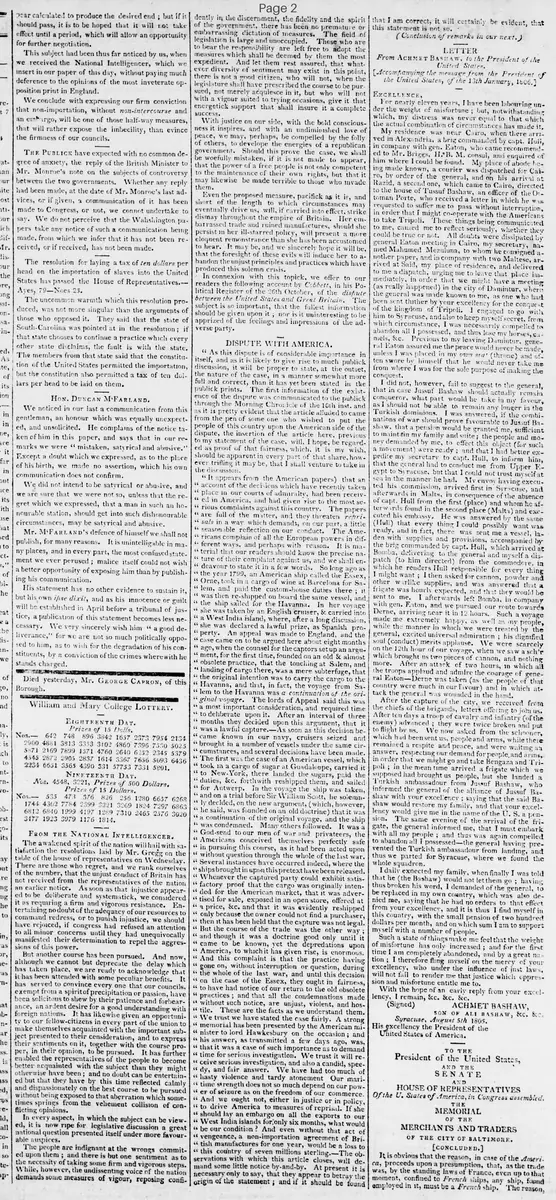
The awakened spirit of the nation will hail with satisfaction the resolutions laid by Mr. Gregg on the table of the house of representatives on Wednesday. There are those who regret, and we rank ourselves of the number, that the unjust conduct of Britain has not received from the representatives of the nation an earlier notice. As soon as that injustice appeared to be deliberate and systematick, we considered it as requiring a firm and vigorous resistance. Entertaining no doubt of the adequacy of our resources to command redress, or to punish injustice, we should have rejoiced, if congress had refused an attention to all minor concerns until they had unequivocally manifested their determination to repel the aggressions of this power.
But another course has been pursued. And now, although we cannot but deprecate the delay which has taken place, we are ready to acknowledge that it has been attended with some peculiar benefits. It has served to convince every one that our councils, exempt from a spirit of precipitation or passion, have been solicitous to shew by their patience and forbearance, an ardent desire for a good understanding with foreign nations. It has likewise given an opportunity to our fellow-citizens in every part of the union to make themselves acquainted with the important subject presented to their consideration, and to express their sentiments on it, together with the course proper, in their opinion, to be pursued. It has further enabled the representatives of the people to become better acquainted with the subject than they might otherwise have been; and no doubt can be entertained but that they have by this time reflected calmly and dispassionately on the best course to be pursued without being exposed to that aberration which sometimes springs from the vehement collision of conflicting opinions.
In every aspect, in which the subject can be viewed, it is now ripe for legislative discussion a great national question presented itself under more favourable auspices.
The people are indignant at the wrongs committed upon them; and there is but one sentiment as to the necessity of taking some firm and vigorous steps. While, however, the undissenting voice of the nation demands some measures of vigour, reposing confidently in the discernment, the fidelity and the spirit of the government, there has been no premature or embarrassing dictation of measures. The field of legislation is large and unoccupied. Those who are to bear the responsibility are left free to adopt the measures which shall be deemed by them the most expedient. And let them rest assured, that whatever diversity of sentiment may exist in this point, there is not a good citizen, who will not, when the legislature shall have prescribed the course to be pursued, not merely acquiesce in it, but who will not with a vigour suited to trying occasions, give it that energetick support that shall insure it a complete success.
With justice on our side, with the bold consciousness it inspires. and with an undiminished love of peace, we may, perhaps, be compelled by the folly of others, to develope the energies of a republican government. Should this prove the case, we shall be woefully mistaken, if it is not made to appear, that the power of a free people is not only competent to the maintenance of their own rights, but that it may likewise be made terrible to those who invade them.
Even the proposed measure, pacifick as it is, and short of the length to which circumstances may eventually drive us, will, if carried into effect, strike dismay throughout the empire of Britain. Her embarrassed trade and ruined manufactures, should she persist in her ill-starred policy, will present a more eloquent remonstrance than she has been accustomed to hear. It may be, and we sincerely hope it will be, that the foresight of these evils will induce her to abandon the unjust principles and practices which have produced this solemn crisis.
In connexion with this topick, we offer to our readers the following account by Cobbett, in his Political Register of the 26th October, of the dispute between the United States and Great Britain. The subject is so important, that the fullest information should be given upon it ; nor is it uninteresting to be apprized of the feelings and impressions of the adverse party.
DISPUTE WITH AMERICA.
"As this dispute is of considerable importance in itself, and as it is likely to give rise to much publick discussion, it will be proper to state, at the outset, the nature of the case, in a manner somewhat more full and correct, than it has yet been stated in the publick prints. The first information of the existence of the dispute was communicated to the publick through the Morning Chronicle of the 10th inst. and as it is pretty evident that the article alluded to came from the pen of some one who wished to put the people of this country upon the American side of the dispute, the insertion of the article here, previous to my statement of the case, will, I hope, be regarded as proof of that fairness, which. it is my wish, should be apparent in every part of that share, however trifling it may be, that I shall venture to take in the discussion.
"It appears from the American papers that an account of the decisions which have recently taken place in our courts of admiralty, had been received in America, and had given rise to the most serious complaints against this country. The papers are full of the matter, and they threaten reprisals in a way which demands, on our part, a little seasonable reflection on our conduct. The Americans complain of all the European powers in different ways, and perhaps with reason. It is material that our readers should know the precise nature of their complaint against us, and we shall endeavour to state it in a few words. So long ago as the year 1799, an American ship called the Essex, Orne, took in a cargo of wine at Barcelona for Salem, and paid the custom-house duties there ; it was then re-shipped on board the same vessel, and the ship sailed for the Havanna. In her voyage she was taken by an English cruiser, & carried into a West India island, where, after a long discussion, she was declared a lawful prize, as Spanish property. An appeal was made to England, and the case came on to be argued here about eight months ago, when the counsel for the captors set up an argument, for the first time, founded on an old & almost obsolete practice, that the touching at Salem, and landing of cargo there, was a mere subterfuge, that the original intention was to carry the cargo to the Havanna, and that, in fact, the voyage from Salem to the Havanna was a continuation of the original voyage. The lords of Appeal said this was a most important consideration, and required time to deliberate upon it. After an interval of three months they decided upon this argument, that it was a lawful capture.—As soon as this decision became known in our navy, cruisers seized and brought in a number of vessels under the same circumstances, and several decisions have been made.
"The first was the case of an American vessel, which took in a cargo of sugar at Guadaloupe, carried it to New-York, there landed the sugars, paid the duties, &c. forthwith reshipped them, and sailed for Antwerp. In the voyage the ship was taken, and on a trial before Sir William Scott, he solemnly decided, on the new argument, (which, however, he said, was founded on an old doctrine) that it was a continuation of the original voyage, and the ship was condemned. Many others followed. It was a God-send to our men of war and privateers, the Americans conceived themselves perfectly safe in pursuing this course, as it had been acted upon without question through the whole of the last war.
"Several instances have occurred indeed, where the ships brought in upon this pretext have been released. Whenever the captured party could exhibit satisfactory proof that the cargo was originally intended for the American market, that it was advertised for sale, exposed in an open store, offered at a price, &c. and that it was evidently reshipped only because the owner could not find a purchaser, then it has been held that the capture was not legal.
"But the course of the trade was the other way ; and though it was a doctrine good only until it came to be known, yet the depredations upon America, to which it has given rise, is enormous.
"And this complaint is that the practice having gone on, without interruption or question, during the whole of the last war, and until this decision on the case of the Essex, they ought in fairness, to have had notice of our return to the old obsolete practices; and that all the condemnations made without such notice, are unjust, violent, and hostile. These are the facts as we understand them.
"We trust we have stated the case fairly. A strong memorial has been presented by the American minister to lord Hawkesbury on the occasion; and his answer, as transmitted a few days ago, was, that it was a case of such importance as to demand time for serious investigation. We trust it will receive serious investigation, and also a candid, speedy, and fair answer. We have had too much of hasty violence and tardy atonement Our maritime strength does not so much depend on our power of seizure as on the freedom of our commerce.
"And we ought not, either in justice or in policy, to drive America to measures of reprisal. If she should lay an embargo on all the exports to our West India islands for only six months, what would be our condition ? And even without that act of vengeance, a non-importation agreement of British manufactures for one year, would be a loss to this country of seven millions sterling.—The observations with which this article closes, will demand some little notice by-and-by. At present it is necessary only to say, that they appear to betray the origin of the statement ; and if it should be found
What sub-type of article is it?
What keywords are associated?
What entities or persons were involved?
Where did it happen?
Foreign News Details
Primary Location
Great Britain
Event Date
26th October
Key Persons
Outcome
multiple american ships condemned as prizes in british admiralty courts; threats of us reprisals including embargo on exports to west india islands and non-importation of british manufactures, potentially costing britain seven millions sterling; american minister presented strong memorial to lord hawkesbury, who requested time for investigation.
Event Details
US Congress considers resolutions by Mr. Gregg against British injustices; Cobbett describes dispute originating from 1799 Essex case where British courts ruled reshipment from US port as continuation of original voyage, leading to seizures of American vessels carrying neutral trade cargoes; Americans complain of sudden revival of obsolete doctrine without notice, calling condemnations unjust; several similar cases condemned by Sir William Scott, though some released if proven for US market.