Thank you for visiting SNEWPapers!
Sign up free
Story
March 31, 1849
New England Religious Herald
Hartford, Hartford County, Connecticut
What is this article about?
Eyewitness account by Dumas of Napoleon passing through Villers-Cotterets en route to Waterloo in high spirits, accompanied by Jerome and Letort, and returning defeated days later, alone and unchanged in demeanor after the loss.
Clipping
OCR Quality
98%
Excellent
Full Text
MISCELLANEOUS.
Napoleon Before and After Waterloo.
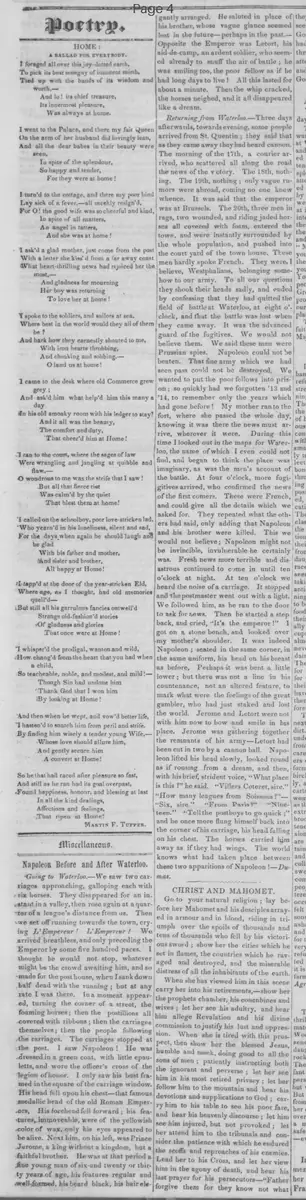
Going to Waterloo.—We saw two carriages approaching, galloping each with six horses. They disappeared for an instant in a valley, then rose again at a quarter of a league's distance from us. Then we set off running towards the town, crying L'Empereur! L'Empereur! We arrived breathless, and only preceding the Emperor by some five hundred paces. I thought he would not stop, whatever might be the crowd awaiting him, and so made for the post house, when I sank down half dead with the running; but at any rate I was there. In a moment appeared, turning the corner of a street, the foaming horses; then the postillions all covered with ribbons; then the carriages themselves; then the people following the carriages. The carriages stopped at the post. I saw Napoleon! He was dressed in a green coat, with little epauletts, and wore the officer's cross of the legion of honor. I only saw his bust framed in the square of the carriage window. His head fell upon his chest—that famous medallic head of the old Roman Emperors. His forehead fell forward; his features, immoveable, were of the yellowish color of wax, only his eyes appeared to be alive. Next him, on his left, was Prince Jerome, a king without a kingdom, but a faithful brother. He was at that period a fine young man of six-and-twenty or thirty years of age, his features regular and well-formed, his beard black, his hair elegantly arranged. He saluted in place of his brother, whose vague glance seemed lost in the future—perhaps in the past. Opposite the Emperor was Letort, his aid-de-camp, an ardent soldier, who seemed already to snuff the air of battle: he was smiling too, the poor fellow as if he had long days to live! All this lasted for about a minute. Then the whip cracked, the horses neighed, and it all disappeared like a dream.
Returning from Waterloo.—Three days afterwards, towards evening, some people arrived from St. Quentin: they said that as they came away they had heard cannon. The morning of the 17th, a courier arrived, who scattered all along the road the news of the victory. The 18th, nothing. The 19th, nothing; only vague rumors were abroad, coming no one knew whence. It was said that the emperor was at Brussels. The 20th, three men in rags, two wounded, and riding jaded horses all covered with foam, entered the town, and were instantly surrounded by the whole population, and pushed into the court yard of the town house. These men hardly spoke French. They were, I believe, Westphalians, belonging somehow to our army. To all our questions they shook their heads sadly, and ended by confessing that they had quitted the field of battle at Waterloo, at eight o'clock, and that the battle was lost when they came away. It was the advanced guard of the fugitives. We would not believe them. We said these men were Prussian spies. Napoleon could not be beaten. That fine army which we had seen pass could not be destroyed. We wanted to put the poor fellows into prison; so quickly had we forgotten '13 and '14, to remember only the years which had gone before! My mother ran to the fort, where she passed the whole day, knowing it was there the news must arrive, wherever it were. During this time I looked out in the maps for Waterloo, the name of which I even could not find, and began to think the place was imaginary, as was the men's account of the battle. At four o'clock, more fugitives arrived, who confirmed the news of the first comers. These were French, and could give all the details which we asked for. They repeated what the others had said, only adding that Napoleon and his brother were killed. This we would not believe; Napoleon might not be invincible, invulnerable he certainly was. Fresh news more terrible and disastrous continued to come in until ten o'clock at night. At ten o'clock we heard the noise of a carriage. It stopped and the postmaster went out with a light. We followed him, as he ran to the door to ask for news. Then he started a step back, and cried, "It's the emperor!" I got on a stone bench, and looked over my mother's shoulder. It was indeed Napoleon: seated in the same corner, in the same uniform, his head on his breast as before. Perhaps it was bent a little lower; but there was not a line in his countenance, not an altered feature, to mark what were the feelings of the great gambler, who had just staked and lost the world. Jerome and Letort were not with him now to bow and smile in his place. Jerome was gathering together the remnants of his army—Letort had been cut in two by a cannon ball. Napoleon lifted his head slowly, looked round as if rousing from a dream, and then, with his brief, strident voice, "What place is this?" he said. "Villers Coterets, sire." "How many leagues from Soissons?"— "Six, sire." "From Paris?" "Nineteen." "Tell the postboys to go quick;" and he once more flung himself back into the corner of his carriage, his head falling on his chest. The horses carried him away as if they had wings. The world knows what had taken place between these two apparitions of Napoleon!—Dumas.
Napoleon Before and After Waterloo.
Going to Waterloo.—We saw two carriages approaching, galloping each with six horses. They disappeared for an instant in a valley, then rose again at a quarter of a league's distance from us. Then we set off running towards the town, crying L'Empereur! L'Empereur! We arrived breathless, and only preceding the Emperor by some five hundred paces. I thought he would not stop, whatever might be the crowd awaiting him, and so made for the post house, when I sank down half dead with the running; but at any rate I was there. In a moment appeared, turning the corner of a street, the foaming horses; then the postillions all covered with ribbons; then the carriages themselves; then the people following the carriages. The carriages stopped at the post. I saw Napoleon! He was dressed in a green coat, with little epauletts, and wore the officer's cross of the legion of honor. I only saw his bust framed in the square of the carriage window. His head fell upon his chest—that famous medallic head of the old Roman Emperors. His forehead fell forward; his features, immoveable, were of the yellowish color of wax, only his eyes appeared to be alive. Next him, on his left, was Prince Jerome, a king without a kingdom, but a faithful brother. He was at that period a fine young man of six-and-twenty or thirty years of age, his features regular and well-formed, his beard black, his hair elegantly arranged. He saluted in place of his brother, whose vague glance seemed lost in the future—perhaps in the past. Opposite the Emperor was Letort, his aid-de-camp, an ardent soldier, who seemed already to snuff the air of battle: he was smiling too, the poor fellow as if he had long days to live! All this lasted for about a minute. Then the whip cracked, the horses neighed, and it all disappeared like a dream.
Returning from Waterloo.—Three days afterwards, towards evening, some people arrived from St. Quentin: they said that as they came away they had heard cannon. The morning of the 17th, a courier arrived, who scattered all along the road the news of the victory. The 18th, nothing. The 19th, nothing; only vague rumors were abroad, coming no one knew whence. It was said that the emperor was at Brussels. The 20th, three men in rags, two wounded, and riding jaded horses all covered with foam, entered the town, and were instantly surrounded by the whole population, and pushed into the court yard of the town house. These men hardly spoke French. They were, I believe, Westphalians, belonging somehow to our army. To all our questions they shook their heads sadly, and ended by confessing that they had quitted the field of battle at Waterloo, at eight o'clock, and that the battle was lost when they came away. It was the advanced guard of the fugitives. We would not believe them. We said these men were Prussian spies. Napoleon could not be beaten. That fine army which we had seen pass could not be destroyed. We wanted to put the poor fellows into prison; so quickly had we forgotten '13 and '14, to remember only the years which had gone before! My mother ran to the fort, where she passed the whole day, knowing it was there the news must arrive, wherever it were. During this time I looked out in the maps for Waterloo, the name of which I even could not find, and began to think the place was imaginary, as was the men's account of the battle. At four o'clock, more fugitives arrived, who confirmed the news of the first comers. These were French, and could give all the details which we asked for. They repeated what the others had said, only adding that Napoleon and his brother were killed. This we would not believe; Napoleon might not be invincible, invulnerable he certainly was. Fresh news more terrible and disastrous continued to come in until ten o'clock at night. At ten o'clock we heard the noise of a carriage. It stopped and the postmaster went out with a light. We followed him, as he ran to the door to ask for news. Then he started a step back, and cried, "It's the emperor!" I got on a stone bench, and looked over my mother's shoulder. It was indeed Napoleon: seated in the same corner, in the same uniform, his head on his breast as before. Perhaps it was bent a little lower; but there was not a line in his countenance, not an altered feature, to mark what were the feelings of the great gambler, who had just staked and lost the world. Jerome and Letort were not with him now to bow and smile in his place. Jerome was gathering together the remnants of his army—Letort had been cut in two by a cannon ball. Napoleon lifted his head slowly, looked round as if rousing from a dream, and then, with his brief, strident voice, "What place is this?" he said. "Villers Coterets, sire." "How many leagues from Soissons?"— "Six, sire." "From Paris?" "Nineteen." "Tell the postboys to go quick;" and he once more flung himself back into the corner of his carriage, his head falling on his chest. The horses carried him away as if they had wings. The world knows what had taken place between these two apparitions of Napoleon!—Dumas.
What sub-type of article is it?
Historical Event
Biography
Tragedy
What themes does it cover?
Fortune Reversal
Tragedy
Misfortune
What keywords are associated?
Napoleon
Waterloo
Defeat
Journey
Eyewitness
Jerome
Letort
What entities or persons were involved?
Napoleon
Prince Jerome
Letort
Dumas
Where did it happen?
Villers Cotterets
Story Details
Key Persons
Napoleon
Prince Jerome
Letort
Dumas
Location
Villers Cotterets
Event Date
June 1815
Story Details
Narrator witnesses Napoleon passing through town en route to Waterloo, appearing contemplative with companions Jerome and Letort; days later, after defeat, Napoleon returns alone, demeanor unchanged, inquiring route to Paris amid rumors of loss.