Thank you for visiting SNEWPapers!
Sign up free
Alexandria Daily Gazette, Commercial & Political
Alexandria, Virginia
What is this article about?
US Congress debates repeal of the Embargo Act in Senate (Nov 21) with speeches by Hillhouse and others criticizing its impact on trade and honor; House (Nov 25) adopts resolutions on violations and petitions, votes on publishing secret foreign affairs documents, ultimately ordering secret journal publication.
Merged-components note: Sequential components forming a single coherent report on congressional debates and secret journal proceedings regarding the embargo
Clippings
1 of 2
OCR Quality
Full Text
Senate of the United States.
Monday, November 21.
EMBARGO.
DEBATE on Mr. Hillhouse's motion for a repeal.
[Continued.]
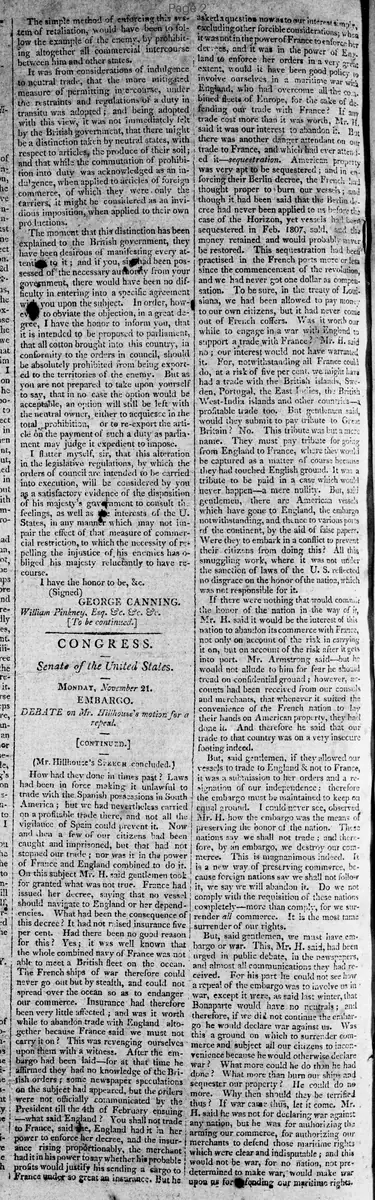
(Mr. Hillhouse's Speech concluded.)
How had they done in times past? Laws had been in force making it unlawful to trade with the Spanish possessions in South America; but we had nevertheless carried on a profitable trade there, and not all the vigilance of Spain could prevent it. Now and then a few of our citizens had been caught and imprisoned, but that had not stopped our trade; nor was it in the power of France and England combined to do it.
On this subject Mr. H. said gentlemen took for granted what was not true. France had issued her decree, saying that no vessel should navigate to England or her dependencies. What had been the consequence of this decree? It had not raised insurance five per cent. Had there been no good reason for this? Yes; it was well known that the whole combined navy of France was not able to meet a British fleet on the ocean. The French ships of war therefore could never go out but by stealth, and could not spread over the ocean so as to endanger our commerce. Insurance had therefore been very little affected; and was it worth while to abandon trade with England altogether because France said we must not carry it on? This was revenging ourselves upon them with a witness. After the embargo had been laid—or at that time he affirmed they had no knowledge of the British orders; some newspaper speculations on the subject had appeared, but the orders were not officially communicated by the President till the 4th of February ensuing—what said England? You shall not trade to France, said she. England had it in her power to enforce her decree, and the insurance rising proportionably, the merchant had it in his power to say whether his probable profits would justify his sending a cargo to France under so great an insurance. But he asked a question now as to our interest simply excluding other forcible considerations; when it was not in the power of France to enforce her decrees, and it was in the power of England to enforce her orders in a very great extent, would it have been good policy to involve ourselves in a maritime war with England, who had overcome all the combined fleets of Europe, for the sake of defending our trade with France? If any trade cost more than it was worth, Mr. H. said it was our interest to abandon it. But there was another danger attendant on our trade to France, and which had ever attended it—sequestration. American property was very apt to be sequestered; and in enforcing their Berlin decree, the French had thought proper to burn our vessels; and though it had been said that the Berlin decree had never been applied to us before the case of the Horizon, yet vessels had been sequestered in Feb. 1807, sold, and the money retained and would probably never be restored. This sequestration had been practised in the French ports more or less since the commencement of the revolution, and we had never got one dollar as compensation. To be sure, in the treaty of Louisiana, we had been allowed to pay money to our own citizens, but it had never come out of French coffers. Was it worth our while to engage in a war with England to support a trade with France? Mr. H. said no; our interest would not have warranted it. For, notwithstanding all France could do, at a risk of five per cent. we might have had a trade with the British islands, Sweden, Portugal, the East Indies, the British West-India islands and other countries—a profitable trade too. But gentlemen said, would they submit to pay tribute to Great Britain? No. This tribute was but a mere name. They must pay tribute for going from England to France, where they would be captured as a matter of course because they had touched English ground. It was a tribute to be paid in a case which would never happen—a mere nullity. But, said gentlemen, there are American vessels which have gone to England, the embargo notwithstanding, and thence to various ports of the continent, by the aid of false papers. Were they to embark in a conflict to prevent their citizens from doing this? All this smuggling work, where it was not under the sanction of laws of the U. S. reflected no disgrace on the honor of the nation, which was not responsible for it.
If there were nothing that would commit the honor of the nation in the way of it, Mr. H. said it would be the interest of this nation to abandon its commerce with France, not only on account of the risk in carrying it on, but on account of the risk after it gets into port. Mr. Armstrong said—but he would not allude to him for fear he should tread on confidential ground; however, accounts had been received from our consuls and merchants, that whenever it suited the convenience of the French nation to lay their hands on American property, they had done it. And therefore he said that our trade to that country was on a very insecure footing indeed.
But, said gentlemen, if they allowed our vessels to trade to England & not to France, it was a submission to her orders and a resignation of our independence: therefore the embargo must be maintained to keep on equal ground. I could never see, observed Mr. H. how the embargo was the means of preserving the honor of the nation. These nations say we shall not trade; and therefore, by an embargo, we destroy our commerce. This is magnanimous indeed. It is a new way of preserving commerce, because foreign nations say we shall not follow it, we say we will abandon it. Do we not comply with the requisition of these nations completely—more than comply, for we surrender all commerce. It is the most tame surrender of our rights.
But, said gentlemen, we must have embargo or war. This, Mr. H. said, had been urged in public debate, in the newspapers, and almost all communications they had received. For his part he could not see how a repeal of the embargo was to involve us in war, except it were, as said last winter, that Bonaparte would have no neutrals; and therefore, if we did not continue the embargo he would declare war against us. Was this a ground on which to surrender commerce and subject all our citizens to inconvenience because he would otherwise declare war? What more could he do than he had done? What more than burn our ships and sequester our property? He could do no more. Why then should they be terrified thus? If war came thus, let it come. Mr. H. said he was not for declaring war against any nation, but he was for authorizing the arming our commerce, for authorizing our merchants to defend those maritime rights which were clear and indisputable; and this would not be war, for no nation, not predetermined to make war, would make war upon us for defending our maritime rights.
not (said he) be willing to go to doubtful rights, as that of the harmony between the mother country and her colonies; but our indisputable neutral rights I am for defending, not abandoning. Mr. R. said he thought when the embargo was laid, though perhaps he had been singular in the opinion, that it was intended as no permanent measure; that the real object was not what had been expressed in the message, but to put down commerce and foster manufactures; to convert all our commercial capital into manufactures, and all our commercial men into manufacturers. Many honest politicians had thought it would be a practicable and useful and beneficial plan, though the contrary had ever been his opinion. In confirmation of his opinion, Mr. R. said, when they looked over the acts of Congress and other publications which had the stamp of authority, or were considered as being approved by the constituted authorities of the country, they were told that the agriculturist and manufacturer should be planted side by side, and that they should sit at their own doors clothed in their own manufactures of those articles which they had before received from others. These ideas could never be realized but by abandoning commerce.
Mr. Alston went at some length into a discussion on the subject of manufactures, using arguments tending to demonstrate that large manufactories are as unsuitable to the genius of a free people, as to the pecuniary habits of the people of the United States.
Mr. Key said no man was more desirous to obey the laws of his country than he was, but in a free country laws could not be forced down. Either by force or in some other way the people would get rid of a disagreeable law. They always had and always would do it. In therefore attempting this system was prostrating the dignity of the government and teaching the people to trample on the constituted authorities. He wished to see the magistracy of a free country omnipotent in its laws; but if by projects of this kind the people were driven to opposition they would not confine themselves to the constitutional remedy, but feeling their power would exercise it with violence. Therefore, when a measure was found inoperative or not right, they should retreat, and they might do it with a good grace, for it would be for the honor of the nation that they should retrace their steps.
Mr. Randolph said he imagined some ulterior steps might be proper if the embargo were raised; but on conversing with members he had found so many different opinions to prevail, that he had not coupled any thing with this. When the embargo should have been done away, no doubt the councils of the nation would come to some result and adopt some measure which would take its place. For all these reasons, Mr. R. concluded by saying that he was clearly of opinion, that his resolution should be adopted, and the embargo repealed.
[To be continued.]
Alexandria Daily Gazette
MONDAY, NOVEMBER 28.
FROM OUR CORRESPONDENT AT WASHINGTON.
FRIDAY, November 25.
Mr. Elliot offered the following resolution:
Resolved, That the President be requested to lay before the House of Representatives a copy of his proclamation respecting the violations of the embargo in the neighborhood of Lake Champlain.--Adopted.
The resolutions laid on the table by Mr. Mason a few days since (see the paper of the 10th instant) were adopted.
Mr. Gardenier, who took his seat to-day, presented a number of petitions from the inhabitants of Ontario county, New York, praying for a repeal of the several embargo laws. Referred to the embargo committee.
SECRET JOURNAL.
A supplementary journal of such proceedings as during the time they were depending, were ordered to be kept secret, and respecting which the injunction of secrecy was afterwards removed by order of the house.
Tuesday, November 8.
The house being cleared of all persons except the members and the clerk,
A confidential message in writing was received from the President of the U. States, by Mr. Coles, his sec'y who delivered in the same and withdrew.
Wednesday, November 9.
The house being cleared of all persons except the members and the clerk, proceeded in the reading of the confidential message of the president of the U. S. and the accompanying documents received on the 8th instant and went through the same,
The said message is in the words following to wit :
To the Senate and House of Representatives of the United States.
The documents communicated with my public message of this day, contain such portions of the correspondencies therein referred to of the respective ministers of the U. S. at Paris and London, as relate to the present state of affairs between those governments and the United States, and as may be made public. I now communicate confidentially such supplementary portions of the same correspondencies as I deem improper for publication, yet necessary to convey to congress full information on a subject of their deliberations so interesting to our country.
TH: JEFFERSON.
Nov. 8. 1808.
Ordered, That the said message and documents do lie on the table.
Wednesday, November 23.
The house being cleared of all persons except the members and clerk--
A motion was made by Mr. Randolph, and seconded that the house do come to the following resolution ;
Resolved, That the injunction of secrecy so far as it relates to the substance of the communications from our respective ministers at Paris and London, which accompanied the presidents message of the 8th inst. be taken off.
And on the question that the house do now proceed to take the said proposed resolution into consideration, it was resolved in the affirmative. Yeas, one hundred and thirteen, Nays 1.
YEAS--L. J. Alston, W. Alston, junr. Bacon, Bard, Barker, Bibb, Blackledge, Blake, Blount, Boyle, Brown, Burwell, Butler, Calhoun, Geo. W. Campbell, J. Campbell, Champion, Chittenden, Clay, Clopton, Cook, Culpepper, Cutts, Dana, Davenport, Dawson, Deane, Desha, Du- rell, Elliot, Ely, Eppes, Findley, Fisk, Franklin, Gardner, Garnett, Gholson, Good- wyn, Gray, Green, Harris, Heister, Helms, Hoge, Holland, Holmes, Humphreys, Ils- ley, J. G. Jackson, Jenkins, R. M. John- son, Jones, Kirkpatrick, Lambert, Liver- more, Lloyd, Love, Macon, Marion, Mas- ters, M'Creery, Milnor, D. Montgomery, J. Montgomery, Jer. Morrow, John Mor- row, Mosely, Mumford, Nelson, Newbold, Newton, Nicholas, Pitkin, Porter, Quincy, Randolph, Rea, Rhea, J. Richards, M. Richards, Riker, Russell, Say, Seaver, Shaw, Sloan, Smelt, Smilie, J. K. Smith, John Smith, Southard, Stanford, Stedman, Storer, Sturges, Taggart, Tailmadge, Tay- lor, Thompson, Trigg, Troup, Upham, Van Allen, Van Horne, Van Rensselaer, Verplanck, Whitehill, Wilbour, D. R. Williams, A. Wilson, N. Wilson, Winn 113.
NAY--Adam Boyd.
The motion was then modified by Mr. Randolph,
Randolph, and seconded, to read as follows:
Resolved, That the injunction of secrecy imposed on the communications from our respective ministers at Paris and London, which accompanied the President's message of the 8th inst. be taken off, with the exception of the extract of a letter from general Armstrong to the Secretary of State, dated Paris, 27th Dec. 1807.
And on the question that the house do agree to the same, it passed in the negative Yeas 31 Nays 82 :
YEAS John Campbell Champion, Chittenden, Davenport. Durell, Ely, Garnett. Gray, Harris, Hoge, R. Jackson, Lewis, Livermore, Lloyd, Macon, Masters, Mil- nor, Jer. Morrow, Moseley Nelson, Quincy, Randolph, Russell, Shaw, Stedman, Sturges, Trigg, Upham, Van Rensselaer, D. R. Williams, N. Wilson--31.
NAYS--L. J. Alston, W. Alston, jun. Bacon, Bard, Baker, Bibb, Blackledge, Blake, Blount, Boyd, Boyle, Brown, Bur- well, Butler, Calhoun, Clopton, Cook, Cul- peper, Cutts, Dana, Dawson, Deane, Desha, Elliott, Eppes, Findley Fisk, Franklin. Gardner, Gholson, Goodwyn, Green, Hei- ster, Helms, Holland, Holmes. Howard, Humpbreys, Ilsley, J. G. Jackson, Jenkins, Jones, Kirkpatrick, Lambert, Marion, M Creery, D. Montgomery, J. Montgomery, Jer. Morrow, Mumford, Newbold, Nicholas, Newton, Pitkin, Porter, Rae, Rhea, J. Richards, M. Richards, Sawyer, Say, Sea- ver, Sloan, Smelt, Smilie, J. K. Smith, John Smith, Southard, Stanford, Storer, Taggart, Tallmadge, Taylor, Thompson, Troup, Van Allen, Van Horne, Verplanck, Whar- ton, Whitehill, Wilbour, A. Wilson, Winn, -82.
Another motion was then made by Mr. Randolph and seconded, that the house do come to the following resolution.
Resolved, That the injunction of secrecy, so far as it relates to the substance of the communications from our respective ministers at Paris and London, which accompanied the President's message of the 8th instant, be taken off.
And on the question that the house do now proceed to take the same into consideration, an adjournment was called for and carried.
THURSDAY, November 24.
The house being cleared of all persons except the members and the clerk, the house proceeded to take into further consideration, the resolution which Mr. Randolph sub- mitted yesterday, in the following words, to wit.
Resolved. That the injunction of secrecy. so far as it relates to the substance of the communications from our respective ministers at Paris and London, which accompanied the President's message of the 8th instant, be taken off, with the exception of the extract of a letter from general Arm- strong to the secretary of state dated Paris, 27th Dec. 1807.
And on the question for consideration, it was resolved in the affirmative. The same being withdrawn, a motion was then made by Mr. Macon and seconded that the house do come to the following resolution.
Resolved, That the injunction of secrecy imposed on the communications from the President, from our respective ministers at Paris and London, be taken off, and that the same be published with the exception of the extract of a letter from general Armstrong to the secretary of state, dated Paris, 27th Dec. 1807.
And on the question that the house do agree to the same, it passed in the negative, yeas 29--nays 82.
YEAS... John Campbell, Champion, Chittenden, Davenport, Durell, Ely, Garnett. Gray, Harris, Hoge, R. Jackson, Lambert, Lewis, Livermore, Macon, Masters, Morrow, Mosely, Nelson, Quincy, Randolph, Russell, Shaw, Stedman, Sturges, Trigg, Upham, Van Rensselaer, D.R. Williams 29.
[And all the others present in the negative
A motion was then made by Mr. Randolph and seconded, that the house do come to the following resolution :
Resolved, That the injunction of secrecy, so far as it relates to the substance of the communications from our respective ministers at London and Paris, which accompanied the president's message of the 8th inst. be taken off, with the exception of the extract of a letter from Gen. Armstrong to the secretary of state, dated Paris, 27th of December,1807.
And on the question that the house do agree to the same, it passed in the negative. Yeas 39-- Nays 67,
Yeas... John Campbell, Champion, Chittenden, Culpepper, Dana, Davenport, Du- rell, Elliott, Ely, Gardenier, Garnett, Gray, Harris, Hoge, R. Jackson, Jenkins, Lewis, Livermore. Lloyd, Marion, Masters Milnor Mosely, Mumford, Pitkin, Quincy, Randolph, Stanford, Stedman, Sturges Swart, Taggart, Tallmadge, Trigg, Upham, Van Horne, Van Rensselaer, D. R. Williams, N. Wilson...39.
[And all the others present in the negative.]
FRIDAY, November 25
The house being cleared of all persons except the members and the clerk.
A motion was made by Mr. Randolph and seconded that the house do come to the following resolution :
That the secret journal be published
The question was taken that the house do now proceed to consider the said proposed resolution ; and resolved in the affirmative. Yeas 101- Nays 16.
Nays- L. J. Alston, Bard, Blount, Boyd. Cook, Cutts, Deane, Findley, Green, Heis- ter, Helms, Humphreys, Nicholas, Smilie, Whitehill, Winn--16.
[And all the others present in the affirma- tive.]
The question was then taken that the house do agree to the said resolution, and resolved in the affirmative., Yeas 95-.. Nays 23.
Nays--L. J. Alston, Bard, Blount, Boyd, Boyle, Brown, Butler, Calhoun, Cook, Deane, Durell, Findley, Green, Heister, Helms, Holland, Nicholas, Seaver, Smith, Smilie, Taylor, Whitehill, Winn-- 23.
And all the others present in the affirma- tive.]
A motion was made by Mr. David R. Williams, and seconded, that the house do come to the following resolution :
Resolved, That the injunction of secrecy, imposed on the letters and extracts of our ministers at Paris and London, accompany- ing the message of the president of the U States, of the 8th inst. except the letter of Mr. Armstrong of the 27th of Dec. 1807, and the words contained in the parenthesis of Mr. Pinkney's letter of the 26th January, 1808, be removed.
It passed in the negative. Yeas 43-- Nays 72.
Yeas--Bassett, Campbell, Champion, Chittenden, Culpepper, Dana, Davenport, Durell, Elliot, Ely, Fisk, Gardenier, Gar- net, Gray, Harris, Hoge, R. Jackson, Lewis, Livermore, Lloyd, Macon, Masters, John Morrow, Moseley, Mumford, Nelson, Pitkin, Quincy, Randolph, Riker Russell, Shaw, Smith, Stedman, Sturges, Swart, Tallmadge, Trigg, Upham, Van Courtiandt, Van Horne, Van Rensselaer, D. R. Williams-43.
[And all the others present in the negative.]
On motion of Mr. Macon, and seconded,
Ordered that the secret journal of this day be published.
On motion, Ordered that the doors be now opened.
What sub-type of article is it?
What keywords are associated?
What entities or persons were involved?
Where did it happen?
Domestic News Details
Primary Location
Washington
Event Date
November 21, 1808
Key Persons
Outcome
debates continued on repeal of the embargo act; resolutions on publishing secret journals passed and failed with various yeas and nays votes; secret journal ordered published.
Event Details
Continuation of Senate debate on Mr. Hillhouse's motion to repeal the Embargo, with speeches arguing against war with England to protect trade with France, criticizing French sequestration of American property, and rejecting the embargo as a surrender of commerce. House proceedings included adoption of resolutions requesting presidential proclamation on embargo violations, petitions for repeal, and debates on removing secrecy from ministerial communications, resulting in votes to publish the secret journal.