Thank you for visiting SNEWPapers!
Sign up free
The Republic
Washington, District Of Columbia
What is this article about?
Trial of Dewan Moolraj in British India for the 1848 murder of officers Anderson and Agnew; ongoing in June with no direct proof against him, but he led the resulting insurrection, criticized Agnew's indiscretions, leading to Punjab War.
Clipping
OCR Quality
Full Text
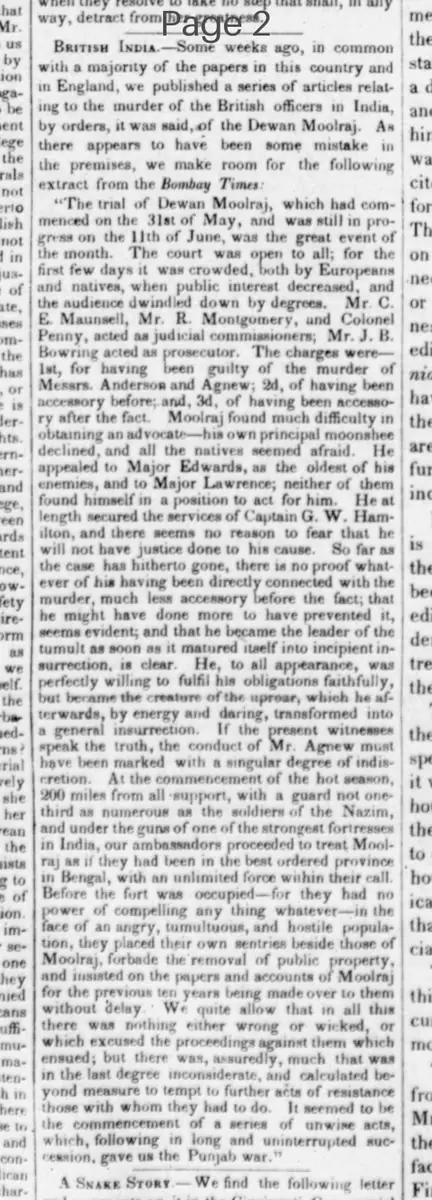
"The trial of Dewan Moolraj, which had commenced on the 31st of May, and was still in progress on the 11th of June, was the great event of the month. The court was open to all; for the first few days it was crowded, both by Europeans and natives, when public interest decreased, and the audience dwindled down by degrees. Mr C. E. Maunsell, Mr. R. Montgomery, and Colonel Penny, acted as judicial commissioners: Mr. J. B Bowring acted as prosecutor. The charges were—
1st, for having been guilty of the murder of Messrs. Anderson and Agnew; 2d, of having been accessory before; and, 3d, of having been accessory after the fact. Moolraj found much difficulty in obtaining an advocate—his own principal moonshee declined, and all the natives seemed afraid. He appealed to Major Edwards, as the oldest of his enemies, and to Major Lawrence; neither of them found himself in a position to act for him. He at length secured the services of Captain G. W. Hamilton, and there seems no reason to fear that he will not have justice done to his cause. So far as the case has hitherto gone, there is no proof whatever of his having been directly connected with the murder, much less accessory before the fact; that he might have done more to have prevented it, seems evident; and that he became the leader of the tumult as soon as it matured itself into incipient insurrection, is clear. He, to all appearance, was perfectly willing to fulfil his obligations faithfully, but became the creature of the uproar, which he afterwards, by energy and daring, transformed into a general insurrection.
If the present witnesses speak the truth, the conduct of Mr. Agnew must have been marked with a singular degree of indiscretion. At the commencement of the hot season, 200 miles from all support, with a guard not one-third as numerous as the soldiers of the Nazim, and under the guns of one of the strongest fortresses in India, our ambassadors proceeded to treat Moolraj as if they had been in the best ordered province in Bengal, with an unlimited force within their call. Before the fort was occupied—for they had no power of compelling any thing whatever—in the face of an angry, tumultuous, and hostile population, they placed their own sentries beside those of Moolraj, forbade the removal of public property, and insisted on the papers and accounts of Moolraj for the previous ten years being made over to them without delay. We quite allow that in all this there was nothing either wrong or wicked, or which excused the proceedings against them which ensued; but there was, assuredly, much that was in the last degree inconsiderate, and calculated beyond measure to tempt to further acts of resistance those with whom they had to do. It seemed to be the commencement of a series of unwise acts, which, following in long and uninterrupted succession, gave us the Punjab war."
What sub-type of article is it?
What keywords are associated?
What entities or persons were involved?
Where did it happen?
Foreign News Details
Primary Location
British India
Event Date
31st Of May To 11th Of June
Key Persons
Outcome
murder of messrs. anderson and agnew; trial ongoing with no proof of direct involvement by moolraj, but he led the insurrection; led to punjab war
Event Details
Trial of Dewan Moolraj for murder of British officers Anderson and Agnew and being accessory before and after the fact, commenced 31st May and ongoing 11th June; judicial commissioners Maunsell, Montgomery, Penny; prosecutor Bowring; Moolraj defended by Hamilton; no direct proof of involvement but failed to prevent and led insurrection; Agnew's actions described as indiscreet, provoking resistance.