Thank you for visiting SNEWPapers!
Sign up free
Daily National Intelligencer
Washington, District Of Columbia
What is this article about?
A letter critiques an essay by 'A Farmer' in the National Intelligencer, arguing that Adam Smith's principles on multiple banks increasing public security from Wealth of Nations do not apply to current U.S. banks due to the suspension of cash payments, which removes the competitive checks on over-issuance.
Clipping
OCR Quality
Full Text
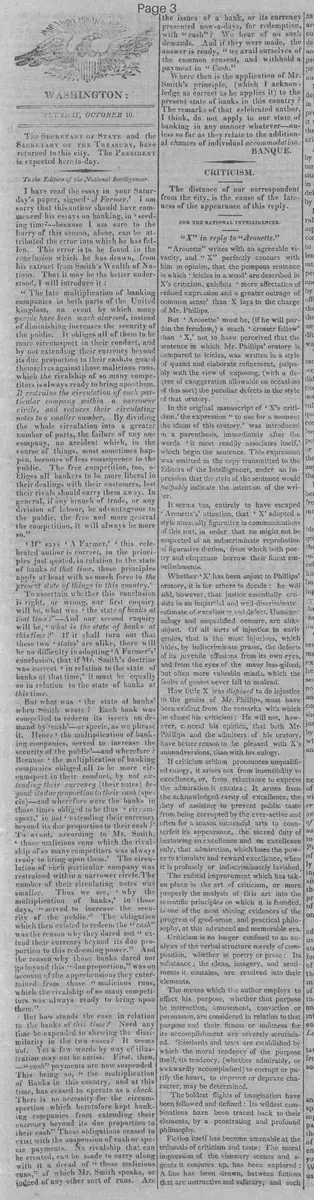
I have read the essay in your Saturday's paper, signed 'A Farmer.' I am sorry that this author should have commenced his essays on banking, in 'seed-time'—because I am sure to the hurry of this season, alone, can be attributed the error into which he has fallen. This error is to be found in the conclusion which he has drawn, from his extract from Smith's Wealth of Nations. That it may be the better understood, I will introduce it :
"The late multiplication of banking companies in both parts of the United Kingdom, an event by which many people have been much alarmed, instead of diminishing increases the security of the public. It obliges all of them to be more circumspect in their conduct, and by not extending their currency beyond its due proportion to their cash, to guard themselves against those malicious runs, which the rivalship of so many competitors is always ready to bring upon them. It restrains the circulation of each particular company within a narrower circle, and reduces their circulating notes to a smaller number. By dividing the whole circulation into a greater number of parts, the failure of any one company, an accident which, in the course of things, must sometimes happen, becomes of less consequence to the public. The free competition, too, obliges all bankers to be more liberal in their dealings with their customers, lest their rivals should carry them away. In general, if any branch of trade, or any division of labour, be advantageous to the public, the free and more general the competition, it will always be more so."
'If,' says 'A Farmer,' this celebrated author is correct, in the principles just quoted, in relation to the state of banks at that time, those principles apply at least with as much force to the present state of things in this country. To ascertain whether this conclusion is right, or wrong, our first enquiry will be, what was the state of banks at that time?"—And our second enquiry will be, 'what is the state of banks at this time?' If it shall turn out that these two states' are alike, there will be no difficulty in adopting 'A Farmer's' conclusion, that if Mr. Smith's doctrine was correct in relation to the state of banks at that time,' it must be equally so in relation to the state of banks at this time.
But what was the state of banks? when Smith wrote? Each bank was compelled to redeem its issues on demand by 'cash'—or specie, as we phrase it. Hence 'the multiplication of banking companies, served to increase the security of the public'—and wherefore? Because the multiplication of banking companies obliged all to be more circumspect in their conduct, by not extending their currency (their notes) beyond its due proportion to their cash (specie)—and wherefore were the banks in those times obliged to be thus 'circumspect,' in not 'extending their currency beyond its due proportion to their cash'? To avoid, according to Mr. Smith, those malicious runs which the rivalship of so many competitors was always ready to bring upon them.? The circulation of each particular company was restrained within a narrower circle. The number of their circulating notes was smaller. Thus we see, why the multiplication of banks, in those days, served to increase the security of the public." The obligation which then existed to redeem the "cash" was the reason why they dared not "extend their currency beyond its due proportion to this redeeming power." And the reason why those banks dared not go beyond this "due proportion," was on account of the apprehensions they entertained from those "malicious runs, which the rivalship of so many competitors was always ready to bring upon them."
But how stands the case in relation to the banks of this time? Need any time be expended in shewing the dissimilarity in the two cases? It seems not. Yet a few words by way of illustration may not be amiss. First, then, "cash" payments are now suspended. This being so, "the multiplication of Banks in this country, and at this time, has ceased to operate as a check. There is no necessity for the circumspection which heretofore kept banking companies from extending their currency beyond its due proportion to their cash." Those obligations ceased to exist with the suspension of cash or specie payments. No rivalship that can be created, can be made to carry along with it a dread of "those malicious runs," of which Mr. Smith speaks, or indeed of any other sort of runs. Are the issues of a bank, or its currency presented now-a-days, for redemption, with "cash?" We hear of no such demands. And if they were made, the answer is ready, "we avail ourselves of the common consent, and withhold a payment in "Cash."
Where then is the application of Mr. Smith's principle (which I acknowledge as correct as he applies it) to the present state of banks in this country? The remarks of that celebrated author, I think, do not apply to our state of banking in any manner whatever—unless so far as they relate to the additional chances of individual accommodation.
BANQUE.
What sub-type of article is it?
What themes does it cover?
What keywords are associated?
What entities or persons were involved?
Letter to Editor Details
Author
Banque.
Recipient
To The Editors Of The National Intelligencer.
Main Argument
adam smith's principles on the benefits of multiple banking companies for public security do not apply to the current state of u.s. banks because cash payments are suspended, eliminating the competitive pressures that enforced circumspection and limited over-issuance of currency.
Notable Details