Thank you for visiting SNEWPapers!
Sign up free
Story
November 22, 1882
Eureka Daily Sentinel
Eureka, Eureka County, Nevada
What is this article about?
Newspaper article from Eureka Sentinel reproduces and critiques Reno Gazette interview with Mrs. J. E. Anderson on her husband James's fatal shooting by George J. Reek in Eureka, Nevada, debating who fired first amid local political intrigue and election disputes. (187 chars)
Clipping
OCR Quality
95%
Excellent
Full Text
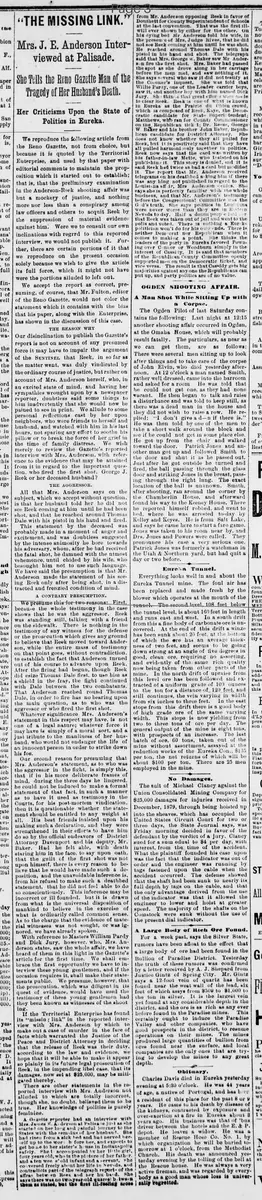
"THE MISSING LINK."
Mrs. J. E. Anderson Inter-viewed at Palisade.
She Tells the Reno Gazette Man of the Tragedy of Her Husband's Death.
Her Criticisms Upon the State of Politics in Eureka.
We reproduce the following article from the Reno Gazette, not from choice, but because it is quoted by the Territorial Enterprise, and used by that paper with editorial comments to maintain the proposition which it started out to establish: that is, that the preliminary examination in the Anderson-Reek shooting affair was but a mockery of justice, and nothing more nor less than a conspiracy among law officers and others to acquit Reek by the suppression of material evidence against him: Were we to consult our own inclinations with regard to this reported interview, we would not publish it. Further, there are certain portions of it that we reproduce on the present occasion solely because we wish to give the article its full force, which it might not have were the portions alluded to left out. We accept the report as correct, presuming, of course, that Mr. Fulton, editor of the Reno Gazette, would not color the statement which it contains with the bias that his paper, along with the Enterprise, has shown in the discussion of this case.
THE REASON WHY
Our disinclination to publish the Gazette's report is not on account of any presumed force it may have to impair the argument of the SENTINEL that Reek, in so far as the matter went, was duly vindicated by the ordinary course of justice, but rather on account of Mrs. Anderson herself, who, in an excited state of mind, and having her sympathies wrought upon by a newspaper reporter, doubtless said some things to him inadvertently that she would now be pained to see in print. We allude to some personal reflections cast by her upon neighbors, who were friends to herself and husband, and watched with him in his last hours, not sparing any effort to soothe his pillow or to break the force of her grief in the time of family distress. We wish merely to review the Gazette's reported interview with Mrs. Anderson, with reference to the evidence that may be attained from it in regard to the important question, who fired the first shot, George J. Reek or her deceased husband?
THE AGGRESSOR.
All that Mrs. Anderson says on the subject, which we accept without question, is that her husband told her he did not see Reek coming at him until he had been shot, and that he reached around Thomas Dale with his pistol in his hand and fired. This statement by the deceased was probably made in a moment of anger and excitement, and was doubtless suggested by the intense animosity he bore towards his adversary, whom, after he had received the fatal shot, he damned with the utmost vehemence, until chided by his wife, who besought him not to use such language.
We have said the presumption is that Mr. Anderson made the statement of his seeing Reek only after being shot, in a distracted and frenzied condition of mind.
A CONTRARY PRESUMPTION.
We presume this for two reasons: First, because the whole testimony in the case shows that he was the aggressor. Reek was standing still, talking with a friend on the sidewalk. There is nothing in the testimony of any witness for the defense or the prosecution which gives any ground to believe that Reek moved toward Anderson, while the entire mass of testimony on that point goes, without contradiction, to establish the fact that Anderson turned out of his course to advance upon Reek. After the firing had begun, though Reek did seize Thomas Dale first, to use him as a shield in the fray, the fight continued with Dale between the two combatants. That Anderson reached round Thomas Dale, in order to fire has no bearing upon the main question, as to who was the aggressor or who fired the first shot.
Whatever significance Mrs. Anderson's statement in this respect may have, is not one of a legal nature; whatever force it may have is simply of a moral sort, and a just tribute to the manliness of her husband, who would not endanger the life of an innocent person in order to strike down his foe.
Our second reason for presuming that Mrs. Anderson's statement, as to who was the aggressor in the fight, is simply this, that if in his more deliberate frames of mind, during the three days he lingered, he could not be induced to make a formal statement of that fact, in such a manner as to have it used as testimony in the Courts, for his post-mortem vindication, then it is questionable whether the statement should be entitled to any weight at all. His best friends insisted upon his making such a declaration, and they were strengthened in their efforts to have him do so by the official endeavors of District Attorney Davenport and his deputy, Mr. Baker. Had he felt able, with death staring him in the face, to say upon oath, that the guilt of the first shot was not upon himself, there is every reason to believe that he would have made such a deposition, and the unavoidable inference is, from his refusal to make such a deathbed statement, that he did not feel able to do so conscientiously. This inference may be incorrect or ill founded, but it is drawn from what is the universal disposition of mankind to believe in the exercise of what is ordinarily called common sense.
As to the charge that the evidence of material witnesses was not sought, or was ignored, we have already spoken.
With reference to Masters William Pardy and Dick Jury, however, who, Mrs. Anderson states, saw the whole affair, we have heard of them in this light in the Gazette's article for the first time. We shall embrace the first opportunity we have to interview these young gentlemen, and if the occasion requires it, shall make their statements public. We presume, however, that the prosecution, which was diligent in its quest of evidence, would have used the testimony of these young gentlemen had they been known as witnesses of the shooting.
If the Territorial Enterprise has found its "missing link" in the reported interview with Mrs. Anderson by which to make out a case of murder in the face of facts which warranted the Justice of the Peace and District Attorney in deciding that the release of Reek was their duty, according to the law and evidence, we hope that it will be able to make it appear so plainly in its future legal prosecution of Reek, in the impending libel case, that its damages, now set at $25,000, may be mitigated thereby.
There are other statements in the reported interview with Mrs. Anderson not alluded to which are totally incorrect, though she, no doubt, believed them to be true. Her knowledge of politics is purely feminine.
A Gazette reporter had an interview with Mrs. James E. Anderson at Palisade just as she started on her long and painful journey to the States with the remains of her husband. She had risen from a sick bed and had nerved herself up to the work before her, and expects to get home to her sister's house in Indianapolis safely. She is accompanied by her little girl, four years old, who is the picture of her father, and a ten weeks' old infant and a servant. She conversed freely about her life in Nevada, and contradicts part of the telegraph reports of the affray between Reek and her husband. She says there was no two-year-old quarrel between them as stated, but the first ill-feeling arose from Mr. Anderson opposing Reek in favor of Douthett for County Superintendent of Schools at the last convention. "That was the first ill will ever shown by either for the other. On his dying bed Mr. Anderson told his wife, in the presence of Mrs. Judge Rives, that he did not see Reek coming at him until he was shot. He reached around Thomas Dale with his pistol in his hand and shot. The telegraph said that Mrs. George W. Baker saw Mr. Anderson fire the first shot. Mrs. Baker had passed the spot as she drove along in her carriage before the men met, and saw nothing of it. She says several who saw it did not testify at the Coroner's inquest. She was told that Willie Pardy, one of the Leader carrier boys, saw it, and another boy with him named Dick Jury. She thinks that great efforts were made to clear Reek. Reek is one of what is known in Eureka as the Prairie du Chien crowd, which is composed of Reek, Kaye, the Democratic candidate for State Superintendent; Matthews, who ran for County Commissioner on the Republican ticket; Dr. Reese, George W. Baker and his brother John Baker, Republican Candidate for District Attorney. She does not know whether they all pulled for Reek, but it is positively said that they have all pulled harmoniously together in politics. Reek now says that the card was written by his father-in-law Mette, who insisted on his publishing it. This story is denied, and it is said Reek had twice as bad a card but modified it. The report that Mr. Anderson received telegrams on his deathbed asking him if there was anything not published in regard to the Louisiana affair, Mrs. Anderson denies. She says she is perfectly familiar with the whole business, and that Mr. Anderson's testimony before the Congressional Committee was the God's truth. She says politics in Louisiana were never worse than they are in Eastern Nevada today. Half a dozen people told her that Reek was taken out of jail and went to the polls and voted. There is nothing a Eureka politician won't do for his own ends. There is neither Democrat nor Republican when it comes to making a point. She thinks the leaders of the party in Eureka favored Powning over Connor or Woodburn simply in the interest of Cassidy. It is said that members of the Republican County Committee openly supported men on the Democratic ticket, and vice versa. The result is that Cassidy gets big majorities against any one the Republicans can put up, and party politics are of no value.
Mrs. J. E. Anderson Inter-viewed at Palisade.
She Tells the Reno Gazette Man of the Tragedy of Her Husband's Death.
Her Criticisms Upon the State of Politics in Eureka.
We reproduce the following article from the Reno Gazette, not from choice, but because it is quoted by the Territorial Enterprise, and used by that paper with editorial comments to maintain the proposition which it started out to establish: that is, that the preliminary examination in the Anderson-Reek shooting affair was but a mockery of justice, and nothing more nor less than a conspiracy among law officers and others to acquit Reek by the suppression of material evidence against him: Were we to consult our own inclinations with regard to this reported interview, we would not publish it. Further, there are certain portions of it that we reproduce on the present occasion solely because we wish to give the article its full force, which it might not have were the portions alluded to left out. We accept the report as correct, presuming, of course, that Mr. Fulton, editor of the Reno Gazette, would not color the statement which it contains with the bias that his paper, along with the Enterprise, has shown in the discussion of this case.
THE REASON WHY
Our disinclination to publish the Gazette's report is not on account of any presumed force it may have to impair the argument of the SENTINEL that Reek, in so far as the matter went, was duly vindicated by the ordinary course of justice, but rather on account of Mrs. Anderson herself, who, in an excited state of mind, and having her sympathies wrought upon by a newspaper reporter, doubtless said some things to him inadvertently that she would now be pained to see in print. We allude to some personal reflections cast by her upon neighbors, who were friends to herself and husband, and watched with him in his last hours, not sparing any effort to soothe his pillow or to break the force of her grief in the time of family distress. We wish merely to review the Gazette's reported interview with Mrs. Anderson, with reference to the evidence that may be attained from it in regard to the important question, who fired the first shot, George J. Reek or her deceased husband?
THE AGGRESSOR.
All that Mrs. Anderson says on the subject, which we accept without question, is that her husband told her he did not see Reek coming at him until he had been shot, and that he reached around Thomas Dale with his pistol in his hand and fired. This statement by the deceased was probably made in a moment of anger and excitement, and was doubtless suggested by the intense animosity he bore towards his adversary, whom, after he had received the fatal shot, he damned with the utmost vehemence, until chided by his wife, who besought him not to use such language.
We have said the presumption is that Mr. Anderson made the statement of his seeing Reek only after being shot, in a distracted and frenzied condition of mind.
A CONTRARY PRESUMPTION.
We presume this for two reasons: First, because the whole testimony in the case shows that he was the aggressor. Reek was standing still, talking with a friend on the sidewalk. There is nothing in the testimony of any witness for the defense or the prosecution which gives any ground to believe that Reek moved toward Anderson, while the entire mass of testimony on that point goes, without contradiction, to establish the fact that Anderson turned out of his course to advance upon Reek. After the firing had begun, though Reek did seize Thomas Dale first, to use him as a shield in the fray, the fight continued with Dale between the two combatants. That Anderson reached round Thomas Dale, in order to fire has no bearing upon the main question, as to who was the aggressor or who fired the first shot.
Whatever significance Mrs. Anderson's statement in this respect may have, is not one of a legal nature; whatever force it may have is simply of a moral sort, and a just tribute to the manliness of her husband, who would not endanger the life of an innocent person in order to strike down his foe.
Our second reason for presuming that Mrs. Anderson's statement, as to who was the aggressor in the fight, is simply this, that if in his more deliberate frames of mind, during the three days he lingered, he could not be induced to make a formal statement of that fact, in such a manner as to have it used as testimony in the Courts, for his post-mortem vindication, then it is questionable whether the statement should be entitled to any weight at all. His best friends insisted upon his making such a declaration, and they were strengthened in their efforts to have him do so by the official endeavors of District Attorney Davenport and his deputy, Mr. Baker. Had he felt able, with death staring him in the face, to say upon oath, that the guilt of the first shot was not upon himself, there is every reason to believe that he would have made such a deposition, and the unavoidable inference is, from his refusal to make such a deathbed statement, that he did not feel able to do so conscientiously. This inference may be incorrect or ill founded, but it is drawn from what is the universal disposition of mankind to believe in the exercise of what is ordinarily called common sense.
As to the charge that the evidence of material witnesses was not sought, or was ignored, we have already spoken.
With reference to Masters William Pardy and Dick Jury, however, who, Mrs. Anderson states, saw the whole affair, we have heard of them in this light in the Gazette's article for the first time. We shall embrace the first opportunity we have to interview these young gentlemen, and if the occasion requires it, shall make their statements public. We presume, however, that the prosecution, which was diligent in its quest of evidence, would have used the testimony of these young gentlemen had they been known as witnesses of the shooting.
If the Territorial Enterprise has found its "missing link" in the reported interview with Mrs. Anderson by which to make out a case of murder in the face of facts which warranted the Justice of the Peace and District Attorney in deciding that the release of Reek was their duty, according to the law and evidence, we hope that it will be able to make it appear so plainly in its future legal prosecution of Reek, in the impending libel case, that its damages, now set at $25,000, may be mitigated thereby.
There are other statements in the reported interview with Mrs. Anderson not alluded to which are totally incorrect, though she, no doubt, believed them to be true. Her knowledge of politics is purely feminine.
A Gazette reporter had an interview with Mrs. James E. Anderson at Palisade just as she started on her long and painful journey to the States with the remains of her husband. She had risen from a sick bed and had nerved herself up to the work before her, and expects to get home to her sister's house in Indianapolis safely. She is accompanied by her little girl, four years old, who is the picture of her father, and a ten weeks' old infant and a servant. She conversed freely about her life in Nevada, and contradicts part of the telegraph reports of the affray between Reek and her husband. She says there was no two-year-old quarrel between them as stated, but the first ill-feeling arose from Mr. Anderson opposing Reek in favor of Douthett for County Superintendent of Schools at the last convention. "That was the first ill will ever shown by either for the other. On his dying bed Mr. Anderson told his wife, in the presence of Mrs. Judge Rives, that he did not see Reek coming at him until he was shot. He reached around Thomas Dale with his pistol in his hand and shot. The telegraph said that Mrs. George W. Baker saw Mr. Anderson fire the first shot. Mrs. Baker had passed the spot as she drove along in her carriage before the men met, and saw nothing of it. She says several who saw it did not testify at the Coroner's inquest. She was told that Willie Pardy, one of the Leader carrier boys, saw it, and another boy with him named Dick Jury. She thinks that great efforts were made to clear Reek. Reek is one of what is known in Eureka as the Prairie du Chien crowd, which is composed of Reek, Kaye, the Democratic candidate for State Superintendent; Matthews, who ran for County Commissioner on the Republican ticket; Dr. Reese, George W. Baker and his brother John Baker, Republican Candidate for District Attorney. She does not know whether they all pulled for Reek, but it is positively said that they have all pulled harmoniously together in politics. Reek now says that the card was written by his father-in-law Mette, who insisted on his publishing it. This story is denied, and it is said Reek had twice as bad a card but modified it. The report that Mr. Anderson received telegrams on his deathbed asking him if there was anything not published in regard to the Louisiana affair, Mrs. Anderson denies. She says she is perfectly familiar with the whole business, and that Mr. Anderson's testimony before the Congressional Committee was the God's truth. She says politics in Louisiana were never worse than they are in Eastern Nevada today. Half a dozen people told her that Reek was taken out of jail and went to the polls and voted. There is nothing a Eureka politician won't do for his own ends. There is neither Democrat nor Republican when it comes to making a point. She thinks the leaders of the party in Eureka favored Powning over Connor or Woodburn simply in the interest of Cassidy. It is said that members of the Republican County Committee openly supported men on the Democratic ticket, and vice versa. The result is that Cassidy gets big majorities against any one the Republicans can put up, and party politics are of no value.
What sub-type of article is it?
Crime Story
Historical Event
Mystery
What themes does it cover?
Crime Punishment
Justice
Deception
What keywords are associated?
Shooting Incident
Fatal Duel
Political Rivalry
Eureka Politics
Reek Acquittal
Anderson Death
Witness Testimony
What entities or persons were involved?
Mrs. J. E. Anderson
James E. Anderson
George J. Reek
Thomas Dale
Mrs. Judge Rives
Willie Pardy
Dick Jury
District Attorney Davenport
Mr. Baker
Mette
Where did it happen?
Eureka, Nevada; Palisade, Nevada
Story Details
Key Persons
Mrs. J. E. Anderson
James E. Anderson
George J. Reek
Thomas Dale
Mrs. Judge Rives
Willie Pardy
Dick Jury
District Attorney Davenport
Mr. Baker
Mette
Location
Eureka, Nevada; Palisade, Nevada
Story Details
James E. Anderson was fatally shot by George J. Reek in Eureka amid political rivalry. Mrs. Anderson's interview claims her husband fired after being shot, reaching around Thomas Dale. The article defends Reek's acquittal, arguing Anderson was the aggressor, and critiques political conspiracies in Eureka.