Thank you for visiting SNEWPapers!
Sign up free
Editorial
March 4, 1817
Richmond Enquirer
Richmond, Richmond County, Virginia
What is this article about?
An anonymous Virginian addresses newly inaugurated President James Monroe, praising his virtues and urging him to govern with firm independence, prioritizing the nation's good by learning to say 'no' to misguided friends, bad measures, or incompetent appointees.
Clipping
OCR Quality
98%
Excellent
Full Text
RICHMOND. MARCH 4, 1817.
To JAMES MONROE, Esq.
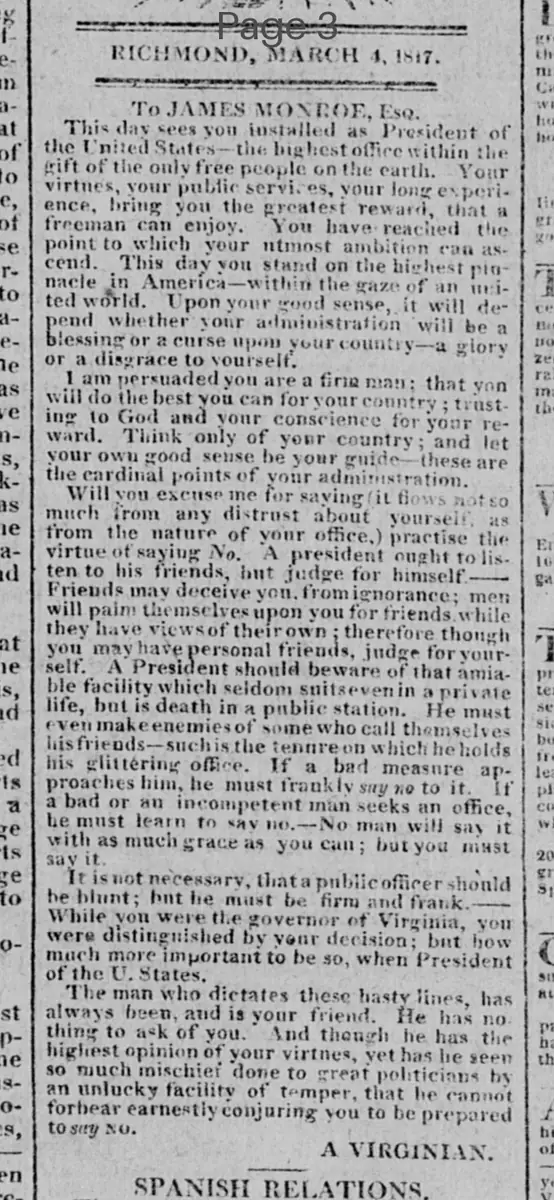
This day sees you installed as President of the United States—the highest office within the gift of the only free people on the earth. Your virtues, your public services, your long experience, bring you the greatest reward, that a freeman can enjoy. You have reached the point to which your utmost ambition can ascend. This day you stand on the highest pinnacle in America—within the gaze of an enlightened world. Upon your good sense, it will depend whether your administration will be a blessing or a curse upon your country—a glory or a disgrace to yourself.
I am persuaded you are a fine man: that you will do the best you can for your country; trusting to God and your conscience for your reward. Think only of your country; and let your own good sense be your guide—these are the cardinal points of your administration.
Will you excuse me for saying (it flows not so much from any distrust about yourself, as from the nature of your office.) practise the virtue of saying No. A president ought to listen to his friends, but judge for himself.—Friends may deceive you, from ignorance; men will palm themselves upon you for friends while they have views of their own; therefore though you may have personal friends, judge for yourself. A President should beware of that amiable facility which seldom suits even in a private life, but is death in a public station. He must even make enemies of some who call themselves his friends—such is the tenure on which he holds his glittering office. If a bad measure approaches him, he must frankly say no to it. If a bad or an incompetent man seeks an office, he must learn to say no.—No man will say it with as much grace as you can; but you must say it.
It is not necessary, that a public officer should be blunt; but he must be firm and frank.—While you were the governor of Virginia, you were distinguished by your decision; but how much more important to be so, when President of the U. States.
The man who dictates these hasty lines, has always been, and is your friend. He has nothing to ask of you. And though he has the highest opinion of your virtues, yet has he seen so much mischief done to great politicians by an unlucky facility of temper, that he cannot forbear earnestly conjuring you to be prepared to say NO.
A VIRGINIAN.
To JAMES MONROE, Esq.
This day sees you installed as President of the United States—the highest office within the gift of the only free people on the earth. Your virtues, your public services, your long experience, bring you the greatest reward, that a freeman can enjoy. You have reached the point to which your utmost ambition can ascend. This day you stand on the highest pinnacle in America—within the gaze of an enlightened world. Upon your good sense, it will depend whether your administration will be a blessing or a curse upon your country—a glory or a disgrace to yourself.
I am persuaded you are a fine man: that you will do the best you can for your country; trusting to God and your conscience for your reward. Think only of your country; and let your own good sense be your guide—these are the cardinal points of your administration.
Will you excuse me for saying (it flows not so much from any distrust about yourself, as from the nature of your office.) practise the virtue of saying No. A president ought to listen to his friends, but judge for himself.—Friends may deceive you, from ignorance; men will palm themselves upon you for friends while they have views of their own; therefore though you may have personal friends, judge for yourself. A President should beware of that amiable facility which seldom suits even in a private life, but is death in a public station. He must even make enemies of some who call themselves his friends—such is the tenure on which he holds his glittering office. If a bad measure approaches him, he must frankly say no to it. If a bad or an incompetent man seeks an office, he must learn to say no.—No man will say it with as much grace as you can; but you must say it.
It is not necessary, that a public officer should be blunt; but he must be firm and frank.—While you were the governor of Virginia, you were distinguished by your decision; but how much more important to be so, when President of the U. States.
The man who dictates these hasty lines, has always been, and is your friend. He has nothing to ask of you. And though he has the highest opinion of your virtues, yet has he seen so much mischief done to great politicians by an unlucky facility of temper, that he cannot forbear earnestly conjuring you to be prepared to say NO.
A VIRGINIAN.
What sub-type of article is it?
Constitutional
What keywords are associated?
Presidential Advice
James Monroe
Firm Governance
Say No
Executive Independence
Public Virtue
What entities or persons were involved?
James Monroe
President Of The United States
A Virginian
Editorial Details
Primary Topic
Advice On Firm Presidential Decision Making
Stance / Tone
Earnest Supportive Counsel
Key Figures
James Monroe
President Of The United States
A Virginian
Key Arguments
Prioritize The Country And Own Good Sense In Administration
Practice Saying 'No' To Bad Measures And Incompetent Appointees
Judge Independently Despite Potentially Deceptive Friends
Be Firm And Frank Without Bluntness In Public Office