Thank you for visiting SNEWPapers!
Sign up free
Editorial
July 13, 1881
Green Mountain Freeman
Montpelier, Washington County, Vermont
What is this article about?
Editorial argues that accumulating wealth is legitimate but must be used morally and Christianly to help the poor escape poverty and share prosperity, warning that ignoring the poor will lead to future troubles. By J. G. Holland in Scribner for July.
Clipping
OCR Quality
95%
Excellent
Full Text
The Winning of Wealth
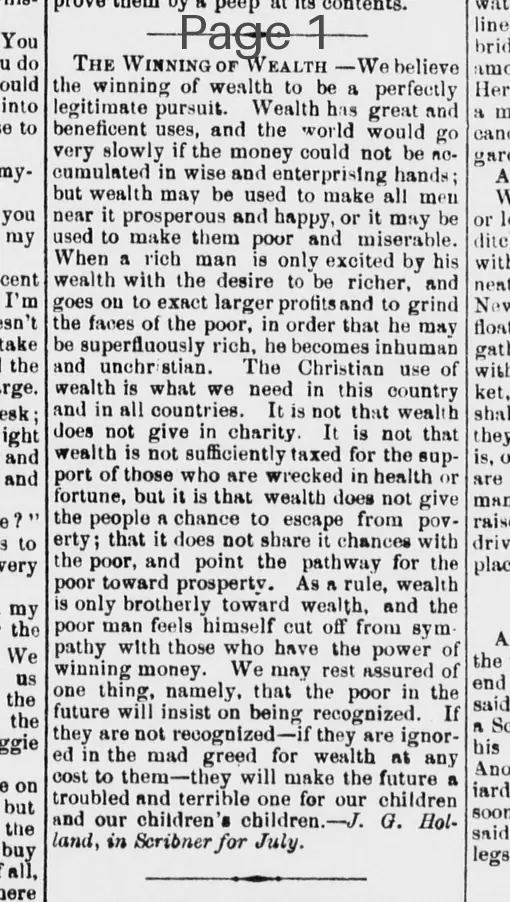
We believe the winning of wealth to be a perfectly legitimate pursuit. Wealth has great and beneficent uses, and the world would go very slowly if the money could not be accumulated in wise and enterprising hands; but wealth may be used to make all men near it prosperous and happy, or it may be used to make them poor and miserable.
When a rich man is only excited by his wealth with the desire to be richer, and goes on to exact larger profits and to grind the faces of the poor, in order that he may be superfluously rich, he becomes inhuman and unchristian. The Christian use of wealth is what we need in this country and in all countries. It is not that wealth does not give in charity. It is not that wealth is not sufficiently taxed for the support of those who are wrecked in health or fortune, but it is that wealth does not give the people a chance to escape from poverty; that it does not share its chances with the poor, and point the pathway for the poor toward prosperity. As a rule, wealth is only brotherly toward wealth, and the poor man feels himself cut off from sympathy with those who have the power of winning money. We may rest assured of one thing, namely, that the poor in the future will insist on being recognized. If they are not recognized—if they are ignored in the mad greed for wealth at any cost to them—they will make the future a troubled and terrible one for our children and our children's children.
—J. G. Holland, in Scribner for July.
We believe the winning of wealth to be a perfectly legitimate pursuit. Wealth has great and beneficent uses, and the world would go very slowly if the money could not be accumulated in wise and enterprising hands; but wealth may be used to make all men near it prosperous and happy, or it may be used to make them poor and miserable.
When a rich man is only excited by his wealth with the desire to be richer, and goes on to exact larger profits and to grind the faces of the poor, in order that he may be superfluously rich, he becomes inhuman and unchristian. The Christian use of wealth is what we need in this country and in all countries. It is not that wealth does not give in charity. It is not that wealth is not sufficiently taxed for the support of those who are wrecked in health or fortune, but it is that wealth does not give the people a chance to escape from poverty; that it does not share its chances with the poor, and point the pathway for the poor toward prosperity. As a rule, wealth is only brotherly toward wealth, and the poor man feels himself cut off from sympathy with those who have the power of winning money. We may rest assured of one thing, namely, that the poor in the future will insist on being recognized. If they are not recognized—if they are ignored in the mad greed for wealth at any cost to them—they will make the future a troubled and terrible one for our children and our children's children.
—J. G. Holland, in Scribner for July.
What sub-type of article is it?
Moral Or Religious
Social Reform
Economic Policy
What keywords are associated?
Wealth Accumulation
Christian Use Of Wealth
Poverty Escape
Greed Warning
Poor Recognition
What entities or persons were involved?
J. G. Holland
The Rich
The Poor
Editorial Details
Primary Topic
Christian And Moral Use Of Wealth To Aid The Poor
Stance / Tone
Advocacy For Benevolent Wealth Use And Warning Against Greed
Key Figures
J. G. Holland
The Rich
The Poor
Key Arguments
Winning Wealth Is Legitimate If Used Beneficently
Wealth Can Make Others Prosperous Or Miserable
Greed For Superfluous Riches Is Inhuman And Unchristian
Christian Use Of Wealth Is Needed To Share Opportunities With The Poor
Poor Will Demand Recognition Or Cause Future Troubles