Thank you for visiting SNEWPapers!
Sign up free
Indiana State Sentinel
Indianapolis, Marion County, Indiana
What is this article about?
A letter advocating for reform of the probate court system in the state by establishing Probate Circuits with competent, legally trained judges elected by the legislature or people, to equalize it with Circuit Courts, reduce errors, and improve efficiency. Written from Brownstown on November 3, 1845.
Clipping
OCR Quality
Full Text
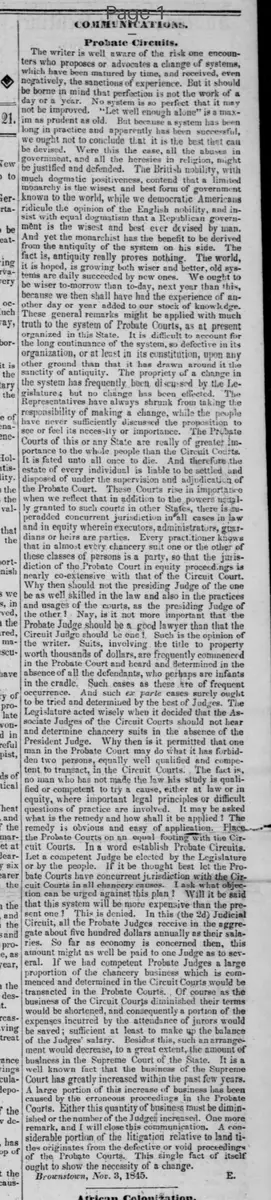
Probate Circuits.
The writer is well aware of the risk one encounters who proposes or advocates a change of systems, which have been matured by time, and received, even negatively, the sanctions of experience. But it should be borne in mind that perfection is not the work of a day or a year. No system is so perfect that it may not be improved. "Let well enough alone" is a maxim as prudent as old. But because a system has been long in practice and apparently has been successful, we ought not to conclude that it is the best that can be devised. Were this the case, all the abuses in government, and all the heresies in religion, might be justified and defended. The British nobility, with much dogmatic positiveness, contend that a limited monarchy is the wisest and best form of government known to the world, while we democratic Americans ridicule the opinion of the English nobility, and insist with equal dogmatism that a Republican government is the wisest and best ever devised by man. And yet the monarchist has the benefit to be derived from the antiquity of the system on his side. The fact is, antiquity really proves nothing. The world, it is hoped, is growing both wiser and better, old systems are daily succeeded by new ones. We ought to be wiser to-morrow than to-day, next year than this, because we then shall have had the experience of another day or year added to our stock of knowledge.
These general remarks might be applied with much truth to the system of Probate Courts, as at present organized in this State. It is difficult to account for the long continuance of the system, so defective in its organization, or at least in its constitution, upon any other ground than that it has drawn around it the sanctity of antiquity. The propriety of a change in the system has frequently been discussed by the Legislature; but no change has been effected. The Representatives have always shrunk from taking the responsibility of making a change, while the people have never sufficiently discussed the proposition to see or feel its necessity or importance. The Probate Courts of this or any State are really of greater importance to the whole people than the Circuit Courts. It is fated unto all once to die. And therefore the estate of every individual is liable to be settled and disposed of under the supervision and adjudication of the Probate Court. These Courts rise in importance when we reflect that in addition to the powers usually granted to such courts in other States, there is superadded concurrent jurisdiction in all cases in law and in equity wherein executors, administrators, guardians or heirs are parties. Every practitioner knows that in almost every chancery suit one or the other of these classes of persons is a party, so that the jurisdiction of the Probate Court in equity proceedings is nearly co-extensive with that of the Circuit Court. Why then should not the presiding Judge of the one be as well skilled in the law and also in the practices and usages of the courts, as the presiding Judge of the other! Nay, is it not more important that the Probate Judge should be a good lawyer than that the Circuit Judge should be one! Such is the opinion of the writer. Suits, involving the title to property worth thousands of dollars, are frequently commenced in the Probate Court and heard and determined in the absence of all the defendants, who perhaps are infants in the cradle. Such cases as these are of frequent occurrence. And such ex parte cases surely ought to be tried and determined by the best of Judges. The Legislature acted wisely when it decided that the Associate Judges of the Circuit Courts should not hear and determine chancery suits in the absence of the President Judge. Why then is it permitted that one man in the Probate Court may do what it has forbidden two persons, equally well qualified and competent to transact, in the Circuit Courts. The fact is, no man who has not made the law his study is qualified or competent to try a cause, either at law or in equity, where important legal principles or difficult questions of practice are involved. It may be asked what is the remedy and how shall it be applied! The remedy is obvious and easy of application. Place the Probate Courts on an equal footing with the Circuit Courts. In a word establish Probate Circuits. Let a competent Judge be elected by the Legislature or by the people. If it be thought best let the Probate Courts have concurrent jurisdiction with the Circuit Courts in all chancery causes. I ask what objection can be urged against this plan? Will it be said that this system will be more expensive than the present one? This is denied. In this (the 2d) Judicial Circuit, all the Probate Judges receive in the aggregate about five hundred dollars annually as their salaries. So far as economy is concerned then, this amount might as well be paid to one Judge as to several. If we had competent Probate Judges a large proportion of the chancery business which is commenced and determined in the Circuit Courts would be transacted in the Probate Courts. Of course as the business of the Circuit Courts diminished their terms would be shortened, and consequently a portion of the expenses incurred by the attendance of jurors would be saved; sufficient at least to make up the balance of the Judges' salary. Besides this, such an arrangement would decrease, to a great extent, the amount of business in the Supreme Court of the State. It is a well known fact that the business of the Supreme Court has greatly increased within the past few years. A large portion of this increase of business has been caused by the erroneous proceedings in the Probate Courts. Either this quantity of business must be diminished or the number of the Judges increased. One more remark, and I will close this communication. A considerable portion of the litigation relative to land titles originates from the defective or void proceedings of the Probate Courts. This single fact of itself ought to show the necessity of a change
Brownstown, Nov. 3, 1845.
E.
What sub-type of article is it?
What themes does it cover?
What keywords are associated?
What entities or persons were involved?
Letter to Editor Details
Author
E.
Main Argument
the current probate court system is defective due to unqualified judges; it should be reformed by establishing probate circuits with competent, legally trained judges elected by the legislature or people, granting concurrent jurisdiction with circuit courts to improve efficiency, reduce errors, and save costs without increasing expenses.
Notable Details