Thank you for visiting SNEWPapers!
Sign up free
Gazette Of The United States And Daily Evening Advertiser
Philadelphia, Philadelphia County, Pennsylvania
What is this article about?
In the French National Convention, committees reported on Popular Societies, praising their past services but warning of dangers from intrigue. A decree was proposed to limit their influence and passed amid applause, despite opposition from some members like Thibodeau and Barrere, with support from Robespierre and others.
Merged-components note: These two components form a continuous article on the French National Convention's report regarding Popular Societies, based on sequential reading order and connected text content.
Clippings
1 of 2
OCR Quality
Full Text
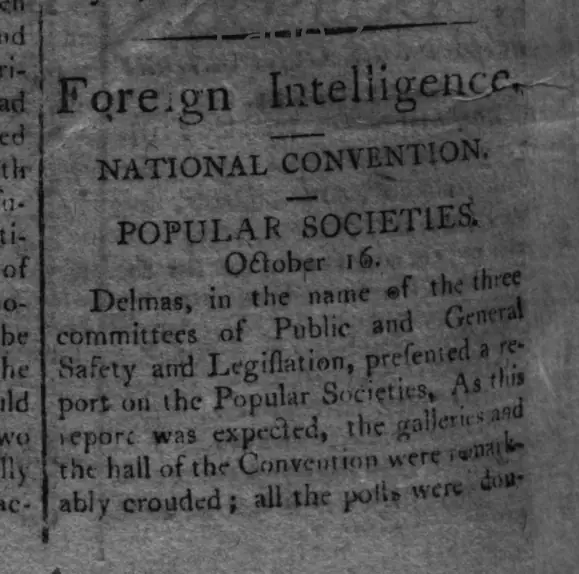
NATIONAL CONVENTION
POPULAR SOCIETIES
The committees of Public Safety and Legislation, presented a report on the Popular Societies. As this report was expected, the galleries and the hall of the Convention were remarkably crowded; all the clubs were consulted.
The guard led, and strong patrols paraded the streets.
Upon which Popular Societies were established. They begin by applauding the principles. He then proceeded to point out the services which had been rendered to the cause of liberty, and the services which these societies had performed. He dreaded the dangers which might arise if vigorous measures were not adopted to prevent them from becoming the instruments of intriguing and ambitious men; he instanced as examples of this danger the events of the 9th Thermidor; he dwelt with great energy on the influence which in the height of the French Republic had lately arisen to such a pitch, that no important measure could be adopted without their aid and concurrence. The revolutionary government, he said, ought to be without a rival, and if the Popular Societies were suffered to take so active a part in the government, the revolutionary principle would be constantly either opposed or checked in its operation.
By correspondence and communication. The means by which these Societies had arrived at this plenitude of power, were, by forming an immense corporation, powerfully influencing the opinion, and the action of government. It had therefore become necessary to apply a strong remedy to this evil: the committee therefore propose the following Decree:
This Decree we have already published.
Thibodeau, Duhem, Lecointre, Craufot and Barrere, opposed the decree on the principle that the Convention had no right to prevent men from assembling and corresponding with each other.
Robespierre, Bentabole, Bourdon of l'Oise, Thuriot, and many other members spoke in favor of the decree.
Those who opposed the decree went on the supposition that the societies were to be destroyed: this was not the case. The Convention only meant to prevent the Societies being injurious to the French republic.
The proposal of the three committees was decreed amid the loudest plaudits.
What sub-type of article is it?
What keywords are associated?
What entities or persons were involved?
Where did it happen?
Foreign News Details
Primary Location
Paris
Key Persons
Outcome
the proposal of the three committees was decreed amid the loudest plaudits.
Event Details
The committees of Public Safety and Legislation presented a report on Popular Societies, highlighting their services to liberty but warning of dangers from intrigue and ambition, citing the 9th Thermidor. They proposed a decree to limit their influence through correspondence and communication to prevent rivalry with the revolutionary government. Opposition argued against restricting assemblies, but supporters like Robespierre prevailed, and the decree passed.