Thank you for visiting SNEWPapers!
Sign up free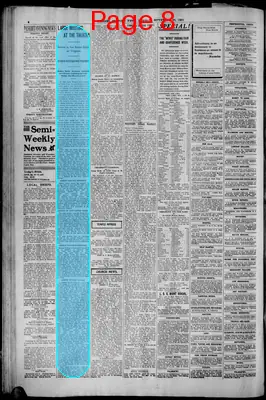
Story
September 30, 1901
Deseret Evening News
Salt Lake City, Salt Lake County, Utah
What is this article about?
A crowded religious meeting at Salt Lake Theater features sermons by Episcopal bishops Gailor, Newcastle, Dudley, and Tuttle, presided by Bishop Leonard. They discuss church principles, liberty, and express gratitude for Utah's peaceful statehood and Spanish-American War contributions, despite Bishop Potter's absence.
Clipping

OCR Quality
98%
Excellent
Full Text
LARGE MEETING
AT THE THEATER
Sermons by Four Eminent Episcopal
Clergymen.
BISHOP POTTER NOT PRESENT
Bishop Tuttle Expresses Gratitude Over Present Conditions In Utah.
Praises War Record of State.
The Salt Lake Theater was crowded last night from the ground floor to the second gallery and many people stood up to witness the religious exercises of the Episcopal church and to hear some eminent divines of that organization. There was marked disappointment over the absence of Bishop Potter, which, as explained by Bishop Leonard, was due to the latter's necessity of going back to Ogden yesterday afternoon in order to secure accommodations to the coast. A letter from him was read in which he expressed the intention of spending a Sabbath in Salt Lake on his return from San Francisco, when he would be pleased to address the people of this city.
Those who spoke last night were Bishop Gailor of Tennessee, the Lord Bishop of Newcastle, England; Bishop Dudley of Kentucky, and Bishop Tuttle of St. Louis. These gentlemen spoke of the origin of the Protestant Episcopal church and endeavored to explain what that church stands for.
Bishop Leonard presided over the services and after the opening exercises he extended a cordial welcome to the visiting clergymen. In his introductory remarks he said he would divide the basis of Christian work into three propositions:
"First, that the great principles of modern civilization and the development of our institutions rest upon Christian principles and Christian truths; second, that more and more through the mists of time we have come to understand that the whole battle was fought about the person of Jesus Christ; and third, that it is impossible in the history of the Christian gospel and its influence in the world to understand fully and completely the work of Christ without an understanding of that historical institution which He founded and which has come down to our own time, and in which we believe when we say, 'I believe in the holy Catholic church.'"
BISHOP GAILOR'S REMARKS.
Bishop Gailor began his remarks by saying that it was hard to talk about the Episcopal church because there never was an institution more misunderstood. But he affirmed that the Episcopal church is in sympathy with modern institutions and modern feelings, in short the church stood for liberty. He said that the interests of nations interplay and intermingle as never before in the world's history. Individualism is passing and institutions are taking its place. Bishop Gailor went on to explain the aims and purposes of the Episcopal church.
BISHOP OF NEWCASTLE TALKS.
The next speaker was the Right Reverend Lord Bishop Jacobs of Newcastle, who said that he visited Utah eighteen years ago, and at that time he little thought that eighteen years hence he would address as Bishop of Newcastle, the magnificent audience that confronted him. He said that the message of the Episcopal church was simply repentance and the remission of sins. This is the message, he said, that every member of his church was in duty bound to take to the nations of the earth.
He said further that the Christian gospel is the moral dynamic of the world, that is that the love of God was the force that moved men to righteousness.
BISHOP DUDLEY'S REMARKS
Bishop Dudley of Kentucky proved to be a speaker of superior ability, and was listened to very closely. He said that the Episcopal church stood for liberty. It did not set up a cast-iron standard of morals for men to conform to, because temptations are not alike to all men. While his son might be tempted by the music of the dance, it would have no temptation for him, no matter how sweet the music, polished the floor or how beautiful the woman. But perhaps in a few days hence, in San Francisco, when parties were arranged, when one man or another had his purpose to gain, then he would be tempted so sorely that it would require all his strength to resist.
BISHOP TUTTLE SPEAKS.
As Bishop Tuttle stepped to the front of the stage he was greeted with loud applause, indicating that the good man is still close in the affections of the people of Salt Lake. He said he was glad to see so many prominent bishops present and asked them if they could find anywhere in America or England a more appreciative, attentive or reverential audience than the one they were facing. "And," he added, "may I tell these friends that we are Methodists, and that we are Presbyterians, and that we are Baptists, and that we are Lutherans, and that we are Hebrews, and that we are Latter-day Saints, who came more than fifty years ago and under the severest strain of hardship founded this city whose kind hospitality we are now enjoying. We are all sorts and conditions of men gathered here tonight, and yet are we not in the unity of spirit, and the bond of peace, and I hope in righteousness of life, well?
"Utah has at last, as the forty-fifth state of the union, taken her stand in walking under the flag and after the flag and ready to defend the flag. Do you want proof of that? Search the military annals of this last war with Spain and find out what the Utah contingent especially as represented by the Utah battery, stood for in the fighting days of the last war, and then make up your minds whether Utah is marching loyally and lovingly keeping step to the music of the union. (Applause.)
"And so will you not glance back with me a moment to the past and thank God that these United States, represented by their government in Washington had the wisdom, the patience and long-suffering forbearance not to force matters to any heroic sort of issue and not to take the torch and kindle the inflammable materials of fanatical earnestness and of deep conviction of their rights for religious liberty under the Constitution, that beat in the hearts of the people who lived here?
"And shall we not also thank God that the people here who manufactured and gave force to public opinion throughout this region where we now stand, also had the patience and forbearance to wait and wait and wait? And so patience and long-suffering and forbearance under God's providence, and under the good sense of the American people, and I may say truly the good sense of the "Mormon" people finally solved the difficult problem. None of you know how difficult it was except we who lived here for twenty years in the past. And the problem was solved without one ounce of bloodshed. Thank God for that.
Bishop Tuttle closed by saying that the Episcopal church stood for individual righteousness and personal holiness and not to ask too many questions about things of which everyone must have his own individual opinion. He also said that the man and the woman who would not come to church and yet did all the good they could show by their actions that they possess the Holy Spirit within them, and added: "Who are you and I that we dare say to them, you do not come to church and therefore stand thou there. We go to church, and therefore we will sit here." In short, he said the Episcopal church wants to help people try to do what Wolseley said to Cromwell, "Let all the ends you aim at be your God's, your country's and truth's."
AT THE THEATER
Sermons by Four Eminent Episcopal
Clergymen.
BISHOP POTTER NOT PRESENT
Bishop Tuttle Expresses Gratitude Over Present Conditions In Utah.
Praises War Record of State.
The Salt Lake Theater was crowded last night from the ground floor to the second gallery and many people stood up to witness the religious exercises of the Episcopal church and to hear some eminent divines of that organization. There was marked disappointment over the absence of Bishop Potter, which, as explained by Bishop Leonard, was due to the latter's necessity of going back to Ogden yesterday afternoon in order to secure accommodations to the coast. A letter from him was read in which he expressed the intention of spending a Sabbath in Salt Lake on his return from San Francisco, when he would be pleased to address the people of this city.
Those who spoke last night were Bishop Gailor of Tennessee, the Lord Bishop of Newcastle, England; Bishop Dudley of Kentucky, and Bishop Tuttle of St. Louis. These gentlemen spoke of the origin of the Protestant Episcopal church and endeavored to explain what that church stands for.
Bishop Leonard presided over the services and after the opening exercises he extended a cordial welcome to the visiting clergymen. In his introductory remarks he said he would divide the basis of Christian work into three propositions:
"First, that the great principles of modern civilization and the development of our institutions rest upon Christian principles and Christian truths; second, that more and more through the mists of time we have come to understand that the whole battle was fought about the person of Jesus Christ; and third, that it is impossible in the history of the Christian gospel and its influence in the world to understand fully and completely the work of Christ without an understanding of that historical institution which He founded and which has come down to our own time, and in which we believe when we say, 'I believe in the holy Catholic church.'"
BISHOP GAILOR'S REMARKS.
Bishop Gailor began his remarks by saying that it was hard to talk about the Episcopal church because there never was an institution more misunderstood. But he affirmed that the Episcopal church is in sympathy with modern institutions and modern feelings, in short the church stood for liberty. He said that the interests of nations interplay and intermingle as never before in the world's history. Individualism is passing and institutions are taking its place. Bishop Gailor went on to explain the aims and purposes of the Episcopal church.
BISHOP OF NEWCASTLE TALKS.
The next speaker was the Right Reverend Lord Bishop Jacobs of Newcastle, who said that he visited Utah eighteen years ago, and at that time he little thought that eighteen years hence he would address as Bishop of Newcastle, the magnificent audience that confronted him. He said that the message of the Episcopal church was simply repentance and the remission of sins. This is the message, he said, that every member of his church was in duty bound to take to the nations of the earth.
He said further that the Christian gospel is the moral dynamic of the world, that is that the love of God was the force that moved men to righteousness.
BISHOP DUDLEY'S REMARKS
Bishop Dudley of Kentucky proved to be a speaker of superior ability, and was listened to very closely. He said that the Episcopal church stood for liberty. It did not set up a cast-iron standard of morals for men to conform to, because temptations are not alike to all men. While his son might be tempted by the music of the dance, it would have no temptation for him, no matter how sweet the music, polished the floor or how beautiful the woman. But perhaps in a few days hence, in San Francisco, when parties were arranged, when one man or another had his purpose to gain, then he would be tempted so sorely that it would require all his strength to resist.
BISHOP TUTTLE SPEAKS.
As Bishop Tuttle stepped to the front of the stage he was greeted with loud applause, indicating that the good man is still close in the affections of the people of Salt Lake. He said he was glad to see so many prominent bishops present and asked them if they could find anywhere in America or England a more appreciative, attentive or reverential audience than the one they were facing. "And," he added, "may I tell these friends that we are Methodists, and that we are Presbyterians, and that we are Baptists, and that we are Lutherans, and that we are Hebrews, and that we are Latter-day Saints, who came more than fifty years ago and under the severest strain of hardship founded this city whose kind hospitality we are now enjoying. We are all sorts and conditions of men gathered here tonight, and yet are we not in the unity of spirit, and the bond of peace, and I hope in righteousness of life, well?
"Utah has at last, as the forty-fifth state of the union, taken her stand in walking under the flag and after the flag and ready to defend the flag. Do you want proof of that? Search the military annals of this last war with Spain and find out what the Utah contingent especially as represented by the Utah battery, stood for in the fighting days of the last war, and then make up your minds whether Utah is marching loyally and lovingly keeping step to the music of the union. (Applause.)
"And so will you not glance back with me a moment to the past and thank God that these United States, represented by their government in Washington had the wisdom, the patience and long-suffering forbearance not to force matters to any heroic sort of issue and not to take the torch and kindle the inflammable materials of fanatical earnestness and of deep conviction of their rights for religious liberty under the Constitution, that beat in the hearts of the people who lived here?
"And shall we not also thank God that the people here who manufactured and gave force to public opinion throughout this region where we now stand, also had the patience and forbearance to wait and wait and wait? And so patience and long-suffering and forbearance under God's providence, and under the good sense of the American people, and I may say truly the good sense of the "Mormon" people finally solved the difficult problem. None of you know how difficult it was except we who lived here for twenty years in the past. And the problem was solved without one ounce of bloodshed. Thank God for that.
Bishop Tuttle closed by saying that the Episcopal church stood for individual righteousness and personal holiness and not to ask too many questions about things of which everyone must have his own individual opinion. He also said that the man and the woman who would not come to church and yet did all the good they could show by their actions that they possess the Holy Spirit within them, and added: "Who are you and I that we dare say to them, you do not come to church and therefore stand thou there. We go to church, and therefore we will sit here." In short, he said the Episcopal church wants to help people try to do what Wolseley said to Cromwell, "Let all the ends you aim at be your God's, your country's and truth's."
What sub-type of article is it?
Historical Event
What themes does it cover?
Providence Divine
Moral Virtue
Justice
What keywords are associated?
Episcopal Church
Salt Lake Theater
Bishop Tuttle
Utah Statehood
Spanish American War
Religious Unity
Providence
What entities or persons were involved?
Bishop Potter
Bishop Leonard
Bishop Gailor
Bishop Jacobs Of Newcastle
Bishop Dudley
Bishop Tuttle
Where did it happen?
Salt Lake Theater, Salt Lake City, Utah
Story Details
Key Persons
Bishop Potter
Bishop Leonard
Bishop Gailor
Bishop Jacobs Of Newcastle
Bishop Dudley
Bishop Tuttle
Location
Salt Lake Theater, Salt Lake City, Utah
Event Date
Last Night
Story Details
Episcopal bishops deliver sermons on church origins, liberty, and Christian principles at a crowded theater meeting. Bishop Tuttle praises Utah's statehood, war record, and peaceful resolution of historical tensions through patience and providence.