Thank you for visiting SNEWPapers!
Sign up free
Story
September 29, 1893
The Globe Republican
Dodge City, Ford County, Kansas
What is this article about?
Historical account of grains and fruits' origins in wild states across latitudes, their cultivation starting in warm regions, global spread, and improvements, noting America's role in corn and potato despite recent habitation.
Clipping
OCR Quality
98%
Excellent
Full Text
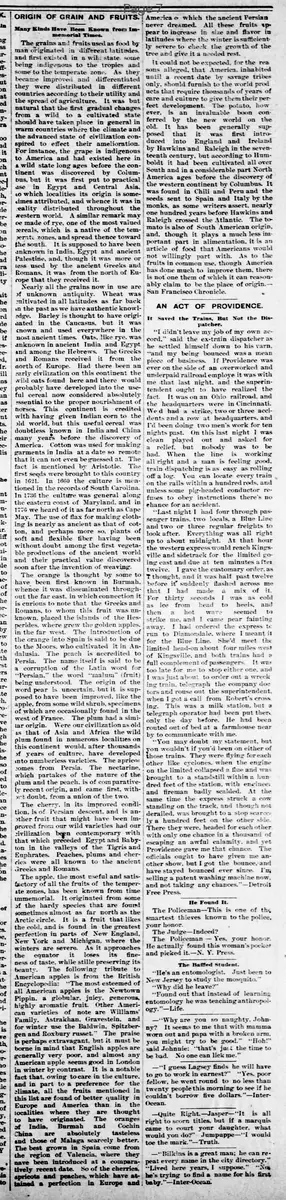
Origin of Grains and Fruits.
Kinds Have Been Restored to Memorial Times.
The grains and fruits used as food by man originated in different latitudes, and first existed in a wild state, some being indigenous to the tropics and some to the temperate zone. As they became improved and differentiated they were distributed in different countries according to their utility and the spread of agriculture. It was but natural that the first gradual changes from a wild to a cultivated state should have taken place in general in warm countries where the climate and the advanced state of civilization conspired to effect their amelioration.
For instance, the grape is indigenous to America and had existed here in a wild state long ages before the continent was discovered by Columbus, but it was first put to practical use in Egypt and Central Asia, to which localities its origin is sometimes attributed, and whence it was in reality distributed throughout the western world. A similar remark may be made of rye, one of the most valued cereals, which is a native of the temperate zones, and spread thence toward the south. It is supposed to have been unknown in India, Egypt and ancient Palestine, and, though it was more or less used by the ancient Greeks and Romans, it was from the north of Europe that they received it.
Nearly all the grains now in use are of unknown antiquity. Wheat was cultivated in all latitudes as far back in the past as we have authentic knowledge. Barley is thought to have originated in the Caucasus, but it was known and used everywhere in the most ancient times. Oats, like rye, was unknown in ancient India and Egypt and among the Hebrews. The Greeks and Romans received it from the north of Europe. Had there been an early civilization on this continent the wild oats found here and there would probably have developed into the useful cereal now considered absolutely essential to the proper nourishment of horses. This continent is credited with having given Indian corn to the old world, but this useful cereal was doubtless known in India and China many years before the discovery of America. Cotton was used for making garments in India at a date so remote that it can not even be guessed at. The fact is mentioned by Aristotle. The first seeds were brought to this country in 1631. In 1660 the culture is mentioned in the records of South Carolina. In 1736 the culture was general along the eastern coast of Maryland, and in 1776 we hear of it as far north as Cape May. The use of flax for making clothing is nearly as ancient as that of cotton, and perhaps more so, plants of soft and flexible fiber having been without doubt among the first vegetable productions of the ancient world and their practical value discovered soon after the invention of weaving.
The orange is thought by some to have been first known in Burmah, whence it was disseminated throughout the far east, in which connection it is curious to note that the Greeks and Romans, to whom this fruit was unknown, placed the islands of the Hesperides, where grew the golden apples, in the far west. The introduction of the orange into Spain is said to be due to the Moors, who cultivated it in Andalusia. The peach is accredited to Persia. The name itself is said to be a corruption of the Latin word for "Persian," the word "malum" (fruit) being understood. The origin of the word pear is uncertain, but it is supposed to have been improved, like the apple, from some wild shrub, specimens of which are occasionally found in the west of France. The plum had a similar origin. Were our civilization as old as that of Asia and Africa the wild plum found in numerous localities on this continent would, after thousands of years of culture, have developed into numberless varieties. The apricot comes from Persia. The nectarine, which partakes of the nature of the plum and the peach, is of comparatively recent origin, and came first, without doubt, from a union of the two.
The cherry, in its improved condition, is of Persian descent, and is another fruit that might have been improved from our wild varieties had our civilization been contemporary with that which preceded Egypt and Babylon in the valleys of the Tigris and Euphrates. Peaches, plums and cherries were all known to the ancient Greeks and Romans.
The apple, the most useful and satisfactory of all the fruits of the temperate zones, has been known from time immemorial. It originated from some of the hardy species that are found sometimes almost as far north as the Arctic circle. It is a fruit that likes the cold, and is found in the greatest perfection in parts of New England, New York and Michigan, where the winters are severe. As it approaches the equator it loses its fineness of taste, while still preserving its beauty. The following tribute to American apples is from the British Encyclopedia: "The most esteemed of all American apples is the Newtown Pippin, a globular, juicy, generous, highly aromatic fruit. Other American varieties of note are Williams' Family, Astrakhan, Gravestein, and for winter use the Baldwin, Spitzbergen and Roxbury russet." The praise is perhaps extravagant, but it must be borne in mind that English apples are generally very poor, and almost any American apple seems good in London in winter by contrast. It is a notable fact that, owing to care in the culture, and in part to a preference for the climate, all the fruits mentioned in this list are found of better quality in Europe and America than in the localities where they are thought to have originated.
The oranges of India, Burmah and Cochin China are absolutely tasteless and those of Malaga scarcely better. The best grown in Spain come from the region of Valencia, where they have been introduced at a comparatively recent date. So of the cherries apricots and peaches, which have attained a perfection in America which the ancient Persian never dreamed. All these fruits appear to increase in size and flavor in latitudes where the winter is sufficiently severe to check the growth of the tree and give it a needed rest.
It could not be expected, for the reasons alleged, that America, inhabited until a recent date by savage tribes only, should furnish to the world products that require thousands of years of care and culture to give them their perfect development. The potato, however, is an invaluable boon conferred by the new world on the old. It has been generally supposed that it was first introduced into England and Ireland by Hawkins and Raleigh in the seventeenth century, but according to Humboldt it had been cultivated all over South and in a considerable part North America ages before the discovery of the western continent by Columbus. It was found in Chili and Peru and the seeds sent to Spain and Italy by the monks, as some writers assert, nearly one hundred years before Hawkins and Raleigh crossed the Atlantic. The tomato is also of South American origin, and, though it plays a much less important part in alimentation, it is an article of food that Americans would not willingly part with. As to the fruits in common use, though America has done much to improve them, there is not one of them of which it can reasonably claim to be the place of origin.—San Francisco Chronicle.
Kinds Have Been Restored to Memorial Times.
The grains and fruits used as food by man originated in different latitudes, and first existed in a wild state, some being indigenous to the tropics and some to the temperate zone. As they became improved and differentiated they were distributed in different countries according to their utility and the spread of agriculture. It was but natural that the first gradual changes from a wild to a cultivated state should have taken place in general in warm countries where the climate and the advanced state of civilization conspired to effect their amelioration.
For instance, the grape is indigenous to America and had existed here in a wild state long ages before the continent was discovered by Columbus, but it was first put to practical use in Egypt and Central Asia, to which localities its origin is sometimes attributed, and whence it was in reality distributed throughout the western world. A similar remark may be made of rye, one of the most valued cereals, which is a native of the temperate zones, and spread thence toward the south. It is supposed to have been unknown in India, Egypt and ancient Palestine, and, though it was more or less used by the ancient Greeks and Romans, it was from the north of Europe that they received it.
Nearly all the grains now in use are of unknown antiquity. Wheat was cultivated in all latitudes as far back in the past as we have authentic knowledge. Barley is thought to have originated in the Caucasus, but it was known and used everywhere in the most ancient times. Oats, like rye, was unknown in ancient India and Egypt and among the Hebrews. The Greeks and Romans received it from the north of Europe. Had there been an early civilization on this continent the wild oats found here and there would probably have developed into the useful cereal now considered absolutely essential to the proper nourishment of horses. This continent is credited with having given Indian corn to the old world, but this useful cereal was doubtless known in India and China many years before the discovery of America. Cotton was used for making garments in India at a date so remote that it can not even be guessed at. The fact is mentioned by Aristotle. The first seeds were brought to this country in 1631. In 1660 the culture is mentioned in the records of South Carolina. In 1736 the culture was general along the eastern coast of Maryland, and in 1776 we hear of it as far north as Cape May. The use of flax for making clothing is nearly as ancient as that of cotton, and perhaps more so, plants of soft and flexible fiber having been without doubt among the first vegetable productions of the ancient world and their practical value discovered soon after the invention of weaving.
The orange is thought by some to have been first known in Burmah, whence it was disseminated throughout the far east, in which connection it is curious to note that the Greeks and Romans, to whom this fruit was unknown, placed the islands of the Hesperides, where grew the golden apples, in the far west. The introduction of the orange into Spain is said to be due to the Moors, who cultivated it in Andalusia. The peach is accredited to Persia. The name itself is said to be a corruption of the Latin word for "Persian," the word "malum" (fruit) being understood. The origin of the word pear is uncertain, but it is supposed to have been improved, like the apple, from some wild shrub, specimens of which are occasionally found in the west of France. The plum had a similar origin. Were our civilization as old as that of Asia and Africa the wild plum found in numerous localities on this continent would, after thousands of years of culture, have developed into numberless varieties. The apricot comes from Persia. The nectarine, which partakes of the nature of the plum and the peach, is of comparatively recent origin, and came first, without doubt, from a union of the two.
The cherry, in its improved condition, is of Persian descent, and is another fruit that might have been improved from our wild varieties had our civilization been contemporary with that which preceded Egypt and Babylon in the valleys of the Tigris and Euphrates. Peaches, plums and cherries were all known to the ancient Greeks and Romans.
The apple, the most useful and satisfactory of all the fruits of the temperate zones, has been known from time immemorial. It originated from some of the hardy species that are found sometimes almost as far north as the Arctic circle. It is a fruit that likes the cold, and is found in the greatest perfection in parts of New England, New York and Michigan, where the winters are severe. As it approaches the equator it loses its fineness of taste, while still preserving its beauty. The following tribute to American apples is from the British Encyclopedia: "The most esteemed of all American apples is the Newtown Pippin, a globular, juicy, generous, highly aromatic fruit. Other American varieties of note are Williams' Family, Astrakhan, Gravestein, and for winter use the Baldwin, Spitzbergen and Roxbury russet." The praise is perhaps extravagant, but it must be borne in mind that English apples are generally very poor, and almost any American apple seems good in London in winter by contrast. It is a notable fact that, owing to care in the culture, and in part to a preference for the climate, all the fruits mentioned in this list are found of better quality in Europe and America than in the localities where they are thought to have originated.
The oranges of India, Burmah and Cochin China are absolutely tasteless and those of Malaga scarcely better. The best grown in Spain come from the region of Valencia, where they have been introduced at a comparatively recent date. So of the cherries apricots and peaches, which have attained a perfection in America which the ancient Persian never dreamed. All these fruits appear to increase in size and flavor in latitudes where the winter is sufficiently severe to check the growth of the tree and give it a needed rest.
It could not be expected, for the reasons alleged, that America, inhabited until a recent date by savage tribes only, should furnish to the world products that require thousands of years of care and culture to give them their perfect development. The potato, however, is an invaluable boon conferred by the new world on the old. It has been generally supposed that it was first introduced into England and Ireland by Hawkins and Raleigh in the seventeenth century, but according to Humboldt it had been cultivated all over South and in a considerable part North America ages before the discovery of the western continent by Columbus. It was found in Chili and Peru and the seeds sent to Spain and Italy by the monks, as some writers assert, nearly one hundred years before Hawkins and Raleigh crossed the Atlantic. The tomato is also of South American origin, and, though it plays a much less important part in alimentation, it is an article of food that Americans would not willingly part with. As to the fruits in common use, though America has done much to improve them, there is not one of them of which it can reasonably claim to be the place of origin.—San Francisco Chronicle.
What sub-type of article is it?
Curiosity
Historical Event
What themes does it cover?
Nature
Exploration
What keywords are associated?
Grain Origins
Fruit History
Wild Cultivation
Agriculture Spread
Plant Distribution
American Plants
Where did it happen?
Various Countries Including America, Asia, Europe, Egypt, India
Story Details
Location
Various Countries Including America, Asia, Europe, Egypt, India
Event Date
Ancient Times To 18th Century
Story Details
The article traces the origins of grains and fruits from wild states in different latitudes, their improvement through cultivation primarily in warm climates, and distribution worldwide, with examples like grapes from America but used in Egypt, wheat from ancient times, and American contributions like corn and potato.