Thank you for visiting SNEWPapers!
Sign up free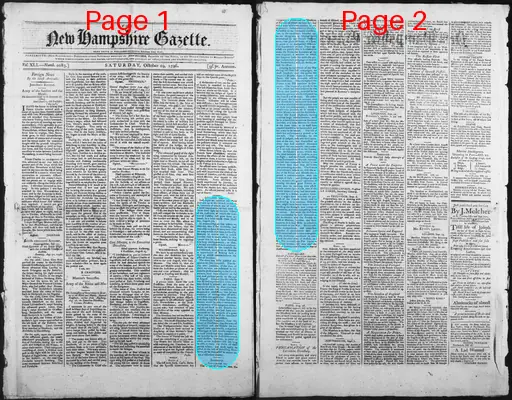
The New Hampshire Gazette
Portsmouth, Rockingham County, New Hampshire
What is this article about?
London report from Paris journals details Austrian victory over Jourdan on August 22-23, but Moreau counters with decisive advances, routing the Archduke's army and extending French conquests in Germany. The Treaty with Baden signals French intent to hold the Rhine, dimming peace prospects.
Merged-components note: Continuation of the summary article across pages, as the text flows directly from one to the next.
Clippings
1 of 2
OCR Quality
Full Text
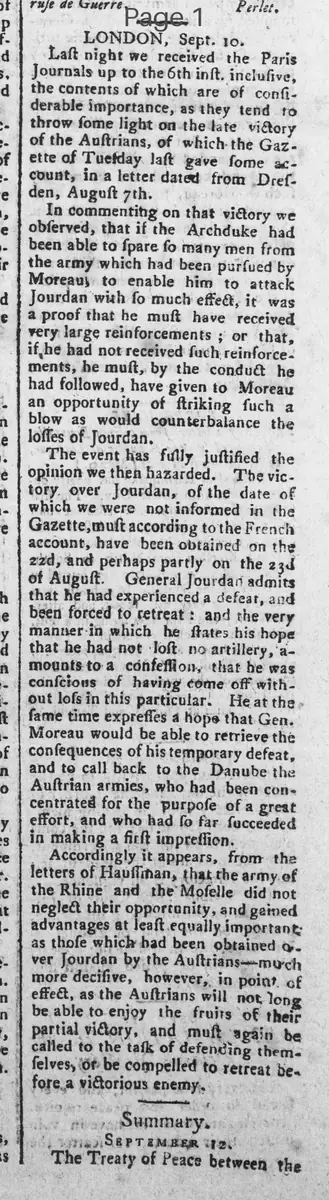
Last night we received the Paris Journals up to the 6th inst. inclusive, the contents of which are of considerable importance, as they tend to throw some light on the late victory of the Austrians, of which the Gazette of Tuesday last gave some account, in a letter dated from Dresden, August 7th.
In commenting on that victory we observed, that if the Archduke had been able to spare so many men from the army which had been pursued by Moreau to enable him to attack Jourdan with so much effect, it was a proof that he must have received very large reinforcements ; or that, if he had not received such reinforcements, he must, by the conduct he had followed, have given to Moreau an opportunity of striking such a blow as would counterbalance the losses of Jourdan.
The event has fully justified the opinion we then hazarded. The victory over Jourdan, of the date of which we were not informed in the Gazette, must according to the French account, have been obtained on the 22d, and perhaps partly on the 23d of August. General Jourdan admits that he had experienced a defeat, and been forced to retreat : and the very manner in which he states his hope that he had lost no artillery, amounts to a confession, that he was conscious of having come off without loss in this particular. He at the same time expresses a hope that Gen. Moreau would be able to retrieve the consequences of his temporary defeat, and to call back to the Danube the Austrian armies, who had been concentrated for the purpose of a great effort, and who had so far succeeded in making a first impression.
Accordingly it appears, from the letters of Haussman, that the army of the Rhine and the Moselle did not neglect their opportunity, and gained advantages at least equally important as those which had been obtained over Jourdan by the Austrians--much more decisive, however, in point of effect, as the Austrians will not long be able to enjoy the fruits of their partial victory, and must again be called to the task of defending themselves, or be compelled to retreat before a victorious enemy.
Summary.
The Treaty of Peace between the
The treaty lately concluded between the Margrave of Baden and the Directory of France, of which we have this day laid a copy before our readers, is very important. Independent of the clauses hostile to the Germanic Constitution, or the conditions imposed upon the Margrave, it displays views entertained by the French Government, that place all hopes of speedy peace at an unexpected distance. The stipulations of that Treaty manifest too plainly that it is resolved to make the Rhine the boundary of the new Republic, a measure to which the Emperor (who has made the present unfortunate campaign to recover the Netherlands) will, no doubt, refuse his assent. Judging by the events of the War during the three last campaigns, we must conclude that the earlier His Imperial Majesty signs a Treaty of Peace, the more favorable will be the conditions. The triumphs of the French arms will continue in Germany. The hopes of a reverse in the War, which had been inspired by the victory over Jourdan, recorded in the Gazette, are now wholly dissipated by the success of Moreau. We observed upon the Gazette account, that the Archduke's movement to attack Jourdan would probably produce one of these two consequences; either it would ruin Jourdan, or it would enable Moreau to ruin the Archduke; either His Royal Highness, having received large reinforcements, must be in a condition to route or surround Jourdan, and keep Moreau in check at the same time, or he must have exposed himself to be surrounded, and his army to be routed. The last of these has unfortunately proved to be the case. The Archduke, by the most ill judged, rash and fatal operation of the war, has diminished an army that had checked Moreau's progress for two months, and rendered it an easy conquest to the Enemy. The Archduke's army, which was the chief bulwark of Austria, is put to flight: and the French, marching from Donawerth to Munich, have extended their conquests further in two or three days than they did in the two preceding months. The French Journals even inform us, that the army of the Rhine and Moselle has opened a communication with the troops of Italy: and perhaps at this very moment the grand operation of uniting the three great French armies may be carrying into effect. There cannot be a doubt, that if the centre Imperial army had been commanded by a skilful, prudent General, it might have retarded the progress of the French forces, and by persevering in a cautious, defensive war, might have found means of exhausting the strength and energy of the enemy, and even compelling them to retreat. But while the Austrians are commanded by such Generals as the Archduke, and the French by such as Moreau, Jourdan, and Buonaparte, it is impossible to calculate the events of the War. We see rashness, inexperience, and indecision opposed to consummate skill, and well concerted and sudden enterprize. If the Archduke continues to command the chief army of Austria, and Mr. Pitt to direct the War Councils of Great Britain, we may read the fate of London and Vienna in that of Amsterdam.
What sub-type of article is it?
What keywords are associated?
What entities or persons were involved?
Where did it happen?
Foreign News Details
Primary Location
Germany
Event Date
22d, And Perhaps Partly On The 23d Of August
Key Persons
Outcome
austrian victory over jourdan leading to his retreat without artillery loss; moreau's counter-success routing archduke's army, french advances to munich, potential unification of french armies; treaty with baden aims for rhine boundary, dimming peace hopes.
Event Details
Paris journals report Austrian defeat of Jourdan on August 22-23, but Moreau exploits the opportunity to gain decisive advantages, forcing Austrians to retreat; editorial summary highlights the Baden treaty's implications for French expansion and critiques Archduke's rash strategy enabling French triumphs in Germany.