Thank you for visiting SNEWPapers!
Sign up free
The Charlotte Journal
Charlotte, Mecklenburg County, North Carolina
What is this article about?
President Andrew Jackson's January 1836 message to Congress details ongoing diplomatic tensions with France over the 1831 treaty's indemnification payment. France demands specific apologies, which the US refuses, leading to suspended relations and recommendations for trade restrictions and naval preparations.
Clipping
OCR Quality
Full Text
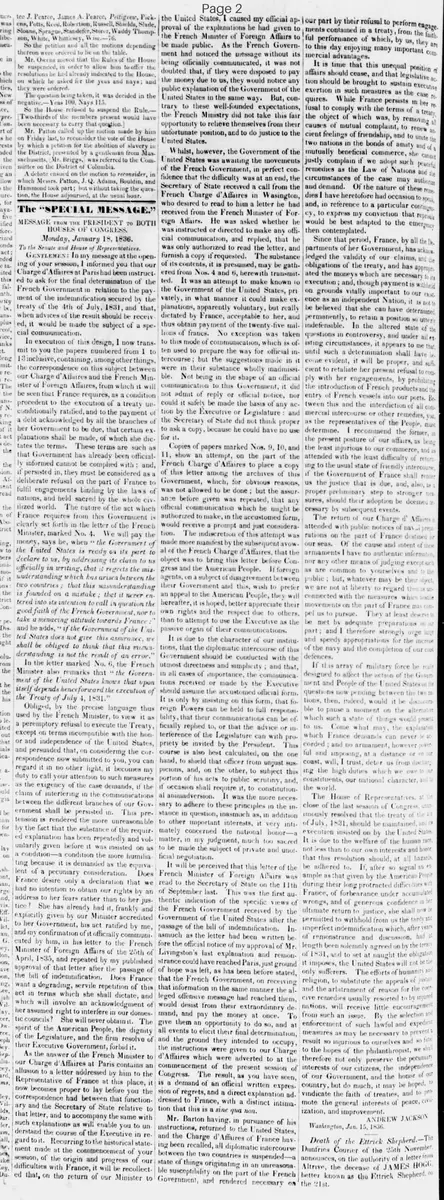
MESSAGE FROM THE PRESIDENT TO BOTH HOUSES OF CONGRESS.
Monday, January 18, 1836.
To the Senate and House of Representatives.
GENTLEMEN: In my message at the opening of your session, I informed you that our Charge d'Affaires at Paris had been instructed to ask for the final determination of the French Government in relation to the payment of the indemnification secured by the treaty of the 4th of July, 1831, and that, when advices of the result should be received, it would be made the subject of a special communication.
In execution of this design, I now transmit to you the papers numbered from 1 to 13 inclusive, containing, among other things, the correspondence on this subject between our Charge d'Affaires and the French Minister of Foreign Affairs, from which it will be seen that France requires, as a condition precedent to the execution of a treaty unconditionally ratified, and to the payment of a debt acknowledged by all the branches of her Government to be due, that certain explanations shall be made, of which she dictates the terms. These terms are such as that Government has already been officially informed cannot be complied with; and, if persisted in, they must be considered as a deliberate refusal on the part of France to fulfil engagements binding by the laws of nations, and held sacred by the whole civilized world. The nature of the act which France requires from this Government is clearly set forth in the letter of the French Minister, marked No. 4. We will pay the money, says he, when "the Government of the United States is ready on its part to declare to us, by addressing its claim to us officially in writing, that it regrets the misunderstanding which has arisen between the two countries; that this misunderstanding is founded on a mistake; that it never entered into its intention to call in question the good faith of the French Government, nor to take a menacing attitude towards France;" and he adds, "if the Government of the United States does not give this assurance, we shall be obliged to think that this misunderstanding is not the result of an error."
In the letter marked No. 6, the French Minister also remarks that "the Government of the United States knows that upon itself depends hereafter the execution of the Treaty of July 4, 1831."
Obliged, by the precise language thus used by the French Minister, to view it as a peremptory refusal to execute the Treaty, except on terms incompatible with the honor and independence of the United States, and persuaded that, on considering the correspondence now submitted to you, you can regard it in no other light, it becomes my duty to call your attention to such measures as the exigency of the case demands, if the claim of interfering in the communications between the different branches of our Government shall be persisted in. This pretension is rendered the more unreasonable by the fact that the substance of the required explanation has been repeatedly and voluntarily given before it was insisted on as a condition—a condition the more humiliating because it is demanded as the equivalent of a pecuniary consideration. Does France desire only a declaration that we had no intention to obtain our rights by an address to her fears rather than to her justice? She has already had it, frankly and explicitly given by our Minister accredited to her Government, his act ratified by me, and my confirmation of it officially communicated by him, in his letter to the French Minister of Foreign Affairs of the 25th of April, 1835, and repeated by my published approval of that letter after the passage of the bill of indemnification. Does France want a degrading, servile repetition of this act in terms which she shall dictate, and which will involve an acknowledgment of her assumed right to interfere in our domestic councils? She will never obtain it. The spirit of the American People, the dignity of the Legislature, and the firm resolve of their Executive Government, forbid it.
As the answer of the French Minister to our Charge d'Affaires at Paris contains an allusion to a letter addressed by him to the Representative of France at this place, it now becomes proper to lay before you the correspondence had between that functionary and the Secretary of State relative to that letter, and to accompany the same with such explanations as will enable you to understand the course of the Executive in regard to it. Recurring to the historical statement made at the commencement of your session, of the origin and progress of our difficulties with France, it will be recollected that, on the return of our Minister to the United States, I caused my official approval of the explanations he had given to the French Minister of Foreign Affairs to be made public. As the French Government had noticed the message without its being officially communicated, it was not doubted that, if they were disposed to pay the money due to us, they would notice any public explanation of the Government of the United States in the same way. But, contrary to these well-founded expectations, the French Ministry did not take this fair opportunity to relieve themselves from their unfortunate position, and to do justice to the United States.
Whilst, however, the Government of the United States was awaiting the movements of the French Government, in perfect confidence that the difficulty was at an end, the Secretary of State received a call from the French Charge d'Affaires in Washington, who desired to read to him a letter he had received from the French Minister of Foreign Affairs. He was asked whether he was instructed or directed to make any official communication, and replied, that he was only authorized to read the letter, and furnish a copy if requested. The substance of its contents, it is presumed, may be gathered from Nos. 4 and 6, herewith transmitted. It was an attempt to make known to the Government of the United States, privately, in what manner it could make explanations, apparently voluntary, but really dictated by France, acceptable to her, and thus obtain payment of the twenty-five millions of francs. No exception was taken to this mode of communication, which is often used to prepare the way for official intercourse; but the suggestions made in it were in their substance wholly inadmissible. Not being in the shape of an official communication to this Government, it did not admit of reply or official notice, nor could it safely be made the basis of any action by the Executive or Legislature: and the Secretary of State did not think proper to ask a copy, because he could have no use for it.
Copies of papers marked Nos. 9, 10, and 11, show an attempt, on the part of the French Charge d'Affaires to place a copy of this letter among the archives of this Government, which, for obvious reasons was not allowed to be done; but the assurance before given was repeated, that any official communication which he might be authorized to make, in the accustomed form, would receive a prompt and just consideration. The indiscretion of this attempt was made more manifest by the subsequent avowal of the French Charge d'Affaires, that the object was to bring this letter before Congress and the American People. If foreign agents, on a subject of disagreement between their Government and this, wish to prefer an appeal to the American People, they will hereafter, it is hoped, better appreciate their own rights and the respect due to others, than to attempt to use the Executive as the passive organ of their communications.
It is due to the character of our institutions, that the diplomatic intercourse of this Government should be conducted with the utmost directness and simplicity; and that, in all cases of importance, the communications received or made by the Executive should assume the accustomed official form. It is only by insisting on this form, that foreign Powers can be held to full responsibility, that their communications can be officially replied to, or that the advice or interference of the Legislature can with propriety be invited by the President. This course is also best calculated, on the one hand, to shield that officer from unjust suspicions, and, on the other, to subject this portion of his acts to public scrutiny, and, if occasion shall require it, to constitutional animadversion. It was the more necessary to adhere to these principles in the instance in question, inasmuch as, in addition to other important interests, it very intimately concerned the national honor—a matter, in my judgment, much too sacred to be made the subject of private and unofficial negotiation.
It will be perceived that this letter of the French Minister of Foreign Affairs was read to the Secretary of State on the 11th of September last. This was the first authentic indication of the specific views of the French Government received by the Government of the United States after the passage of the bill of indemnification. Inasmuch as the letter had been written before the official notice of my approval of Mr. Livingston's last explanation and remonstrance could have reached Paris, just ground of hope was left, as has been before stated, that the French Government, on receiving that information in the same manner the alleged offensive message had reached them, would desist from their extraordinary demand, and pay the money at once. To give them an opportunity to do so, and at all events to elicit their final determination, and the ground they intended to occupy, the instructions were given to our Charge d'Affaires which were adverted to at the commencement of the present session of Congress. The result, as you have seen, is a demand of an official written expression of regrets, and a direct explanation addressed to France, with a distinct intimation that this is a sine qua non.
Mr. Barton having, in pursuance of his instructions, returned to the United States, and the Charge d'Affaires of France having been recalled, all diplomatic intercourse between the two countries is suspended—a state of things originating in an unreasonable susceptibility on the part of the French Government, and rendered necessary on our part by their refusal to perform engagements contained in a treaty, from the faithful performance of which, by us, they are to this day enjoying many important commercial advantages.
It is time that this unequal position of affairs should cease, and that legislative action should be brought to sustain executive exertion in such measures as the case requires. While France persists in her refusal to comply with the terms of a treaty, the object of which was, by removing all causes of mutual complaint, to renew ancient feelings of friendship, and to unite the two nations in the bonds of amity and of a mutually beneficial commerce, she cannot justly complain if we adopt such peaceful remedies as the Law of Nations and the circumstances of the case may authorize and demand. Of the nature of these remedies I have heretofore had occasion to speak, and, in reference to a particular contingency, to express my conviction that reprisals would be best adapted to the emergency then contemplated.
Since that period, France, by all the Departments of her Government, has acknowledged the validity of our claims, and the obligations of the treaty, and has appropriated the moneys which are necessary to its execution; and, though payment is withheld on grounds vitally important to our existence as an independent Nation, it is not to be believed that she can have determined permanently, to retain a position so utterly indefensible. In the altered state of the questions in controversy, and under all existing circumstances, it appears to me that, until such a determination shall have become evident, it will be proper, and sufficient to retaliate her present refusal to comply with her engagements, by prohibiting the introduction of French products and the entry of French vessels into our ports. Between this and the interdiction of all commercial intercourse or other remedies, you, as the representatives of the People, must determine. I recommend the former, in the present posture of our affairs, as being the least injurious to our commerce, and as attended with the least difficulty of returning to the usual state of friendly intercourse, if the Government of France shall render us the justice that is due, and, also, as a proper preliminary step to stronger measures, should their adoption be deemed necessary by subsequent events.
The return of our Charge d'Affaires attended with public notices of naval preparations on the part of France destined at our seas. Of the cause and intent of these armaments I have no authentic information, nor any other means of judging except such as are common to yourselves and to the public; but, whatever may be their object we are not at liberty to regard them as unconnected with the measures which hostile movements on the part of France may compel us to pursue. They at least deserve to be met by adequate preparations on our part; and I therefore strongly urge large and speedy appropriations for the increase of the navy and the completion of our coast defences.
If this array of military force be really designed to affect the action of the Government and People of the United States on the questions now pending between the two nations, then, indeed, would it be disgraceful to pause a moment on the alternative which such a state of things would present to us. Come what may, the explanation which France demands can never be accorded; and no armament, however powerful and imposing, at a distance or on our coast, will, I trust, deter us from discharging the high duties which we owe to our constituents, our national character, and the world.
The House of Representatives, at the close of the last session of Congress, unanimously resolved that the treaty of the 4th of July, 1831, should be maintained, and its execution insisted on by the United States. It is due to the welfare of the human race, not less than to our own interests and honor that this resolution should, at all hazards be adhered to. If, after so signal an example as that given by the American People during their long protracted difficulties with France, of forbearance under accumulated wrongs, and of generous confidence in her ultimate return to justice, she shall now be permitted to withhold from us the tardy and imperfect indemnification which, after years of remonstrance and discussion, had at length been solemnly agreed on by the treaty of 1831, and to set at naught the obligation it imposes, the United States will not be the only sufferers. The efforts of humanity and religion, to substitute the appeals of justice and the arbitrament of reason for the coercive remedies usually resorted to by injured nations, will receive little encouragement from such an issue.
By the selection and enforcement of such lawful and expedient measures as may be necessary to prevent a result so injurious to ourselves and so fatal to the hopes of the philanthropist, we shall therefore not only preserve the pecuniary interests of our citizens, the independence of our Government, and the honor of our country, but do much, it may be hoped, to vindicate the faith of treaties, and to promote the general interests of peace, civilization, and improvement.
ANDREW JACKSON
Washington, Jan. 15, 1836.
What sub-type of article is it?
What keywords are associated?
What entities or persons were involved?
Where did it happen?
Foreign News Details
Primary Location
France
Event Date
1831 1836
Key Persons
Outcome
diplomatic relations suspended; us recommends prohibiting french products and vessels; urges naval preparations in response to french armaments.
Event Details
President Jackson transmits correspondence showing France's refusal to pay 1831 treaty indemnification without US apologies dictated by France, which US deems incompatible with honor. Relations suspended after recalls; Jackson recommends trade restrictions and military readiness.