Thank you for visiting SNEWPapers!
Sign up free
The Virginia Gazette
Richmond, Williamsburg, Richmond County, Virginia
What is this article about?
A letter to the House of Delegates warns against granting establishment to unordained sectarian preachers, arguing they lack proper divine commission like biblical figures and promote heresy, sedition, and potential civil war, threatening the established Church in colonial Virginia, October 1776.
Merged-components note: These components form a single continuous opinion piece signed 'PHILOEPISCOPUS' on ecclesiastical establishments and sects, spanning a page break; relabeled to letter_to_editor as it fits a reader's submitted debate piece.
Clippings
1 of 2
OCR Quality
Full Text
I have not sent these prophets, yet they ran;
I have not spoken to them, yet they prophesy.
Jer. xxiii. 21.
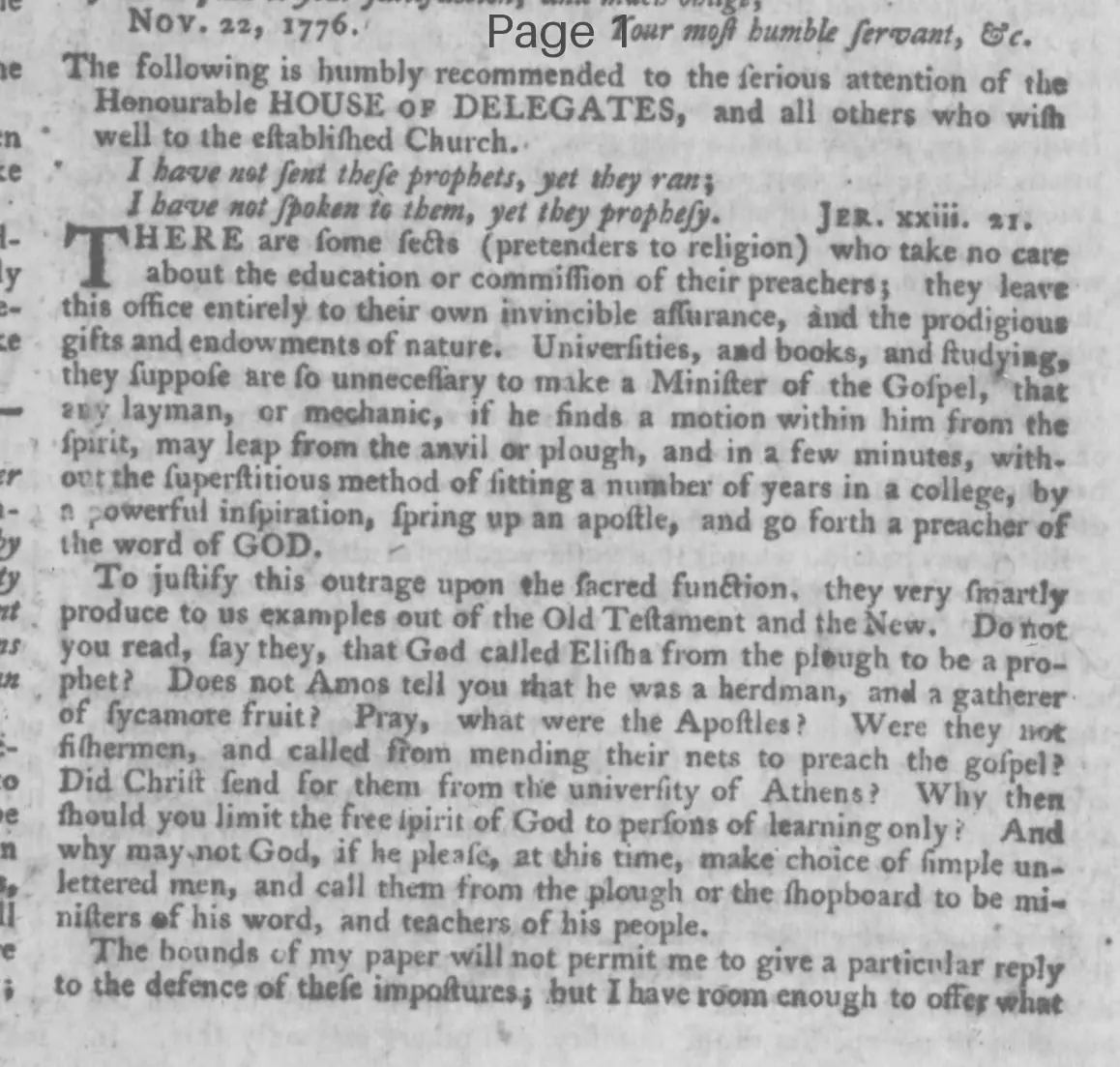
HERE are some sects (pretenders to religion) who take no care about the education or commission of their preachers; they leave this office entirely to their own invincible assurance, and the prodigious gifts and endowments of nature. Universities, and books, and studying, they suppose are so unnecessary to make a Minister of the Gospel, that any layman, or mechanic, if he finds a motion within him from the spirit, may leap from the anvil or plough, and in a few minutes, without the superstitious method of sitting a number of years in a college, by a powerful inspiration, spring up an apostle, and go forth a preacher of the word of GOD. To justify this outrage upon the sacred function, they very smartly produce to us examples out of the Old Testament and the New. Do not you read, say they, that God called Elisha from the plough to be a prophet? Does not Amos tell you that he was a herdsman, and a gatherer of sycamore fruit? Pray, what were the Apostles? Were they not fishermen, and called from mending their nets to preach the gospel? Did Christ send for them from the university of Athens? Why then should you limit the free spirit of God to persons of learning only? And why may not God, if he please, at this time, make choice of simple unlettered men, and call them from the plough or the shopboard to be ministers of his word, and teachers of his people. The bounds of my paper will not permit me to give a particular reply to the defence of these impostures; but I have room enough to offer what
will be a sufficient confutation. In answer, therefore, I must confess that the same divine power that was able to make a herdsman a prophet, or a fisherman an apostle, is as able in our times also to make the meanest mechanic one of the greatest luminaries of the church; but though in former ages the gifts of God were dispersed without respect of persons, whether he does this in ours is very much to be questioned: For were I to argue this controversy with one of those invaders of the function, I would ask him, what commission he has to usurp upon the office, or by the secret instinct and motion of the holy spirit. But then I must ask who signed him his patent? He will tell me, perhaps, that he is called by the secret instinct and motion of the holy spirit. But then I must ask him, what he can show to persuade others that he is thus distinguished? Elisha had his mantle from Elijah, which was evidence sufficient that he was called to be a prophet. The Apostles likewise had the power of working miracles, which infallibly proved the divinity of their commission. Now if any of these men, who pretend to the same authority, can make iron swim, or, like Elisha, in another case, can tell what George the third and Lord North say in the King's closet, when they forge chains for this continent; if, like St. Peter, they can cure diseases by their shadows passing over them; or, like the rest of the Apostles, who were perfectly illiterate, on a sudden speak Greek and Latin, and all the languages of the east, I pronounce the controversy at an end. And here I must once more repeat my former question, and ask them, by what signs of the holy spirit the world may be satisfied that they are so called? By what? Why, do not you hear them preach, unfold prophecies, interpret parables, and draw proofs from the Revelations? Can any of your great scholars, with all the study of philosophy, fathers, councils, schoolmen, either hold your congregations longer, or send them away more edified? Alas! it must be confessed, to the reproach of religion, that these men are very familiar with the mysteries of the holy writings: But does the spirit of God assist men to give the lie to himself? Does the spirit of God assist men to expound the prophets and the apostles into adultery, enthusiasm, murder, and heresy? Does the spirit of God inspire men with villainy; encourage them to stone us for our vineyard, and urge scripture for it; to commit sacrilege with prophetical texts in their mouths, and with the cant of types and antitypes contrive the overthrow of churches and nations? Has the spirit of God any thing to do with men exactly represented by the poets under the fiction of one of the infernal furies, who ascends from hell with a firebrand in her hand, and snakes on her head, scatters war, treason, and sedition, as she passes; every hair hurled among the people becomes a stinging and a serpent, and every shaking of her torch sets villages, and cities, and kingdoms, and empires, in a combustion? But we should allow that these usurpers have the inward call of the spirit of God, yet God is so much the God of order, that unless they enter themselves into his service, by submitting to the rites of consecration, which God has ordained in his church, as the standing signs of their calling, every act of the ministry they perform is but a sacrifice like theirs, who offered strange fire before the Lord, and miserably perished by their own forbidden censers. Was not Elisha the prophet called by a visible sign? Had not Elijah the command of God to anoint Elisha the son of Shaphat to be a prophet in his room? If we look back upon the levitical law, we shall find a very great care observed in the ordination of priests before they were received into the sacred function; there were abundance of sacrifices offered for them; they were washed at the door of the tabernacle; then the coat, the ephod, the breast-plate, and the miter, were put upon them; and in the last place followed the anointing oil that was poured upon their heads: This was the consecration of the priests of those times. The ceremonies of consecration in the New Testament were different, I confess, from those of the Old, but answerable to them; there was a public meeting of the Church, a presentation of the person to be ordained, solemn applications made that he might become useful to the Church; and, as a seal of the rest, the imposition of the Bishop's hands, assisted by the presbyters. But it may be said, what is this to the vocation of the apostles? Were not they without the formality of laying on of hands, without all this conveying of orders, and the Holy Ghost by fingers? What imposition of hands went to change St. Peter from a fisherman into an apostle? In answer to this, it must be owned that the apostles were not consecrated to the ministry by such rites and imposition of hands, as was afterwards practiced in the Church; yet something answerable went to their consecration before they were invested with authority to preach the gospel to the world; for besides their first vocation by the Lord, they were endued with power by the descent of the Holy Ghost; and how did he descend? In a soft, secret, invisible persuasion of the fancy? No, in a rushing, mighty wind, which was an audible evidence to the ear, and sat upon their heads in the shape of cloven tongues of fire, which was a visible demonstration to the eye likewise: So that the difference between the admission of the apostles to the ministry and others was only this: In
other consecrations, the Bishop only granted the power to preach, but bestowed not the gifts, but here the Holy Ghost bestowed both. Let these men now make it appear that the Holy Ghost has thus descended upon them, and furnished them with such excellent accomplishments, I should think it the greatest happiness of my life to see them in our pulpits, and should immediately become one of their disciples. In short, when I perceive the holiness and religion of these preachers consist only in the devout composure of their looks and deportment; when they take their text out of the bible, and deliver nonsense and blasphemy; when they rail at the established church, and preach down its doctrines and discipline; let their countenance be ever so demure, let them never so devoutly bewail the divisions of their country, which they help to make miserable; or let them weep never so passionately over the congregation which they have broken in factions; how seemingly holy, how unprofane soever their behaviour be; though scripture overflow in their mouths; though they never eat, nor drink, nor speak, but with a whining sanctified tone; yet they are still cheats and enthusiasts, a scandal to religion, and dangerous to the commonwealth; they break violently into the sheepfold, and stand upon record in the book of God as hirelings, thieves, and robbers. Lo! these are the men who are now applying for an establishment; at least to be set on a level with the established Church: In which application should they be gratified, it requires no great share of wisdom to foresee that it may be productive of numberless evils; particularly a civil war among ourselves (which the Hon. Convention may at this juncture think a little unreasonable) and, what is full as bad, a total subversion of all true religion in this colony.
PHILOEPISCOPUS.
BUCKINGHAM, October 1776.
What sub-type of article is it?
What themes does it cover?
What keywords are associated?
What entities or persons were involved?
Letter to Editor Details
Author
Philoepiscopus
Recipient
Honourable House Of Delegates, And All Others Who Wish Well To The Established Church
Main Argument
unordained sectarian preachers lack proper divine commission and visible signs of authority, unlike biblical examples, and granting them establishment would lead to heresy, sedition, civil war, and subversion of true religion in the colony.
Notable Details