Thank you for visiting SNEWPapers!
Sign up free
Literary
September 28, 1873
The Morning Star And Catholic Messenger
New Orleans, Orleans County, Louisiana
What is this article about?
Clarence Spencer quarrels with his wife Sarah over breakfast and carries the emotional burden to work. His employer, Mr. Wardle, counsels him on the folly of prolonging marital discord and urges immediate reconciliation. Clarence returns home, apologizes, and they reunite happily, learning a lasting lesson in forgiveness and love.
Clipping
OCR Quality
98%
Excellent
Full Text
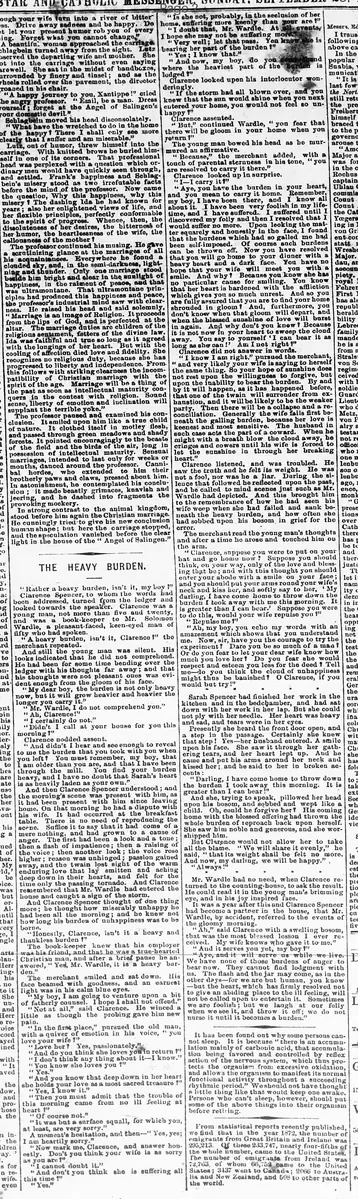
THE HEAVY BURDEN.
“Rather a heavy burden, isn't it, my boy?” Clarence Spencer, to whom the words had been addressed, turned from the ledger and looked towards the speaker. Clarence was a young man, not more than five and twenty, and was a book-keeper to Mr. Solomon Wardle, a pleasant-faced, keen-eyed man of fifty who had spoken.
“A heavy burden, isn't it, Clarence?” the merchant repeated. And still the young man was silent. His looks indicated that he did not comprehend. He had been for some time bending over the ledger with his thoughts far away; and that his thoughts were not pleasant ones was evident enough from the gloom of his face.
“My dear boy, the burden is not only heavy now, but it will grow heavier and heavier the longer you carry it.”
“Mr. Wardle, I do not comprehend you.”
“Ah, Clarence!”
“I certainly do not.”
“Didn't I call at your house for you this morning?” Clarence nodded assent. “And didn't I hear and see enough to reveal to me the burden that you took with you when you left? You must remember, my boy, that I am older than you are, and that I have been through the mill. You find your burden heavy, and I have no doubt that Sarah's heart is as heavily laden as your own.”
And then Clarence Spencer understood; and the morning's scene was present with him, as it had been present with him since leaving home. On that morning he had a dispute with his wife. It had occurred at the breakfast table. There is no need of reproducing the scene. Suffice it to say that it had come of a mere nothing, and had grown to a cause of anger. The first had been a look and a tone; then a flash of impatience; then a raising of the voice; then another look; the voice rose higher; reason was unhinged; passion gained sway, and the twain lost sight of the warm enduring love that lay smitten and aching deep down in their hearts, and felt for the time only the passing tornado. And Clarence remembered that Mr. Wardle had entered the house and caught a sign of the storm.
And Clarence Spencer thought of one thing more; he thought how miserably unhappy he had been all the morning; and he knew not how long his burden of unhappiness was to be borne.
“Honestly, Clarence, isn't it a heavy and thankless burden?”
The book-keeper knew that his employer was his friend, and that he was a true-hearted Christian man, and after a brief pause he answered, “Yes, Mr. Wardle, it is a heavy burden.”
The merchant smiled and sat down. His face beamed with goodness, and an earnest light was in his calm blue eyes.
“My boy, I am going to venture upon a bit of fatherly counsel. I hope I shall not offend.”
“Not at all,” said Clarence. He winced a little as though the probing gave him new pain.
“In the first place,” pursued the old man, with a quiver of emotion in his voice, “you love your wife.”
“Love her? Yes, passionately.”
“And do you think she loves you in return?”
“I don't think anything about it—I know.”
“You know she loves you?”
“Yes.”
“And you know that deep down in her heart she holds your love as a most sacred treasure?”
“Yes, I know it.”
“Then you must admit that the trouble of this morning came from no ill feeling at heart!”
“Of course not.”
“It was but a surface squall, for which you, at least, are very sorry.”
A moment's hesitation, and then—“Yes, yes; I am heartily sorry.”
“Now mark me, Clarence, and answer honestly. Don't you think your wife is as sorry as you are?”
“I cannot doubt it.”
“And don't you think she is suffering all this time?”
“Yes.”
“Is she not, probably, in the seclusion of her home, suffering more keenly than you are?”
“I doubt that, Mr. Wardle. At least, I hope she may not be suffering more.”
“Very well; let that pass. You know she is bearing her part of the burden?”
“Yes; I know that.”
“And now, my boy, do you comprehend where the heaviest part of the burden is lodged?”
Clarence looked upon his interlocutor wonderingly.
“If the storm had all blown over, and you knew that the sun would shine when you next entered your home, you would not feel so unhappy.”
Clarence assented.
“But,” continued Wardle, “you fear that there will be gloom in your home when you return.”
The young man bowed his head as he murmured an affirmative.
“Because,” the merchant added, with a touch of parental sternness in his tone, “you are resolved to carry it there.”
Clarence looked up in surprise.
“I—carry it?”
“Aye, you have the burden in your heart, and you mean to carry it home. Remember, my boy, I have been there, and I know all about it. I have been very foolish in my lifetime, and I have suffered. I suffered until I discovered my folly and then I resolved that I would suffer no more. Upon looking the matter squarely and honestly in the face, I found that the burdens which had so galled me had been self-imposed. Of course such burdens can be thrown off. Now you have resolved that you will go home to your dinner with a heavy heart and a dark face. You have no smile. And why? Because you know she has no particular cause for smiling. You know that her heart is hardened with the affliction which gives you so much unrest. And so you are fully assured that you are to find your home shrouded in gloom! And, furthermore, you don't know when that gloom will depart, and when the blessed sunshine of love will burst in again. And why don't you know? Because it is not now in your heart to sweep the cloud away. You say to yourself 'I can bear it as long as she can!' Am I not right?”
Clarence did not answer in words.
“I know I am right,” pursued the merchant, “and very likely your wife is saying to herself the same thing. So your hope of sunshine does not rest upon the willingness to forgive, but upon the inability to bear the burden. By and by it will happen, as it has happened before, that one of the twain will surrender from exhaustion, and it will be likely to be the weaker party. Then there will be a collapse and a reconciliation. Generally the wife fails first beneath the galling burden, because her love is keenest and most sensitive. The husband in such case acts the part of a coward. When he might with a breath blow the cloud away, he cringes and cowers until his wife is forced to let the sunshine in through her breaking heart.”
Clarence listened, and was troubled. He saw the truth and he felt its weight. He was not a fool, nor was he a liar. During the silence that followed he reflected upon the past, and he called to mind scenes just such as Mr. Wardle had depicted. And this brought him to the remembrance of how he had seen his wife weep when she had failed and sank beneath the heavy burden, and how often she had sobbed upon his bosom in grief for the error.
The merchant read the young man's thoughts and after a time he arose and touched him on the arm.
“Clarence, suppose you were to put on your hat and go home now. Suppose you should think, on your way, only of the love and blessing that be; and with this thought you should enter your abode with a smile on your face; and you should put your arms round your wife's neck and kiss her, and softly say to her, ‘My darling, I have come home to throw down the burden I took away with me this morning. It is greater than I can bear.’ Suppose you were to do this, would your wife repulse you?”
“Repulse me?”
“Ah, my boy, you echo my words with an amazement which shows that you understand me. Now, sir, have you the courage to try the experiment? Dare you be so much of a man! Or do you fear to let your dear wife know how much you love her? Do you fear she would respect and esteem you less for the deed? Tell me—do you think the cloud of unhappiness might thus be banished? O Clarence, if you would but try!”
Sarah Spencer had finished her work in the kitchen and in the bedchamber, and had sat down with her work in her lap. But she could not ply with her needle. Her heart was heavy and sad, and tears were in her eyes. Presently she heard the front door open, and a step in the passage. Certainly she knew that step! Yes, her husband entered. A smile upon his face. She saw it through her gathering tears, and her heart leapt up. And he came and put his arms around her neck and kissed her; and he said to her in broken accents:
“Darling, I have come home to throw down the burden I took away this morning. It is greater than I can bear.”
And she, trying to speak, pillowed her head upon his bosom, and sobbed and wept like a child. Oh, could he forgive her? His coming home with the blessed offering had thrown the whole burden of reproach back upon herself. She saw him noble and generous, and she worshipped him.
But Clarence would not allow her to take all the blame.
“We will share it evenly,” he said, “that its weight shall be felt no more. And now, my darling, we will be happy.”
“Always!”
Mr. Wardle had no need, when Clarence returned to the counting-house, to ask the result. He could read it in the young man's brimming eye, and in his joy-inspired face.
It was a year after this and Clarence Spencer had become a partner in the house, that Mr. Wardle, by accident, referred to the events of the gloomy morning.
“Ah,” said Clarence with a swelling bosom, “that was the most blessed lesson I ever received. My wife knows who gave it to me.”
“And it serves you yet, my boy?”
“Aye, and it will serve us while we live. We have none of those burdens of anger to bear now. They cannot find lodgment with us. The flash and the jar may come, as in the other days—for we are but human, you know—but the heart, which has firmly resolved not to give an abiding place to the ill feeling, will not be called upon to entertain it. Sometimes we are foolish; but we laugh at our folly when we see it, and throw it off: we do not nurse it until it becomes a burden.”
“Rather a heavy burden, isn't it, my boy?” Clarence Spencer, to whom the words had been addressed, turned from the ledger and looked towards the speaker. Clarence was a young man, not more than five and twenty, and was a book-keeper to Mr. Solomon Wardle, a pleasant-faced, keen-eyed man of fifty who had spoken.
“A heavy burden, isn't it, Clarence?” the merchant repeated. And still the young man was silent. His looks indicated that he did not comprehend. He had been for some time bending over the ledger with his thoughts far away; and that his thoughts were not pleasant ones was evident enough from the gloom of his face.
“My dear boy, the burden is not only heavy now, but it will grow heavier and heavier the longer you carry it.”
“Mr. Wardle, I do not comprehend you.”
“Ah, Clarence!”
“I certainly do not.”
“Didn't I call at your house for you this morning?” Clarence nodded assent. “And didn't I hear and see enough to reveal to me the burden that you took with you when you left? You must remember, my boy, that I am older than you are, and that I have been through the mill. You find your burden heavy, and I have no doubt that Sarah's heart is as heavily laden as your own.”
And then Clarence Spencer understood; and the morning's scene was present with him, as it had been present with him since leaving home. On that morning he had a dispute with his wife. It had occurred at the breakfast table. There is no need of reproducing the scene. Suffice it to say that it had come of a mere nothing, and had grown to a cause of anger. The first had been a look and a tone; then a flash of impatience; then a raising of the voice; then another look; the voice rose higher; reason was unhinged; passion gained sway, and the twain lost sight of the warm enduring love that lay smitten and aching deep down in their hearts, and felt for the time only the passing tornado. And Clarence remembered that Mr. Wardle had entered the house and caught a sign of the storm.
And Clarence Spencer thought of one thing more; he thought how miserably unhappy he had been all the morning; and he knew not how long his burden of unhappiness was to be borne.
“Honestly, Clarence, isn't it a heavy and thankless burden?”
The book-keeper knew that his employer was his friend, and that he was a true-hearted Christian man, and after a brief pause he answered, “Yes, Mr. Wardle, it is a heavy burden.”
The merchant smiled and sat down. His face beamed with goodness, and an earnest light was in his calm blue eyes.
“My boy, I am going to venture upon a bit of fatherly counsel. I hope I shall not offend.”
“Not at all,” said Clarence. He winced a little as though the probing gave him new pain.
“In the first place,” pursued the old man, with a quiver of emotion in his voice, “you love your wife.”
“Love her? Yes, passionately.”
“And do you think she loves you in return?”
“I don't think anything about it—I know.”
“You know she loves you?”
“Yes.”
“And you know that deep down in her heart she holds your love as a most sacred treasure?”
“Yes, I know it.”
“Then you must admit that the trouble of this morning came from no ill feeling at heart!”
“Of course not.”
“It was but a surface squall, for which you, at least, are very sorry.”
A moment's hesitation, and then—“Yes, yes; I am heartily sorry.”
“Now mark me, Clarence, and answer honestly. Don't you think your wife is as sorry as you are?”
“I cannot doubt it.”
“And don't you think she is suffering all this time?”
“Yes.”
“Is she not, probably, in the seclusion of her home, suffering more keenly than you are?”
“I doubt that, Mr. Wardle. At least, I hope she may not be suffering more.”
“Very well; let that pass. You know she is bearing her part of the burden?”
“Yes; I know that.”
“And now, my boy, do you comprehend where the heaviest part of the burden is lodged?”
Clarence looked upon his interlocutor wonderingly.
“If the storm had all blown over, and you knew that the sun would shine when you next entered your home, you would not feel so unhappy.”
Clarence assented.
“But,” continued Wardle, “you fear that there will be gloom in your home when you return.”
The young man bowed his head as he murmured an affirmative.
“Because,” the merchant added, with a touch of parental sternness in his tone, “you are resolved to carry it there.”
Clarence looked up in surprise.
“I—carry it?”
“Aye, you have the burden in your heart, and you mean to carry it home. Remember, my boy, I have been there, and I know all about it. I have been very foolish in my lifetime, and I have suffered. I suffered until I discovered my folly and then I resolved that I would suffer no more. Upon looking the matter squarely and honestly in the face, I found that the burdens which had so galled me had been self-imposed. Of course such burdens can be thrown off. Now you have resolved that you will go home to your dinner with a heavy heart and a dark face. You have no smile. And why? Because you know she has no particular cause for smiling. You know that her heart is hardened with the affliction which gives you so much unrest. And so you are fully assured that you are to find your home shrouded in gloom! And, furthermore, you don't know when that gloom will depart, and when the blessed sunshine of love will burst in again. And why don't you know? Because it is not now in your heart to sweep the cloud away. You say to yourself 'I can bear it as long as she can!' Am I not right?”
Clarence did not answer in words.
“I know I am right,” pursued the merchant, “and very likely your wife is saying to herself the same thing. So your hope of sunshine does not rest upon the willingness to forgive, but upon the inability to bear the burden. By and by it will happen, as it has happened before, that one of the twain will surrender from exhaustion, and it will be likely to be the weaker party. Then there will be a collapse and a reconciliation. Generally the wife fails first beneath the galling burden, because her love is keenest and most sensitive. The husband in such case acts the part of a coward. When he might with a breath blow the cloud away, he cringes and cowers until his wife is forced to let the sunshine in through her breaking heart.”
Clarence listened, and was troubled. He saw the truth and he felt its weight. He was not a fool, nor was he a liar. During the silence that followed he reflected upon the past, and he called to mind scenes just such as Mr. Wardle had depicted. And this brought him to the remembrance of how he had seen his wife weep when she had failed and sank beneath the heavy burden, and how often she had sobbed upon his bosom in grief for the error.
The merchant read the young man's thoughts and after a time he arose and touched him on the arm.
“Clarence, suppose you were to put on your hat and go home now. Suppose you should think, on your way, only of the love and blessing that be; and with this thought you should enter your abode with a smile on your face; and you should put your arms round your wife's neck and kiss her, and softly say to her, ‘My darling, I have come home to throw down the burden I took away with me this morning. It is greater than I can bear.’ Suppose you were to do this, would your wife repulse you?”
“Repulse me?”
“Ah, my boy, you echo my words with an amazement which shows that you understand me. Now, sir, have you the courage to try the experiment? Dare you be so much of a man! Or do you fear to let your dear wife know how much you love her? Do you fear she would respect and esteem you less for the deed? Tell me—do you think the cloud of unhappiness might thus be banished? O Clarence, if you would but try!”
Sarah Spencer had finished her work in the kitchen and in the bedchamber, and had sat down with her work in her lap. But she could not ply with her needle. Her heart was heavy and sad, and tears were in her eyes. Presently she heard the front door open, and a step in the passage. Certainly she knew that step! Yes, her husband entered. A smile upon his face. She saw it through her gathering tears, and her heart leapt up. And he came and put his arms around her neck and kissed her; and he said to her in broken accents:
“Darling, I have come home to throw down the burden I took away this morning. It is greater than I can bear.”
And she, trying to speak, pillowed her head upon his bosom, and sobbed and wept like a child. Oh, could he forgive her? His coming home with the blessed offering had thrown the whole burden of reproach back upon herself. She saw him noble and generous, and she worshipped him.
But Clarence would not allow her to take all the blame.
“We will share it evenly,” he said, “that its weight shall be felt no more. And now, my darling, we will be happy.”
“Always!”
Mr. Wardle had no need, when Clarence returned to the counting-house, to ask the result. He could read it in the young man's brimming eye, and in his joy-inspired face.
It was a year after this and Clarence Spencer had become a partner in the house, that Mr. Wardle, by accident, referred to the events of the gloomy morning.
“Ah,” said Clarence with a swelling bosom, “that was the most blessed lesson I ever received. My wife knows who gave it to me.”
“And it serves you yet, my boy?”
“Aye, and it will serve us while we live. We have none of those burdens of anger to bear now. They cannot find lodgment with us. The flash and the jar may come, as in the other days—for we are but human, you know—but the heart, which has firmly resolved not to give an abiding place to the ill feeling, will not be called upon to entertain it. Sometimes we are foolish; but we laugh at our folly when we see it, and throw it off: we do not nurse it until it becomes a burden.”
What sub-type of article is it?
Prose Fiction
Dialogue
What themes does it cover?
Love Romance
Moral Virtue
What keywords are associated?
Marital Discord
Reconciliation
Forgiveness
Moral Counsel
Husband Wife
Emotional Burden
Literary Details
Title
The Heavy Burden.
Key Lines
"My Darling, I Have Come Home To Throw Down The Burden I Took Away With Me This Morning. It Is Greater Than I Can Bear."
"We Will Share It Evenly," He Said, "That Its Weight Shall Be Felt No More. And Now, My Darling, We Will Be Happy."
"That Was The Most Blessed Lesson I Ever Received. My Wife Knows Who Gave It To Me."