Thank you for visiting SNEWPapers!
Sign up free
The Madison Daily Leader
Madison, Lake County, South Dakota
What is this article about?
U.S. Supreme Court Justice Holmes ruled Indiana's 1893 law taxing express and telegraph companies unconstitutional for interfering with interstate commerce, reversing a circuit court decision in the case of James C. Fargo vs. William H. Hart.
Clipping
OCR Quality
Full Text
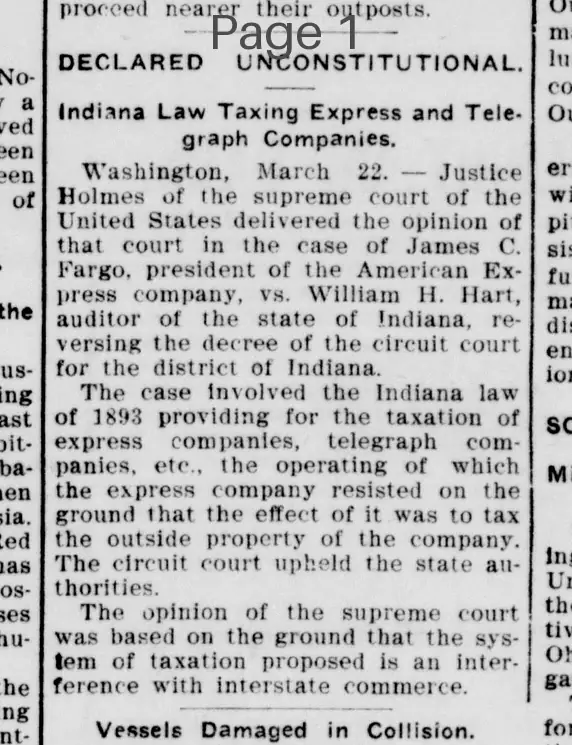
Indiana Law Taxing Express and Telegraph Companies.
Washington, March 22.—Justice Holmes of the supreme court of the United States delivered the opinion of that court in the case of James C. Fargo, president of the American Express company, vs. William H. Hart, auditor of the state of Indiana, reversing the decree of the circuit court for the district of Indiana.
The case involved the Indiana law of 1893 providing for the taxation of express companies, telegraph companies, etc., the operating of which the express company resisted on the ground that the effect of it was to tax the outside property of the company.
The circuit court upheld the state authorities.
The opinion of the supreme court was based on the ground that the system of taxation proposed is an interference with interstate commerce.
What sub-type of article is it?
What keywords are associated?
What entities or persons were involved?
Where did it happen?
Domestic News Details
Primary Location
Washington
Event Date
March 22
Key Persons
Outcome
reversing the decree of the circuit court; indiana law of 1893 declared unconstitutional as interference with interstate commerce.
Event Details
Justice Holmes delivered the Supreme Court opinion in the case of James C. Fargo, president of the American Express company, vs. William H. Hart, auditor of Indiana, involving resistance to the Indiana law of 1893 taxing express and telegraph companies on grounds of taxing outside property; circuit court had upheld state authorities.