Thank you for visiting SNEWPapers!
Sign up free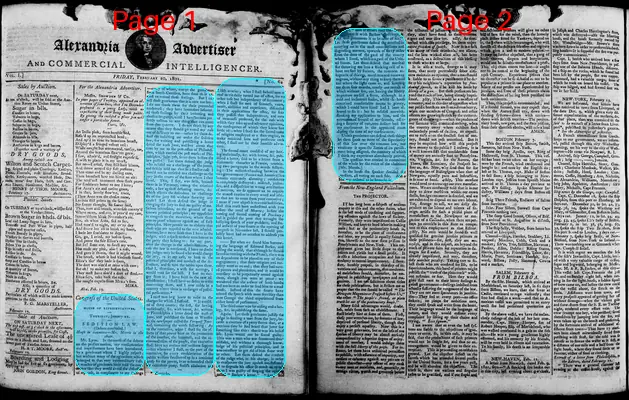
Alexandria Advertiser And Commercial Intelligencer
Alexandria, Virginia
What is this article about?
In the U.S. House of Representatives on January 22, Rep. Matthew Lyon spoke against the Sedition Law during debate, detailing his own 1798 prosecution, imprisonment, and judicial biases. He criticized the law's application and defended his published letters. The vote tied 48-48; Speaker decided in favor, ordering a bill brought in.
Merged-components note: Continuation of the report on the congressional debate in the House of Representatives regarding the Sedition Law, featuring Mr. Lyon's speech.
Clippings
1 of 2
OCR Quality
Full Text
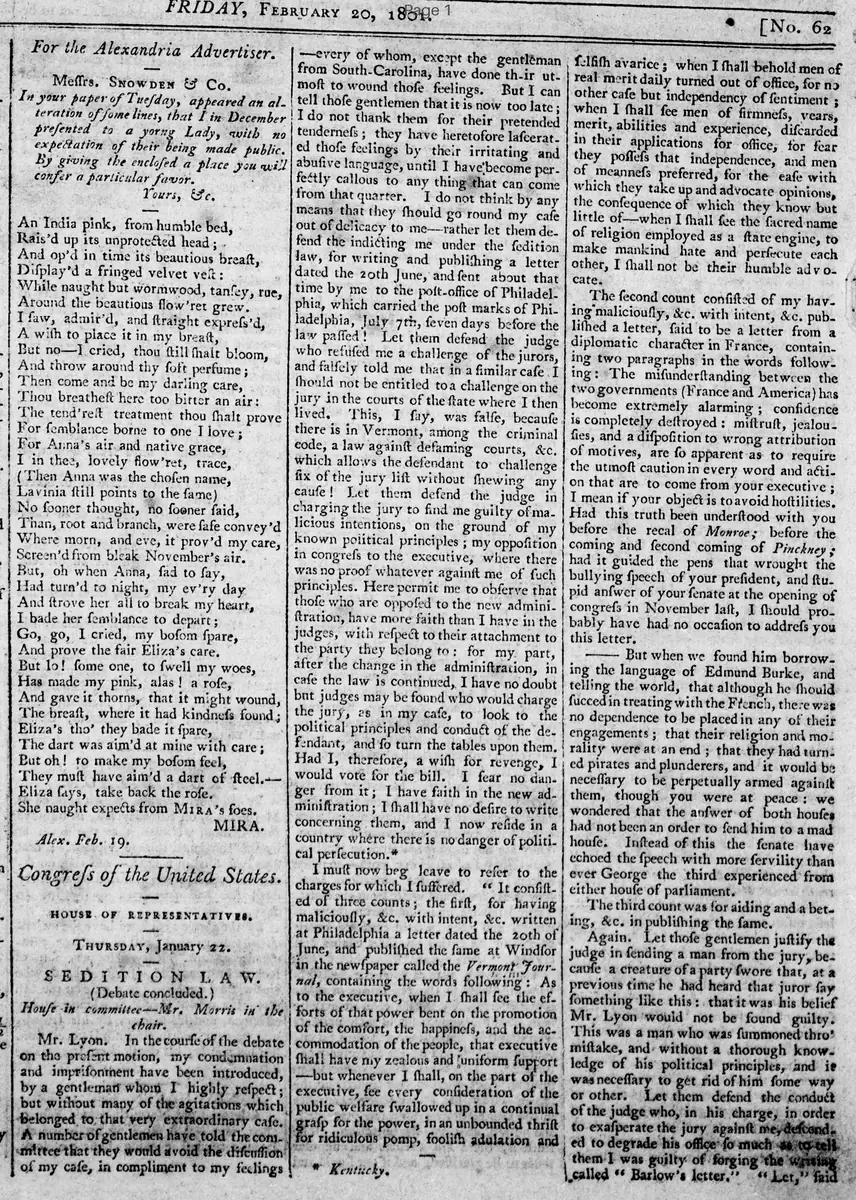
HOUSE OF REPRESENTATIVES
THURSDAY January 22
SEDITION LAW
(Debate concluded.)
House in Committee—Mr. Morris in the
Mr. Lyon. In the course of the debate
on the present motion, my condemnation
and imprisonment have been introduced,
by a gentleman whom I highly respect;
but without many of the agitations which
belonged to that very extraordinary case.
A number of gentlemen have told the com-
mittee that they would avoid the discussion
of my case, in compliment to my feelings
—every of whom, except the gentleman
from South-Carolina, have done their ut-
most to wound those feelings. But I can
tell those gentlemen that it is now too late;
I do not thank them for their pretended
tenderness; they have heretofore lacerated.
those feelings by their irritating and
abusive language, until I have become per-
fectly callous to any thing that can come
from that quarter. I do not think by any
means that they should go round my case
out of delicacy to me—rather let them de-
fend the indicting me under the sedition
law, for writing and publishing a letter
dated the 20th June, and sent about that
time by me to the post-office of Philadelphia,
which carried the post marks of Philadelphia,
July 7th, seven days before the
law passed! Let them defend the judge
who refused me a challenge of the jurors,
and falsely told me that in a similar case I
should not be entitled to a challenge on the
jury in the courts of the state where I then
lived. This, I say, was false, because
there is in Vermont, among the criminal
code, a law against defaming courts, &c.
which allows the defendant to challenge
six of the jury list without shewing any
cause! Let them defend the judge in
charging the jury to find me guilty of ma-
licious intentions, on the ground of my
known political principles; my opposition
in congress to the executive; where there
was no proof whatever against me of such
principles. Here permit me to observe that
those who are opposed to the new admini-
stration, have more faith than I have in the
judges, with respect to their attachment to
the party they belong to: for my part,
after the change in the administration, in
case the law is continued, I have no doubt
but judges may be found who would charge
the jury, as in my case, to look to the
political principles and conduct of the de-
fendant, and so turn the tables upon them.
Had I, therefore, a wish for revenge, I
would vote for the bill. I fear no dan-
ger from it; I have faith in the new ad.
ministration: I shall have no desire to write
concerning them, and I now reside in a
country where there is no danger of politi.
cal persecution.
I must now beg leave to refer to the
charges for which I suffered. It consist-
ed of three counts; the first, for having
maliciously, &c. with intent, &c. written
at Philadelphia a letter dated the 20th of
June, and published the same at Windsor
in the newspaper called the Vermont Jour-
nal, containing the words following: As
to the executive, when I shall see the ef-
forts of that power bent on the promotion
of the comfort, the happiness, and the ac-
commodation of the people, that executive
shall have my zealous and uniform support
—but whenever I shall, on the part of the
executive, see every consideration of the
public welfare swallowed up in a continual
grasp for the power, in an unbounded thirst
for ridiculous pomp, foolish adulation and
in * Kentucky.
[No. 62
selfish avarice; when I shall behold men of
real merit daily turned out of office, for no
other cause but independency of sentiment;
when I shall see men of firmness, years,
merit, abilities and experience, discarded
in their applications for office, for fear
they possess that independence, and men
of meanness preferred, for the ease with
which they take up and advocate opinions,
the consequence of which they know but
little of—when I shall see the sacred name
of religion employed as a state engine, to
make mankind hate and persecute each
other, I shall not be their humble advo-
cate.
The second count consisted of my hav-
ing maliciously, &c. with intent, &c. pub-
lised a letter, said to be a letter from a
diplomatic character in France, contain-
ing two paragraphs in the words follow-
ing: The misunderstanding between the
two governments (France and America) has
become extremely alarming; confidence
is completely destroyed: mistrust, jealousy,
lies, and a disposition to wrong attribution
of motives, are so apparent as to require
the utmost caution in every word and acti-
on that are to come from your executive;
I mean if your object is to avoid hostilities.
Had this truth been understood with you
before the recall of Monroe; before the
coming and second coming of Pinckney:
had it guided the pens that wrought the
bullying speech of your president, and stu-
pid answer of your senate at the opening of
congress in November last, I should pro-
bably have had no occasion to address you
this letter.
...- But when we found him borrow.
ing the language of Edmund Burke, and
telling the world, that although he should
succeed in treating with the French, there was
no dependence to be placed in any of their
engagements; that their religion and mo.
rality were at an end: that they had turn.
ed pirates and plunderers, and it would be
necessary to be perpetually armed against
them, though you were at peace: we
wondered that the answer of both houses
had not been an order to send him to a mad
house. Instead of this the senate have
echoed the speech with more servility than
ever George the third experienced from
either house of parliament.
The third count was for aiding and abet-
ing, &c. in publishing the same.
Again. Let those gentlemen justify the
judge in sending a man from the jury, be-
cause a creature of a party swore that, at a
previous time he had heard that juror say
something like this: that it was his belief
Mr. Lyon would not be found guilty.
This was a man who was summoned thro'
mistake, and without a thorough know.
ledge of his political principles, and it
was necessary to get rid of him some way
or other. Let them defend the conduct
of the judge who, in his charge, in order
to exasperate the jury against me descended:
to degrade his office so much as to tell
them I was guilty of forging the writing
called "Barlow's letter." "Let," said
But, 'men of letters read that letter and compare it with Barlow's writings, & they will pronounce it to be none of his!'
Let those gentlemen defend the marshal in carrying me in the most contumelious and degrading manner, upwards of forty miles from the door of the gaol of the county where I lived, which is a gaol of the United States. Let them defend that marshal for throwing me into a stinking cell of about ten feet by fifteen, the common receptacle of thieves, murderers and runaway negroes, without anything to keep the cold out where the light came in, and keeping me there four months, nearly one month of which without fire, not having the liberty to procure myself a stove, although in a cold and inclement season, whilst the house contained comfortable rooms in plenty, which I could have hired had I been allowed to do it: but he refused notwithstanding my application to him, and the entreaties of several of my friends, offering a security of 100,000 dollars bail for my continuance in the appointed room during the time of my confinement.
Unless gentlemen can defend these things let them speak no more of the superiority of this law over the common law; nor vindicate it upon the limits of its punishment being assigned, the contrary of which I think my experience abundantly proved.
The question was carried in committee of the whole by the voice of the chairman (Mr. Morris.)
In the house the speaker decided the question, 48 voting on each side. And a bill was ordered to be brought in.
What sub-type of article is it?
What keywords are associated?
What entities or persons were involved?
Domestic News Details
Event Date
Thursday January 22
Key Persons
Outcome
the vote in the house tied at 48-48; the speaker decided the question in favor, and a bill was ordered to be brought in.
Event Details
During debate on the Sedition Law in the House Committee of the Whole, Mr. Lyon recounted his prosecution and imprisonment under the law for publishing critical letters, criticizing the judge's refusal of jury challenges, biased jury instructions based on political principles, and harsh treatment by the marshal including confinement in a poor cell. He quoted the offending letters criticizing the executive and foreign policy. The debate concluded with the motion passing on the chairman's voice.