Thank you for visiting SNEWPapers!
Sign up free
Editorial
March 21, 1856
Cooper's Clarksburg Register
Clarksburg, Harrison County, West Virginia
What is this article about?
An editorial advocating for a Southern Democratic presidential candidate in 1856, praising Jesse Bright, Isaac Toucey, and especially Henry A. Wise for his firmness in foreign affairs, while reviewing past nominations and arguing for Southern representation.
Clipping
OCR Quality
95%
Excellent
Full Text
The Presidency.
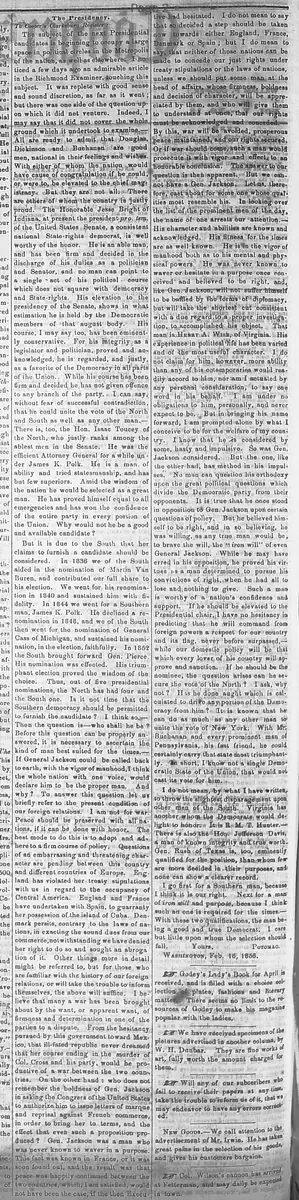
The subject of the next Presidential candidates is beginning to occupy a large space in political circles in the Metropolis of the nation, as well as elsewhere. I noticed a few days ago an admirable article in the Richmond Examiner, touching this subject. It was replete with good sense and sound discretion, as far as it went: but there was one side of the question upon which it did not venture. Indeed, I may say that it did not cover the whole ground which it undertook to examine. All are ready to admit that Douglas, Dickinson and Buchanan are good men, national in their feelings and wishes. With either of whom the nation would have cause of congratulation if he could or were to be elevated to the chief magistracy. But they are not all. There are others of whom the country is justly proud. The Honorable Jesse Bright of Indiana, at present the president pro tem. of the United States Senate, a consistent national State-rights democrat, is well worthy of the honor. He is an able man, and has been firm and decided in the discharge of his duties as a politician and Senator, and no man can point to a single act of his political course which does not square with democracy and State-rights. His elevation to the presidency of the Senate, shows in what estimation he is held by the Democratic members of that august body. His course, I may say too, has been eminently conservative. For his integrity as a legislator and politician, proved and acknowledged, he is regarded, and justly as a favorite of the Democracy in all parts of the Union. While his course has been firm and decided he has not given offence to any branch of the party. I can say, without fear of successful contradiction, that he could unite the vote of the North and South as well as any other man.—There is, too, the Hon. Isaac Toucey of the North, who justly ranks among the ablest men in the Senate. He was the efficient Attorney General for a while under James K. Polk. He is a man of ability and tried statesmanship, and has but few superiors. Amid the wisdom of the nation he would be selected as a great man. He has proved himself equal to all emergencies and has won the confidence of the entire party in every portion of the Union. Why would not he be a good and available candidate?
But it is due to the South that her claims to furnish a candidate should be considered. In 1836 we of the South aided in the nomination of Martin Van Buren, and contributed our full share to his election. We went for his renomination in 1840 and sustained him with fidelity. In 1844 we went for a Southern man, James K. Polk. He declined a re-nomination in 1848, and we of the South then went for the nomination of General Cass of Michigan, and sustained his nomination, in the election, faithfully. In 1852 the South brought forward Gen. Pierce. His nomination was effected. His triumphant election proved the wisdom of the choice. Thus, out of five presidential nominations, the North has had four and the South one. Is it not time that the Southern democracy should be permitted to furnish the candidate? I think so.—Then the question is—who shall he be?
Before this question can be properly answered, it is necessary to ascertain the kind of man best suited for the times.—If General Jackson could be called back to earth, with the vigor of manhood, I think the whole nation with one voice, would declare him to be the proper man. And why? To answer this question let us briefly refer to the present condition of our foreign relations. I am not for war. Peace should be preserved with all nations, if it can be done with honor. The best mode to do this is to adopt and adhere to a firm course of policy. Questions of an embarrassing and threatening character are pending between this country and different countries of Europe. England has violated her treaty stipulations with us in regard to the occupancy of Central America. England and France have undertaken with Spain, to guarantee her possession of the island of Cuba. Denmark persists, contrary to the laws of nations, in exacting the sound dues from our commerce, notwithstanding we have denied her right to do so and sought an abrogation of it. Other things more in detail might be referred to, but for those who are familiar with the history of our foreign relations, or will take the trouble to inform themselves, the above will suffice. I believe that many a war has been brought about by the want, or apparent want, of firmness and determination in one of the parties to a dispute. From the hesitancy pursued by this government toward Mexico, that ill-fated republic never dreamed that her course ending in the murder of Col. Cross and his party, would be productive of a war between the two countries. On the other hand: who does not remember the boldness of Gen. Jackson in asking the Congress of the United States to authorize him to issue letters of marque and reprisal against French commerce, in order to bring her to terms, and the effect that even such a proposition produced? Gen. Jackson was a man who was never known to waver in a purpose. This fact was known in France, or it was soon found out, and the result was that peace was happily continued between the two countries, which I am satisfied, would not have been the case if the then Executive had hesitated, I do not mean to say that so decided a step should be taken now towards either England, France, Denmark or Spain; but I do mean to say, that neither of those nations can be made to concede our just rights under treaty stipulations or the laws of nations, unless we should put some man at the head of affairs, whose firmness, boldness and decision of character, will be appreciated by them, and who will give them to understand at once, that our rights must be acknowledged and conceded.—By this, war will be avoided, prosperous peace maintained, and our rights secured. Or if war should come, such a man would prosecute it with vigor and effect, to an honorable conclusion. The answer to our question is then apparent. But we cannot have a Gen. Jackson. Let us, therefore, cast about for some one whose qualities most resemble his. In looking over the list of the prominent men of the day, the name of one arrests our attention. His character and abilities are known and acknowledged. His fitness for the times are as well known. He is in the vigor of manhood both as to his mental and physical powers. He was never known to waver or hesitate in a purpose once conceived and believed to be right, and, like Gen. Jackson, will not suffer himself to be baffled by the forms of diplomacy, but will take the shortest cut consistent with a due regard to a proper investigation, to accomplish his object. That man is Henry A. Wise, of Virginia. His experience in political life has been varied and of the most useful character. I do not claim for him, however, more ability than any of his contemporaries would readily accord to him, nor am I actuated by any personal consideration, to say one word in his behalf. I am under no obligations to him, personally, and never expect to be, But in bringing his name forward; I am prompted alone by what I conceive to be for the welfare of my country. I know that he is considered by some, hasty and impulsive. So was Gen. Jackson considered. But the one, like the other, has method in his impulses. No man can question his orthodoxy upon the great political questions which divide the Democratic party from their opponents. It is true that he once stood in opposition to Gen. Jackson upon certain questions of policy. But he believed himself to be right, and in so believing, he was willing, as any true man would be to brave the will, the "iron will" of even General Jackson. While he may have erred in his opposition, he proved his virtues as a man determined to pursue his convictions of right, when he had all to lose and nothing to gain. Such a man is worthy of a nation's confidence and support. If he should be elevated to the Presidential chair, I have no hesitancy in predicting that he will command from foreign powers a respect for our country and its flag, never before surpassed,—while our domestic policy will be that which every lover of his country will approve and sanction. Or if he should be the nominee, the question arises can he secure the vote of the North? I ask, why not? Has he done aught which is calculated to drive any portion of the Democracy from him? It is known that he can do as much as any other man to unite the vote of New York: With Mr. Buchanan and every prominent man of Pennsylvania, his fast friend, he could certainly carry that state most triumphantly. In short, I know not a single Democratic State of the Union, that would not cast its vote for him. I do not mean, by what I have written, to throw the slightest disparagement upon other men of the South. I have a high regard for R. M. T. Hunter.—There is also the Hon. Jefferson Davis, a man of known integrity and true worth. Gen. Rusk of Texas is, too, eminently qualified for the position, than whom few are more decided in their purposes, and none can show a clearer record. I go first for a Southern man, because I think it is our right. Next for a man of iron will and purpose, because I think such an one is required for the times.—With these two qualifications, the man being a good and true Democrat, I care but little upon whom the selection should fall.
Yours, "Potomac".
Washington, Feb. 16, 1856.
The subject of the next Presidential candidates is beginning to occupy a large space in political circles in the Metropolis of the nation, as well as elsewhere. I noticed a few days ago an admirable article in the Richmond Examiner, touching this subject. It was replete with good sense and sound discretion, as far as it went: but there was one side of the question upon which it did not venture. Indeed, I may say that it did not cover the whole ground which it undertook to examine. All are ready to admit that Douglas, Dickinson and Buchanan are good men, national in their feelings and wishes. With either of whom the nation would have cause of congratulation if he could or were to be elevated to the chief magistracy. But they are not all. There are others of whom the country is justly proud. The Honorable Jesse Bright of Indiana, at present the president pro tem. of the United States Senate, a consistent national State-rights democrat, is well worthy of the honor. He is an able man, and has been firm and decided in the discharge of his duties as a politician and Senator, and no man can point to a single act of his political course which does not square with democracy and State-rights. His elevation to the presidency of the Senate, shows in what estimation he is held by the Democratic members of that august body. His course, I may say too, has been eminently conservative. For his integrity as a legislator and politician, proved and acknowledged, he is regarded, and justly as a favorite of the Democracy in all parts of the Union. While his course has been firm and decided he has not given offence to any branch of the party. I can say, without fear of successful contradiction, that he could unite the vote of the North and South as well as any other man.—There is, too, the Hon. Isaac Toucey of the North, who justly ranks among the ablest men in the Senate. He was the efficient Attorney General for a while under James K. Polk. He is a man of ability and tried statesmanship, and has but few superiors. Amid the wisdom of the nation he would be selected as a great man. He has proved himself equal to all emergencies and has won the confidence of the entire party in every portion of the Union. Why would not he be a good and available candidate?
But it is due to the South that her claims to furnish a candidate should be considered. In 1836 we of the South aided in the nomination of Martin Van Buren, and contributed our full share to his election. We went for his renomination in 1840 and sustained him with fidelity. In 1844 we went for a Southern man, James K. Polk. He declined a re-nomination in 1848, and we of the South then went for the nomination of General Cass of Michigan, and sustained his nomination, in the election, faithfully. In 1852 the South brought forward Gen. Pierce. His nomination was effected. His triumphant election proved the wisdom of the choice. Thus, out of five presidential nominations, the North has had four and the South one. Is it not time that the Southern democracy should be permitted to furnish the candidate? I think so.—Then the question is—who shall he be?
Before this question can be properly answered, it is necessary to ascertain the kind of man best suited for the times.—If General Jackson could be called back to earth, with the vigor of manhood, I think the whole nation with one voice, would declare him to be the proper man. And why? To answer this question let us briefly refer to the present condition of our foreign relations. I am not for war. Peace should be preserved with all nations, if it can be done with honor. The best mode to do this is to adopt and adhere to a firm course of policy. Questions of an embarrassing and threatening character are pending between this country and different countries of Europe. England has violated her treaty stipulations with us in regard to the occupancy of Central America. England and France have undertaken with Spain, to guarantee her possession of the island of Cuba. Denmark persists, contrary to the laws of nations, in exacting the sound dues from our commerce, notwithstanding we have denied her right to do so and sought an abrogation of it. Other things more in detail might be referred to, but for those who are familiar with the history of our foreign relations, or will take the trouble to inform themselves, the above will suffice. I believe that many a war has been brought about by the want, or apparent want, of firmness and determination in one of the parties to a dispute. From the hesitancy pursued by this government toward Mexico, that ill-fated republic never dreamed that her course ending in the murder of Col. Cross and his party, would be productive of a war between the two countries. On the other hand: who does not remember the boldness of Gen. Jackson in asking the Congress of the United States to authorize him to issue letters of marque and reprisal against French commerce, in order to bring her to terms, and the effect that even such a proposition produced? Gen. Jackson was a man who was never known to waver in a purpose. This fact was known in France, or it was soon found out, and the result was that peace was happily continued between the two countries, which I am satisfied, would not have been the case if the then Executive had hesitated, I do not mean to say that so decided a step should be taken now towards either England, France, Denmark or Spain; but I do mean to say, that neither of those nations can be made to concede our just rights under treaty stipulations or the laws of nations, unless we should put some man at the head of affairs, whose firmness, boldness and decision of character, will be appreciated by them, and who will give them to understand at once, that our rights must be acknowledged and conceded.—By this, war will be avoided, prosperous peace maintained, and our rights secured. Or if war should come, such a man would prosecute it with vigor and effect, to an honorable conclusion. The answer to our question is then apparent. But we cannot have a Gen. Jackson. Let us, therefore, cast about for some one whose qualities most resemble his. In looking over the list of the prominent men of the day, the name of one arrests our attention. His character and abilities are known and acknowledged. His fitness for the times are as well known. He is in the vigor of manhood both as to his mental and physical powers. He was never known to waver or hesitate in a purpose once conceived and believed to be right, and, like Gen. Jackson, will not suffer himself to be baffled by the forms of diplomacy, but will take the shortest cut consistent with a due regard to a proper investigation, to accomplish his object. That man is Henry A. Wise, of Virginia. His experience in political life has been varied and of the most useful character. I do not claim for him, however, more ability than any of his contemporaries would readily accord to him, nor am I actuated by any personal consideration, to say one word in his behalf. I am under no obligations to him, personally, and never expect to be, But in bringing his name forward; I am prompted alone by what I conceive to be for the welfare of my country. I know that he is considered by some, hasty and impulsive. So was Gen. Jackson considered. But the one, like the other, has method in his impulses. No man can question his orthodoxy upon the great political questions which divide the Democratic party from their opponents. It is true that he once stood in opposition to Gen. Jackson upon certain questions of policy. But he believed himself to be right, and in so believing, he was willing, as any true man would be to brave the will, the "iron will" of even General Jackson. While he may have erred in his opposition, he proved his virtues as a man determined to pursue his convictions of right, when he had all to lose and nothing to gain. Such a man is worthy of a nation's confidence and support. If he should be elevated to the Presidential chair, I have no hesitancy in predicting that he will command from foreign powers a respect for our country and its flag, never before surpassed,—while our domestic policy will be that which every lover of his country will approve and sanction. Or if he should be the nominee, the question arises can he secure the vote of the North? I ask, why not? Has he done aught which is calculated to drive any portion of the Democracy from him? It is known that he can do as much as any other man to unite the vote of New York: With Mr. Buchanan and every prominent man of Pennsylvania, his fast friend, he could certainly carry that state most triumphantly. In short, I know not a single Democratic State of the Union, that would not cast its vote for him. I do not mean, by what I have written, to throw the slightest disparagement upon other men of the South. I have a high regard for R. M. T. Hunter.—There is also the Hon. Jefferson Davis, a man of known integrity and true worth. Gen. Rusk of Texas is, too, eminently qualified for the position, than whom few are more decided in their purposes, and none can show a clearer record. I go first for a Southern man, because I think it is our right. Next for a man of iron will and purpose, because I think such an one is required for the times.—With these two qualifications, the man being a good and true Democrat, I care but little upon whom the selection should fall.
Yours, "Potomac".
Washington, Feb. 16, 1856.
What sub-type of article is it?
Partisan Politics
Foreign Affairs
What keywords are associated?
Presidential Candidates
Democratic Party
Southern Nominee
Henry A Wise
Foreign Relations
State Rights
1856 Election
What entities or persons were involved?
Jesse Bright
Isaac Toucey
Henry A. Wise
James K. Polk
Martin Van Buren
General Cass
Gen. Pierce
General Jackson
R. M. T. Hunter
Jefferson Davis
Gen. Rusk
Douglas
Dickinson
Buchanan
Editorial Details
Primary Topic
Advocacy For Southern Democratic Presidential Candidate Henry A. Wise
Stance / Tone
Strongly Supportive Of Firm Southern Leadership For 1856 Presidency
Key Figures
Jesse Bright
Isaac Toucey
Henry A. Wise
James K. Polk
Martin Van Buren
General Cass
Gen. Pierce
General Jackson
R. M. T. Hunter
Jefferson Davis
Gen. Rusk
Douglas
Dickinson
Buchanan
Key Arguments
Southern Democrats Deserve The 1856 Nomination After Supporting Northern Candidates Previously
Presidency Requires A Firm Leader Like Jackson To Handle Foreign Disputes With England, France, Spain, Denmark
Henry A. Wise Embodies Jackson's Decisiveness And Orthodoxy In Democratic Principles
Wise Can Unite North And South Without Alienating Any Party Faction
Other Southern Candidates Like Hunter, Davis, Rusk Are Also Qualified