Thank you for visiting SNEWPapers!
Sign up free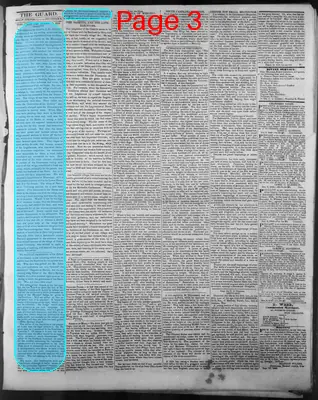
Editorial
November 8, 1842
The Guard
Holly Springs, Marshall County, Mississippi
What is this article about?
Editorial argues that while some Democrats supported Mississippi bank charters, Whigs were the primary advocates, and opposition mainly came from Democrats. It highlights unfair blame on Democrats and includes an exchange revealing a fabricated legal opinion in the Southron as a hoax by a correspondent, fooling other editors.
Clipping
OCR Quality
98%
Excellent
Full Text
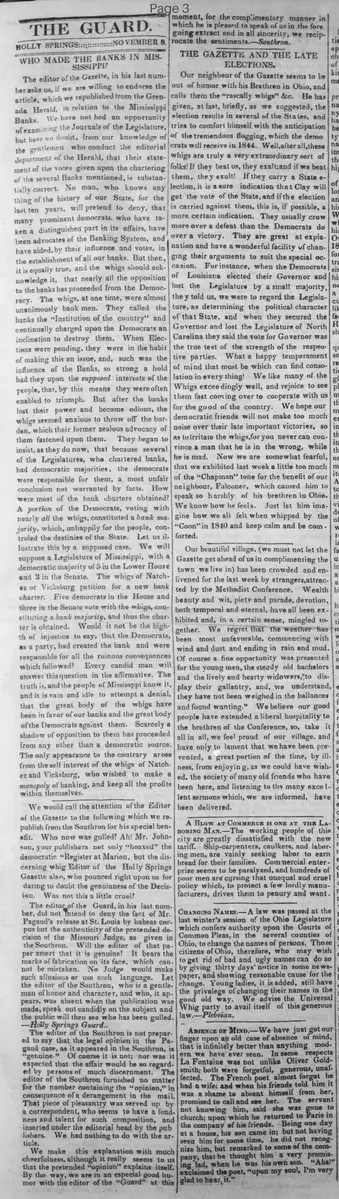
WHO MADE THE BANKS IN MISSISSIPPI?
The editor of the Gazette, in his last number asks us, if we are willing to endorse the article, which we republished from the Grenada Herald, in relation to the Mississippi Banks. We have not had an opportunity of examining the Journals of the Legislature, but have no doubt, from our knowledge of the gentlemen who conduct the editorial department of the Herald, that their statement of the votes given upon the chartering of the several Banks mentioned, is substantially correct. No man, who knows anything of the history of our State, for the last ten years, will pretend to deny, that many prominent democrats, who have taken a distinguished part in its affairs, have been advocates of the Banking System, and have aided, by their influence and votes, in the establishment of all our banks. But then, it is equally true, and the whigs should acknowledge it, that nearly all the opposition to the banks has proceeded from the Democracy. The whigs, at one time, were almost unanimously bank men. They called the banks the "Institutions of the country" and continually charged upon the Democrats an inclination to destroy them. When Elections were pending, they were in the habit of making this an issue, and, such was the influence of the Banks, so strong a hold had they upon the supposed interests of the people, that, by this means they were often enabled to triumph. But after the banks lost their power and become odious, the whigs seemed anxious to throw off the burden, which their former zealous advocacy of them fastened upon them. They began to insist, as they do now, that because several of the Legislatures, who chartered banks, had democratic majorities, the democrats were responsible for them, a most unfair conclusion not warranted by facts. How were most of the bank charters obtained? A portion of the Democrats, voting with nearly all the whigs, constituted a bank majority, which, unhappily for the people, controlled the destinies of the State. Let us illustrate this by a supposed case. We will suppose a Legislature of Mississippi, with a democratic majority of 5 in the Lower House and 3 in the Senate. The whigs of Natchez or Vicksburg petition for a new bank charter. Five democrats in the House and three in the Senate vote with the whigs, constituting a bank majority, and thus the charter is obtained. Would it not be the height of injustice to say, that the Democrats, as a party, had created the bank and were responsible for all the ruinous consequences which followed? Every candid man will answer this question in the affirmative. The truth is, and the people of Mississippi know it, and it is vain and idle to attempt a denial, that the great body of the whigs have been in favor of our banks and the great body of the Democrats against them. Scarcely a shadow of opposition to them has proceeded from any other than a democratic source. The only appearance to the contrary arose from the self interest of the whigs of Natchez and Vicksburg, who wished to make a monopoly of banking, and keep all the profits within themselves.
We would call the attention of the Editor of the Gazette to the following which we republish from the Southron for his special benefit. Who now was gulled? Ah! Mr. Johnson, your publishers not only "hoaxed" the democratic "Register at Marion" but the discerning whig Editor of the Holly Springs Gazette also, who pounced right upon us for daring to doubt the genuineness of the Decision. Was not this a little cruel?
The editor of the Guard, in his last number, did not intend to deny the fact of Mr. Pagaud's release at St. Louis by habeas corpus but the authenticity of the pretended decision of the Missouri Judge, as given in the Southron. Will the editor of that paper assert that it is genuine? It bears the marks of fabrication on its face, which cannot be mistaken. No Judge would make such allusions or use such language. Let the editor of the Southron, who is a gentleman of honor and character, and who, it appears, was absent when the publication was made, speak out candidly on the subject and the public will then see who has been gulled.—Holly Springs Guard.
The editor of the Southron is not prepared to say that the legal opinion in the Pagaud case, as it appeared in the Southron, is "genuine." Of course it is not; nor was it expected that the affair would be so regarded by persons of much discernment. The editor of the Southron furnished no matter for the number containing the "opinion," in consequence of a derangement in the mail. That piece of pleasantry was served up by a correspondent, who seems to have a fondness and talent for such composition, and inserted under the editorial head by the publishers. We had nothing to do with the article.
We make this explanation with much cheerfulness, although it really seems to us that the pretended "opinion" explains itself. By the way, we are in an especial good humor with the editor of the "Guard" at this moment, for the complimentary manner in which he is pleased to speak of us in the foregoing extract and in all sincerity, we reciprocate the sentiments.—Southron.
The editor of the Gazette, in his last number asks us, if we are willing to endorse the article, which we republished from the Grenada Herald, in relation to the Mississippi Banks. We have not had an opportunity of examining the Journals of the Legislature, but have no doubt, from our knowledge of the gentlemen who conduct the editorial department of the Herald, that their statement of the votes given upon the chartering of the several Banks mentioned, is substantially correct. No man, who knows anything of the history of our State, for the last ten years, will pretend to deny, that many prominent democrats, who have taken a distinguished part in its affairs, have been advocates of the Banking System, and have aided, by their influence and votes, in the establishment of all our banks. But then, it is equally true, and the whigs should acknowledge it, that nearly all the opposition to the banks has proceeded from the Democracy. The whigs, at one time, were almost unanimously bank men. They called the banks the "Institutions of the country" and continually charged upon the Democrats an inclination to destroy them. When Elections were pending, they were in the habit of making this an issue, and, such was the influence of the Banks, so strong a hold had they upon the supposed interests of the people, that, by this means they were often enabled to triumph. But after the banks lost their power and become odious, the whigs seemed anxious to throw off the burden, which their former zealous advocacy of them fastened upon them. They began to insist, as they do now, that because several of the Legislatures, who chartered banks, had democratic majorities, the democrats were responsible for them, a most unfair conclusion not warranted by facts. How were most of the bank charters obtained? A portion of the Democrats, voting with nearly all the whigs, constituted a bank majority, which, unhappily for the people, controlled the destinies of the State. Let us illustrate this by a supposed case. We will suppose a Legislature of Mississippi, with a democratic majority of 5 in the Lower House and 3 in the Senate. The whigs of Natchez or Vicksburg petition for a new bank charter. Five democrats in the House and three in the Senate vote with the whigs, constituting a bank majority, and thus the charter is obtained. Would it not be the height of injustice to say, that the Democrats, as a party, had created the bank and were responsible for all the ruinous consequences which followed? Every candid man will answer this question in the affirmative. The truth is, and the people of Mississippi know it, and it is vain and idle to attempt a denial, that the great body of the whigs have been in favor of our banks and the great body of the Democrats against them. Scarcely a shadow of opposition to them has proceeded from any other than a democratic source. The only appearance to the contrary arose from the self interest of the whigs of Natchez and Vicksburg, who wished to make a monopoly of banking, and keep all the profits within themselves.
We would call the attention of the Editor of the Gazette to the following which we republish from the Southron for his special benefit. Who now was gulled? Ah! Mr. Johnson, your publishers not only "hoaxed" the democratic "Register at Marion" but the discerning whig Editor of the Holly Springs Gazette also, who pounced right upon us for daring to doubt the genuineness of the Decision. Was not this a little cruel?
The editor of the Guard, in his last number, did not intend to deny the fact of Mr. Pagaud's release at St. Louis by habeas corpus but the authenticity of the pretended decision of the Missouri Judge, as given in the Southron. Will the editor of that paper assert that it is genuine? It bears the marks of fabrication on its face, which cannot be mistaken. No Judge would make such allusions or use such language. Let the editor of the Southron, who is a gentleman of honor and character, and who, it appears, was absent when the publication was made, speak out candidly on the subject and the public will then see who has been gulled.—Holly Springs Guard.
The editor of the Southron is not prepared to say that the legal opinion in the Pagaud case, as it appeared in the Southron, is "genuine." Of course it is not; nor was it expected that the affair would be so regarded by persons of much discernment. The editor of the Southron furnished no matter for the number containing the "opinion," in consequence of a derangement in the mail. That piece of pleasantry was served up by a correspondent, who seems to have a fondness and talent for such composition, and inserted under the editorial head by the publishers. We had nothing to do with the article.
We make this explanation with much cheerfulness, although it really seems to us that the pretended "opinion" explains itself. By the way, we are in an especial good humor with the editor of the "Guard" at this moment, for the complimentary manner in which he is pleased to speak of us in the foregoing extract and in all sincerity, we reciprocate the sentiments.—Southron.
What sub-type of article is it?
Partisan Politics
Economic Policy
What keywords are associated?
Mississippi Banks
Democrats Whigs
Bank Charters
Political Responsibility
Newspaper Hoax
Pagaud Case
What entities or persons were involved?
Democrats
Whigs
Grenada Herald
Gazette
Southron
Holly Springs Guard
Mr. Pagaud
Editorial Details
Primary Topic
Responsibility For Mississippi Bank Charters
Stance / Tone
Defending Democrats Against Blame For Banks, Pro Democratic
Key Figures
Democrats
Whigs
Grenada Herald
Gazette
Southron
Holly Springs Guard
Mr. Pagaud
Key Arguments
- many prominent democrats advocated for banks but opposition mainly from democrats
- whigs were almost unanimously pro-bank and used it in elections
- bank charters obtained by some democrats voting with whigs
- unfair to blame democratic party entirely for banks
- fabricated legal opinion in southron was a hoax by correspondent