Thank you for visiting SNEWPapers!
Sign up free
Story
December 1, 1875
The Weekly Clarion
Jackson, Meridian, Hinds County, Lauderdale County, Mississippi
What is this article about?
Comprehensive 1875 report on the National Grange, detailing membership growth to 1,450,000, officer list, financials showing $229,533 income and $180,995 expenditures in 1874, cooperative enterprises saving members millions, and social benefits across U.S. states.
Clipping
OCR Quality
98%
Excellent
Full Text
The Weekly Clarion.
WEDNESDAY. - DECEMBER 1. 1875
STATISTICS
OF THE
NATIONAL
GRANGE.
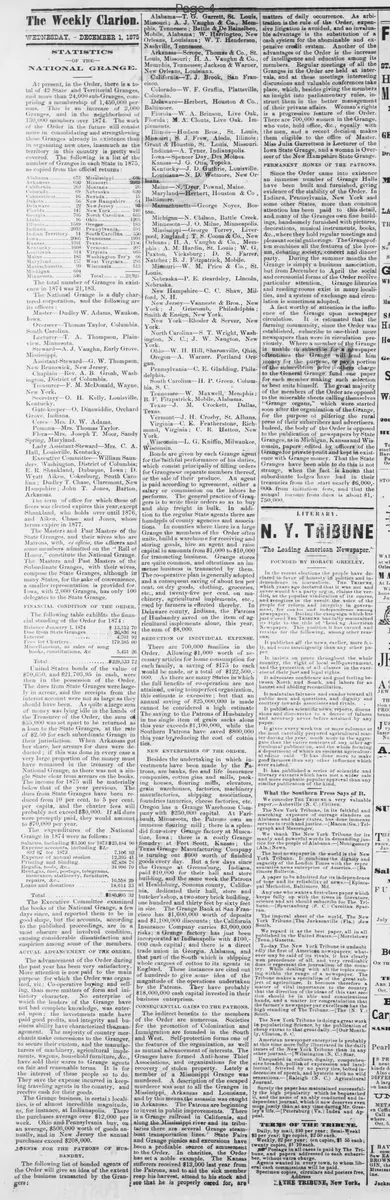
At present, in the Order, there is a total of 42 State and Territorial Granges and more than 24,000 sub-Granges, comprising a membership of 1,450,000 persons.
This is an increase of 2,000 Granges, and in the neighborhood of 130,000 members over 1874. The work of the Order in the future will consist more in consolidating and strengthening those Granges already in existence than in organizing new ones, inasmuch as the territory in this country is pretty well covered. The following is a list of the number of Granges in each State in 1875, as copied from the official returns:
The total number of Granges in existence in 1874 was 21,183.
The National Grange is a duly chartered corporation, and the following are its officers:
Master—Dudley W. Adams, Waukon, Iowa.
Overseer—Thomas Taylor, Columbia, South Carolina.
Lecturer—T. A. Thompson, Plainview, Minnesota.
Steward—A. J. Vaughn, Early Grove, Mississippi.
Assistant-Steward—G. W. Thompson, New Brunswick, New Jersey.
Chaplain—Rev. A. B. Grosh, Washington, District of Columbia.
Treasurer—F. M. McDonald, Wayne, New York.
Secretary—O. H. Kelly, Louisville, Kentucky.
Gate-keeper—O. Dinswiddie, Orchard Grove, Indiana.
Ceres—Mrs. D. W. Adams.
Pomona—Mrs. Thomas Taylor.
Flora—Mrs. Joseph T. Moor, Sandy Spring, Maryland.
Lady Assistant-Steward—Mrs. C. A. Hall, Louisville, Kentucky.
Executive Committee—William Saunders, Washington, District of Columbia; E. R. Shankland, Dubuque, Iowa; Wyatt Aiken, Cokesbury, South Carolina; Dudley T. Chase, Claremont, New Hampshire; John T. Jones, Barton, Arkansas.
The term of office for which these officers was elected expires this year, except Shankland, who holds over until 1876, and Aiken, Chase and Jones, whose terms expire in 1877.
The Masters and Past Masters of the State Granges, and their wives who are Matrons, with, ex officio, the officers and some members admitted on the Roll of Honor, constitute the National Grange.
The Masters and Past Masters of the Subordinate Granges, with their wives compose the State Granges, although in many States, for the sake of convenience, a smaller representation is provided for. Iowa, with 2,000 Granges, has only 100 delegates to the State Grange.
FINANCIAL CONDITION OF THE ORDER.
The following table exhibits the financial standing of the Order for 1874:
Balance January 1, 1874 $13,152.70
Due from State Granges 26,836.84
Interest 4,701.92
Fees for Charters 179,385.00
Miscellaneous, as sales of song books, constitutions, etc. 5,451.26
Total $229,533.72
United States bonds of the value of $70,650, and $21,703.95 in cash, were then in the possession of the Order.
The dues from State Granges were largely in arrear, and the receipts from the interest account were not as large as they should have been. As quite a large sum of money was lying idle in the hands of the Treasurer of the Order, the sum of $55,000 was set apart to be returned as a loan to the State Granges, at the rate of $2.50 for each subordinate Grange in their jurisdiction. When Arkansas got her share, her arrears for dues were deducted; if this was done in every case a very large proportion of the money must have remained in the treasury of the National Grange, as there was not a single State clear from arrears on the books.
The income for 1875 will be materially below that of the year previous. The dues from State Granges have been reduced from 10 per cent. to 5 per cent. per capita, and the charter fees will probably not exceed $80,000. If all dues were promptly paid, they would amount to $70,000 per year.
The expenditures of the National Grange in 1874 were as follows:
Salaries, including $3,500 for 1873 $23,454.90
Expense accounts, including $2,592.07 for 1873 7,106.93
Expense of annual session 12,395.41
Printing and binding 67,838.76
Regalia, tools, etc. 34,996.70
Rent, gas, fuel, postage, telegrams, insurance, stationery, furniture, repairs, etc. 16,558.29
Loans and donations 18,614.33
Total $180,995.32
The Executive Committee examined the books of the National Grange, a few days since, and reported them to be in good shape, but the accounts, according to the published proceedings, are in a most obscure and involved condition, causing considerable dissatisfaction and suspicion among some of the members.
ACTUAL ADVANCEMENT OF THE ORDER
The advancement of the Order during the past year has been very satisfactory. More attention is now paid to the main purpose for which the Order was organized, viz: Co-operative buying and selling, than mere matters of form and initiatory character. No enterprise of which the leaders of the Grange have not had complete knowledge, was entered upon: the investments made have paid good profits, and integrity and business ability have characterized the management. The majority of country merchants make concessions to the Granger, to secure their custom, and the manufacturers of machinery, agricultural implements, wagons, household furniture, etc., have sold their wares to Grange agents on fair and reasonable terms. It is for the interest of these people so to do. They save the expense incurred in keeping traveling agents in the country, and receive cash for their goods.
The Grange business, in certain localities, is of almost incredible magnitude, as, for instance, at Indianapolis. There the purchases average over $12,000 per week. Ohio and Pennsylvania buy, on an average, $500,000 worth of goods annually, and in New Jersey the annual purchases exceed $208,000.
AGENTS FOR THE PATRONS OF HUSBANDRY,
The following list of bonded agents of the Order will give an idea of the extent of the business transacted by the Grangers:
Alabama—T. G. Garrett, St. Louis, Missouri; A. J. Vaughn & Co., Memphis, Tennessee; Battle & De Bain, Mobile, Alabama; W. Harrington, New Orleans, Louisiana; W. T. Henderson, Nashville, Tennessee.
Arkansas—Scrope, Thomas & Co., St. Louis, Missouri; H. A. Vaughn & Co., Memphis, Tennessee; Jackson & Warner, New Orleans, Louisiana.
California—T. J. Brook, San Francisco.
Colorado—W. F. Graflin, Plattsville, Colorado.
Delaware—Herbert, Houston & Co.,
Florida—W. A. Brinson, Live Oak, Florida; M. A. Clouts, Live Oak. Implements.
Illinois—Hudson Bros., St. Louis, Missouri; S. J. Frew, Aledo, Illinois; Grant & Houston, St. Louis, Missouri.
Indiana—A. Tyner, Indianapolis.
Iowa—Spencer Day, Des Moines.
Kansas—J. G. Otis, Topeka.
Kentucky—J. D. Guthrie, Louisville.
Louisiana—N. D. Wetmore, New Orleans.
Maine—N. Dyer, Pownal, Maine.
Maryland—Herbert, Houston & Co., Baltimore.
Massachusetts—George Noyes, Boston.
Michigan—N. Chilson, Battle Creek.
Minnesota—J. O. Milne, Minneapolis.
Mississippi—George Torrey, Liverpool, England; T. S. Coons & Co., New Orleans; H. A. Vaughn & Co., Memphis; A. M. Hardin, St. Louis; W. G. Paxton, Vicksburg; D. S. Farrer, Natchez; B. J. Fitzpatrick, Mobile.
Missouri—W. M. Price & Co., St. Louis.
Nebraska—P. E. Beardsley, Lincoln, Nebraska.
New Hampshire—C. C. Shaw, Milford, N. H.
New Jersey—Vanneste & Bros., New York; J. Griscomb, Philadelphia; Smith & Ensign, New York.
New York—Rhoder & Server, New York.
North Carolina—S. T. Wright, Washington, N. C.; J. W. Naughton, New York.
Ohio—W. H. Hill, Sharonville, Ohio.
Oregon—A. Warner, Portland, Oregon.
Pennsylvania—C. E. Gladding, Philadelphia.
South Carolina—H. P. Green, Columbia, S. C.
Tennessee—W. Maxwell, Memphis; B. F. Fitzpatrick, Mobile, Alabama.
Texas—J. M. Crockett, Dallas, Texas.
Vermont—J. H. Crosby, St. Albans.
Virginia—C. E. Featherstone, Richmond, Virginia; C. R. Hatton, New York.
Wisconsin—L. G. Kniffin, Milwaukee, Wisconsin.
Bonds are given by each Grange agent for the faithful performance of his duties, which consist principally of filling orders for Granges or separate members thereof, or the sale of their produce. An agent is paid according to agreement, either a salary or commission on the labors he performs. The general practice of Grangers is to write their orders so as to buy and ship freight in bulk. In addition to the regular State agents there are hundreds of county agencies and associations. In counties where there is a large Grange the members of the Order often unite, build a warehouse for receiving and storing goods, hire an agent and raise capital in amounts from $1,000 to $10,000 for transacting business. Grange stores are quite common, and oftentimes an immense business is transacted by them. The co-operative plan is generally adopted and a consequent saving of about ten per cent. on dry goods, clothing, groceries, etc., and twenty-five per cent. on machinery, agricultural implements, etc., used by farmers is effected thereby. In Delaware county, Indiana, the Patrons of Husbandry saved on the item of agricultural implements alone, this year, the sum of $8,000.
REDUCTION OF INDIVIDUAL EXPENSE.
There are 700,000 families in the Order. Allowing $1,000 worth of necessary articles for home consumption for each family, a saving of $175 to each would be made, or a total of $122,500,000. As there are many States in which the full benefits of co-operation are not attained, owing to imperfect organization, this estimate is excessive; but that an annual saving of $25,000,000 is made cannot be considered a high estimate. The saving to the Patrons of Husbandry in the single item of grain sacks alone this year exceeds $1,100,000, while the Southern Patrons have saved $800,000 this year by reducing the cost of cotton ties.
Besides the undertaking in which investments have been made by the Patrons, are banks, fire and life insurance companies, cotton gins and mills, packing houses, flouring mills, elevators, grain warehouses, factories, machinery manufactories, shipping associations, foundries, tanneries, cheese factories, etc. Oregon has a Grange Warehouse Company with $250,000 capital. At Faribault, Minnesota, the Patrons own an immense flouring mill; there is a splendid four-story Grange factory at Muscatine, Iowa; there is a costly Grange foundry at Fort Scott, Kansas; the Texas Grange Manufacturing Company is turning out $600 worth of finished goods every day. But a few days since the Grange at Greensburg, Indiana, paid $10,000 for their hall and store building, and the same week the Patrons at Healdsburg, Sonoma county, California, dedicated their hall, store and butcher's shop, a two-story brick building, one hundred and thirty feet by sixty feet in size. The Grange Bank at San Francisco has $1,600,000 worth of deposits and $1,100,000 discounts; the California Insurance Company carries $3,000,000 risks; a Grange factory has just been incorporated at Indianapolis with $100,000 cash capital; and there is a direct trade union in Georgia, Alabama, and that part of the South which is shipping whole cargoes of cotton to its agents in England. These instances are cited out of hundreds to give some idea of the magnitude of the operations undertaken by the Patrons. They have probably $18,000,000 cash capital invested in their business enterprises.
CONSEQUENTIAL GAINS TO THE PATRONS.
The indirect benefits to the members of the Order are numerous. Societies for the promotion of Colonization and Immigration are founded in the South and West. Self-protection forms one of the features of the organization, as well as mutual advancement of interests. The Granges have formed Anti-horse Thief Associations, and organizations for the recovery of stolen property. Lately a member of a Mississippi Grange was murdered. A description of the escaped murderer was sent to all the Granges in Mississippi, Arkansas and Louisiana, and by this means the assassin was caught in Arkansas. The Patrons are beginning to invest in public improvements. There is a Grange railroad in California, and along the Mississippi river and its tributaries there are several Grange steamboat transportation lines. State Fairs and Grange picnics and excursions have been a profitable source of amusement to the Order. In charities, the Order has set a noble example. The Kansas sufferers received $13,000 last year from the Patrons, and to aid the sick member reap his harvest, attend to his stock and see that he is properly cared for, are matters of daily occurrence. As arbitration is the rule of the Order, expensive litigation is avoided, and an invaluable advantage is the substitution of a cash system for the abominable and expensive credit system. Another of the advantages of the Order is the increase of intelligence and education among its members. Regular meetings of all the Granges in the Order are held at intervals, and at these meetings interesting discussions and valuable conferences take place, which, besides giving the members an insight into parliamentary rules, instruct them in the better management of their private affairs. Woman's rights is a progressive feature of the Order. There are 700,000 women in the Grange, who vote, hold office, etc., equally with the men, and a recent decision makes them eligible to the office of Master. Miss Julia Garrettson is Lecturer of the Iowa State Grange, and a woman is Overseer of the New Hampshire State Grange.
PERMANENT HOMES OF THE PATRONS.
Since the Order came into existence an immense number of Grange Halls have been built and furnished, giving evidence of the stability of the Order. In Indiana, Pennsylvania, New York and some other States, more than common attention has been paid to this detail, and many of the Granges own fine buildings, handsomely furnished with pictures, decorations, musical instruments, books, etc., where they hold regular meetings and pleasant social gatherings. The Grange of ten combines all the features of the lyceum, debating society, concert and dinner party. During the summer months the Grange is simply a business association, but from December to April the social and ceremonial forms of the Order receive particular attention. Grange libraries and reading-rooms exist in many localities, and a system of exchange and circulation is sometimes adopted.
A fact worthy of attention is the influence of the Grange upon newspaper circulation. It is estimated that the farming community, since the Order was established, subscribe to one-third more newspapers than were in circulation previously. Where a member of the Grange is unable to subscribe for a newspaper oftentimes the Grange will lend him money for the purpose, or pay a portion of the subscription price; others charge to the General Grange fund one paper for each member making such selection as best suits himself. The great majority of the members of the Order are opposed to the miserable sheets calling themselves "Grange organs," which were started soon after the organization of the Grange, for the purpose of pilfering the rural press of their subscribers and advertisers. Indeed, the body of the Order is opposed to the publication of newspapers by State Granges, as in Michigan, Kansas and Wisconsin, papers edited by officers of the Grange for private profit and kept in existence with Grange money. That the State Granges have been able to do this is not strange, when the fact is known that subordinate lodges have had in their treasuries from the start nearly $6,000,000 from initiation fees, and that the annual income from dues is about $1,750,000.
WEDNESDAY. - DECEMBER 1. 1875
STATISTICS
OF THE
NATIONAL
GRANGE.
At present, in the Order, there is a total of 42 State and Territorial Granges and more than 24,000 sub-Granges, comprising a membership of 1,450,000 persons.
This is an increase of 2,000 Granges, and in the neighborhood of 130,000 members over 1874. The work of the Order in the future will consist more in consolidating and strengthening those Granges already in existence than in organizing new ones, inasmuch as the territory in this country is pretty well covered. The following is a list of the number of Granges in each State in 1875, as copied from the official returns:
The total number of Granges in existence in 1874 was 21,183.
The National Grange is a duly chartered corporation, and the following are its officers:
Master—Dudley W. Adams, Waukon, Iowa.
Overseer—Thomas Taylor, Columbia, South Carolina.
Lecturer—T. A. Thompson, Plainview, Minnesota.
Steward—A. J. Vaughn, Early Grove, Mississippi.
Assistant-Steward—G. W. Thompson, New Brunswick, New Jersey.
Chaplain—Rev. A. B. Grosh, Washington, District of Columbia.
Treasurer—F. M. McDonald, Wayne, New York.
Secretary—O. H. Kelly, Louisville, Kentucky.
Gate-keeper—O. Dinswiddie, Orchard Grove, Indiana.
Ceres—Mrs. D. W. Adams.
Pomona—Mrs. Thomas Taylor.
Flora—Mrs. Joseph T. Moor, Sandy Spring, Maryland.
Lady Assistant-Steward—Mrs. C. A. Hall, Louisville, Kentucky.
Executive Committee—William Saunders, Washington, District of Columbia; E. R. Shankland, Dubuque, Iowa; Wyatt Aiken, Cokesbury, South Carolina; Dudley T. Chase, Claremont, New Hampshire; John T. Jones, Barton, Arkansas.
The term of office for which these officers was elected expires this year, except Shankland, who holds over until 1876, and Aiken, Chase and Jones, whose terms expire in 1877.
The Masters and Past Masters of the State Granges, and their wives who are Matrons, with, ex officio, the officers and some members admitted on the Roll of Honor, constitute the National Grange.
The Masters and Past Masters of the Subordinate Granges, with their wives compose the State Granges, although in many States, for the sake of convenience, a smaller representation is provided for. Iowa, with 2,000 Granges, has only 100 delegates to the State Grange.
FINANCIAL CONDITION OF THE ORDER.
The following table exhibits the financial standing of the Order for 1874:
Balance January 1, 1874 $13,152.70
Due from State Granges 26,836.84
Interest 4,701.92
Fees for Charters 179,385.00
Miscellaneous, as sales of song books, constitutions, etc. 5,451.26
Total $229,533.72
United States bonds of the value of $70,650, and $21,703.95 in cash, were then in the possession of the Order.
The dues from State Granges were largely in arrear, and the receipts from the interest account were not as large as they should have been. As quite a large sum of money was lying idle in the hands of the Treasurer of the Order, the sum of $55,000 was set apart to be returned as a loan to the State Granges, at the rate of $2.50 for each subordinate Grange in their jurisdiction. When Arkansas got her share, her arrears for dues were deducted; if this was done in every case a very large proportion of the money must have remained in the treasury of the National Grange, as there was not a single State clear from arrears on the books.
The income for 1875 will be materially below that of the year previous. The dues from State Granges have been reduced from 10 per cent. to 5 per cent. per capita, and the charter fees will probably not exceed $80,000. If all dues were promptly paid, they would amount to $70,000 per year.
The expenditures of the National Grange in 1874 were as follows:
Salaries, including $3,500 for 1873 $23,454.90
Expense accounts, including $2,592.07 for 1873 7,106.93
Expense of annual session 12,395.41
Printing and binding 67,838.76
Regalia, tools, etc. 34,996.70
Rent, gas, fuel, postage, telegrams, insurance, stationery, furniture, repairs, etc. 16,558.29
Loans and donations 18,614.33
Total $180,995.32
The Executive Committee examined the books of the National Grange, a few days since, and reported them to be in good shape, but the accounts, according to the published proceedings, are in a most obscure and involved condition, causing considerable dissatisfaction and suspicion among some of the members.
ACTUAL ADVANCEMENT OF THE ORDER
The advancement of the Order during the past year has been very satisfactory. More attention is now paid to the main purpose for which the Order was organized, viz: Co-operative buying and selling, than mere matters of form and initiatory character. No enterprise of which the leaders of the Grange have not had complete knowledge, was entered upon: the investments made have paid good profits, and integrity and business ability have characterized the management. The majority of country merchants make concessions to the Granger, to secure their custom, and the manufacturers of machinery, agricultural implements, wagons, household furniture, etc., have sold their wares to Grange agents on fair and reasonable terms. It is for the interest of these people so to do. They save the expense incurred in keeping traveling agents in the country, and receive cash for their goods.
The Grange business, in certain localities, is of almost incredible magnitude, as, for instance, at Indianapolis. There the purchases average over $12,000 per week. Ohio and Pennsylvania buy, on an average, $500,000 worth of goods annually, and in New Jersey the annual purchases exceed $208,000.
AGENTS FOR THE PATRONS OF HUSBANDRY,
The following list of bonded agents of the Order will give an idea of the extent of the business transacted by the Grangers:
Alabama—T. G. Garrett, St. Louis, Missouri; A. J. Vaughn & Co., Memphis, Tennessee; Battle & De Bain, Mobile, Alabama; W. Harrington, New Orleans, Louisiana; W. T. Henderson, Nashville, Tennessee.
Arkansas—Scrope, Thomas & Co., St. Louis, Missouri; H. A. Vaughn & Co., Memphis, Tennessee; Jackson & Warner, New Orleans, Louisiana.
California—T. J. Brook, San Francisco.
Colorado—W. F. Graflin, Plattsville, Colorado.
Delaware—Herbert, Houston & Co.,
Florida—W. A. Brinson, Live Oak, Florida; M. A. Clouts, Live Oak. Implements.
Illinois—Hudson Bros., St. Louis, Missouri; S. J. Frew, Aledo, Illinois; Grant & Houston, St. Louis, Missouri.
Indiana—A. Tyner, Indianapolis.
Iowa—Spencer Day, Des Moines.
Kansas—J. G. Otis, Topeka.
Kentucky—J. D. Guthrie, Louisville.
Louisiana—N. D. Wetmore, New Orleans.
Maine—N. Dyer, Pownal, Maine.
Maryland—Herbert, Houston & Co., Baltimore.
Massachusetts—George Noyes, Boston.
Michigan—N. Chilson, Battle Creek.
Minnesota—J. O. Milne, Minneapolis.
Mississippi—George Torrey, Liverpool, England; T. S. Coons & Co., New Orleans; H. A. Vaughn & Co., Memphis; A. M. Hardin, St. Louis; W. G. Paxton, Vicksburg; D. S. Farrer, Natchez; B. J. Fitzpatrick, Mobile.
Missouri—W. M. Price & Co., St. Louis.
Nebraska—P. E. Beardsley, Lincoln, Nebraska.
New Hampshire—C. C. Shaw, Milford, N. H.
New Jersey—Vanneste & Bros., New York; J. Griscomb, Philadelphia; Smith & Ensign, New York.
New York—Rhoder & Server, New York.
North Carolina—S. T. Wright, Washington, N. C.; J. W. Naughton, New York.
Ohio—W. H. Hill, Sharonville, Ohio.
Oregon—A. Warner, Portland, Oregon.
Pennsylvania—C. E. Gladding, Philadelphia.
South Carolina—H. P. Green, Columbia, S. C.
Tennessee—W. Maxwell, Memphis; B. F. Fitzpatrick, Mobile, Alabama.
Texas—J. M. Crockett, Dallas, Texas.
Vermont—J. H. Crosby, St. Albans.
Virginia—C. E. Featherstone, Richmond, Virginia; C. R. Hatton, New York.
Wisconsin—L. G. Kniffin, Milwaukee, Wisconsin.
Bonds are given by each Grange agent for the faithful performance of his duties, which consist principally of filling orders for Granges or separate members thereof, or the sale of their produce. An agent is paid according to agreement, either a salary or commission on the labors he performs. The general practice of Grangers is to write their orders so as to buy and ship freight in bulk. In addition to the regular State agents there are hundreds of county agencies and associations. In counties where there is a large Grange the members of the Order often unite, build a warehouse for receiving and storing goods, hire an agent and raise capital in amounts from $1,000 to $10,000 for transacting business. Grange stores are quite common, and oftentimes an immense business is transacted by them. The co-operative plan is generally adopted and a consequent saving of about ten per cent. on dry goods, clothing, groceries, etc., and twenty-five per cent. on machinery, agricultural implements, etc., used by farmers is effected thereby. In Delaware county, Indiana, the Patrons of Husbandry saved on the item of agricultural implements alone, this year, the sum of $8,000.
REDUCTION OF INDIVIDUAL EXPENSE.
There are 700,000 families in the Order. Allowing $1,000 worth of necessary articles for home consumption for each family, a saving of $175 to each would be made, or a total of $122,500,000. As there are many States in which the full benefits of co-operation are not attained, owing to imperfect organization, this estimate is excessive; but that an annual saving of $25,000,000 is made cannot be considered a high estimate. The saving to the Patrons of Husbandry in the single item of grain sacks alone this year exceeds $1,100,000, while the Southern Patrons have saved $800,000 this year by reducing the cost of cotton ties.
Besides the undertaking in which investments have been made by the Patrons, are banks, fire and life insurance companies, cotton gins and mills, packing houses, flouring mills, elevators, grain warehouses, factories, machinery manufactories, shipping associations, foundries, tanneries, cheese factories, etc. Oregon has a Grange Warehouse Company with $250,000 capital. At Faribault, Minnesota, the Patrons own an immense flouring mill; there is a splendid four-story Grange factory at Muscatine, Iowa; there is a costly Grange foundry at Fort Scott, Kansas; the Texas Grange Manufacturing Company is turning out $600 worth of finished goods every day. But a few days since the Grange at Greensburg, Indiana, paid $10,000 for their hall and store building, and the same week the Patrons at Healdsburg, Sonoma county, California, dedicated their hall, store and butcher's shop, a two-story brick building, one hundred and thirty feet by sixty feet in size. The Grange Bank at San Francisco has $1,600,000 worth of deposits and $1,100,000 discounts; the California Insurance Company carries $3,000,000 risks; a Grange factory has just been incorporated at Indianapolis with $100,000 cash capital; and there is a direct trade union in Georgia, Alabama, and that part of the South which is shipping whole cargoes of cotton to its agents in England. These instances are cited out of hundreds to give some idea of the magnitude of the operations undertaken by the Patrons. They have probably $18,000,000 cash capital invested in their business enterprises.
CONSEQUENTIAL GAINS TO THE PATRONS.
The indirect benefits to the members of the Order are numerous. Societies for the promotion of Colonization and Immigration are founded in the South and West. Self-protection forms one of the features of the organization, as well as mutual advancement of interests. The Granges have formed Anti-horse Thief Associations, and organizations for the recovery of stolen property. Lately a member of a Mississippi Grange was murdered. A description of the escaped murderer was sent to all the Granges in Mississippi, Arkansas and Louisiana, and by this means the assassin was caught in Arkansas. The Patrons are beginning to invest in public improvements. There is a Grange railroad in California, and along the Mississippi river and its tributaries there are several Grange steamboat transportation lines. State Fairs and Grange picnics and excursions have been a profitable source of amusement to the Order. In charities, the Order has set a noble example. The Kansas sufferers received $13,000 last year from the Patrons, and to aid the sick member reap his harvest, attend to his stock and see that he is properly cared for, are matters of daily occurrence. As arbitration is the rule of the Order, expensive litigation is avoided, and an invaluable advantage is the substitution of a cash system for the abominable and expensive credit system. Another of the advantages of the Order is the increase of intelligence and education among its members. Regular meetings of all the Granges in the Order are held at intervals, and at these meetings interesting discussions and valuable conferences take place, which, besides giving the members an insight into parliamentary rules, instruct them in the better management of their private affairs. Woman's rights is a progressive feature of the Order. There are 700,000 women in the Grange, who vote, hold office, etc., equally with the men, and a recent decision makes them eligible to the office of Master. Miss Julia Garrettson is Lecturer of the Iowa State Grange, and a woman is Overseer of the New Hampshire State Grange.
PERMANENT HOMES OF THE PATRONS.
Since the Order came into existence an immense number of Grange Halls have been built and furnished, giving evidence of the stability of the Order. In Indiana, Pennsylvania, New York and some other States, more than common attention has been paid to this detail, and many of the Granges own fine buildings, handsomely furnished with pictures, decorations, musical instruments, books, etc., where they hold regular meetings and pleasant social gatherings. The Grange of ten combines all the features of the lyceum, debating society, concert and dinner party. During the summer months the Grange is simply a business association, but from December to April the social and ceremonial forms of the Order receive particular attention. Grange libraries and reading-rooms exist in many localities, and a system of exchange and circulation is sometimes adopted.
A fact worthy of attention is the influence of the Grange upon newspaper circulation. It is estimated that the farming community, since the Order was established, subscribe to one-third more newspapers than were in circulation previously. Where a member of the Grange is unable to subscribe for a newspaper oftentimes the Grange will lend him money for the purpose, or pay a portion of the subscription price; others charge to the General Grange fund one paper for each member making such selection as best suits himself. The great majority of the members of the Order are opposed to the miserable sheets calling themselves "Grange organs," which were started soon after the organization of the Grange, for the purpose of pilfering the rural press of their subscribers and advertisers. Indeed, the body of the Order is opposed to the publication of newspapers by State Granges, as in Michigan, Kansas and Wisconsin, papers edited by officers of the Grange for private profit and kept in existence with Grange money. That the State Granges have been able to do this is not strange, when the fact is known that subordinate lodges have had in their treasuries from the start nearly $6,000,000 from initiation fees, and that the annual income from dues is about $1,750,000.
What sub-type of article is it?
Historical Event
What themes does it cover?
Triumph
Moral Virtue
What keywords are associated?
National Grange
Patrons Of Husbandry
Cooperative Business
Farmers Organization
Financial Statistics
Membership Growth
What entities or persons were involved?
Dudley W. Adams
Thomas Taylor
O. H. Kelly
William Saunders
Where did it happen?
United States
Story Details
Key Persons
Dudley W. Adams
Thomas Taylor
O. H. Kelly
William Saunders
Location
United States
Event Date
1875
Story Details
Report on the National Grange's growth to 24,000 sub-Granges and 1,450,000 members, officer structure, 1874 finances with $229,533 income and cooperative businesses saving $25M annually, investments in enterprises, and social benefits like education and women's rights.