Thank you for visiting SNEWPapers!
Sign up free
The Tribune
Beaufort, Beaufort County, South Carolina
What is this article about?
Billy Birch of the San Francisco Minstrels recounts the history of Negro minstrelsy, from early troupes like the Virginia Minstrels and Thomas D. Rice's influence, to successes of Christy's and Buckleys, his own start in 1844, and the business's profitability.
Clipping
OCR Quality
Full Text
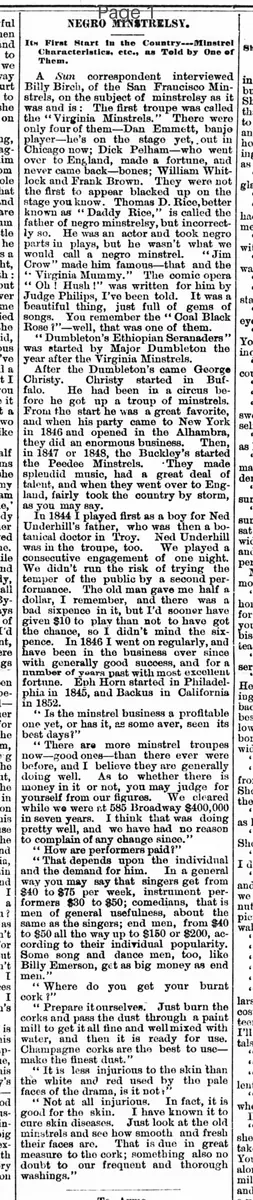
Its First Start In the Country—Minstrel
Characteristics, etc., as Told by One of
Them.
A Sun correspondent interviewed
Billy Birch, of the San Francisco Minstrels, on the subject of minstrelsy as it
was and is: The first troupe was called
the "Virginia Minstrels." "There were
only four of them—Dan Emmett, banjo
player—he's on the stage yet, out in
Chicago now; Dick Pelham—who went
over to England, made a fortune, and
never came back—bones: William Whitlock and Frank Brown. They were not
the first to appear blacked up on the
stage you know. Thomas D. Rice, better
known as "Daddy Rice," is called the
father of negro minstrelsy, but incorrectly so. He was an actor and took negro
parts in plays, but he wasn't what we
would call a negro minstrel. "Jim
Crow" made him famous—that and the
"Virginia Mummy." The comic opera
"Oh! Hush!" was written for him by
Judge Phillips, I've been told. It was a
beautiful thing, just full of gems of
songs. You remember the "Coal Black
Rose?" well, that was one of them.
"Dumbleton's Ethiopian Serenaders"
was started by Major Dumbleton the
year after the Virginia Minstrels.
After the Dumbleton's came George
Christy.
Christy started in Buffalo.
He had been in a circus before he got up a troupe of minstrels.
From the start he was a great favorite,
and when his party came to New York
in 1846 and opened in the Alhambra,
they did an enormous business. Then,
in 1847 or 1848, the Buckleys started
the Peedee Minstrels. They made
splendid music, had a great deal of
talent, and when they went over to England, fairly took the country by storm,
as you may say.
In 1844 I played first as a boy for Ned
Underhill's father, who was then a botanical doctor in Troy. Ned Underhill
was in the troupe, too. We played a
consecutive engagement of one night
We didn't run the risk of trying the
temper of the public by a second performance. The old man gave me half a
dollar, I remember, and there was a
bad sixpence in it, but I'd sooner have
given $10 to play than not to have got
the chance, so I didn't mind the sixpence. In 1846 I went on regularly, and
have been in the business ever since
with generally good success, and for a
umber of years past with most excellent
fortune. Eph Horn started in Philadelphia in 1845, and Backus in California
in 1852.
"Is the minstrel business a profitable
one yet, or has it, as some aver, seen its
best days?"
"There are more minstrel troupes
now—good ones—than there ever were
before, and I believe they are generally
doing well.
As to whether there is
money in it or not, you may judge for
yourself from our figures. We cleared
while we were at 585 Broadway $400,000
in seven years. I think that was doing
pretty well, and we have had no reason
to complain of any change since.
"How are performers paid?"
"That depends upon the individual
and the demand for him. In a general
way you may say that singers get from
$40 to $75 per week, instrument performers $30 to $50; comedians, that is
men of general usefulness, about the
same as the singers; end men, from $40
to $50 all the way up to $150 or $200, according to their individual popularity.
Some song and dance men, too, like
Billy Emerson, get as big money as end
men.
Where do you get your burnt
cork?"
"Prepare it ourselves. Just burn the
corks and pass the dust through a paint
mill to get it all fine and well mixed with
water, and then it is ready for use.
Champagne corks are the best to use—
make the finest dust."
"It is less injurious to the skin than
the white and red used by the pale
faces of the drama, is it not?"
"Not at all injurious. In fact, it is
good for the skin. I have known it to
cure skin diseases. Just look at the old
minstrels and see how smooth and fresh
their faces are.
That is due in great
measure to the cork; something also no
doubt to our frequent and thorough
washings."
What sub-type of article is it?
What themes does it cover?
What keywords are associated?
What entities or persons were involved?
Where did it happen?
Story Details
Key Persons
Location
United States, England
Event Date
1840s 1850s
Story Details
Billy Birch recounts the origins of Negro minstrelsy with the Virginia Minstrels in the early 1840s, Thomas D. Rice's role as an influential actor, subsequent troupes like Dumbleton's Ethiopian Serenaders and Christy's Minstrels achieving great success in New York and England, his own entry into the business in 1844, and the ongoing profitability including performer salaries and burnt cork preparation.