Thank you for visiting SNEWPapers!
Sign up free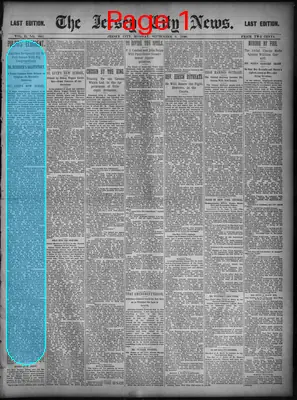
Story
September 8, 1890
The Jersey City News
Jersey City, Hudson County, New Jersey
What is this article about?
Report on the reopening of churches for fall with large congregations, focusing on Rev. John L. Scudder's sermon at the Tabernacle on Christian life emphasizing piety, honesty, and common sense, critiquing impiety, selfishness, and religious hypocrisy.
Clipping

OCR Quality
98%
Excellent
Full Text
PULPITS ELOQUENT
Churches Re-Opened for the Fall Season With Big Congregations.
DR. SCUDDER'S SALUTATORY
A Strong Common Sense Sermon on Religion--Dr. Mitchell's Discourse,
A large congregation listened to an eloquent sermon at the Tabernacle last evening. The Rev. John L. Scudder, bronzed and somewhat stouter as a result of his summer vacation, occupied the pulpit. The choir sang with its usual excellence and perhaps more than usual verve. A new Brussels carpet and other matters of interior decoration gave the auditorium a cheery appearance.
Mr. Scudder chose his text from Titus ii, 12. His subject was, "Christian life includes piety, honesty and common sense." He said:--"The impious man stands guilty of one of the gravest offences. He persists in committing the profoundest sin of omission known to human thought. He shows no deference to the Almighty. If there is anything that makes our blood boil and our fingers tingle it is to see children treat their parents with discourtesy and rudeness. Now a man who, in his everyday life, utterly ignores his Heavenly Father and treats Him with disrespect by failing to acknowledge Him, is living a hard hearted life. All the affection of a kind God is wasted upon him. All God's mercies are received without even a 'Thank you.'" The man is supremely selfish. He will take all he can get and give in return nothing but haughtiness and a scornful indifference.
"It is our duty to develop ourselves in every department of our being. A man whose religious nature has died out for want of proper care is truly a pitiable object. He is only half a man. His soul is like the truncated pyramid of the ancient mound builders, sad, sad monuments of a glory passed away.
"There are thousands of people who are more religious than they are willing to admit. Judging from church statistics, we should say that the impiety of mankind was overwhelming in its proportions; but church statistics are not correct criteria. Some entertain the absurd notions that piety is a sort of weakness: that religion is well enough for women and children, but unbecoming the independence and iron strength of manhood. How often, in spite of all this false philosophy, men will harbor religious thoughts away down in those recesses of the soul. A man is often serious and thoughtful when all the world, and even his own family, think him as cold as a stone. Perhaps the more seriously he thinks upon these themes the more he laughs to throw others off the scent, and to disguise his own feelings. A great part of religious feeling in this world is covered up. It is a cowardly piety. Still, it is piety after all. You have heard people sing when they were alone, and sing lustily, affectingly, too. But if they think someone is listening to them, how suddenly the music stops. Just the same way they are ashamed to be caught with a tear on their cheeks. I confess my inability to understand this widespread reluctance to testify to the noblest sentiments and affections of the soul. I fail to see how anyone can claim to be a fully developed man who is not avowedly religious.
"Every religious man, looking into his own experience, has often felt himself between the centrifugal forces of temptation and this centripetal restraining force of allegiance to his maker. For example, you own a piece of property, and a man comes to you with intention to buy, and asks you how much you consider it to be worth. You answer $7,000. But if the assessor calls you say about $5,000. When the customer approaches you look at your possessions through a telescope. When the tax gatherer arrives you deftly reverse the telescope and ask the officer to look through the other end. This love of the dollar runs in our national veins. It is in the blood of the American people and crops out everywhere. A lawyer told me he was one day running for a ferryboat and snagged his shoes. They were his pride. He had paid $14 for the pair. But, said he, 'I didn't pay for the new pair which I was obliged to purchase.' 'Who paid for them?' I asked. 'My client,' he replied, with a true lawyer's smile.
"Glance into politics. What a world of chicanery here: so much of it that the word 'politician' has become an opprobrious epithet. The average politician looks upon an office in the light of a mine. From it he expects to reimburse himself for all expenses incurred in reaching it, and to feather his nest most luxuriantly during the days of his occupancy. How few politicians nowadays who cannot be swayed by a bribe? It is said one of our legislators was offered a bribe to vote for a certain bill. 'What, sir,' he exclaimed, 'you take me for one who can be bribed? You insult my sense of honor. But, in case I should vote for that measure, how much would you give me?'"
In concluding Mr. Scudder decried grave and sanctimonious faces as unnecessary to religion. He opposed monasteries and nunneries as non-essential in the effort to shut off worldly temptation. Christ was an all-the-world's man. The intense excitement, which in the name of religion is gotten up at certain revivals, was nonsensical, he said. Said he, "I believe in revivals. I believe a healthy glow of the soul rather than a white heat of excitement and bluster in which all sound judgment is burned up. I do not believe in this pretending to be more than we are, those mannerisms and whining tones. They are a species of spiritual disease. Then, again, there is bigotry. It is a parasite abstracting the sap and retarding growth. The sooner it is cut off the better. I believe a man has lost his common sense when he affirms that he is free from sin, that, like the angels, he is living in a state of entire sanctification. He is either weak, or has assumed a cloak of perfection for villainy. Religion is not a fine art. It is not resolvable into fine singing, literary culture and imposing architecture. It is not addressed to the imagination, dazzling the mind with costly shrines, brilliant candles and almost regal pomp; nor is it morbid sentimentalism whose only pleasure is an intensification of feeling. Religion is loving God, hating what he hates. It is a spiritual development, a growth in grace and likeness to Christ until finally corruption puts on incorruption, and earth is swallowed up in Heaven."
Churches Re-Opened for the Fall Season With Big Congregations.
DR. SCUDDER'S SALUTATORY
A Strong Common Sense Sermon on Religion--Dr. Mitchell's Discourse,
A large congregation listened to an eloquent sermon at the Tabernacle last evening. The Rev. John L. Scudder, bronzed and somewhat stouter as a result of his summer vacation, occupied the pulpit. The choir sang with its usual excellence and perhaps more than usual verve. A new Brussels carpet and other matters of interior decoration gave the auditorium a cheery appearance.
Mr. Scudder chose his text from Titus ii, 12. His subject was, "Christian life includes piety, honesty and common sense." He said:--"The impious man stands guilty of one of the gravest offences. He persists in committing the profoundest sin of omission known to human thought. He shows no deference to the Almighty. If there is anything that makes our blood boil and our fingers tingle it is to see children treat their parents with discourtesy and rudeness. Now a man who, in his everyday life, utterly ignores his Heavenly Father and treats Him with disrespect by failing to acknowledge Him, is living a hard hearted life. All the affection of a kind God is wasted upon him. All God's mercies are received without even a 'Thank you.'" The man is supremely selfish. He will take all he can get and give in return nothing but haughtiness and a scornful indifference.
"It is our duty to develop ourselves in every department of our being. A man whose religious nature has died out for want of proper care is truly a pitiable object. He is only half a man. His soul is like the truncated pyramid of the ancient mound builders, sad, sad monuments of a glory passed away.
"There are thousands of people who are more religious than they are willing to admit. Judging from church statistics, we should say that the impiety of mankind was overwhelming in its proportions; but church statistics are not correct criteria. Some entertain the absurd notions that piety is a sort of weakness: that religion is well enough for women and children, but unbecoming the independence and iron strength of manhood. How often, in spite of all this false philosophy, men will harbor religious thoughts away down in those recesses of the soul. A man is often serious and thoughtful when all the world, and even his own family, think him as cold as a stone. Perhaps the more seriously he thinks upon these themes the more he laughs to throw others off the scent, and to disguise his own feelings. A great part of religious feeling in this world is covered up. It is a cowardly piety. Still, it is piety after all. You have heard people sing when they were alone, and sing lustily, affectingly, too. But if they think someone is listening to them, how suddenly the music stops. Just the same way they are ashamed to be caught with a tear on their cheeks. I confess my inability to understand this widespread reluctance to testify to the noblest sentiments and affections of the soul. I fail to see how anyone can claim to be a fully developed man who is not avowedly religious.
"Every religious man, looking into his own experience, has often felt himself between the centrifugal forces of temptation and this centripetal restraining force of allegiance to his maker. For example, you own a piece of property, and a man comes to you with intention to buy, and asks you how much you consider it to be worth. You answer $7,000. But if the assessor calls you say about $5,000. When the customer approaches you look at your possessions through a telescope. When the tax gatherer arrives you deftly reverse the telescope and ask the officer to look through the other end. This love of the dollar runs in our national veins. It is in the blood of the American people and crops out everywhere. A lawyer told me he was one day running for a ferryboat and snagged his shoes. They were his pride. He had paid $14 for the pair. But, said he, 'I didn't pay for the new pair which I was obliged to purchase.' 'Who paid for them?' I asked. 'My client,' he replied, with a true lawyer's smile.
"Glance into politics. What a world of chicanery here: so much of it that the word 'politician' has become an opprobrious epithet. The average politician looks upon an office in the light of a mine. From it he expects to reimburse himself for all expenses incurred in reaching it, and to feather his nest most luxuriantly during the days of his occupancy. How few politicians nowadays who cannot be swayed by a bribe? It is said one of our legislators was offered a bribe to vote for a certain bill. 'What, sir,' he exclaimed, 'you take me for one who can be bribed? You insult my sense of honor. But, in case I should vote for that measure, how much would you give me?'"
In concluding Mr. Scudder decried grave and sanctimonious faces as unnecessary to religion. He opposed monasteries and nunneries as non-essential in the effort to shut off worldly temptation. Christ was an all-the-world's man. The intense excitement, which in the name of religion is gotten up at certain revivals, was nonsensical, he said. Said he, "I believe in revivals. I believe a healthy glow of the soul rather than a white heat of excitement and bluster in which all sound judgment is burned up. I do not believe in this pretending to be more than we are, those mannerisms and whining tones. They are a species of spiritual disease. Then, again, there is bigotry. It is a parasite abstracting the sap and retarding growth. The sooner it is cut off the better. I believe a man has lost his common sense when he affirms that he is free from sin, that, like the angels, he is living in a state of entire sanctification. He is either weak, or has assumed a cloak of perfection for villainy. Religion is not a fine art. It is not resolvable into fine singing, literary culture and imposing architecture. It is not addressed to the imagination, dazzling the mind with costly shrines, brilliant candles and almost regal pomp; nor is it morbid sentimentalism whose only pleasure is an intensification of feeling. Religion is loving God, hating what he hates. It is a spiritual development, a growth in grace and likeness to Christ until finally corruption puts on incorruption, and earth is swallowed up in Heaven."
What sub-type of article is it?
Biography
Historical Event
What themes does it cover?
Moral Virtue
Providence Divine
What keywords are associated?
Sermon
Piety
Common Sense
Religion
Impiety
Honesty
What entities or persons were involved?
Rev. John L. Scudder
Where did it happen?
Tabernacle
Story Details
Key Persons
Rev. John L. Scudder
Location
Tabernacle
Event Date
Last Evening
Story Details
Rev. Scudder delivers a sermon on Christian life including piety, honesty, and common sense, criticizing impiety, hidden religiosity, dishonesty in business and politics, and excesses in religious practice, advocating genuine spiritual growth.