Thank you for visiting SNEWPapers!
Sign up free
Alexandria Gazette, Commercial And Political
Alexandria, Virginia
What is this article about?
Massachusetts House of Representatives committee report critiques unreliable State Department records on impressed American seamen, relies on merchant testimonies estimating only 12 genuine U.S. impressments from 21,060 employed over 15 years, discusses legal principles, and notes few French cases.
Merged-components note: Merged following tables into the legislative report as they contain relevant numerical data on impressments.
Clipping
OCR Quality
Full Text
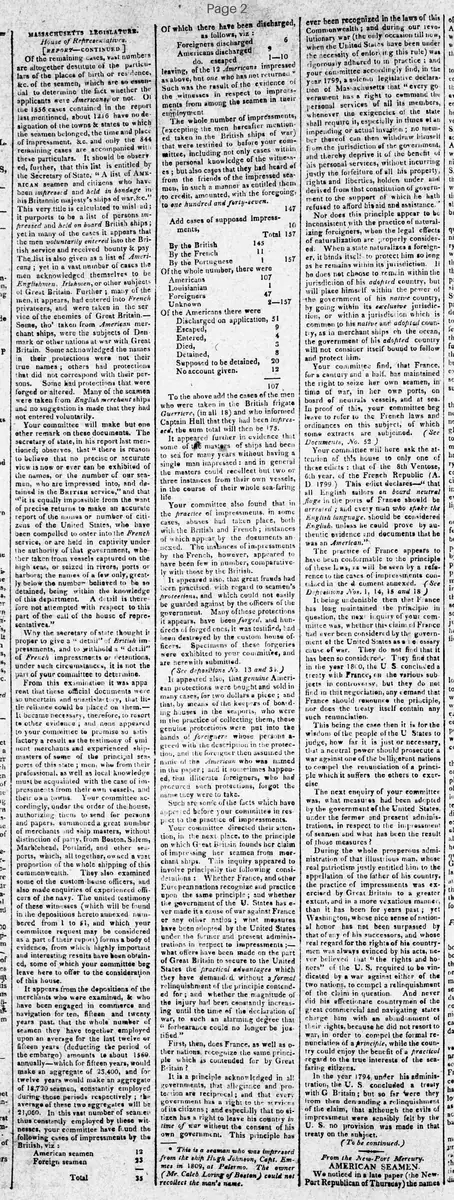
House of Representatives.
Report—continued.
Of the remaining cases, vast numbers
are altogether destitute of the particu-
lars of the places of birth or residence,
&c. of the seamen, which are so essen-
tial to determine the fact whether the
applicants were Americans, or not. Of
the 1556 cases contained in the report
last mentioned, about 1216 have no de-
signation of the towns & states to which
the seamen belonged, the time and place
of impressment, &c. and only the 340
remaining cases are accompanied with
these particulars. It should be obser-
ved, further, that this list is entitled by
the Secretary of State, "A list of AME-
RICAN seamen and citizens who have
been impressed and held in bondage in
his Britannic majesty's ships of war, &c."
This very title is calculated to misle ad;
it purports to be a list of persons im-
pressed and held on board British ships;
yet in many of the cases it appears that
the men voluntarily entered into the Bri-
tish service and received bounty & pay
The list is also given as a list of Ameri-
cans; yet in a vast number of cases the
men acknowledged themselves to be
Englishmen, Irishmen, or other subjects
of Great Britain. Further: many of the
men, it appears, had entered into French
privateers, and were taken in the ser-
vice of the enemies of Great Britain.
Some, tho' taken from American mer-
chant ships, were the subjects of Den-
mark or other nations at war with Great
Britain. Some acknowledged the names
in their protections were not their
true names; others had protections
that did not correspond with their per-
sons. Some had protections that were
forged or altered. Many of the seamen
were taken from English merchant ships
and no suggestion is made that they had
not entered voluntarily.
Your committee will make but one
other remark on these documents. Tho
secretary of state, in his report last men-
tioned; observes, that "there is reason
to believe that no precise or accurate
view is now or ever can be exhibited of
the names, or the number of our sea-
men, who are impressed into, and de-
tained in the British service," and that
"it is equally impossible from the want
of precise returns to make an accurate
report of the names or number of citi-
zens of the United States, who have
been compelled to enter into the French
service, or are held in captivity under
the authority of that government, whe-
ther taken from vessels captured on the
high seas, or seized in rivers, ports or
harbors; the names of a few only, great-
ly below the number believed to be so
detained, being within the knowledge
of this department. A detail is there-
fore not attempted with respect to this
part of the call of the house of repre-
sentatives."
Why the secretary of state thought it
proper to give a "detail" of British im-
pressments, and to withhold a "detail"
of French impressments or detentions,
under such circumstances, it is not the
part of your committee to determine.
From this examination it was appa-
rent that these official documents were
so uncertain and unsatisfactory, that lit-
tle reliance could be placed on them.
It became necessary, therefore, to resort
to other evidence; and none appeared
to your committee to promise so satis-
factory a result as the testimony of emi-
nent merchants and experienced ship-
master of some of the principal sea-
ports of this state; men, who from their
professional, as well as local knowledge
must be acquainted with the case of im-
pressments from their own vessels, and
their own towns. Your committee ac-
accordingly, under the order of the house,
authorizing them to send for persons
and papers, summoned a great number
of merchants and ship masters, without
distinction of party, from Boston, Salem,
Marblehead, Portland, and other sea-
ports, which, all together, owned a vast
proportion of the whole shipping of this
commonwealth. They also examined
some of the custom-house officers, and
also made enquiries of experienced offi-
cers of the navy. The united testimony
of these witnesses (which will be found
in the depositions hereto annexed, num-
bered from 1 to 31, and which your
committee request may be considered
as a part of their report) forms a body of
evidence, from which highly important
and interesting results have been ob-
tained, some of which your committee beg
leave here to offer to the consideration
of this house.
It appears from the depositions of the
merchants who were examined, & who
have been engaged in commerce and
navigation for ten, fifteen and twenty
years past, that the whole number of
seamen they have together employed
upon an average for the last twelve or
fifteen years (deducting the period of
the embargo) amounts to about 1560.
annually—which for fifteen years, would
make an aggregate of 23,400, and for
twelve years would make an aggregate
of 18,720 seamen, constantly employed
during those periods respectively; the
average of these two aggregates will be
21,060. In this vast number of seamen
thus constantly employed by these wit-
nesses, your committee have found the
following cases of impressments by the
British, viz:
American seamen
Foreign
seamen
Of which there have been discharged.
as follows, viz
Foreigners discharged
Americans discharged
do. escaped
leaving, of the 12 Americans impressed
as above, but one who has not returned
Such was the result of the evidence of
the witnesses in respect to impres-
ments from among the seamen in their
employment
(excepting the men hereafter mention-
ed taken in the British ships of war
The whole number of impressments,
that were testified to before your com-
mittee, including not only cases within
the personal knowledge of the witness-
es; but also cases that they had heard of
from the friends of the impressed sea-
men, in such a manner as entitled them
to credit, amounted, with the foregoing.
to one hundred and forty-seven.
147
Add cases of supposed impres-
sments,
10
Total 157
By the British
By the French
157
107
To the above add the cases of the men
who were taken in the British frigate
Guerriere, (in all 18) and who informed
Captain Hull that they had been impres-
sed, the sum total will then be 175.
It appeared further in evidence that
some of the
masters of ships had been
to sea for many years without having a
single man impressed: and in general
the masters could recollect but two or
three instances from their own vessels,
in the course of their whole sea-faring
life.
Your committee also found that in
the practice of impressments, in some
cases, abuses had taken place, both
with the British and French; instances
of which appear by the documents an-
nexed. The instances of impressments
by the French, however, appeared to
have been few in number, compara-
tively with those by the British.
It appeared also, that great frauds had
been practised, with regard to seamen's
protections, and which could not easily
be guarded against by the officers of the
government. Many of those protections
it appears, have been forged, and hun-
dreds of forged ones, it was testified, had
been destroyed by the custom house of-
ficeers.
Specimens of these forgeries
were exhibited to your committee, and
are herewith submitted.
(See depositions No. 13 and 34.)
It appeared also, that genuine Ameri-
can protections were bought and sold in
many cases, for two dollars a piece; and
that, by means of the keepers of board-
ing houses in the seaports, who were
in the practice of collecting them, these
genuine protections were put into the
hands of foreigners whose persons a-
greed with the description in the protec-
tion, and the foreigner then assumed the
name of the American who was named
in the paper; and it sometimes happen-
ed, that illiterate foreigners, who had
procured such protections, forgot the
name they were to take.
Such are some of the facts which have
appeared before your committee in res-
pect to the practice of impressments.
Your committee directed their atten-
tion, in the next place, to the principle
on which Great Britain founds her claim
of impressing her seamen from mer-
chant ships. This inquiry appeared to
involve principally the following consi-
derations: Whether France, and other
European nations recognize and practice
upon the same principle; and whether
the government of the U. States has e-
ver made it a cause of war against France
or any other nation; what measures
have been adopted by the United States
under the former and present adminis-
trations in respect to impressments
what offers have been made on the part
of Great Britain to secure to the United
States the practical advantages which
they have demanded, without a formal
relinquishment of the principle contend-
ed for: and whether the magnitude of
the injury had been constantly increas-
ing until the time of the declaration of
war, to such an alarming degree that
"forbearance could no longer be jus-
tified."
First, then, does France, as well as O-
ther nations, recognize the same princi-
ple which is contended for by Great
Britain?
It is a principle acknowledged in all
governments, that allegiance and pro-
tection are reciprocal; and that every
government has a right to the services
of its citizens; and especially that no ci-
tizen has a right to leave his country in
time of war without the consent of his
own government. This principle has
* This is a seaman who was impressed
from the ship Hugh Johnson, Capt. Em-
mes in 1809, at Palermo. The owner
( Mr. Caleb Loring of Boston) could not
recollect the man's name.
Commonwealth; and during our revo-
lutionary war (the only occasion till now,
when the United States have been under
the necessity of enforcing this rule) was
your committee accordingly find, in the
year 1799, a solemn legislative declara-
tion of Massachusetts that "every go-
vernment has a right to command the
personal services of all its members,
whenever the exigencies of the state
shall require it, especially in times of an
impending or actual invasion; no mem-
ber thereof can then withdraw himself
from the jurisdiction of the government,
and thereby deprive it of the benefit of
his personal services, without incurring
justly the forfeiture of all his property,
rights and liberties, holden under and
derived from that constitution of govern-
ment to the support of which he hath
refused to afford his aid and assistance."
Nor does this principle appear to be
inconsistent with the practice of natural-
izing foreigners, when the legal effects
of naturalization are properly consider-
ed. When a state naturalizes a foreign-
er, it binds itself to protect him so long
as he remains within its jurisdiction. If
he does not choose to remain within the
jurisdiction of his adopted country, but
will place himself within the power of
the government of his native country,
by going within its exclusive jurisdic-
tion, or within a jurisdiction which is
common to his native and adopted coun-
try, as in merchant ships on the ocean,
the government of his adopted country
will not consider itself bound to follow
and protect him.
Your committee find, that France,
for a century and a half, has maintained
the right to seize her own seamen, in
time of war, in her own ports, on
board of neutral vessels, and at sea.
In proof of this, your committee beg
leave to refer to the French laws and
ordinances on this subject, of which
some extracts are subjoined. (See
Documents, No. 52 )
Your committee will here ask the at-
tention of this house to only one of
these edicts: that of the 8th Ventose,
6th year, of the French Republic (A.
D 1799) This edict declares—" that
all English sailors on board neutral
flags in the ports of France should be
arrested; and every man who spoke the
English language, should be considered
English, unless he could prove by au-
thentic evidence and documents that he
was an American."
The practice of France appears to
have been conformable to the principle
of these laws, as will be seen by a refe-
rence to the cases of impressments con-
tained in the document annexed. See
Depositions Nos. 1, 14, 15 and 18.
It being undeniable then that France
has long maintained the principle in
question, the next inquiry of your com-
mittee was, whether this claim of France
had ever been considered by the govern-
ment of the United States as a necessary
Cause of war.
They do not find that it
has been so considered. They find that
in the year 1800, the U S. concluded a
treaty with France, on the various sub-
jects in controversy, but they do not
find in that negociation, any demand that
France should renounce the principle,
nor does the treaty itself contain any
such renunciation.
This being the case then it is for the
wisdom of the people of the U States to
judge, how far it is just or necessary,
that a neutral power should prosecute a
war against one of the belligerent nations
to compel the renunciation of a princi-
ple which it suffers the others to exer-
cise
The next enquiry of your committee
was, what measures had been adopted
by the government of the United States,
under the former and present adminis-
trations, in respect to the impressment
of seamen and what has been the result
of those measures?
During the whole prosperous admi-
nistration of that illustrious man, whose
real patriotism justly entitled him to the
appellation of the father of his country.
the practice of impressments was ex-
ercised by Great Britain to a greater
extent, and in a more vexatious manner
than it has been for years past; yet
Washington, whose nice sense of nation-
al honor has not been surpassed by
that of any of his successors, and whose
real regard for the rights of his country-
men was always evinced by his acts, ne-
ver believed that "the rights and ho-
nors" of the U. S. required to be vin-
dicated by a war against either of the
two nations, to compel a relinquishment
of the claim in question. And never
did his affectionate countrymen of the
great commercial and navigating states
charge him with an abandonment of
their rights, because he did not resort to
war, in order to compel the formal re-
nunciation of a principle, while the coun-
try could enjoy the benefit of a practical
regard to the true interests of the sea-
far ing citizens.
In the year 1794, under his adminis-
tration, the U. S. concluded a treaty
with G Britain; but so far were they
from then demanding a relinquishment
of the claim, that although the evils of
impressment were sensibly felt by the
U. S. no provision was made in that
treaty on the subject.
( To be continued.)
| By the Portuguese | 107 |
| Of the whole number, there were | |
| Americans | 1 |
| Louisianian | 47 |
| Foreigners | 2—157 |
| Unknown |
| Discharged on application, 51 |
| Escaped, 9 |
| Entered, 4 |
| Died, 3 |
| Detained, 8 |
| Supposed to be detained, 20 |
| No account given. 12 |
What sub-type of article is it?
What keywords are associated?
What entities or persons were involved?
Where did it happen?
Domestic News Details
Primary Location
Massachusetts
Key Persons
Outcome
12 americans impressed out of 21,060 employed; 147 total impressments testified, plus 10 supposed, totaling 157 by british and french; 18 from guerriere; most discharged, escaped, or entered service; few detained.
Event Details
House committee examines impressment records, finds them unreliable due to missing details, voluntary enlistments, foreign nationals, and forgeries; testimonies from merchants and shipmasters from Boston, Salem, etc., report low incidence of American impressments; discusses legal principles of allegiance and historical practices by Britain, France, and U.S.