Thank you for visiting SNEWPapers!
Sign up free
Putnam Patriot
Putnam, Windham County, Connecticut
What is this article about?
Detailed account of the Civilian Conservation Corps reforestation camp at West Glocester, Rhode Island, where 240 young unemployed men from the state engage in forestry work, construction, and conservation under army supervision, aimed at relieving unemployment and rehabilitating participants' health and morale.
Clipping
OCR Quality
Full Text
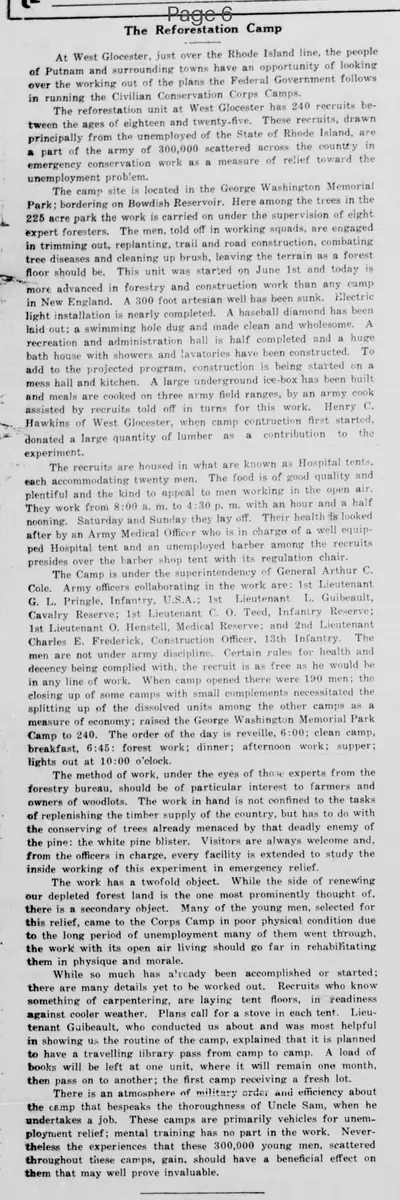
At West Glocester, just over the Rhode Island line, the people of Putnam and surrounding towns have an opportunity of looking over the working out of the plans the Federal Government follows in running the Civilian Conservation Corps Camps.
The reforestation unit at West Glocester has 240 recruits between the ages of eighteen and twenty-five. These recruits, drawn principally from the unemployed of the State of Rhode Island, are a part of the army of 300,000 scattered across the country in emergency conservation work as a measure of relief toward the unemployment problem.
The camp site is located in the George Washington Memorial Park; bordering on Bowdish Reservoir. Here among the trees in the 225 acre park the work is carried on under the supervision of eight expert foresters. The men, told off in working squads, are engaged in trimming out, replanting, trail and road construction, combating tree diseases and cleaning up brush, leaving the terrain as a forest floor should be. This unit was started on June 1st and today is more advanced in forestry and construction work than any camp in New England. A 300 foot artesian well has been sunk. Electric light installation is nearly completed. A baseball diamond has been laid out; a swimming hole dug and made clean and wholesome. A recreation and administration hall is half completed and a huge bath house with showers and lavatories have been constructed. To add to the projected program, construction is being started on a mess hall and kitchen. A large underground ice-box has been built and meals are cooked on three army field ranges, by an army cook assisted by recruits told off in turns for this work. Henry C. Hawkins of West Glocester, when camp construction first started, donated a large quantity of lumber as a contribution to the experiment.
The recruits are housed in what are known as Hospital tents, each accommodating twenty men. The food is of good quality and plentiful and the kind to appeal to men working in the open air. They work from 8:00 a. m. to 4:30 p. m. with an hour and a half nooning. Saturday and Sunday they lay off. Their health is looked after by an Army Medical Officer who is in charge of a well equipped Hospital tent and an unemployed barber among the recruits presides over the barber shop tent with its regulation chair.
The Camp is under the superintendency of General Arthur C. Cole. Army officers collaborating in the work are: 1st Lieutenant G. L. Pringle, Infantry, U.S.A.; 1st Lieutenant L. Guibeault, Cavalry Reserve; 1st Lieutenant C. O. Teed, Infantry Reserve; 1st Lieutenant O. Henstell. Medical Reserve: and 2nd Lieutenant Charles E. Frederick, Construction Officer, 13th Infantry. The men are not under army discipline. Certain rules for health and decency being complied with, the recruit is as free as he would be in any line of work. When camp opened there were 190 men; the closing up of some camps with small complements necessitated the splitting up of the dissolved units among the other camps as a measure of economy; raised the George Washington Memorial Park Camp to 240. The order of the day is reveille, 6:00; clean camp, breakfast, 6:45; forest work; dinner; afternoon work; supper; lights out at 10:00 o'clock.
The method of work, under the eyes of those experts from the forestry bureau, should be of particular interest to farmers and owners of woodlots. The work in hand is not confined to the tasks of replenishing the timber supply of the country, but has to do with the conserving of trees already menaced by that deadly enemy of the pine: the white pine blister. Visitors are always welcome and from the officers in charge, every facility is extended to study the inside working of this experiment in emergency relief.
The work has a twofold object. While the side of renewing our depleted forest land is the one most prominently thought of, there is a secondary object. Many of the young men, selected for this relief, came to the Corps Camp in poor physical condition due to the long period of unemployment many of them went through, the work with its open air living should go far in rehabilitating them in physique and morale.
While so much has already been accomplished or started; there are many details yet to be worked out. Recruits who know something of carpentering, are laying tent floors, in readiness against cooler weather. Plans call for a stove in each tent. Lieutenant Guibeault, who conducted us about and was most helpful in showing us the routine of the camp, explained that it is planned to have a travelling library pass from camp to camp. A load of books will be left at one unit, where it will remain one month, then pass on to another; the first camp receiving a fresh lot.
There is an atmosphere of military order and efficiency about the camp that bespeaks the thoroughness of Uncle Sam, when he undertakes a job. These camps are primarily vehicles for unemployment relief; mental training has no part in the work. Nevertheless the experiences that these 300,000 young men, scattered throughout these camps, gain, should have a beneficial effect on them that may well prove invaluable.
What sub-type of article is it?
What themes does it cover?
What keywords are associated?
What entities or persons were involved?
Where did it happen?
Story Details
Key Persons
Location
West Glocester, Rhode Island, George Washington Memorial Park, Bordering Bowdish Reservoir
Event Date
Started On June 1st
Story Details
The Civilian Conservation Corps camp at West Glocester employs 240 young unemployed men in reforestation, trail construction, and forest conservation under expert supervision, with facilities including tents, a hospital, bath house, and recreation areas; daily routine includes work from 8 a.m. to 4:30 p.m., aimed at relieving unemployment and improving participants' physical and moral condition.