Thank you for visiting SNEWPapers!
Sign up free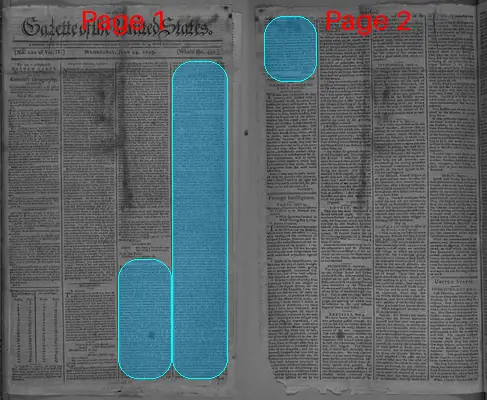
Gazette Of The United States
New York, New York County, New York
What is this article about?
An anonymous letter defends President Washington's neutrality proclamation amid the French Revolution, refutes criticisms in the National Gazette for abuse and overreach, and attacks the editor as an unqualified poet and libeler seeking to undermine government.
Merged-components note: This is a single continuous letter to the editor criticizing the National Gazette, spanning across page 1 and 2; the second part was mislabeled as editorial.
Clippings
1 of 2
OCR Quality
Full Text
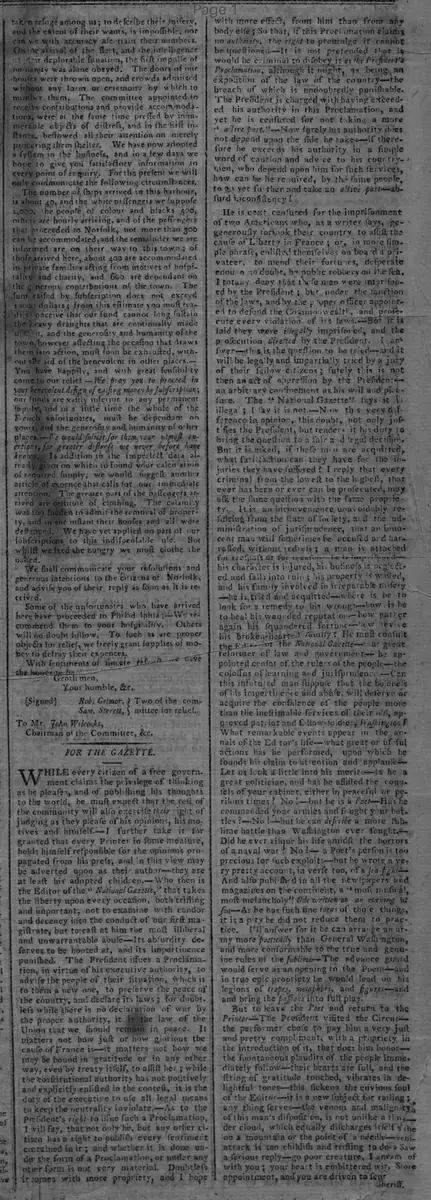
WHILE every citizen of publishing his thoughts to the world, he must expect that the rest of the community will also exercise their right of judging as they please of his opinions, his motives and himself. I further take it for granted that every Printer in some measure, holds himself responsible for the opinions propagated from his press, and in this view may be adverted upon as their author—they are at least his adopted children.—Who then is the Editor of the "National Gazette," that takes the liberty upon every occasion, both trifling and important, not to examine with candor and decency into the conduct of our first magistrate, but to cast at him the most illiberal and unwarrantable abuse—Its absurdity deserves to be hooted at, and its impertinence punished. The President issues a Proclamation, in virtue of his executive authority, to advise the people of their situation, which is to them a new one, to preserve the peace of the country, and declare its laws; or doubtless while there is no declaration of war by the proper authority, it is the law of the Union that we should remain in peace. It matters not how just or how glorious the cause of France is—it matters not how we may be bound in gratitude or in any other way, even by treaty itself, to assist her; while the constitutional authority has not positively and explicitly enlisted in the contest, it is the duty of the executive to use all legal means to keep the neutrality inviolate.—As to the President's right to issue such a Proclamation, I will say, that not only he, but any other citizen has a right to publish every sentiment contained in it; and whether it is done under the form of a Proclamation, or under any other form is not very material. Doubtless it comes with more propriety, and I hope with more effect, from him than from anybody else; So that, if this Proclamation claims no authority, the right to promulge it cannot be questioned—It is not pretended that it would be criminal to disobey it as the President's Proclamation, although it might, as being an exposition of the law of the country—the breach of which is undoubtedly punishable.
The President is charged with having exceeded his authority in this Proclamation, and yet he is censured for not taking a more active part.—Now surely his authority does not depend upon the side he takes—if therefore he exceeds his authority in a simple word of caution and advice to his countrymen, who depend upon him for such services, how can he be required, by the same people, to go yet further and take an active part—absurd inconsistency!
He is next censured for the imprisonment of two Americans who, as a writer says, generously forsook their country to assist the cause of Liberty in France; or, in more simple phrase, enlisted themselves on board a privateer, to mend their fortunes, desperate adventurers no doubt, but public robbers on the sea.
I totally deny that these men were imprisoned by the President: but under the sanction of the laws, and by the proper officer appointed to defend the Commonwealth, and prosecute every violation of its laws.—But it is said they were illegally imprisoned, and the prosecution directed by the President. I answer—this is the question to be tried—and it will be legally and impartially tried by a jury of their fellow-citizens; surely this is not then an act of oppression by the President—an arbitrary confinement at his will and pleasure. The "National Gazette" says it is; I say it is not.—Now this very difference in opinion, this doubt, not only justifies the President, but renders it his duty to bring the question to a fair and legal decision.
But it is asked, if these men are acquitted, what satisfaction can they have for the injuries they have suffered? I reply that every criminal from the lowest to the highest, that ever has been or ever can be prosecuted, may ask the same question with the same propriety. It is an inconvenience unavoidably resulting from the state of society and the administration of jurisprudence, that an innocent man will sometimes be accused and harassed, without redress; a man is attached for trespass or for treason his character is injured, his business is neglected and falls into ruin; his property is wasted, and his family involved in irreparable misery—he is tried and acquitted—where is he to look for a remedy to his wrongs—how is he to heal his wounded reputation how gather again his squandered fortune—how revive his broken-hearted family? He must consult the Editor of the National Gazette—that great reformer of law and government—the appointed censor of the rulers of the people—the colossus of learning and jurisprudence—Can this infatuated man suppose that the boldness of his impertinence and abuse, will deserve or acquire the confidence of the people more than the inestimable services of their old, approved patriot and fellow-soldier, Washington What remarkable events appear in the annals of the Editor's life—what great or useful actions has he performed, upon which he founds his claim to attention and applause—Let us look a little into his merits—is he a great politician, and has he assisted the councils of your cabinet, either in peaceful or perilous times? No—but he is a Poet—Has he commanded your armies and fought your battles?—No!—but he can describe a more sublime battle than Washington ever fought.—Did he ever risk his life amidst the horrors of a naval war? No!—a Poet's person is too precious for such exploits—but he wrote a very pretty account, in verse too, of a sea-fight—And also published in all the newspapers and magazines on the continent, a "most mundane, most melancholy" Ode written on an evening walk—As he has such fine ideas of those things, it is a pity he did not reduce them to practice. I'll answer for it he can arrange an army more poetically than General Washington, and more conformable to the true and genuine rules of the sublime—The advance guard would serve as an opening to the Poem—and in true epic propriety he would lead on his legions of tropes, metaphors, and figures—and bring the passions into full play.
But to leave the Poet and return to the Printer—The President visited the Circus. the performer chose to pay him a very just and pretty compliment, with a propriety in the introduction of it, that does him honor—the spontaneous plaudits of the people immediately follow—their hearts are full, and the string of gratitude touched, vibrates in delightful tones—this sickens the envious soul of the Editor—it is a new subject for railing; any thing serves—the venom and malignity of this man's disposition, is not unlike a thunder cloud, which equally discharges itself upon a mountain or the point of a needle—veni—attack is too childish and trifling to deserve a serious reply go poor creature, I am sorry for you; your heart is embittered with disappointment, and you are driven to every expedient
The usual and last refuge of the writers of the abuse—after many unsuccessful attempts to gain an honest living, you have deemed it less honorable—I mean a professed Libeller—engaged in one more infallible, though murderer of good men and good government, and a disturber of the public peace—there is no community so purged of wicked and designing characters, whose prosperity depends upon the troubles and convulsions of their country, or whose restless, uneasy tempers cannot bear an hour of peace, but that a mind willing like yours, to prostitute itself indiscriminately to all the measures and sentiments of such characters, and usher their venom into the world, may find sufficient employment, and earn the bread of the most degrading dependence, a dependence on the vices of others—while I execrate thy conduct, I almost pity thy necessities—but look up and behold the arm of JUSTICE.
Philadelphia.
From the (CHARLESTON) STATE GAZETTE.
What sub-type of article is it?
What themes does it cover?
What keywords are associated?
What entities or persons were involved?
Letter to Editor Details
Recipient
The Gazette
Main Argument
the letter defends president washington's neutrality proclamation as a legitimate advisory act within his executive duties and refutes charges of overreach or oppression in the imprisonment of americans aiding france, while condemning the national gazette's editor for abusive, unqualified attacks on the president.
Notable Details