Thank you for visiting SNEWPapers!
Sign up free
Story
March 24, 1953
Atlanta Daily World
Atlanta, Fulton County, Georgia
What is this article about?
The abolition of the Office of Price Stabilization due to lifted price controls ends jobs for several high-ranking Negro officials in Washington, who transition to private law practices, other government roles, academia, or international work amid an employment freeze.
Clipping
OCR Quality
98%
Excellent
Full Text
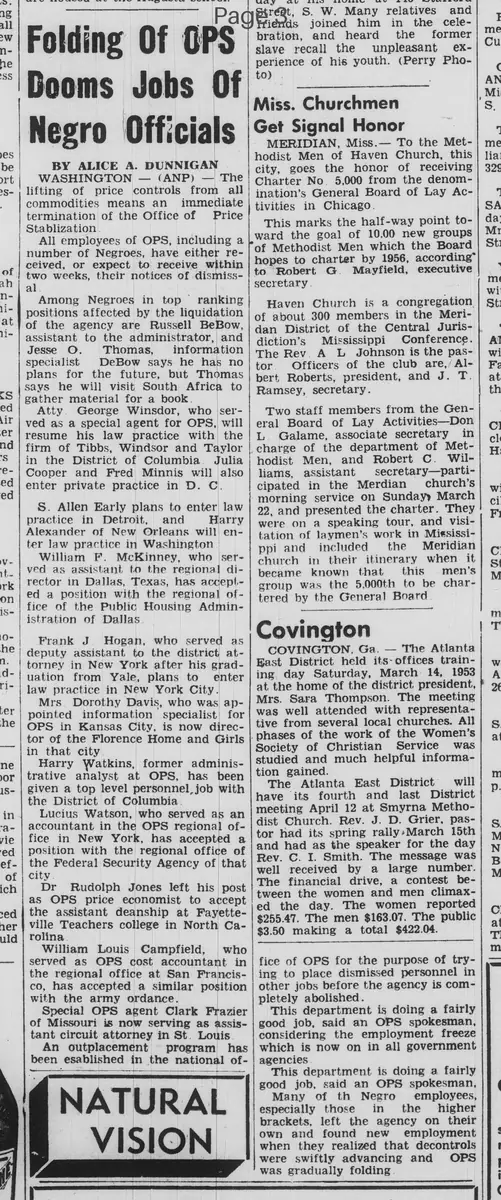
Folding Of OPS Dooms Jobs Of Negro Officials
BY ALICE A. DUNNIGAN
WASHINGTON- (ANP) The lifting of price controls from all commodities means an immediate termination of the Office of Price Stablization.
All employees of OPS, including a number of Negroes, have either received, or expect to receive within two weeks, their notices of dismissal.
Among Negroes in top ranking positions affected by the liquidation of the agency are Russell DeBow, assistant to the administrator, and Jesse O. Thomas, information specialist.
DeBow says he has no plans for the future, but Thomas says he will visit South Africa to gather material for a book.
Atty George Windsor, who served as a special agent for OPS, will resume his law practice with the firm of Tibbs, Windsor and Taylor in the District of Columbia. Julia Cooper and Fred Minnis will also enter private practice in D. C.
S. Allen Early plans to enter law practice in Detroit, and Harry Alexander of New Orleans will enter law practice in Washington.
William F. McKinney, who served as assistant to the regional director in Dallas, Texas, has accepted a position with the regional office of the Public Housing Administration of Dallas.
Frank J Hogan, who served as deputy assistant to the district attorney in New York after his graduation from Yale, plans to enter law practice in New York City.
Mrs Dorothy Davis, who was appointed information specialist for OPS in Kansas City, is now director of the Florence Home and Girls in that city.
Harry Watkins, former administrative analyst at OPS, has been given a top level personnel job with the District of Columbia.
Lucius Watson, who served as an accountant in the OPS regional office in New York, has accepted a position with the regional office of the Federal Security Agency of that city.
Dr. Rudolph Jones left his post as OPS price economist to accept the assistant deanship at Fayetteville Teachers college in North Carolina.
William Louis Campfield, who served as OPS cost accountant in the regional office at San Francisco, has accepted a similar position with the army ordnance.
Special OPS agent Clark Frazier of Missouri is now serving as assistant circuit attorney in St. Louis.
An outplacement program has been established in the national office of OPS for the purpose of trying to place dismissed personnel in other jobs before the agency is completely abolished.
This department is doing a fairly good job, said an OPS spokesman, considering the employment freeze which is now on in all government agencies.
Many of the Negro employees, especially those in the higher brackets, left the agency on their own and found new employment when they realized that decontrols were swiftly advancing and OPS was gradually folding.
BY ALICE A. DUNNIGAN
WASHINGTON- (ANP) The lifting of price controls from all commodities means an immediate termination of the Office of Price Stablization.
All employees of OPS, including a number of Negroes, have either received, or expect to receive within two weeks, their notices of dismissal.
Among Negroes in top ranking positions affected by the liquidation of the agency are Russell DeBow, assistant to the administrator, and Jesse O. Thomas, information specialist.
DeBow says he has no plans for the future, but Thomas says he will visit South Africa to gather material for a book.
Atty George Windsor, who served as a special agent for OPS, will resume his law practice with the firm of Tibbs, Windsor and Taylor in the District of Columbia. Julia Cooper and Fred Minnis will also enter private practice in D. C.
S. Allen Early plans to enter law practice in Detroit, and Harry Alexander of New Orleans will enter law practice in Washington.
William F. McKinney, who served as assistant to the regional director in Dallas, Texas, has accepted a position with the regional office of the Public Housing Administration of Dallas.
Frank J Hogan, who served as deputy assistant to the district attorney in New York after his graduation from Yale, plans to enter law practice in New York City.
Mrs Dorothy Davis, who was appointed information specialist for OPS in Kansas City, is now director of the Florence Home and Girls in that city.
Harry Watkins, former administrative analyst at OPS, has been given a top level personnel job with the District of Columbia.
Lucius Watson, who served as an accountant in the OPS regional office in New York, has accepted a position with the regional office of the Federal Security Agency of that city.
Dr. Rudolph Jones left his post as OPS price economist to accept the assistant deanship at Fayetteville Teachers college in North Carolina.
William Louis Campfield, who served as OPS cost accountant in the regional office at San Francisco, has accepted a similar position with the army ordnance.
Special OPS agent Clark Frazier of Missouri is now serving as assistant circuit attorney in St. Louis.
An outplacement program has been established in the national office of OPS for the purpose of trying to place dismissed personnel in other jobs before the agency is completely abolished.
This department is doing a fairly good job, said an OPS spokesman, considering the employment freeze which is now on in all government agencies.
Many of the Negro employees, especially those in the higher brackets, left the agency on their own and found new employment when they realized that decontrols were swiftly advancing and OPS was gradually folding.
What sub-type of article is it?
Historical Event
What themes does it cover?
Misfortune
Fortune Reversal
What keywords are associated?
Ops Termination
Negro Officials
Job Losses
Price Controls
Employment Transition
What entities or persons were involved?
Russell Debow
Jesse O. Thomas
Atty George Windsor
Julia Cooper
Fred Minnis
S. Allen Early
Harry Alexander
William F. Mckinney
Frank J Hogan
Mrs Dorothy Davis
Harry Watkins
Lucius Watson
Dr. Rudolph Jones
William Louis Campfield
Clark Frazier
Where did it happen?
Washington
Story Details
Key Persons
Russell Debow
Jesse O. Thomas
Atty George Windsor
Julia Cooper
Fred Minnis
S. Allen Early
Harry Alexander
William F. Mckinney
Frank J Hogan
Mrs Dorothy Davis
Harry Watkins
Lucius Watson
Dr. Rudolph Jones
William Louis Campfield
Clark Frazier
Location
Washington
Story Details
The lifting of price controls terminates the Office of Price Stabilization, affecting Negro employees in top positions who receive dismissal notices and pursue new opportunities in private practice, other government agencies, academia, or abroad.