Thank you for visiting SNEWPapers!
Sign up free
The Daily Herald
New Haven, New Haven County, Connecticut
What is this article about?
Correspondence from Washington on March 7, 1841, reports rumors of war due to British demands for the release of McLeod, amid dispatches from London and U.S. minister Stevenson. Senate debates by Clay and Buchanan promote peace, emphasizing mutual interests against conflict.
Clipping
OCR Quality
Full Text
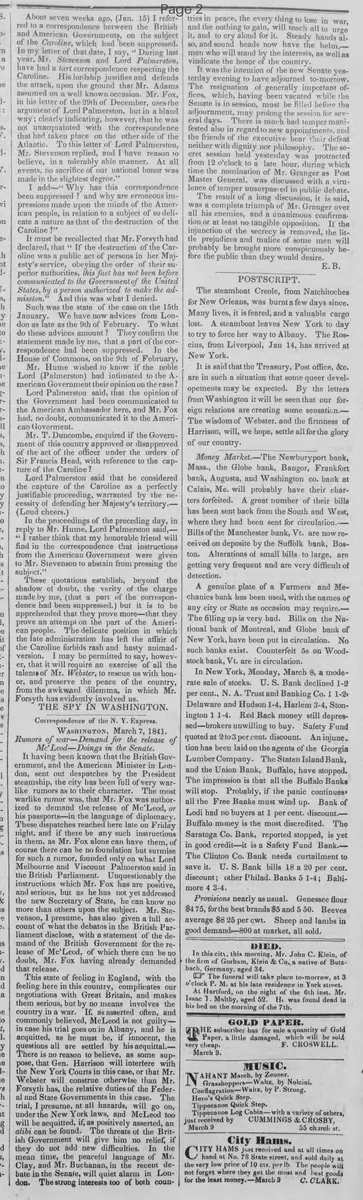
Correspondence of the N. Y. Express.
WASHINGTON, March 7, 1841.
Rumors of war—Demand for the release of Mc'Leod—Doings in the Senate.
It having been known that the British Government, and the American Minister in London, sent out despatches by the President steamship, the city has been full of very warlike rumors as to their character. The most warlike rumor was, that Mr. Fox was authorized to demand the release of Mc'Leod, or his passports—in the language of diplomacy.
These dispatches reached here late on Friday night, and if there be any such instructions in them. as Mr. Fox alone can have them, of course there can be no foundation but surmise for such a rumor, founded only on what Lord Melbourne and Viscount Palmerston said in the British Parliament. Unquestionably the instructions which Mr. Fox has are positive, and serious, but as he has not yet addressed the new Secretary of State, he can know no more than others upon the subject. Mr. Stevenson, I presume, has also given a full account of what the debates in the British Parliament disclose, with a statement of the demand of the British Government for the release of Mc'Leod, of which there can be no doubt, Mr. Fox having already demanded that release.
This state of feeling in England, with the feeling here in this country, complicates our negotiations with Great Britain, and makes them serious, but by no means involves the country in a war. If, as asserted often, and commonly believed, McLeod is not guilty—in case his trial goes on in Albany, and he is acquitted, as he must be, if innocent, the questions all are settled by his acquittal. There is no reason to believe, as some suppose, that Gen. Harrison will interfere with the New York Courts in this case, or that Mr. Webster will construe otherwise than Mr. Forsyth has, the relative duties of the Federal and State Governments in this case. The trial, I presume, at all hazards, will go on, under the New York laws, and McLeod too will be acquitted, if, as positively asserted, an alibi can be found. The threats of the British Government will give him no relief, if they do not add new difficulties. In the mean time, the peaceful language of Mr. Clay, and Mr. Buchanan, in the recent debate in the Senate, will quiet alarm in London. The strong interests too of both countries in peace, the every thing to lose in war, and the nothing to gain, will teach all to urge it, and to cry aloud for it. Steady hands also, and sound heads now have the helm,—men who will stand by the interests, as well as vindicate the honor of the country.
What sub-type of article is it?
What keywords are associated?
What entities or persons were involved?
Where did it happen?
Foreign News Details
Primary Location
London
Event Date
March 7, 1841
Key Persons
Outcome
no war anticipated; mcleod expected to be acquitted if innocent, settling issues; peaceful senate rhetoric to calm london.
Event Details
Rumors of war circulate in Washington after British dispatches arrive via the President steamship, suggesting Mr. Fox may demand McLeod's release or passports. British Parliament debates by Lord Melbourne and Viscount Palmerston highlight demands for McLeod's release, already made by Fox. Mr. Stevenson reports on these. Negotiations with Britain are complicated but not leading to war. McLeod's trial in Albany under New York laws will proceed, with expected acquittal via alibi. Senate debate by Clay and Buchanan promotes peace, emphasizing mutual interests.