Thank you for visiting SNEWPapers!
Sign up free
Portland Gazette, And Maine Advertiser
Portland, Cumberland County, Maine
What is this article about?
In Aaron Burr's 1807 treason trial in Richmond, Commodore Thomas Truxtun testifies about 1805 conversations in Philadelphia where Burr discussed western land speculations, urged Truxtun to leave the U.S. Navy, and proposed commanding a naval expedition to Mexico in case of war with Spain, involving General Wilkinson and others, which Truxtun rejected.
Clipping
OCR Quality
Full Text
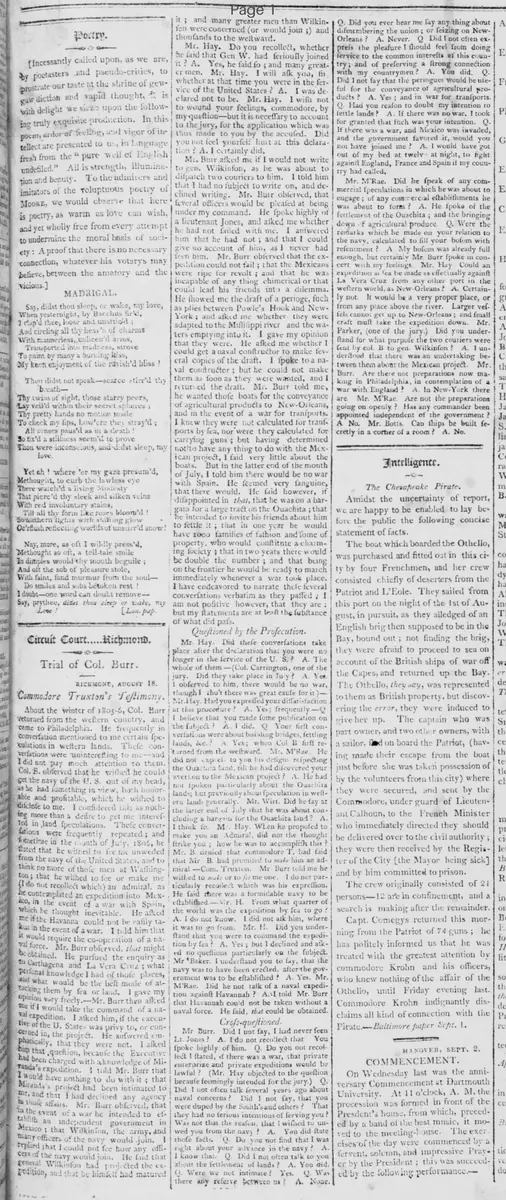
TRIAL OF COL. BURR.
RICHMOND, AUGUST 18.
Commodore Truxtun's Testimony.
About the winter of 1805-6, Col. Burr returned from the western country, and came to Philadelphia. He frequently in conversation mentioned to me certain speculations in western lands. These conversations were uninteresting to me—and I did not pay much attention to them. Col. B. observed that he wished he could get the navy of the U. S. out of my head, as he had something in view, both honorable and profitable, which he wished to disclose to me. I considered this as nothing more than a desire to get me interested in land speculations. These conversations were frequently repeated; and sometime in the month of July, 1805, he stated that he wished to see me unwedded from the navy of the United States, and to think no more of those men at Washington; that he wished to see or make me (I do not recollect which) an admiral, as he contemplated an expedition into Mexico, in the event of a war with Spain, which he thought inevitable. He asked me if the Havana could not be easily taken in the event of a war. I told him that it would require the co-operation of a naval force. Mr. Burr observed, that might be obtained. He pursued the enquiry as to Carthagena and La Vera Cruz; what personal knowledge I had of those places, and what would be the best mode of attacking them by sea or land. I gave my opinion very freely.—Mr. Burr then asked me if I would take the command of a naval expedition. I asked him, if the executive of the U. States was privy to, or concerned in, the project. He answered emphatically, that they were not. I asked him that question, because the Executive had been charged with a knowledge of Miranda's expedition. I told Mr. Burr that I would have nothing to do with it; that Miranda's project had been intimated to me, and that I had declined any agency in those affairs. Mr. Burr observed, that in the event of a war he intended to establish an independent Mexico; that Wilkinson, the army, and government in many officers of the navy would join. I replied that I could not see how any officers of the navy would join. He said that general Wilkinson had projected the expedition, and that he himself had matured it; and many greater men than Wilkinson were concerned (or would join;) and thousands to the westward.
Mr. Hay. Do you recollect, whether he said that Gen W. had seriously joined it? A. Yes, he said so; and many greater men. Mr. Hay. I will ask you, sir, whether at that time you were in the service of the United States? A. I was declared not to be. Mr. Hay. I wish not to wound your feelings, commodore, by my question—but it is necessary to account to the jury, for the application which was thus made to you by the accused. Did you not feel yourself hurt at this declaration? A. I certainly did.
Mr. Burr asked me if I would not write to gen. Wilkinson, as he was about to dispatch two couriers to him. I told him that I had no subject to write on, and declined writing. Mr. Burr observed, that several officers would be pleased at being under my command. He spoke highly of a lieutenant Jones, and asked me whether he had not sailed with me. I answered him that he had not; and that I could give no account of him, as I never had seen him. Mr. Burr observed that the expedition could not fail; that the Mexicans were ripe for revolt; and that he was incapable of any thing chimerical or that could lead his friends into a dilemma. He showed me the draft of a periauge, such as plies between Paulus' Hook and New-York; and asked me whether they were adapted to the Mississippi river and the waters emptying into it. I gave my opinion that they were. He asked me whether I could get a naval constructor to make several copies of the draft. I spoke to a naval constructor: but he could not make them as soon as they were wanted, and I returned the draft. Mr. Burr told me, he wanted those boats for the conveyance of agricultural products to New-Orleans, and in the event of a war for transports. I knew they were not calculated for transports by sea, nor were they calculated for carrying guns; but having determined not to have any thing to do with the Mexican project, I said very little about the boats. But in the latter end of the month of July, I told him there would be no war with Spain. He seemed very sanguine, that there would. He said however, if disappointed in that, that he was on a bargain for a large tract on the Ouachita; that he intended to invite his friends about him to settle it: that in one year he would have 1000 families of fashion and some of property, who would constitute a charming society; that in two years there would be double the number; and that being on the frontier he would be ready to march immediately whenever a war took place. I have endeavored to narrate these several conversations verbatim as they passed; I am not positive however, that they are: but my statements are at least the substance of what did pass.
Questioned by the Prosecution.
Mr. Hay. Did these conversations take place after the declaration that you were no longer in the service of the U. S.? A. The whole of them—(Col. Carrington, one of the jury. Did they take place in July? A. Yes I observed to him, there would be no war, though I thought there was great cause for it)— Mr. Hay. Had you expressed your dissatisfaction at this procedure? A. Yes; frequently—Q. I believe that you made some publication on the subject? A. I did. Q. Your first conversations were about building bridges, settling lands, &c.? A. Yes; when Col. B. first returned from the westward. Mr. M'Rae. He did not expell to you his design respecting the Ouachita land, till he had discovered your aversion to the Mexican project? A. He had not spoken particularly about the Ouachita lands; but previously about speculation in western lands generally. Mr. Wirt. Did he say at the latter end of July that he was about concluding a bargain for the Ouachita land? A. I think so. Mr. Hay. When he proposed to make you an Admiral, did not the thought strike you; how he was to accomplish this? Mr. B. denied that commodore T. had said that Mr. B. had promised to make him an admiral—Com. Truxtun. Mr. Burr told me he wished to make or to see me one. I do not particularly recollect which was his expression. He said there was a formidable navy to be established.—Mr. H. From what quarter of the world was the expedition by sea to go? A. I do not know. I did not ask him, where it was to go from. Mr. H. Did you understand that you were to command the expedition by sea? A. Yes; but I declined and asked no questions particularly on the subject. Mr. Baker. I understand you to say, that the navy was to have been erected, after the government was to be established? A. Yes. Mr. M'Rae. Did he not talk of a naval expedition against Havannah? A. As I told Mr. Burr that Havannah could not be taken without a naval force. He said, that could be obtained.
Cross-questioned.
Mr. Burr. Did I not say, I had never seen Lt. Jones? A. I do not recollect that you spoke highly of him. Q. Do you not recollect I stated, if there was a war, that private enterprise and private expeditions would be lawful? (Mr. Hay objected to the question because seemingly intended for the jury.) Q. Did I not often talk several years ago about naval concerns? Did I not say, that you were duped by the Smiths and others? That they had no serious intentions of serving you? Was not that the reason that I wished to unwed you from the navy? A. You did state those facts. Q. Do you not find that I was right about your advance in the navy? A. I know that. Q. Did I not often talk to you about the settlement of land? A. You did. Q. Were we not intimate? Yes. Q. Was there any reserve between us? A. None, Q. Did you ever hear me say any thing about dismembering the union; or seizing on New-Orleans? A. Never. Q. Did I not often express the pleasure I should feel from doing service to the common interests of this country; and of preserving a strong connection with my countrymen? A. You did. Q. Did I not say that the periauges would be useful for the conveyance of agricultural products? A. Yes; and in war for transports. Q. Had you reason to doubt my intention to settle lands? A. If there was no war, I took for granted that such was your intention. Q. If there was a war, and Mexico was invaded, and the government favored it, would you not have joined me? A. I would have got out of my bed at twelve at night, to fight against England, France and Spain if my country had called,
Mr. M'Rae. Did he speak of any commercial speculations in which he was about to engage; of any commercial establishments he was about to form? A. He spoke of the settlement of the Ouachita; and the bringing down agricultural produce. Q. Were the remarks which he made on your relation to the navy, calculated to fill your bosom with resentment? A. My bosom was already full enough, but certainly Mr. Burr spoke in concert with my feelings. Mr. Hay. Could an expedition at sea be made as effectually against La Vera Cruz from any other port in the western world, as New-Orleans? A. Certainly not. It would be a very proper place, or from any place above the river. Larger vessel cannot get up to New-Orleans; and small craft must take the expedition down. Mr. Parker, (one of the jury.) Did you understand for what purpose the two couriers were sent by col. B. to gen. Wilkinson? A. I understood that there was an undertaking between them about the Mexican project. Mr. Burr. Are there not preparations now making in Philadelphia, in contemplation of a war with England? A. In New-York there are. Mr. M'Rae. Are not the preparations going on openly? Has any commander been appointed independent of the government? A. No. Mr. Botts. Can ships be built secretly in a corner of a room? A. No.
What sub-type of article is it?
What themes does it cover?
What keywords are associated?
What entities or persons were involved?
Where did it happen?
Story Details
Key Persons
Location
Richmond; Philadelphia
Event Date
Winter Of 1805 6; July 1805; August 18
Story Details
Commodore Truxtun recounts conversations with Aaron Burr in Philadelphia in 1805, where Burr discussed land speculations, urged Truxtun to leave the U.S. Navy, proposed making him an admiral for a Mexican expedition in case of war with Spain involving Wilkinson and others, and showed boat drafts; Truxtun declined involvement, suspecting unauthorized conspiracy similar to Miranda's.