Thank you for visiting SNEWPapers!
Sign up free
Editorial
October 25, 1796
Gazette Of The United States, & Philadelphia Daily Advertiser
Philadelphia, Philadelphia County, Pennsylvania
What is this article about?
Phocion No. IX defends John Adams against charges by Hampden that he voted against the House in the Senate, refuting the claim and criticizing Jefferson's supporters. It attacks Jefferson's character, citing his abandonment of duties in 1781 and 1793, contrasting with Adams, Washington, and Hamilton's firmness in crises.
Clipping
OCR Quality
95%
Excellent
Full Text
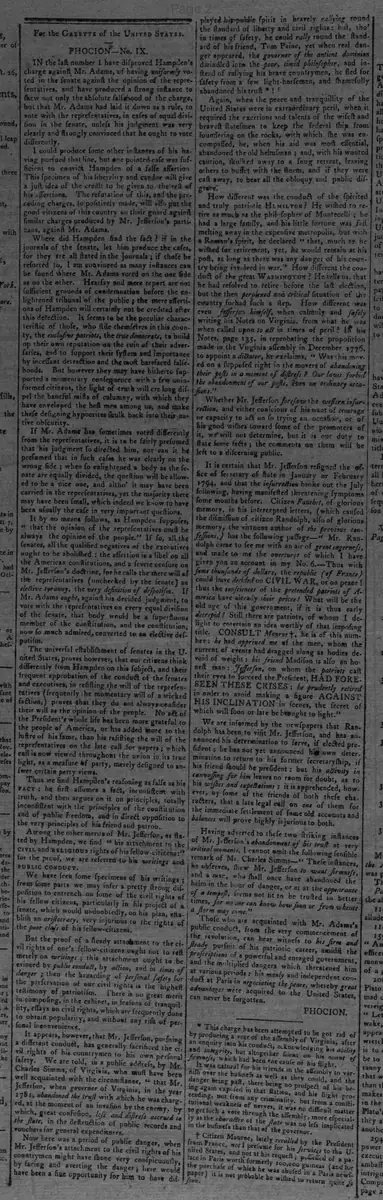
For the Gazette of the United States.
PHOCION No. IX.
IN the last number I have disproved Hampden's
charge against Mr. Adams, of having uniformly vo-
ted in the senate against the opinion of the repre-
sentatives, and have produced a strong instance to
shew not only the absolute falsehood of the charge,
but that Mr. Adams had laid it down as a rule, to
vote with the representatives, in cases of equal divi-
sion in the senate, unless his judgment was very
clearly and strongly convinced that he ought to vote
differently.
I could produce some other instances of his ha-
ving pursued that line, but one pointed case was suf-
ficient to convict Hampden of a false assertion
This specimen of his liberality and candor will give
a just idea of the credit to be given to the rest of
his assertions. The refutation of this, and the pre-
ceding charges. so positively made, will also put the
good citizens of this country on their guard against
similar charges produced by Mr. Jefferson's parti-
zans, against Mr. Adams.
Where did Hampden find the fact? if in the
journals of the senate, let him produce the cases,
for they are all stated in the journals: if those be
resorted to, I am convinced as many instances can
be found where Mr. Adams voted on the one side
as on the other. Hear-say and mere report are not
sufficient grounds of condemnation before the en-
lightened tribunal of the public the mere assertions of Hampden will certainly not be credited after
this detection. It seems to be the peculiar charac-
teristic of those, who style themselves in this coun-
try, the exclusive patriots, the true democrats, to build
up their own reputation on the ruin of their adver-
saries, and to support their system and importance
by incessant detraction and the most barefaced false-
hoods. But however they may have hitherto sup-
ported a momentary consequence with a few unin-
formed citizens, the light of truth will ere long di-
pel the baneful mists of calumny, with which they
have enveloped the best men among us, and make
these designing hypocrites skulk back into their na-
tive obscurity.
If Mr. Adams has sometimes voted differently
from the representatives, it is to be fairly presumed
that his judgment so directed him, nor can it be
presumed that in such cases he was clearly on the
wrong side ; when so enlightened a body as the se-
nate are equally divided, the question will be allow-
ed to be a nice one, and altho' it may have been
carried in the representatives, yet the majority there
may have been small, which indeed we know to have
been usually the case in very important questions.
It by no means follows, as Hampden supposes,
" that the opinion of the representatives must be
always the opinion of the people." If so, all the
senates, all the qualified negatives of the executives
ought to be abolished : the assertion is a libel on all
the American constitutions, and a severe censure on
Mr. Jefferson's doctrine, for he calls the mere will of
the representatives (unchecked by the senate an
d elective tyranny, the very definition of despotism. If
Mr. Adams ought, against his decided judgment, to
vote with the representatives on every equal division
of the senate, that body would be a superfluous
member of the constitution, and the constitution.
now so much admired, converted to an elective de-
potism.
The universal establishment of senates in the U.
nited States, proves however, that our citizens think
differently from Hampden on this subject, and their
frequent approbation of the conduct of the senates
and executives, in resisting the will of the representa-
tives (frequently the momentary will of a wicked
faction,) proves that they do not always consider
their will as the opinion of the people. No act of
the President's whole life has been more grateful to
the people of America, or has added more to the
lustre of his fame, than his resisting the will of the
representatives on the late call for papers; which
call is now viewed throughout the union in its true
light, as a measure of party, merely designed to an-
swer certain party views.
Thus we find Hampden's reasoning as false as his
fact : he first assumes a fact, inconsistent with
truth, and then argues on it on principles, totally
inconsistent with the principles of the constitution
and of public freedom, and in direct opposition to
the very principles of his friend and patron.
Among the other merits of Mr Jefferson, as sta-
ted by Hampden, we find " his attachment to the
civil and Religious rights of his fellow-citizens:"
for the proof, we are referred to his writings and
PUBLIC CONDUCT.
We have seen some specimens of his writings ;
from some parts we may infer a pretty strong di-
sposition to entrench on some of the civil rights of
his fellow citizens, particularly in his project of a
senate, which would undoubtedly, on his plan, esta-
blish an aristocracy, very injurious to the rights of
the poor class of his fellow-citizens.
But the proof of a steady attachment to the ci-
vil rights of one's fellow-citizens ought not to rest
merely on writings ; this attachment ought to be
evinc ed by public conduct, by action, and in times of
danger ; then the hazarding of personal safety for
the preservation of our civil rights is the highest
testimony of patriotism. There is no great merit
in composing, in the cabinet, in seasons of tranquil-
lity, essays on civil rights, which are frequently done
to obtain popularity, and without any risk of per-
sonal inconvenience.
It appears, however, that Mr. Jefferson, pursuing
a different conduct, has generally sacrificed the ci-
vil rights of his countrymen to his own personal
safety. · We are told, in a public address, by Mr.
Charles Simms, of Virginia, who must have been
well acquainted with the circumstance, " that Mr.
Jefferson, when governor of Virginia, in the year
1781, abandoned the trust with which he was charg-
ed, at the moment of an invasion by the enemy, by
which, great confusion, loss and distress accrued to
the state, in the destruction of public records and
vouchers for general expenditures."
Now here was a period of public danger, when
Mr. Jefferson's attachment to the civil rights of his
countrymen might have shone very conspicuously,
by facing and averting the danger; here would
have been a fine opportunity for him to have dis-
played his public spirit in bravely rallying round
the standard of liberty and civil rights: but, tho'
in times of safety. he could rally round the stand-
ard of his friend, -Tom Paine, yet when real dan-
ger appeared, the governor of the ancient dominion
dwindled into the poor, timid philosopher, and in-
stead of rallying his brave countrymen, he fled for
safety from a few light-horsemen, and shamefully
abandoned his trust * .
Again, when the peace and tranquillity of the
United States were in extraordinary peril, when it
required the exertions and talents of the wisest and
bravest statesmen to keep the federal ship from
foundering on the rocks, with which she was en-
compassed, he, when his aid was most essential,
abandoned the old helmsman : and, with his wonted
caution, skulked away to a snug retreat, leaving
others to buffet with the storm, and if they were
cast away, to bear all the obloquy and public di-
sgrace.
How different was the conduct of the spirited
and truly patriotic Hamilton? He wished to re-
tire as much as the philosopher of Monticello ; he
had a large family, and his little fortune was fast
melting away in the expensive metropolis, but with
Roman's spirit, he declared " that, much as he
wished for retirement, yet, he would remain at his
post, as long as there was any danger of his coun-
try being involved in war." How different the con-
duct of the great Washington? He tells us, that
he had resolved to retire before the last election,
but the then perplexed and critical situation of the
country forbad such a step. How different was
even Jefferson himself, when calmly and safely
writing his Notes on Virginia. from what he was
when called upon to act in times of peril ? In his
Notes. page 135, in reprobating the proposition
made in the Virginia assembly in December 1776,
to appoint a dictator, he exclaims, " Was this mov-
ed on a supposed right in the movers of abandoning
their posts in a moment of distress ? Our laws forbid
the abandonment of our posts, even on ordinary occa-
sions."
Whether Mr. Jefferson foresaw the western insur-
rection, and either conscious of his want of courage
or capacity to act on so trying an occasion, or of
his good wishes toward some of the promoters of
it, we will not determine, but it is our duty to
state some facts; the comments on them will be
left to a discerning public.
It is certain that Mr. Jefferson resigned the of-
fice of secretary of state in January or February
1793, and that the insurrection broke out the July
following, having manifested threatening symptoms
some months before. Citizen Fauchet, of glorious
memory, in his intercepted letters, (which caused
the dismission of citizen Randolph, also of glorious
memory, the virtuous author of the previous ten-
sions,) has the following passage-" Mr. Ran-
dolph came to see me with an air of great eagerness,
and made to me the overtures of which I have
given you an account in my No. 6.- Thus with
some thousands of dollars, the republic (of France)
could have decided on CIVIL WAR, or on peace!
thus the consciences of the pretended patriots of A-
merica have already their prices! What will be the
old age of this government, if it is thus early
decrepit! Still there are patriots, of whom I de-
light to entertain an idea worthy of that imposing
title. CONSULT Monroe t. he is of this num-
ber: he had assured me of the men, whom the
current of events had dragged along as bodies de-
void of weight : his friend Madison is also an ho-
net man: Jefferson, on whom the patriots cast
their eyes to succeed the President, HAD FORE-
SEEN THESE CRISES: he prudently retired
in order to avoid making a figure AGAINST
HIS INCLINATION in scenes, the secret of
which will soon or late be brought to light."
We are informed by the newspapers that Ran-
dolph has been to visit Mr. Jefferson, and has an-
nounced his determination to serve, if elected pre-
sident ; he has not yet announced his own determi-
nation to return to his former secretaryship, if
his friend should be president : but his activity in
canvassing for him leaves no room for doubt, as to
his wishes and expectations : it is apprehended, how-
ever, by some of the friends of both these cha-
racters, that a late legal call on one of them for
the immediate settlement of some old accounts and
balances will prove highly injurious to both.
Having adverted to these two striking instances
of Mr. Jefferson's abandonment of his trust at very
critical moments, I cannot omit the following sensible
remark of Mr. Charles Simms-" These instances,
he observes, shew Mr. Jefferson to want firmness,
and a man, who shall once have abandoned the
helm in the hour of danger, or at the appearance
of a tempest, seems not fit to be trusted in better
times, for no one can know how soon or from whence
a storm may come.'
'Those who are acquainted with Mr. Adams's
public conduct, from the very commencement of
the revolution, can bear witness to his firm and
steady pursuit of his patriotic career, amidst the
proscriptions of a powerful and enraged government,
and the multiplied dangers which threatened him
at various periods: his manly and independent con-
duct at Paris in negotiating the peace, whereby great
advantages were acquired to the United States,
can never be forgotten.
PHOCION.
* This charge has been attempted to be got rid of
by producing a vote of the assembly of Virginia, after
an enquiry into his conduct, acknowledging his ability
and integrity, but altogether silent on his want of
firmness, which had been the cause of his flight.
It was natural for his friends in the assembly to var-
nish over the business as well as they could, and the
danger being past, there being no prospect of his be-
ing again exposed in that station, and his flight pro-
ceeding, not from any criminality. but from a consti-
tutional weakness of nerves, it was no difficult matter
to get such a vote through the assembly, more especial-
ly as the character of the state was no less implicated
in the business than that of the governor.
+ Citizen Monroe, lately recalled by the President
from France, not I presume for his services to the U.
nited States, and not at his request; possessed of a pa-
lace in Paris worth formerly 100,000 guineas (and for
the purchase of which he was abused in a Paris news-
paper) it is not probable he wished to return quite so
soon.
PHOCION No. IX.
IN the last number I have disproved Hampden's
charge against Mr. Adams, of having uniformly vo-
ted in the senate against the opinion of the repre-
sentatives, and have produced a strong instance to
shew not only the absolute falsehood of the charge,
but that Mr. Adams had laid it down as a rule, to
vote with the representatives, in cases of equal divi-
sion in the senate, unless his judgment was very
clearly and strongly convinced that he ought to vote
differently.
I could produce some other instances of his ha-
ving pursued that line, but one pointed case was suf-
ficient to convict Hampden of a false assertion
This specimen of his liberality and candor will give
a just idea of the credit to be given to the rest of
his assertions. The refutation of this, and the pre-
ceding charges. so positively made, will also put the
good citizens of this country on their guard against
similar charges produced by Mr. Jefferson's parti-
zans, against Mr. Adams.
Where did Hampden find the fact? if in the
journals of the senate, let him produce the cases,
for they are all stated in the journals: if those be
resorted to, I am convinced as many instances can
be found where Mr. Adams voted on the one side
as on the other. Hear-say and mere report are not
sufficient grounds of condemnation before the en-
lightened tribunal of the public the mere assertions of Hampden will certainly not be credited after
this detection. It seems to be the peculiar charac-
teristic of those, who style themselves in this coun-
try, the exclusive patriots, the true democrats, to build
up their own reputation on the ruin of their adver-
saries, and to support their system and importance
by incessant detraction and the most barefaced false-
hoods. But however they may have hitherto sup-
ported a momentary consequence with a few unin-
formed citizens, the light of truth will ere long di-
pel the baneful mists of calumny, with which they
have enveloped the best men among us, and make
these designing hypocrites skulk back into their na-
tive obscurity.
If Mr. Adams has sometimes voted differently
from the representatives, it is to be fairly presumed
that his judgment so directed him, nor can it be
presumed that in such cases he was clearly on the
wrong side ; when so enlightened a body as the se-
nate are equally divided, the question will be allow-
ed to be a nice one, and altho' it may have been
carried in the representatives, yet the majority there
may have been small, which indeed we know to have
been usually the case in very important questions.
It by no means follows, as Hampden supposes,
" that the opinion of the representatives must be
always the opinion of the people." If so, all the
senates, all the qualified negatives of the executives
ought to be abolished : the assertion is a libel on all
the American constitutions, and a severe censure on
Mr. Jefferson's doctrine, for he calls the mere will of
the representatives (unchecked by the senate an
d elective tyranny, the very definition of despotism. If
Mr. Adams ought, against his decided judgment, to
vote with the representatives on every equal division
of the senate, that body would be a superfluous
member of the constitution, and the constitution.
now so much admired, converted to an elective de-
potism.
The universal establishment of senates in the U.
nited States, proves however, that our citizens think
differently from Hampden on this subject, and their
frequent approbation of the conduct of the senates
and executives, in resisting the will of the representa-
tives (frequently the momentary will of a wicked
faction,) proves that they do not always consider
their will as the opinion of the people. No act of
the President's whole life has been more grateful to
the people of America, or has added more to the
lustre of his fame, than his resisting the will of the
representatives on the late call for papers; which
call is now viewed throughout the union in its true
light, as a measure of party, merely designed to an-
swer certain party views.
Thus we find Hampden's reasoning as false as his
fact : he first assumes a fact, inconsistent with
truth, and then argues on it on principles, totally
inconsistent with the principles of the constitution
and of public freedom, and in direct opposition to
the very principles of his friend and patron.
Among the other merits of Mr Jefferson, as sta-
ted by Hampden, we find " his attachment to the
civil and Religious rights of his fellow-citizens:"
for the proof, we are referred to his writings and
PUBLIC CONDUCT.
We have seen some specimens of his writings ;
from some parts we may infer a pretty strong di-
sposition to entrench on some of the civil rights of
his fellow citizens, particularly in his project of a
senate, which would undoubtedly, on his plan, esta-
blish an aristocracy, very injurious to the rights of
the poor class of his fellow-citizens.
But the proof of a steady attachment to the ci-
vil rights of one's fellow-citizens ought not to rest
merely on writings ; this attachment ought to be
evinc ed by public conduct, by action, and in times of
danger ; then the hazarding of personal safety for
the preservation of our civil rights is the highest
testimony of patriotism. There is no great merit
in composing, in the cabinet, in seasons of tranquil-
lity, essays on civil rights, which are frequently done
to obtain popularity, and without any risk of per-
sonal inconvenience.
It appears, however, that Mr. Jefferson, pursuing
a different conduct, has generally sacrificed the ci-
vil rights of his countrymen to his own personal
safety. · We are told, in a public address, by Mr.
Charles Simms, of Virginia, who must have been
well acquainted with the circumstance, " that Mr.
Jefferson, when governor of Virginia, in the year
1781, abandoned the trust with which he was charg-
ed, at the moment of an invasion by the enemy, by
which, great confusion, loss and distress accrued to
the state, in the destruction of public records and
vouchers for general expenditures."
Now here was a period of public danger, when
Mr. Jefferson's attachment to the civil rights of his
countrymen might have shone very conspicuously,
by facing and averting the danger; here would
have been a fine opportunity for him to have dis-
played his public spirit in bravely rallying round
the standard of liberty and civil rights: but, tho'
in times of safety. he could rally round the stand-
ard of his friend, -Tom Paine, yet when real dan-
ger appeared, the governor of the ancient dominion
dwindled into the poor, timid philosopher, and in-
stead of rallying his brave countrymen, he fled for
safety from a few light-horsemen, and shamefully
abandoned his trust * .
Again, when the peace and tranquillity of the
United States were in extraordinary peril, when it
required the exertions and talents of the wisest and
bravest statesmen to keep the federal ship from
foundering on the rocks, with which she was en-
compassed, he, when his aid was most essential,
abandoned the old helmsman : and, with his wonted
caution, skulked away to a snug retreat, leaving
others to buffet with the storm, and if they were
cast away, to bear all the obloquy and public di-
sgrace.
How different was the conduct of the spirited
and truly patriotic Hamilton? He wished to re-
tire as much as the philosopher of Monticello ; he
had a large family, and his little fortune was fast
melting away in the expensive metropolis, but with
Roman's spirit, he declared " that, much as he
wished for retirement, yet, he would remain at his
post, as long as there was any danger of his coun-
try being involved in war." How different the con-
duct of the great Washington? He tells us, that
he had resolved to retire before the last election,
but the then perplexed and critical situation of the
country forbad such a step. How different was
even Jefferson himself, when calmly and safely
writing his Notes on Virginia. from what he was
when called upon to act in times of peril ? In his
Notes. page 135, in reprobating the proposition
made in the Virginia assembly in December 1776,
to appoint a dictator, he exclaims, " Was this mov-
ed on a supposed right in the movers of abandoning
their posts in a moment of distress ? Our laws forbid
the abandonment of our posts, even on ordinary occa-
sions."
Whether Mr. Jefferson foresaw the western insur-
rection, and either conscious of his want of courage
or capacity to act on so trying an occasion, or of
his good wishes toward some of the promoters of
it, we will not determine, but it is our duty to
state some facts; the comments on them will be
left to a discerning public.
It is certain that Mr. Jefferson resigned the of-
fice of secretary of state in January or February
1793, and that the insurrection broke out the July
following, having manifested threatening symptoms
some months before. Citizen Fauchet, of glorious
memory, in his intercepted letters, (which caused
the dismission of citizen Randolph, also of glorious
memory, the virtuous author of the previous ten-
sions,) has the following passage-" Mr. Ran-
dolph came to see me with an air of great eagerness,
and made to me the overtures of which I have
given you an account in my No. 6.- Thus with
some thousands of dollars, the republic (of France)
could have decided on CIVIL WAR, or on peace!
thus the consciences of the pretended patriots of A-
merica have already their prices! What will be the
old age of this government, if it is thus early
decrepit! Still there are patriots, of whom I de-
light to entertain an idea worthy of that imposing
title. CONSULT Monroe t. he is of this num-
ber: he had assured me of the men, whom the
current of events had dragged along as bodies de-
void of weight : his friend Madison is also an ho-
net man: Jefferson, on whom the patriots cast
their eyes to succeed the President, HAD FORE-
SEEN THESE CRISES: he prudently retired
in order to avoid making a figure AGAINST
HIS INCLINATION in scenes, the secret of
which will soon or late be brought to light."
We are informed by the newspapers that Ran-
dolph has been to visit Mr. Jefferson, and has an-
nounced his determination to serve, if elected pre-
sident ; he has not yet announced his own determi-
nation to return to his former secretaryship, if
his friend should be president : but his activity in
canvassing for him leaves no room for doubt, as to
his wishes and expectations : it is apprehended, how-
ever, by some of the friends of both these cha-
racters, that a late legal call on one of them for
the immediate settlement of some old accounts and
balances will prove highly injurious to both.
Having adverted to these two striking instances
of Mr. Jefferson's abandonment of his trust at very
critical moments, I cannot omit the following sensible
remark of Mr. Charles Simms-" These instances,
he observes, shew Mr. Jefferson to want firmness,
and a man, who shall once have abandoned the
helm in the hour of danger, or at the appearance
of a tempest, seems not fit to be trusted in better
times, for no one can know how soon or from whence
a storm may come.'
'Those who are acquainted with Mr. Adams's
public conduct, from the very commencement of
the revolution, can bear witness to his firm and
steady pursuit of his patriotic career, amidst the
proscriptions of a powerful and enraged government,
and the multiplied dangers which threatened him
at various periods: his manly and independent con-
duct at Paris in negotiating the peace, whereby great
advantages were acquired to the United States,
can never be forgotten.
PHOCION.
* This charge has been attempted to be got rid of
by producing a vote of the assembly of Virginia, after
an enquiry into his conduct, acknowledging his ability
and integrity, but altogether silent on his want of
firmness, which had been the cause of his flight.
It was natural for his friends in the assembly to var-
nish over the business as well as they could, and the
danger being past, there being no prospect of his be-
ing again exposed in that station, and his flight pro-
ceeding, not from any criminality. but from a consti-
tutional weakness of nerves, it was no difficult matter
to get such a vote through the assembly, more especial-
ly as the character of the state was no less implicated
in the business than that of the governor.
+ Citizen Monroe, lately recalled by the President
from France, not I presume for his services to the U.
nited States, and not at his request; possessed of a pa-
lace in Paris worth formerly 100,000 guineas (and for
the purchase of which he was abused in a Paris news-
paper) it is not probable he wished to return quite so
soon.
What sub-type of article is it?
Partisan Politics
Constitutional
What keywords are associated?
Adams Defense
Jefferson Criticism
Senate Voting
Partisan Calumny
Constitutional Checks
Abandonment Of Duty
Whiskey Rebellion
Firmness In Crisis
What entities or persons were involved?
Mr. Adams
Hampden
Mr. Jefferson
President Washington
Hamilton
Charles Simms
Citizen Fauchet
Randolph
Monroe
Tom Paine
Editorial Details
Primary Topic
Defense Of John Adams Against Partisan Attacks By Jefferson Supporters
Stance / Tone
Strongly Pro Adams And Anti Jefferson, Emphasizing Constitutional Checks And Personal Firmness
Key Figures
Mr. Adams
Hampden
Mr. Jefferson
President Washington
Hamilton
Charles Simms
Citizen Fauchet
Randolph
Monroe
Tom Paine
Key Arguments
Disproves Hampden's False Charge That Adams Uniformly Voted Against House In Senate Ties
Adams Followed Rule To Vote With House Unless Judgment Strongly Differed
Criticizes Jefferson For Abandoning Governorship In 1781 During British Invasion
Jefferson Resigned As Secretary Of State In 1793 Before Whiskey Rebellion, Possibly Foreseeing Crisis
Contrasts Jefferson's Timidity With Adams, Washington, And Hamilton's Steadfastness In Danger
Defends Senate's Role As Check On House, Against Hampden's View That House Represents People Always
Accuses Jefferson's Partisans Of Calumny And Falsehoods To Build Their Reputation