Thank you for visiting SNEWPapers!
Sign up free
Literary
June 21, 1861
Muscatine Weekly Journal
Muscatine, Muscatine County, Iowa
What is this article about?
An explanatory essay on the philosophy of rain, detailing how uniform temperature prevents precipitation, cold air's lower humidity capacity, and cooling air leads to cloud formation and rain through condensation.
Clipping
OCR Quality
95%
Excellent
Full Text
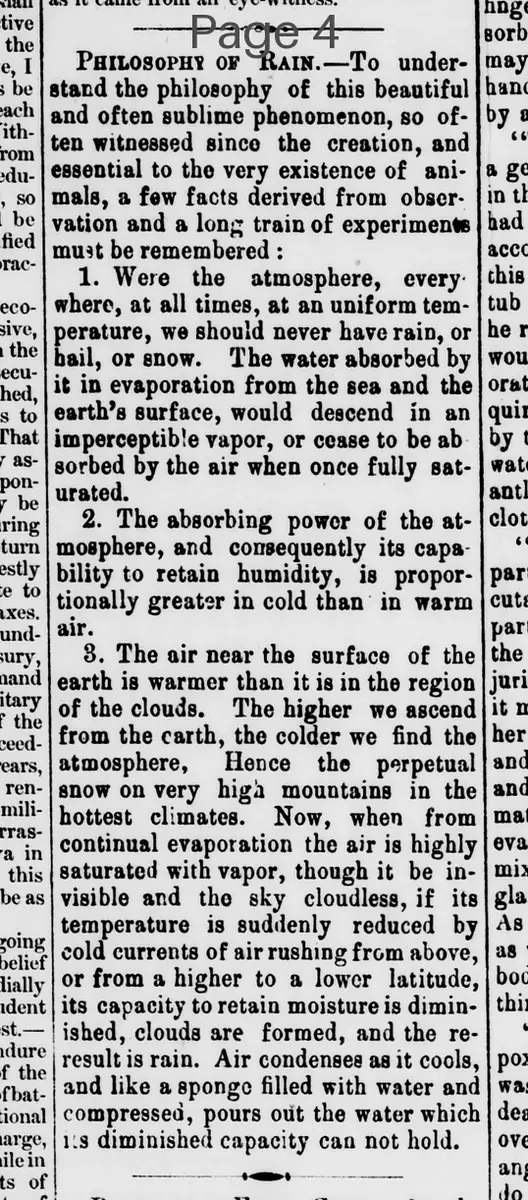
Philosophy of Rain.—To understand the philosophy of this beautiful and often sublime phenomenon, so often witnessed since the creation, and essential to the very existence of animals, a few facts derived from observation and a long train of experiments must be remembered:
1. Were the atmosphere, everywhere, at all times, at an uniform temperature, we should never have rain, or hail, or snow. The water absorbed by it in evaporation from the sea and the earth's surface, would descend in an imperceptible vapor, or cease to be absorbed by the air when once fully saturated.
2. The absorbing power of the atmosphere, and consequently its capability to retain humidity, is proportionally greater in cold than in warm air.
3. The air near the surface of the earth is warmer than it is in the region of the clouds. The higher we ascend from the earth, the colder we find the atmosphere,
Hence the perpetual snow on very high mountains in the hottest climates. Now, when from continual evaporation the air is highly saturated with vapor, though it be invisible and the sky cloudless, if its temperature is suddenly reduced by cold currents of air rushing from above, or from a higher to a lower latitude, its capacity to retain moisture is diminished, clouds are formed, and the result is rain. Air condenses as it cools, and like a sponge filled with water and compressed, pours out the water which its diminished capacity can not hold.
1. Were the atmosphere, everywhere, at all times, at an uniform temperature, we should never have rain, or hail, or snow. The water absorbed by it in evaporation from the sea and the earth's surface, would descend in an imperceptible vapor, or cease to be absorbed by the air when once fully saturated.
2. The absorbing power of the atmosphere, and consequently its capability to retain humidity, is proportionally greater in cold than in warm air.
3. The air near the surface of the earth is warmer than it is in the region of the clouds. The higher we ascend from the earth, the colder we find the atmosphere,
Hence the perpetual snow on very high mountains in the hottest climates. Now, when from continual evaporation the air is highly saturated with vapor, though it be invisible and the sky cloudless, if its temperature is suddenly reduced by cold currents of air rushing from above, or from a higher to a lower latitude, its capacity to retain moisture is diminished, clouds are formed, and the result is rain. Air condenses as it cools, and like a sponge filled with water and compressed, pours out the water which its diminished capacity can not hold.
What sub-type of article is it?
Essay
What themes does it cover?
Nature
What keywords are associated?
Rain Philosophy
Atmosphere
Evaporation
Condensation
Clouds
Temperature
Humidity
Literary Details
Title
Philosophy Of Rain.
Key Lines
Were The Atmosphere, Everywhere, At All Times, At An Uniform Temperature, We Should Never Have Rain, Or Hail, Or Snow.
The Absorbing Power Of The Atmosphere, And Consequently Its Capability To Retain Humidity, Is Proportionally Greater In Cold Than In Warm Air.
Air Condenses As It Cools, And Like A Sponge Filled With Water And Compressed, Pours Out The Water Which Its Diminished Capacity Can Not Hold.