Thank you for visiting SNEWPapers!
Sign up free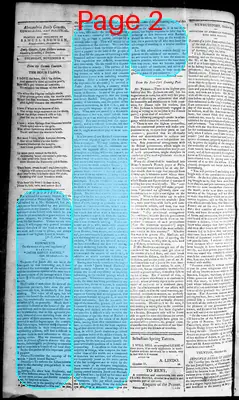
Editorial
November 2, 1809
Alexandria Daily Gazette, Commercial & Political
Alexandria, Virginia
What is this article about?
Reprint from Philadelphia's The Tickler of a satirical sermon by S.F. on the biblical verse 'Jacob kissed Rachel,' humorously defending kissing as an innocent, natural, and virtuous social practice to be emulated.
Clipping
OCR Quality
95%
Excellent
Full Text
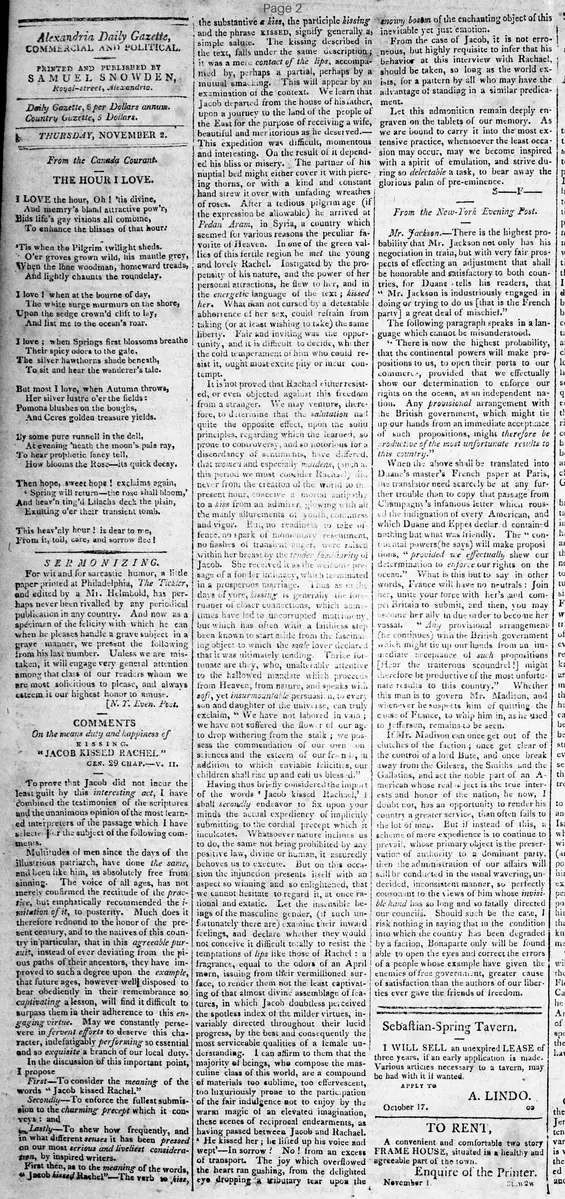
SERMONIZING.
For wit and for sarcastic humor, a little paper printed at Philadelphia, The Tickler, and edited by a Mr. Helmbold, has perhaps never been rivalled by any periodical publication in any country. And now as a specimen of the felicity with which he can when he pleases handle a grave subject in a grave manner, we present the following from his last number. Unless we are mistaken, it will engage very general attention among that class of our readers whom we are most solicitous to please, and always esteem it our highest honor to amuse.
[N. Y. Even. Post.]
COMMENTS
On the means duty and happiness of
KISSING.
"JACOB KISSED RACHEL."
GEN. 29 CHAP.--V. II.
To prove that Jacob did not incur the least guilt by this interesting act, I have combined the testimonies of the scriptures and the unanimous opinion of the most learned interpreters of the passage which I have selected for the subject of the following comments.
Multitudes of men since the days of the illustrious patriarch, have done the same, and been like him, as absolutely free from sinning. The voice of all ages, has not merely confirmed the rectitude of the practice, but emphatically recommended the imitation of it, to posterity. Much does it therefore redound to the honor of the present century, and to the natives of this country in particular, that in this agreeable pursuit, instead of ever deviating from the pious paths of their ancestors, they have improved to such a degree upon the example, that future ages, however well disposed to bear obediently in their remembrance so captivating a lesson, will find it difficult to surpass them in their adherence to this engaging virtue. May we constantly persevere in fervent efforts to deserve this character, indefatigably performing so essential and so exquisite a branch of our social duty.
In the discussion of this important point, I propose
First --To consider the meaning of the words "Jacob kissed Rachel."
Secondly--To enforce the fullest submission to the charming precept which it conveys : and
Lastly--To shew how frequently, and in what different senses it has been pressed on our most serious and liveliest consideration, by inspired writers.
First then, as to the meaning of the words, "Jacob kissed Rachel" --The verb to kiss, the substantive a kiss, the participle kissing and the phrase kissed, signify generally a simple salute. The kissing described in the text, falls under the same description: it was a mere contact of the lips, accompanied by, perhaps a partial, perhaps by a mutual smacking. This will appear by an examination of the context. We learn that Jacob departed from the house of his father, upon a journey to the land of the people of the East for the purpose of receiving a wife, beautiful and meritorious as he deserved. This expedition was difficult, momentous and interesting. On the result of it depended his bliss or misery. The partner of his nuptial bed might either cover it with piercing thorns, or with a kind and constant hand strew it over with unfading wreathes of roses. After a tedious pilgrimage (if the expression be allowable) he arrived at Padan Aram, in Syria, a country which seemed for various reasons the peculiar favorite of Heaven. In one of the green valleys of this fertile region he met the young and lovely Rachel. Instigated by the propensity of his nature, and the power of her personal attractions, he flew to her, and in the energetic language of the text; kissed her. What man not cursed by a detestable abhorrence of her sex, could refrain from taking (or at least wishing to take) the same liberty. Fair and inviting was the opportunity, and it is difficult to decide, whether the cold temperament of him who could resist it, ought most excite pity or incur contempt.
It is not proved that Rachael either resisted, or even objected against this freedom from a stranger. We may venture, therefore, to determine that the salutation had quite the opposite effect, upon the solicitous principles, regarding which the learned, so prone to controversy, and so notorious for a discordancy of sentiments, have differed. I affirm that women and especially maidens, (such at this period we must consider Rachael) did never from the creation of the world to the present hour, conceive a mortal antipathy to a kiss from an admirer, glowing with all the manly allurements of youth, comeliness and vigor. But, no readiness to take offence, no spark of involuntary resentment, no flashes of transient anger, were raised within her breast by the tender familiarity of Jacob. She received it as the welcome presage of a fonder intimacy, which terminated in a prosperous marriage. Thus as in the days of yore, kissing is generally the forerunner of closer connections, which sometimes have led to uncorrupted matrimony but which has often with a faithless step been known to start aside from the fascinating object to which the male lover declared that it was ultimately tending. Thrice fortunate are they, who, unalterably attentive to the hallowed mandate which proceeds from Heaven, from nature, and speaks with soft, yet insurmountable persuasion, to every son and daughter of the universe, can truly exclaim, "We have not labored in vain; we have not suffered the flower of our age to drop withering from the stalk; we possess the commendation of our own consciences and the esteem of our friends, in addition to which enviable felicities, our children shall rise up and call us blessed."
Having thus briefly considered the import of the words 'Jacob kissed Rachael.' I shall secondly endeavor to fix upon your minds the actual expediency of implicitly submitting to the cordial precept which it inculcates. Whatsoever nature inclines us to do, the same not being prohibited by any positive law, divine or human, it assuredly behoves us to execute. But on this occasion the injunction presents itself with an aspect so winning and so enlightened, that we cannot hesitate to regard it, at once rational and ecstatic. Let the insensible beings of the masculine gender, (if such unfortunately there are) examine their inward feelings, and declare whether they would not conceive it difficult totally to resist the temptations of lips like those of Rachel: a fragrance, equal to the odors of an April morn, issuing from their vermillioned surface, to render them not the least captivating of that almost divine assemblage of features, in which Jacob doubtless perceived the spotless index of the milder virtues, invariably directed throughout their lucid progress, by the best and consequently the most serviceable qualities of a female understanding. I can affirm to them that the majority of beings, who compose the masculine class of this world, are a compound of materials too sublime, too effervescent, too luxuriously prone to the participation of the fair indulgence not to enjoy by the warm magic of an elevated imagination, these scenes of reciprocal endearments, as having passed between Jacob and Rachael. He kissed her: he lifted up his voice and wept'--In sorrow? No! from an excess of transport. The joy which overflowed the heart ran gushing, from the delighted eye dropping a tributary tear upon the snowy bosom of the enchanting object of this inevitable yet just emotion.
From the case of Jacob, it is not erroneous, but highly requisite to infer that his behavior at this interview with Rachael, should be taken, so long as the world exists, for a pattern by all who may have the advantage of standing in a similar predicament.
Let this admonition remain deeply engraven on the tablets of our memory. As we are bound to carry it into the most extensive practice, whensoever the least occasion may occur, may we become inspired with a spirit of emulation, and strive during so delectable a task, to bear away the glorious palm of pre-eminence.
S. F.
For wit and for sarcastic humor, a little paper printed at Philadelphia, The Tickler, and edited by a Mr. Helmbold, has perhaps never been rivalled by any periodical publication in any country. And now as a specimen of the felicity with which he can when he pleases handle a grave subject in a grave manner, we present the following from his last number. Unless we are mistaken, it will engage very general attention among that class of our readers whom we are most solicitous to please, and always esteem it our highest honor to amuse.
[N. Y. Even. Post.]
COMMENTS
On the means duty and happiness of
KISSING.
"JACOB KISSED RACHEL."
GEN. 29 CHAP.--V. II.
To prove that Jacob did not incur the least guilt by this interesting act, I have combined the testimonies of the scriptures and the unanimous opinion of the most learned interpreters of the passage which I have selected for the subject of the following comments.
Multitudes of men since the days of the illustrious patriarch, have done the same, and been like him, as absolutely free from sinning. The voice of all ages, has not merely confirmed the rectitude of the practice, but emphatically recommended the imitation of it, to posterity. Much does it therefore redound to the honor of the present century, and to the natives of this country in particular, that in this agreeable pursuit, instead of ever deviating from the pious paths of their ancestors, they have improved to such a degree upon the example, that future ages, however well disposed to bear obediently in their remembrance so captivating a lesson, will find it difficult to surpass them in their adherence to this engaging virtue. May we constantly persevere in fervent efforts to deserve this character, indefatigably performing so essential and so exquisite a branch of our social duty.
In the discussion of this important point, I propose
First --To consider the meaning of the words "Jacob kissed Rachel."
Secondly--To enforce the fullest submission to the charming precept which it conveys : and
Lastly--To shew how frequently, and in what different senses it has been pressed on our most serious and liveliest consideration, by inspired writers.
First then, as to the meaning of the words, "Jacob kissed Rachel" --The verb to kiss, the substantive a kiss, the participle kissing and the phrase kissed, signify generally a simple salute. The kissing described in the text, falls under the same description: it was a mere contact of the lips, accompanied by, perhaps a partial, perhaps by a mutual smacking. This will appear by an examination of the context. We learn that Jacob departed from the house of his father, upon a journey to the land of the people of the East for the purpose of receiving a wife, beautiful and meritorious as he deserved. This expedition was difficult, momentous and interesting. On the result of it depended his bliss or misery. The partner of his nuptial bed might either cover it with piercing thorns, or with a kind and constant hand strew it over with unfading wreathes of roses. After a tedious pilgrimage (if the expression be allowable) he arrived at Padan Aram, in Syria, a country which seemed for various reasons the peculiar favorite of Heaven. In one of the green valleys of this fertile region he met the young and lovely Rachel. Instigated by the propensity of his nature, and the power of her personal attractions, he flew to her, and in the energetic language of the text; kissed her. What man not cursed by a detestable abhorrence of her sex, could refrain from taking (or at least wishing to take) the same liberty. Fair and inviting was the opportunity, and it is difficult to decide, whether the cold temperament of him who could resist it, ought most excite pity or incur contempt.
It is not proved that Rachael either resisted, or even objected against this freedom from a stranger. We may venture, therefore, to determine that the salutation had quite the opposite effect, upon the solicitous principles, regarding which the learned, so prone to controversy, and so notorious for a discordancy of sentiments, have differed. I affirm that women and especially maidens, (such at this period we must consider Rachael) did never from the creation of the world to the present hour, conceive a mortal antipathy to a kiss from an admirer, glowing with all the manly allurements of youth, comeliness and vigor. But, no readiness to take offence, no spark of involuntary resentment, no flashes of transient anger, were raised within her breast by the tender familiarity of Jacob. She received it as the welcome presage of a fonder intimacy, which terminated in a prosperous marriage. Thus as in the days of yore, kissing is generally the forerunner of closer connections, which sometimes have led to uncorrupted matrimony but which has often with a faithless step been known to start aside from the fascinating object to which the male lover declared that it was ultimately tending. Thrice fortunate are they, who, unalterably attentive to the hallowed mandate which proceeds from Heaven, from nature, and speaks with soft, yet insurmountable persuasion, to every son and daughter of the universe, can truly exclaim, "We have not labored in vain; we have not suffered the flower of our age to drop withering from the stalk; we possess the commendation of our own consciences and the esteem of our friends, in addition to which enviable felicities, our children shall rise up and call us blessed."
Having thus briefly considered the import of the words 'Jacob kissed Rachael.' I shall secondly endeavor to fix upon your minds the actual expediency of implicitly submitting to the cordial precept which it inculcates. Whatsoever nature inclines us to do, the same not being prohibited by any positive law, divine or human, it assuredly behoves us to execute. But on this occasion the injunction presents itself with an aspect so winning and so enlightened, that we cannot hesitate to regard it, at once rational and ecstatic. Let the insensible beings of the masculine gender, (if such unfortunately there are) examine their inward feelings, and declare whether they would not conceive it difficult totally to resist the temptations of lips like those of Rachel: a fragrance, equal to the odors of an April morn, issuing from their vermillioned surface, to render them not the least captivating of that almost divine assemblage of features, in which Jacob doubtless perceived the spotless index of the milder virtues, invariably directed throughout their lucid progress, by the best and consequently the most serviceable qualities of a female understanding. I can affirm to them that the majority of beings, who compose the masculine class of this world, are a compound of materials too sublime, too effervescent, too luxuriously prone to the participation of the fair indulgence not to enjoy by the warm magic of an elevated imagination, these scenes of reciprocal endearments, as having passed between Jacob and Rachael. He kissed her: he lifted up his voice and wept'--In sorrow? No! from an excess of transport. The joy which overflowed the heart ran gushing, from the delighted eye dropping a tributary tear upon the snowy bosom of the enchanting object of this inevitable yet just emotion.
From the case of Jacob, it is not erroneous, but highly requisite to infer that his behavior at this interview with Rachael, should be taken, so long as the world exists, for a pattern by all who may have the advantage of standing in a similar predicament.
Let this admonition remain deeply engraven on the tablets of our memory. As we are bound to carry it into the most extensive practice, whensoever the least occasion may occur, may we become inspired with a spirit of emulation, and strive during so delectable a task, to bear away the glorious palm of pre-eminence.
S. F.
What sub-type of article is it?
Satire
Moral Or Religious
What keywords are associated?
Kissing
Jacob Rachel
Biblical Precedent
Satire
Social Duty
Moral Virtue
Natural Inclination
What entities or persons were involved?
Jacob
Rachel
Mr. Helmbold
The Tickler
N. Y. Even. Post.
S. F.
Editorial Details
Primary Topic
Satirical Defense Of Kissing Using Biblical Precedent Of Jacob And Rachel
Stance / Tone
Humorous Endorsement Of Kissing As Innocent Social Duty
Key Figures
Jacob
Rachel
Mr. Helmbold
The Tickler
N. Y. Even. Post.
S. F.
Key Arguments
Jacob's Kiss Was A Sinless Simple Salute
Kissing Is Biblically Approved And Recommended For Imitation
Natural Inclination To Kiss Is Not Prohibited By Law
Women Do Not Object To Kisses From Admirers
Kissing Often Leads To Marriage And Happiness
Jacob's Example Should Be Emulated Extensively