Thank you for visiting SNEWPapers!
Sign up free
Daily Richmond Whig
Richmond, Virginia
What is this article about?
Biographical notices from the London Courier on the new British Ministry under Earl Grey as Premier, detailing his career from opposition leader to head of government, and the Marquis of Lansdowne as Lord President of the Council, highlighting their political histories and roles in past administrations.
Clipping
OCR Quality
Full Text
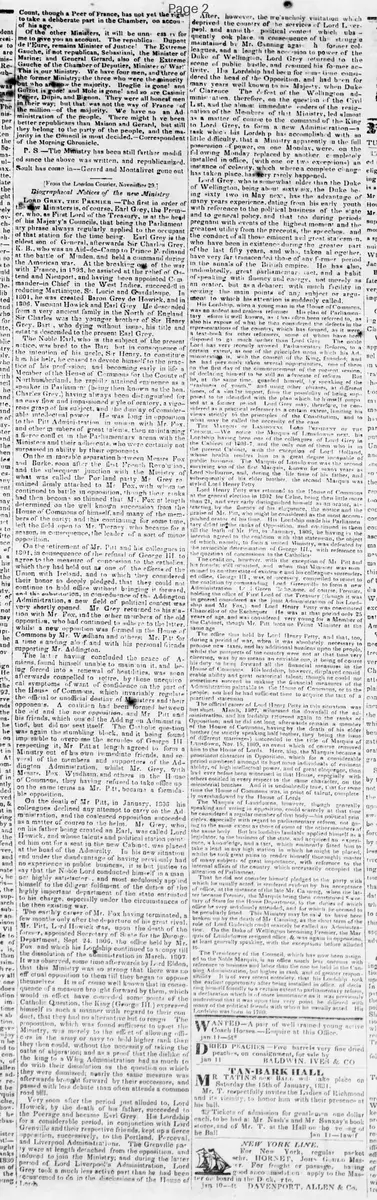
Biographical Notices of the new Ministry.
LORD GREY, THE PREMIER. — The first in order of the new Ministers is, of course, Earl Grey, the Premier, who, as First Lord of the Treasury, is at the head of his Majesty's Councils, that being the Parliamentary phrase always regularly applied to the occupant of that station for the time being. Earl Grey is the eldest son of General, afterwards Sir Charles Grey, K. B., who was an Aid-de-Camp to Prince Ferdinand at the battle of Minden, and held a command during the American war. At the breaking out of the war with France, in 1793, he assisted at the relief of Ostend and Nieuport, and having been appointed Commander-in-Chief in the West Indies, succeeded in reducing Martinique, St. Lucie and Guadaloupe. In 1801, he was created Baron Grey de Howick, and in 1806, Viscount Howick and Earl Grey. He descended from a very ancient family in the North of England. Sir Charles was the younger brother of Sir Henry Grey, Bart., who dying without issue, his title and estates descended to the present Earl Grey.
The Noble Earl, who is the subject of the present notice, was bred to the Bar: but in consequence of the intention of his uncle, Sir Henry, to constitute him his heir, he ceased to devote himself to the practice of his profession: and becoming early in life a Member of the House of Commons for the County of Northumberland, he rapidly attained eminence as a speaker in Parliament (being then known as the hon. Charles Grey), having always been distinguished for an easy flow and impassioned style of oratory, a vigorous grasp of his subject, and the display of considerable intellectual power. He was long in opposition to the Pitt Administration in unison with Mr. Fox, and other members of great talents, then maintaining a fierce conflict in the Parliamentary arena with the Ministers and their adherents, who were certainly not surpassed in ability by their opponents.
On the memorable separation between Messrs. Fox and Burke, soon after the first French Revolution, and the subsequent junction with the Ministry of what was called the Portland party, Mr. Grey remained firmly attached to Mr. Fox, with whom he continued to battle in opposition, though their ranks had then become so thinned that Mr. Fox at length determined on the well known succession from the House of Commons of himself, and many of the members of the party: and this continuing for some time, left the field open to Mr. Tierney who became for a season, in consequence, the leader of a sort of minor opposition.
On the retirement of Mr. Pitt and his colleagues in 1801, in consequence of the refusal of George III to agree to the measure of concession to the Catholics, which they had held out as one of the effects of the Union with Ireland, and to which they considered their honor so deeply pledged, that they could not continue to hold office without bringing it forward, and the substitution, in consequence of the Addington Administration, a new field of political contest was very shortly opened. Mr. Grey returned to his station with Mr. Fox, and the other members of the old opposition, who had continued to adhere to the latter, whilst a new opposition was formed in the House of Commons by Mr. Windham and others: Mr. Pitt for a time standing aloof and with his personal friends supporting Mr. Addington.
The latter having concluded the peace of Amiens, found himself unable to maintain it, and being forced into a renewal of hostilities, was soon afterwards compelled to retire, by those unequivocal symptoms of want of confidence on the part of the House of Commons, which invariably regulate the official or unofficial destiny of Ministers and their opponents. A coalition had been formed between the old and the new opposition, and Mr. Pitt and his friends, which ousted the Addington Administration, but did not seat itself. The Catholic question was again the stumbling block, and it being found impossible to overcome the scruples of George III respecting it, Mr. Pitt at length agreed to form a Ministry out of his own immediate friends, and several of the members and supporters of the Addington Administration, whilst Mr. Grey, with Messrs. Fox, Windham, and others in the House of Commons, they having refused to take office upon the same terms as Mr. Pitt, became a formidable opposition.
On the death of Mr. Pitt, in January, 1806, his colleagues declined any attempt to carry on the Administration, and the coalesced opposition succeeded as a matter of course to the helm. Mr. Grey, who, on his father being created an Earl, was called Lord Howick, and whose talents and political station pointed him out for a seat in the new Cabinet, was placed at the head of the Admiralty. In his new situation and under the disadvantage of having previously had no experience in public business, it is but justice to say that the Noble Lord conducted himself in a manner highly satisfactory, and most sedulously applied himself to the diligent fulfillment of the duties of the highly important department of the state entrusted to his charge, especially under the circumstances of the then existing war.
The earthly career of Mr. Fox having terminated, a few months only after the departure of his great rival, Mr. Pitt, Lord Howick was, upon the death of the former, appointed Secretary of State for the Foreign Department, Sept. 24, 1806, the office held by Mr. Fox, and which his Lordship continued to occupy till the dissolution of the administration in March, 1807. It was observed, some time afterwards by Lord Eldon, that this Ministry was so strong that there was no effectual opposition to them till they began to oppose themselves. It is of course well known that in consequence of a measure brought forward by them, which would in effect have conceded some points of the Catholic Question, the King (George III.) expressed himself in such a manner with regard to their conduct, that they had no alternative but to resign. The proposition, which was found sufficient to upset the Ministry, was merely to the effect of allowing officers in the army or navy to hold higher rank than they then could, without the necessity of taking the oaths of abjuration; and as a proof that the dislike of the king to a Whig Administration had as much to do with their dissolution as the question on which they were dismissed: nearly the same measure was afterwards brought forward by their successors, and passed with less debate than often attends a common road bill.
Very soon after the period just alluded to, Lord Howick, by the death of his father, succeeded to the Peerage and became Earl Grey. His Lordship for a considerable period, in conjunction with Lord Grenville and their respective friends, kept up a fierce opposition, successively, to the Portland, Perceval, and Liverpool Administrations. The Grenville party were at length detached from the opposition, and induced to join the Ministry; and during the latter period of Lord Liverpool's Administration, Lord Grey took a much less active part than he had been accustomed to do in the discussions of the House of Lords.
After, however, the melancholy visitation which deprived the country of the services of Lord Liverpool, and amid the political contest which subsequently took place, in consequence of the struggle maintained by Mr. Canning against his former colleagues, and at length the accession to power of the Duke of Wellington, Lord Grey returned to the scene of public bustle, and resumed his former activity. His Lordship had been for some time considered the head of the Opposition, and had been for many years well known to his Majesty, when Duke of Clarence. The defeat of the Wellington administration, therefore, on the question of the Civil List, and the almost immediate tenders of the resignation of the Members of the Ministry, led almost as a matter of course to the command of the King to Lord Grey, to form a new Administration — a task which his Lordship has accomplished with so little difficulty, that a Ministry apparently in the full possession of power, on one Monday, were, on the following Monday replaced by another, completely installed in office, (with one or two exceptions) an instance of celerity, which where a complete change has taken place, has very rarely happened.
Lord Grey, who is somewhat older than the Duke of Wellington, being about sixty six, the Duke being sixty two in May next, has the advantage of many years experience, dating from his early youth with reference to the political business of the state and to general policy, and that too during periods pregnant with events of the highest moment and the greatest utility from the precepts, the speeches, and the conduct of all those eminent and great statesmen, who have been in existence during the greater part of the last fifty years, and who, taken altogether, have very far transcended those of any former period in the annals of the British empire. He has also, undoubtedly, great parliamentary tact, and a habit of speaking with fluency and energy, not merely as an orator, but as a debater: with much facility in seizing the main points of any subject or argument to which his attention is suddenly called.
His Lordship, when a young man in the House of Commons, was an ardent and zealous reformer. His plan of Parliamentary reform is well known, as it has often been referred to, as also his expose of what he then considered the defects in the representations of the country, which has formed, as it were, a text-book for other reformers, some of whom have been disposed to go much further than Lord Grey.
The noble Lord has very recently avowed Parliamentary Reform, to a certain extent, as one of the principles upon which his Administration is, with the consent of the King, founded; and he had previously taken several opportunities, one of them on the first day of the commencement of the present session, of declaring himself to be still an advocate of reform. But he, at the same time, guarded himself, by speaking of the "rashness of youth," and using other phrases, at different times, of a similar import, from the possibility of being supposed to be identified with the plan which he himself proposed at a former period. Lord Grey may, therefore, be considered as a practical reformer to a certain extent, limiting his views strictly to the principles of the Constitution, and to what may be called the necessity of the case.
THE MARQUIS OF LANSDOWNE, LORD PRESIDENT OF THE COUNCIL. — We notice the Marquis of Lansdowne next, his Lordship having been one of the colleagues of Lord Grey in the Cabinet of 1806-7, and the only one of them who is in the present Cabinet, with the exception of Lord Holland, whose health renders him in a great degree incapable of public business. The Marquis of Lansdowne was the second surviving son of the first Marquis, known for many years as Lord Shelburne, and, during the life time of his father, and subsequently of his elder brother, the second Marquis was styled Lord Henry Petty.
Lord Henry Petty was returned to the House of Commons at the general election in 1802 for Calne, being then little more than 21, and very early distinguished himself as an orator, attracting, by the fluency of his eloquence, the notice and the praise of Mr. Pitt, who might be considered as the most accomplished orator of his time. His Lordship made his Parliamentary debut in the ranks of Opposition, and continued in them till the death of Mr. Pitt, in January, 1806, he having in the interim agreed to the coalition with that statesman, the object of which, namely, to form a united Ministry, was defeated by the invincible determination of George III., with reference to the question of concessions to the Catholics:
The coalition, however, with the exception of Mr. Pitt and his friends; still subsisted, and when that Minister was summoned to another state of existence and his colleagues surrendered office, George III. was, of necessity, compelled to resort to the coalition by commanding Lord Grenville to form a new Administration. Lord Grenville became, of course, Premier, holding the office of First Lord of the Treasury (though it was in general considered as the joint Administration of his Lordship and Mr. Fox.) and Lord Henry Petty was constituted Chancellor of the Exchequer. He was at that period only 25 years of age, and was considered very young for a Member of the Cabinet, though Mr. Pitt became Prime Minister at the same age.
The office thus held by Lord Henry Petty, and that, too, during a period of war, when it was absolutely necessary to propose new taxes, and lay additional burdens upon the people, whilst the prospects of the country were not at that time very cheering, was by no means an enviable one, it being of course his duty to bring forward all the financial measures in the House of Commons. His lordship, however, displayed considerable ability and great oratorical talent: though he could not sometimes succeed in making the financial measures of the Administration palatable to the House of Commons, or to the people; nor had he had sufficient time to acquire the tact of a practised statesman.
The official career of Lord Henry Petty in this situation was but short. March, 1807, witnessed the downfall of the administration, and his lordship returned again to the ranks of Opposition: and he did not long afterwards remain a member of the House of Commons, having by the death of his elder brother (or strictly speaking half brother, they being the issue of different marriages) succeeded to the title of Marquis of Lansdown, Nov. 15, 1809, an event which of course removed him to the House of Lords. Here, also, the Marquis became a prominent character in Opposition, which for a considerable period numbered amongst its host more individuals of eminent ability, of high intellectual power, and of great eloquence, than had ever before been witnessed in that House, especially with others entitled in every respect to the same character, on the ministerial benches. And it is undoubtedly true, that for some time the House of Commons was, in point of talent, completely overshadowed by the House of Lords.
The Marquis of Lansdowne, however, though generally speaking and voting in opposition, could scarcely at that time be considered a regular member of that body — his political principles, especially with regard to parliamentary reform, not going to the same extent as those of some of the other members of the same body. But his lordship laudably applied himself as a legislator, to the business of the state, and acquired an experience, a knowledge, and a tact, which eminently fitted him to take a lead in any high station in which he might be placed, whilst he took great pains to render himself thoroughly master of many subjects of great importance, with reference to the internal affairs of the country which necessarily occupied the attention of Parliament.
That he did not consider himself pledged to the party with which he usually acted is rendered evident by his acceptance of office, at the instance of the late Mr. Canning, when the latter became Premier, the Marquis being then constituted Secretary of State for the Home Department, to the duties of which office he very sedulously attended, and for which he seemed to be peculiarly fitted. This Ministry may be said to have been broken up by the death of Mr. Canning, as the short term of the rule of Lord Goderich could scarcely be called an Administration. On the Duke of Wellington becoming Premier, the Marquis of Lansdowne resigned office & was again in opposition at least generally speaking, with the exceptions before alluded to.
The Presidency of the Council, which has now been assigned to the Noble Marquis, is an office much less onerous with reference to business and labor than the one he held in the Canning Administration, but higher in rank and of greater responsibility. It is of very recent notoriety, that his Lordship took the earliest opportunity after being installed in office, of declaring himself friendly to a certain extent to parliamentary reform, a declaration which is of more importance as it was previously understood that it was upon this very point he differed with many of the political friends with whom he usually acted. His Lordship was born in 1780.
What sub-type of article is it?
What keywords are associated?
What entities or persons were involved?
Where did it happen?
Foreign News Details
Primary Location
London
Event Date
November 29
Key Persons
Outcome
formation of new whig administration under earl grey following defeat of wellington ministry on civil list question; rapid installation with minimal exceptions.
Event Details
Biographical account of Earl Grey's career from early parliamentary opposition with Fox, through various administrations and oppositions, to becoming Premier as First Lord of the Treasury; highlights his reform advocacy and experience. Similar biography of Marquis of Lansdowne, from early Commons role to Chancellor of Exchequer, opposition, and now Lord President of the Council, noting his support for limited parliamentary reform.