Thank you for visiting SNEWPapers!
Sign up free
Story
October 8, 1874
Independent Statesman
Concord, Merrimack County, New Hampshire
What is this article about?
Philosophical essay on human nature's tendency toward error, the innate sense of right, the necessity of moral progress over idleness and sensuous pursuits, and the accountability for one's conduct in advancing or hindering societal improvement.
Clipping
OCR Quality
100%
Excellent
Full Text
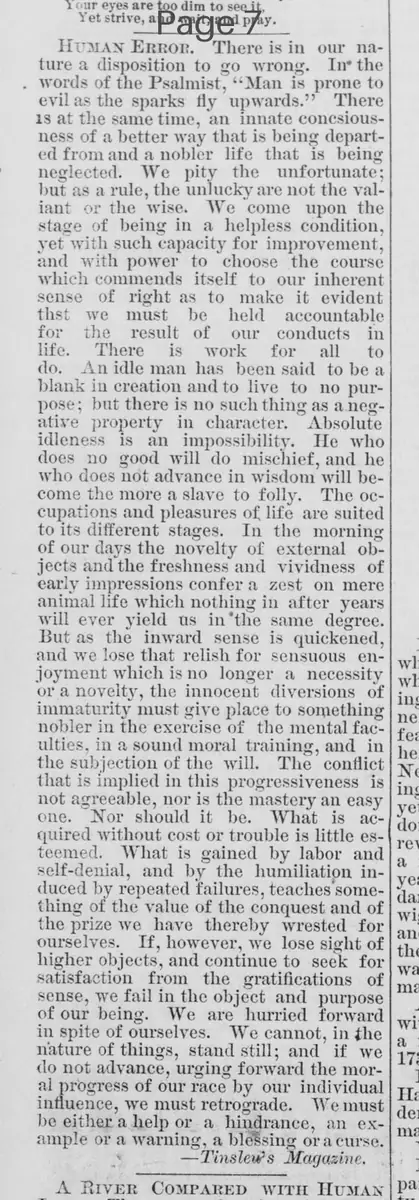
HUMAN ERROR. There is in our nature a disposition to go wrong. In the words of the Psalmist, "Man is prone to evil as the sparks fly upwards." There is at the same time an innate consciousness of a better way that is being departed from and a nobler life that is being neglected. We pity the unfortunate; but as a rule, the unlucky are not the valiant or the wise. We come upon the stage of being in a helpless condition, yet with such capacity for improvement, and with power to choose the course which commends itself to our inherent sense of right as to make it evident that we must be held accountable for the result of our conducts in life. There is work for all to do. An idle man has been said to be a blank in creation and to live to no purpose; but there is no such thing as a negative property in character. Absolute idleness is an impossibility. He who does no good will do mischief, and he who does not advance in wisdom will become the more a slave to folly. The occupations and pleasures of life are suited to its different stages. In the morning of our days the novelty of external objects and the freshness and vividness of early impressions confer a zest on mere animal life which nothing in after years will ever yield us in the same degree. But as the inward sense is quickened, and we lose that relish for sensuous enjoyment which is no longer a necessity or a novelty, the innocent diversions of immaturity must give place to something nobler in the exercise of the mental faculties, in a sound moral training, and in the subjection of the will. The conflict that is implied in this progressiveness is not agreeable, nor is the mastery an easy one. Nor should it be. What is acquired without cost or trouble is little esteemed. What is gained by labor and self-denial, and by the humiliation induced by repeated failures, teaches something of the value of the conquest and of the prize we have thereby wrested for ourselves. If, however, we lose sight of higher objects, and continue to seek for satisfaction from the gratifications of sense, we fail in the object and purpose of our being. We are hurried forward in spite of ourselves. We cannot, in the nature of things, stand still; and if we do not advance, urging forward the moral progress of our race by our individual influence, we must retrograde. We must be either a help or a hindrance, an example or a warning, a blessing or a curse.
-Tinsley's Magazine.
-Tinsley's Magazine.
What sub-type of article is it?
Philosophical Essay
Moral Reflection
What themes does it cover?
Moral Virtue
What keywords are associated?
Human Error
Moral Progress
Idleness
Self Denial
Character Development
Accountability
Story Details
Story Details
Reflection on humanity's innate proneness to error and evil, contrasted with an inner sense of right; emphasizes accountability, the dangers of idleness leading to mischief, the progression from youthful sensuous pleasures to mature moral and intellectual pursuits through effort and self-denial, and the necessity of advancing moral progress or facing regression.